The wagon train left St. Louis on the fifteenth of September, and Eleanor Hayes learned, in the first week, that the West did not care whether a woman was brave.
She had imagined the journey in the way people imagine things they have only read about in pamphlets: a line of white-topped wagons rolling across open prairie under a wide blue sky, the children laughing, the air clean and full of promise. The reality was mud and dust and cold mornings and nights so dark that the stars seemed to press down on the wagons like a weight. The reality was oxen that died on the trail and were left where they fell, and graves dug by the side of the road with nothing to mark them but a pile of stones, and women who had started the journey with husbands and finished it alone.
Eleanor's wagon was small. It had been Daniel's idea, once, to own a wagon — a foolish dream he had laughed about at the dinner table, a thing for other men — and now it was all they had. She had sold the house and the furniture, and what was left after Mr. Crane's man had taken his share bought a second-hand wagon, two oxen, a sack of flour, a sack of beans, a barrel of salt pork, and a tin of coffee. The children rode in the back, packed in among the bedding and the cooking pots, and Eleanor walked beside the oxen most days, because the wagon was too heavy for the animals as it was, and because walking kept her warm.
Sarah walked with her. At twelve, Sarah had decided that she was a woman now, and she carried Edward when Eleanor's arms gave out, and she helped Catherine and Margaret gather buffalo chips for the fire, and she never complained, not once, in four months. Eleanor watched her daughter grow older on that trail, day by day, and it hurt her more than the cold and the hunger and the blisters on her feet, because Sarah should have been learning to sew and to sing and to be a girl, and instead she was learning how to keep a fire alive in the rain and how to quiet a frightened three-year-old when the wolves howled at night.
Thomas walked too, when he could, though he was eleven and the trail was long and his legs were short. He appointed himself the protector of the family, and he carried a stick he had found on the first day out of St. Louis, and he walked at the back of the wagon with his stick over his shoulder, watching the trail behind them as if he expected something to come after them. James and William, nine and seven, rode in the wagon and fought over the same small patch of blanket and made up again within the hour, the way brothers do. Margaret, eight, and Catherine, six, held hands whenever the wagon jolted, and they sang the hymns Eleanor had taught them in Philadelphia, their small voices thin in the wide air.
Edward rode on Eleanor's hip or slept in the wagon, and he cried when he was cold and cried when he was hungry, and Eleanor held him and whispered to him that it would be all right, that they were going to a new home, that his father was watching over them, and she tried to believe it herself.
The wagon master was a man named Josiah Boone, a lean, sun-baked man of fifty who had made the crossing eleven times and had no patience for anyone who slowed the train. He told Eleanor on the second day that a widow with seven children was a burden the train could not afford, and that if she fell behind, the train would not wait for her.
"We will not fall behind," Eleanor said.
She meant it. She walked until her feet bled inside her boots, and then she wrapped her feet in rags and walked some more. She rose before dawn to get the fire going and the coffee made. She learned to yoke the oxen herself, because there was no one else to do it. She learned to read the sky for weather, and to smell rain coming, and to find water where the ground looked dry. The other women in the train watched her, at first with pity, and then with something closer to respect, and one of them, a German woman named Marta with five children of her own, began to share her fire with Eleanor in the evenings, and to teach her how to bake bread in a Dutch oven buried in coals.
"Your husband," Marta said one night, as they sat by the fire and the children slept in the wagons, "he is dead?"
"Yes," Eleanor said.
"And you go west alone?"
"I go west with my children," Eleanor said. "That is not alone."
Marta nodded. She did not say anything else. She handed Eleanor a cup of coffee, and they sat together in silence, and the stars pressed down on the wagons, and somewhere out on the prairie a coyote cried, and Eleanor thought of Daniel, and of the little house in Philadelphia, and of how far away all of it was now.
The trail took them across the Platte River, and the water was cold and fast, and the wagons had to be caulked and floated, and one wagon overturned, and a family's goods were lost to the river, and Eleanor held Edward tight and prayed as her own wagon swayed in the current. It took them past Fort Laramie, where the soldiers stared at the women and children as if they were ghosts, and past Chimney Rock, which rose out of the flat land like a finger pointing at the sky, and into the mountains, where the snow began to fall in October and did not stop.
By November, the flour was gone. They ate beans and salt pork, and then beans alone, and then whatever the men could shoot. The oxen grew thin. One of them died on a cold morning near South Pass, and Eleanor wept over it, not because she loved the animal, but because it meant the other ox would have to pull the wagon alone, and because it meant they were one step closer to being stranded in the mountains with winter coming on.
Josiah Boone came to her that night. He stood by her fire with his hat in his hands, and he looked at the children sleeping in the wagon, and he looked at Eleanor, and he said, "Mrs. Hayes, I have been thinking. There is a settlement ahead, Covenant Creek. The train will winter there. You could stay. There is a Bride Society office in the town. They arrange marriages for widows. It is not a good arrangement, and I will not lie to you about it, but it is an arrangement, and it is better than freezing to death on this trail with seven children."
Eleanor looked at him for a long time. She thought of the letter she had burned in the kitchen stove in Philadelphia, and of the words "placed separately," and of the pamphlet with the drawing of the mountains. She thought of Sarah, who was twelve and already a woman in every way that mattered, and of Edward, who was three and had never known a home that was not a wagon or a house that was not warm enough.
"Thank you, Mr. Boone," she said. "We will stay in Covenant Creek."
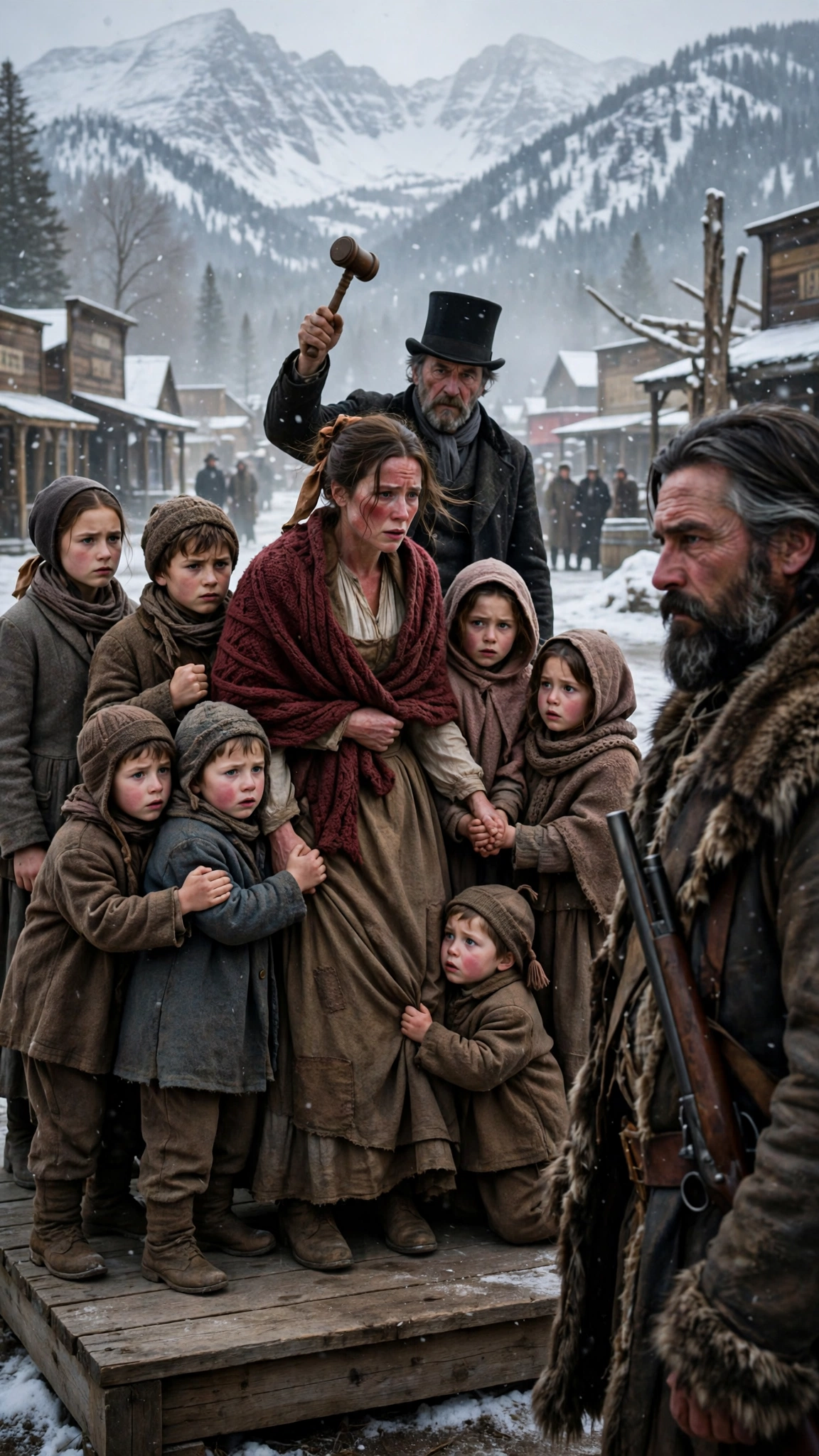
They reached the town in the second week of January. It was smaller than Eleanor had imagined: a single street of wooden storefronts, a mercantile, an assay office, a church, a handful of cabins, and the mountains rising behind it all, white and enormous, like a wall at the end of the world. The snow was deep. The wind was hard. The people of Covenant Creek came out to stare at the wagon train, and their faces were curious and guarded, and Eleanor felt their eyes on her and on her children, counting them, weighing them, the way people weigh livestock at a market.
Mrs. Cromwell found her the next morning. She came to the livery stable where the train had camped, in her dark Victorian dress and her black bonnet, with her leather gloves and her documents, and she looked Eleanor up and down the way a buyer looks at a horse.
"Mrs. Hayes," she said. "I am Mrs. Cromwell, of the Bride Society Office. I understand you are a widow with seven children, seeking a husband in the territory."
"Yes, ma'am," Eleanor said.
Mrs. Cromwell consulted her documents. "Seven children is a great many children, Mrs. Hayes. Most men in this territory will not take seven children. The Society's terms are clear. A marriage contract is offered at auction. The price is set according to the woman's circumstances. In your case, the price will be fifty dollars. If no man bids, the children will be placed in territorial custody — the orphanages at Cheyenne, and the work farms. The Society will do its best to keep them together, but I must be honest with you: the Society's best is often not very good."
Eleanor stood very still. She felt Sarah's hand slip into hers, and she squeezed it, hard, once.
"When is the auction?" she asked.
"Tomorrow afternoon," Mrs. Cromwell said. "In the square. You will stand on the platform with your children. You will wear your best clothes. And you will smile, Mrs. Hayes, if you can manage it, because no man bids for a woman who looks as though she has already given up."
Mrs. Cromwell turned and walked back toward the street, her boots crunching in the snow, her documents tucked under her arm, and Eleanor stood in the doorway of the livery stable with her seven children around her, and she looked up at the mountains, and she thought of the long road from Philadelphia, and of Daniel, and of the promise she had made to Sarah in the kitchen.
"We stay together," she said, quietly, to no one but herself. "Whatever happens tomorrow, we stay together."
That night, she washed the children's faces and combed their hair and mended the worst of the tears in their clothes, and she took out her burgundy-red shawl — the warmest thing she owned, the shawl her mother had knitted for her when she married Daniel — and she wrapped it around her shoulders, and she sat by the small stove in the stable and watched her children sleep, and she prayed, not for a husband, and not for money, but for one thing only: that when the auctioneer lifted his gavel in the square tomorrow, someone, somewhere in that crowd, would be willing to take all seven.
She had almost drifted off when she felt a small movement beside her, and she opened her eyes to find Sarah sitting up in the bedding, her blanket pulled around her shoulders, her face pale in the glow of the stove.
"Mama," Sarah whispered, so as not to wake the others. "Are you afraid?"
Eleanor considered lying. She had lied to her children before, small lies, the kind mothers tell to keep the dark away — that the wolves were far off, that the food would last, that the river was not as deep as it looked. But Sarah was thirteen, and Sarah had walked beside the oxen for four months, and Sarah had seen her mother wrap her bleeding feet in rags and keep walking, and Eleanor knew that her daughter would hear a lie now, and that a lie now would cost her something she could not afford to lose.
"Yes," she said quietly. "I am afraid."
Sarah nodded, as if she had expected that answer, and she moved closer, until her shoulder pressed against Eleanor's.
"What if no one bids?" Sarah asked. "What if they take us away?"
"Then I will find you," Eleanor said. "Every one of you. I will walk to Cheyenne, and I will walk to every work farm in the territory, and I will bring you home. Do you hear me, Sarah? Whatever they do tomorrow, it is not the end. It is only a day. And days pass."
Sarah was quiet for a moment, watching the stove's small red eye of heat.
"Mama," she said at last, "if a man buys us — if he takes us to his house — will he be kind?"
Eleanor took her daughter's cold hand in hers. She thought of Daniel, who had never once raised his voice to her, who had taught Sarah to read by lamplight, who had carried Edward on his shoulders through the market. She thought of Mr. Crane's man in the black coat, with his ledger and his polite, merciless voice. She thought of the men she had seen in the square that afternoon, their faces curious and guarded, and she did not know what to say, because she did not know the answer.
"I do not know," she said honestly. "But I know this. Whatever man takes us, he takes all of us, or he takes none of us. And whatever house we go to, we go together, and we look after each other, and we do not forget who we are. We are the Hayes family. We are seven children and their mother. And no one — no auctioneer, no Society, no man in this territory — gets to decide that we are worth less than that."
Sarah leaned her head against Eleanor's shoulder, and after a while her breathing slowed, and she slept. Eleanor sat awake a long time after that, listening to the wind move around the stable and the horses shifting in their stalls, holding her daughter's hand, and thinking about the morning.
When dawn came, gray and cold, she woke the children one by one. She washed their faces in cold water from the pump, and she combed their hair, and she braided Margaret's and Catherine's hair the way her own mother had braided hers, and she helped Thomas knot his neckerchief, and she lifted Edward onto her hip and kissed the top of his head. She put on her cream blouse and her brown dress, and she wrapped the burgundy-red shawl around her shoulders, and she looked at her seven children standing in the cold stable, in their worn winter clothes, with their hair combed and their faces clean, and she thought that they were the most beautiful thing she had ever seen, and that no price in the world could ever be enough for them.
"Come on, my darlings," she said. "It is time."