Summer came to the mountain, and with it, a change Eleanor could feel in the air of the cabin, the way a person feels a change in the weather before the sky shows it.
The snow melted. The creek behind the cabin ran high and cold and loud. Caleb plowed a garden patch behind the barn, and Eleanor planted beans and potatoes and carrots, and the children weeded and watered, and the days grew long and warm, and the nights were soft with the smell of pine and woodsmoke. Thomas had begun to follow Caleb everywhere — to the traps, to the barn, to the woodpile — and Caleb, to Eleanor's surprise, had begun to teach him: how to set a snare, how to read a track, how to sharpen an axe, how to tell when a storm was coming by the color of the sky. Sarah had begun to sit with Caleb in the evenings, asking him questions about the mountains, about the animals, about the war, and Caleb answered her, slowly, in his rough, careful way, as if each answer cost him something and he had decided, at last, that she was worth the price.
It was Sarah who opened the locked door. Not by force — Sarah would never have forced it — but by asking, one evening in June, in the plain, direct way she had, "Mr. Roar, what is behind the locked door?"
The cabin went quiet. The fire crackled. Caleb set down the piece of wood he had been whittling, and he looked at Sarah for a long moment, and then he looked at Eleanor, and Eleanor saw, in his pale eyes, a man standing at the edge of a decision he had been avoiding for twenty years.
He stood up. He went to the back of the cabin. He took a key from a nail by the fireplace — a key Eleanor had never noticed, because it hung among the cooking pots and the tools, hidden in plain sight — and he unlocked the door, and he pushed it open, and he stood aside.
"Come," he said. "It is time you knew."
The room behind the locked door was small, and it was clean, and it was exactly as it had been left, years ago. There was a bed, neatly made, with a patchwork quilt folded at its foot. There was a washstand, with a pitcher and a basin. There was a small wooden cradle beside the bed, and a rocking chair by the window, and a shelf with books, and a dresser with a hairbrush on it, and a shawl draped over the back of the chair — a shawl the color of faded bluebells, carefully folded, as if its owner had just stepped out of the room and would be back in a moment.
Eleanor stood in the doorway, and she understood, all at once, what she was looking at. This was not a storeroom. This was not a room full of guns or gold. This was a woman's room. A room that had been kept, year after year, by a man who could not bear to let it change.
"Her name was Anna," Caleb said, and his voice was low and rough, and it shook, just slightly, the way a man's voice shakes when he is saying something he has not said aloud in twenty years. "Anna Roar. She was my wife."
He stood in the doorway with his hands hanging at his sides, and he looked at the room, and he told them the story, slowly, the way a man tells a story he has carried alone for so long that the telling of it feels like setting down a weight.
He had been nineteen when the war came, and he had gone to fight for the Union, because his father had fought, and because it was what young men did. He had been twenty-three when he came home, and Anna had waited for him — she had waited three years, working in her father's store, writing him letters he carried in his coat, next to his heart — and they had married in the spring, in a little church in Ohio, and they had been happy, in the plain, ordinary way that happy people are, and they had talked about going west, about building a cabin in the mountains, about raising children where the air was clean and the land was wide.
And then the fever came. It came in the winter, and it took the town the way a fire takes dry grass, and Anna fell ill first, and then the baby — their son, not yet a year old, a boy named Samuel, with Anna's eyes — and Caleb nursed them both, day and night, carrying water, changing cloths, praying to a God he had not spoken to since the war, and it did not matter. The fever took Anna in three days. It took Samuel two days later. And Caleb buried them both in the churchyard in Ohio, side by side, under a single stone, and he sold everything he owned, and he came west, alone, and he built this cabin, high up in the mountains, where no one would find him, and where no one would ask him about the wife and the son he had lost.
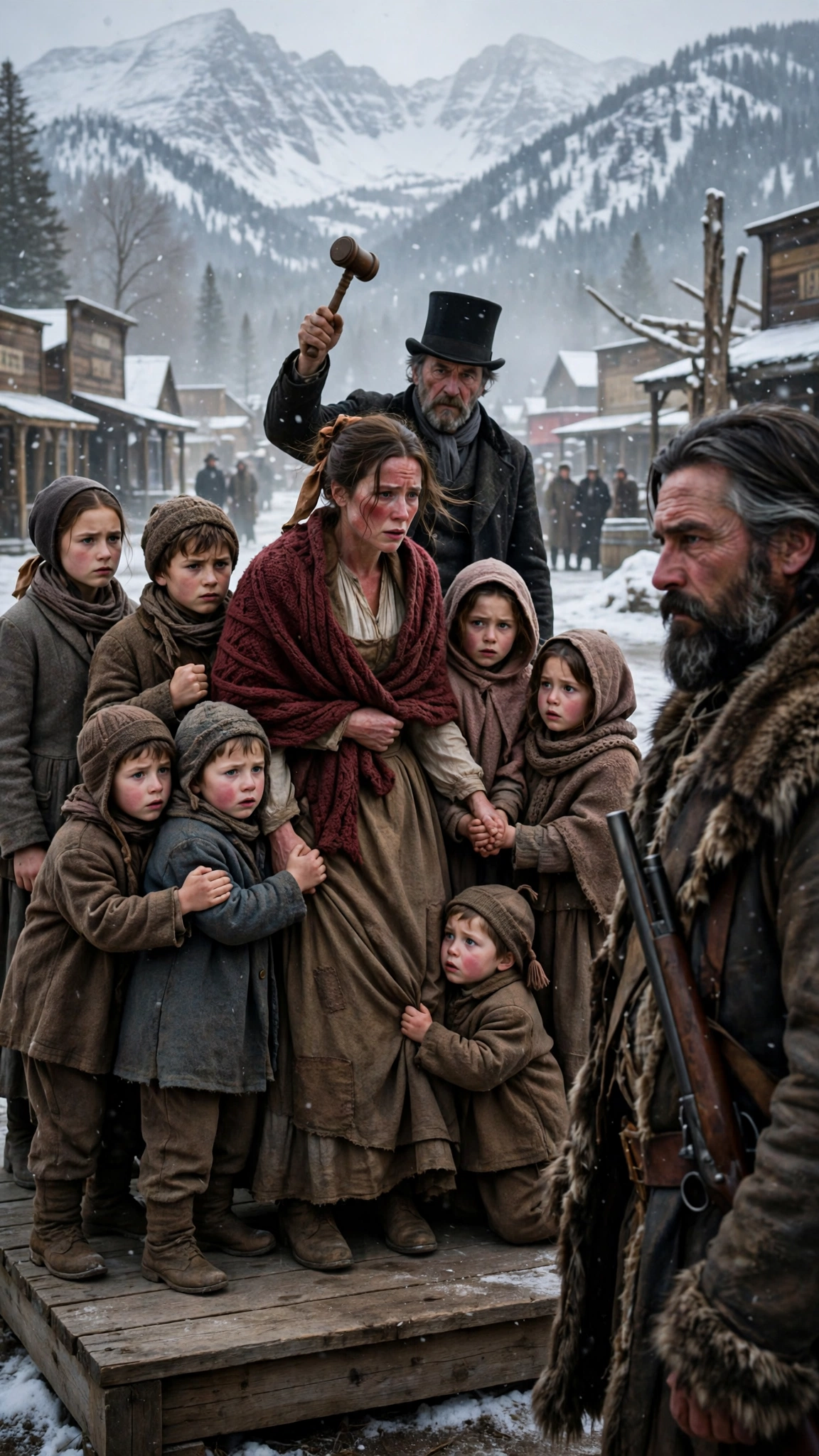
"I kept the room," he said, "because it was the only thing I had left of her. I kept it locked because I could not bear to look at it, and I could not bear to let it go. And when you came — when you came with seven children, and you stood on that platform in the square, and you would not cry — I saw her in you. Not her face. Her spine. The way she stood. Anna would have stood the way you stood."
Eleanor stood in the doorway of Anna's room, and tears were running down her face, and she did not try to stop them, because this was not a time for holding back. She looked at the small wooden cradle, and at the patchwork quilt, and at the bluebell shawl on the chair, and she thought of Daniel, and of the little house in Philadelphia, and of all the things she had lost, and she understood that the man standing beside her had lost everything too, and that he had carried it alone for twenty years, and that he had just — for the first time — let someone else carry a part of it.
Sarah went into the room, slowly, and she touched the quilt with one hand, gently, the way a person touches something sacred, and she looked at Caleb, and she said, "She would be glad, Mr. Roar. That her room is open. That children are in this house again."
Caleb's face worked, and for a moment Eleanor thought he might weep, and then he mastered himself, the way he always did, and he nodded, once, and he said, "Perhaps."
That night, after the children were asleep, Eleanor found Caleb sitting by the fire, and she sat across from him, and for a long time neither of them spoke. The fire burned low. The wind moved through the pines. And at last Eleanor said, very quietly, "Thank you for telling us. I know what it cost you."
He looked at her across the firelight, and his pale eyes were not cold at all. They were tired, and they were open, and they were — for the first time since she had met him — unafraid.
"I have been alone for twenty years, Eleanor," he said, and it was the first time he had ever used her name. "I thought that was what I wanted. I thought the mountain was enough. But these last months — the noise in the house, the children laughing, the bread baking, you at the table in the morning — I have begun to think that perhaps I was wrong. Perhaps a man is not meant to live alone with a locked door. Perhaps he is meant to open it."
Eleanor's heart was beating very fast. She looked at the man across the fire — at his weathered face, his gray-streaked hair, his huge, work-worn hands — and she thought of Daniel, and she thought of the promise she had made to herself in Philadelphia, that she would never love again, that her children were all she had, and that loving a man had cost her everything once and she would not pay that price again. And she thought of Caleb Roar, who had paid three hundred dollars for a family he did not know, and who had spent twenty years of gold to keep his word, and who had just opened a door he had kept locked for half his life — and she understood that the wall she had built around her own heart was no different from his locked door, and that it was time, at last, to open it too.
"I think," she said quietly, "that perhaps you are right."
They sat by the fire until it burned down to embers, and neither of them said anything more, and it was enough. Outside, the creek ran high and cold and loud in the summer dark, and the stars pressed down on the mountains, and in the loft above them, seven children slept in a warm cabin, in a house that was no longer a stranger's house, but a home — and the locked door at the back of the cabin stood open, and the room behind it was no longer a shrine to the dead, but a room waiting, at last, to be lived in again.
The next morning, the house felt different. Eleanor noticed it the moment she woke: the air in the cabin was lighter, as if a window had been opened somewhere she could not see. She dressed and went into the main room, and the door to Anna's room stood open, and sunlight was falling across the floorboards where the door had always been shut, and Sarah was standing in the doorway with a broom in her hand, sweeping the floor of the little room with great care, as if she were sweeping a church.
"She would want it clean," Sarah said, when she saw her mother watching. "If someone is going to live here again."
Eleanor did not ask who Sarah meant. She took a cloth and went to help, and together they dusted the dresser and washed the window and shook out the patchwork quilt and hung it over the line in the yard to air in the sun. Margaret and Catherine carried the little wooden cradle out onto the porch, and they scrubbed it with soap and water, and they set it in the sun to dry, and Edward sat beside it, solemnly guarding it with his wooden horse, as if the cradle were the most important thing in the world.
Caleb watched them from the yard, his arms folded, and Eleanor could see that he did not know what to do with himself — that the room had been locked for so long that having it open, and having people in it, was like learning to walk again. And then Thomas came to him, with a piece of pine in his hand and Caleb's small sharp knife, and he said, "Will you teach me to carve, Mr. Roar? Like Edward's horse?"
Caleb looked down at the boy for a long moment. Then he took the wood and the knife, and he sat down on the chopping block, and he motioned for Thomas to sit beside him, and he began to show him — how to hold the knife, how to cut with the grain, how to be patient, how to let the shape come out of the wood instead of forcing it. And Thomas listened with his whole body, the way boys listen when they are learning something that matters, and Eleanor watched them from the porch, and she thought of Daniel, who had taught Thomas to read by lamplight, and she thought of Anna, whose room was full of sunlight for the first time in twenty years, and she thought that this — this ordinary morning, this ordinary work, this ordinary kindness — was what a family was.
Later that day, when the work was done and the children were playing in the yard, Eleanor went into Anna's room alone. She stood by the dresser, and she looked at the hairbrush, and at the books on the shelf, and at the bluebell shawl draped over the back of the chair, and she lifted the shawl, gently, and held it against her cheek. It smelled of cedar and time and a woman she had never met. She folded it carefully and set it back on the chair, and she whispered, so quietly that only the room could hear her, "Thank you, Anna. I will look after him. I promise."
When she came out, Caleb was standing in the doorway, and he had heard her — she could see it in his face — and he did not speak, and she did not speak, and they stood there together in the sunlight, in the open doorway of a room that had been locked for twenty years, and it was enough. It was more than enough. It was the beginning of everything.