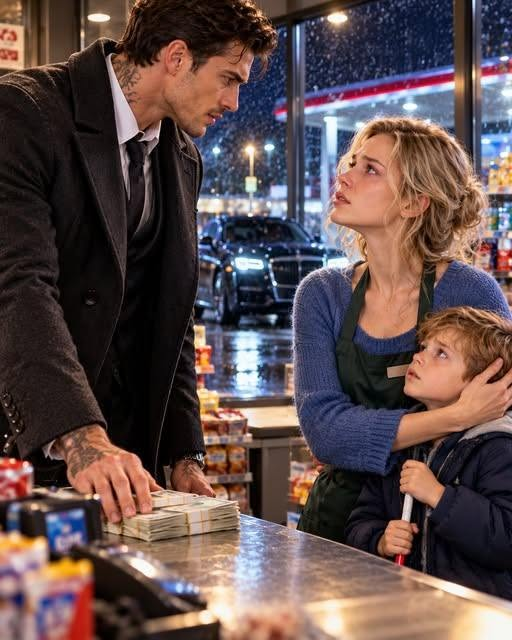
The morning of Noah's surgery, the hospital gave us a room that was too quiet.
It was the kind of quiet I knew well — the quiet of waiting rooms and bad news, of held breath and ticking clocks. Noah sat on the edge of the bed in a gown that swallowed him, his small legs swinging, his hands folded in his lap the way I had taught him to fold them when he was nervous. He had asked for his cane twice, and twice I had told him it was safe, that Ethan was holding it, that it would be right here when he woke up.
Ethan had not sat down since we arrived.
He paced the corridor outside the room with Noah's white cane in both hands, carrying it the way a man carries something entrusted to him — carefully, almost formally, as if it were made of glass. The most feared man in Chicago, reduced to a father walking a hallway, counting the tiles. I watched him through the doorway and thought about how seven years of anger had ended here, not with shouting, not with revenge, but with a man who could not sit still because his son was about to be wheeled away by strangers.
"Mommy." Noah's face turned toward my voice. "Will it hurt when I wake up?"
"A little," I said, because I had never lied to him about the hard things. "Like a headache behind your eyes. And the doctors will give you medicine, and I'll be right here, and so will—" I stopped.
"Ethan," Noah finished, solemn as a little judge. "He promised. On the piano. He said promises on the piano count double."
I looked out at the corridor. Ethan had heard. He stood in the doorway with the cane across his palms like an offering, and his throat worked, and he nodded once — at Noah, who couldn't see it, so he said it out loud, the way we had all learned to say things out loud in our house.
"I promised," he said. "I'm here, buddy. I'm not going anywhere."
When they came for Noah, I walked beside the bed until the double doors that I could not pass. Ethan walked on the other side, one hand on the rail, and when the doors swung shut between us and our son, the sound they made was soft and final and the worst sound I had heard since the night I was eighteen and got into Blake's car in the rain.
I don't know how long we stood there. I know that at some point my hand, shaking, went looking for something to hold on to, and found Ethan's sleeve, and then his hand — and he held on like a man who had been waiting seven years to be held on to. We did not speak. There was nothing to say that the holding didn't say better. The surgeon had explained it all days before: the window was now, the retinas, the delicate work, the chances that were good but not certain, the partial sight that would still change everything. Partial. I had turned the word over and over in the night. Partial meant light. Partial meant shapes, faces, the outlines of the world. Partial meant my son might see my face.
Ethan turned my hand over in his at one point and pressed his thumb into my palm, slow, the way you calm an animal, the way you calm yourself.
"He's tougher than both of us," he said quietly. "You raised him that way."
"You would have, too," I said. "You did. In every story."
His jaw tightened. He looked at the double doors. "When he wakes up," he said, "whatever he sees — or doesn't — nothing changes. You hear me, Claire? Nothing about us changes on the other side of those doors."
"I know," I said. And I did. That was the thing seven years had taught us both: the love was not the variable. It never had been.
Noah came through the surgery the way he came through everything — quietly, bravely, and asking for water. The bandages stayed on for days, and those days were their own kind of waiting room. We took turns sleeping in the chair beside his bed. Ethan read to him — badly, at first, stumbling over the picture-book words, then better, learning to describe every picture out loud without being asked. Noah corrected his animal sounds. A feared mafia boss, practicing a cow noise at two in the morning in a children's ward, while my son laughed into his pillow. I stood in the doorway with two cups of hospital coffee and thought: this is it. This is the life that was stolen. It's late, and it's scarred, and it's ours.
The morning they removed the bandages, the nurse dimmed the lights.
"Easy, sweetheart," she said. "Everything's going to be bright and blurry. That's normal. Just blink and let it come."
I was on one side of the bed. Ethan was on the other — and then, at the last moment, something in him seemed to decide, and he moved. He came around the bed and knelt down beside it, right in Noah's eyeline, close, the way you get close for a child who has spent six years measuring the world by voice and touch. He didn't say anything. He was breathing like the hallway was still under his feet.
The nurse lifted the last of the gauze away.
Noah blinked. His eyes — unfocused, watering, my eyes and Ethan's jaw and six years of darkness — moved slowly across the light. He frowned the way he did when he was listening hard, except now he was doing it with his whole face turned up to the room, and I watched shapes find him: the window first, a bright rectangle that made him squint and then, wondering, not look away.
"There's… light," he said, uncertain. "It has edges."
Then his gaze drifted — past the nurse, past the machines — and stopped.
It stopped on Ethan.
Ethan Hale, on his knees beside a hospital bed, in the dimmed light, close enough to touch, his face doing none of the things it had learned to do in seven years of being feared. He was crying without making a sound. I don't think he knew.
Noah stared. A long moment. Six years of a voice in the dark, resolving at last into a face.
"You're taller," Noah said, with enormous seriousness, "than your voice."
Ethan made a sound that was half laugh and half something breaking open. "Yeah," he managed. "Yeah, buddy. Sorry about that."
"Your eyes are wet."
"They do that now," Ethan said. "Since you." And Noah reached out — a little off, still measuring by the old map — and Ethan leaned in the last few inches so that our son's hand found his cheek, and Noah's fingers moved over his father's face the way they had moved over mine a thousand times, learning it. Except now he could see his hand doing it. He watched his own hand on Ethan's cheek like it was the most interesting thing in the world.
"Mommy," he said, not looking away, "he looks like the stories."
I was crying too hard to answer him properly. I managed, "I told you he was handsome."
"You said that in the sad ones too," Noah said, and Ethan laughed for real then, and the nurse pretended to check a chart, smiling at the wall.
Healing is not a movie montage, whatever people say. It was weeks of eye drops and dark glasses and follow-up appointments, of Noah moving through the world like a man reading a book in a language he half knew — drunk on it, furious with it, exhausted by noon. He learned colors the way other children learn swear words: greedily, out of order, with total commitment. Red was his favorite for a week because the sign at the pharmacy was red. He informed us that thunder had been a disappointing thing to finally see, but that rain on the windows was "better than the sound of it," and no one in our house argued.
Ethan had the station rebuilt while Noah recovered.
I want to be precise about this, because precision matters to me now. He did not ask my permission, which should have angered me, and would have, seven years or even seven months earlier. But he also did not put his name on a single thing. I came home from a follow-up appointment one gray afternoon and stood in the doorway of Miller's Fuel & Grocery — except it wasn't Miller's anymore. The sign was new. I'd find out later that Noah, in the hospital, describing the old place from memory, had been asked what the sign should say, and had announced that it should say WHITMORE'S because "that's us," and that there should be a sun on it, "a yellow one, the warm kind," and Ethan had simply had it done, exactly that, down to the painted sun Noah now traced with one recovering finger every single day to make sure it was still there.
Inside: new floors that didn't stick. Shelves that stood straight. A heater that worked. And the paperwork, in a plain folder on the counter, with my name on it. Sole owner. No liens, no loans, no signature of his anywhere except the one that had transferred it.
I found him restocking the milk cooler, because of course I did.
"Ethan." I held up the folder. "What is this?"
"Yours," he said, not looking up, very busy with milk. "It was always supposed to be yours. I just bought out the men who owned the building so they'd stop bleeding it."
"You can't just—"
"I'm not buying you, Claire." He stood up then, and closed the cooler, and looked at me with the patience of a man who had rehearsed. "Giving back what the years charged you. There's a difference. The years charged you a piano, and a stage, and a name on a sign. I'm returning property." A pause. "You can sell it. You can burn it. It's yours either way. That's what makes it a gift and not a leash."
I stood in my own clean, warm, rebuilt store and cried into the accounts folder like an idiot, and Noah, wearing his dark glasses like a tiny celebrity, patted my arm and said, "The sun is still there, Mommy. I checked twice."
The piano came on a Tuesday.
A real piano — not new, better than new, a dark upright with honest wear on the keys — delivered to the corner of the store by four men and one very nervous Ethan, who had apparently stood at the warehouse and played three notes on eleven different pianos before choosing, though he knew nothing about pianos, because, he said, he was listening for the one that sounded like the roof of a trailer with stolen birthday candles on it. I don't know what that means either. He was right, though. It was the one.
It stood in the corner by the window for three days before I touched it.
Seven years is a long time for hands to remember. Mine had scanned cigarettes and stocked milk; they had held a white cane and a small boy and a hundred double shifts. On the fourth evening, after close, with the rain starting up outside and Noah sitting cross-legged on the counter stool eating apple slices, I sat down on the bench and lifted the fall board.
Chopin. The Nocturne in E-flat, the one I had played at fourteen in a hall my mother wore her good dress to. I got four bars in and my fingers forgot, and I sat with my hands in my lap and breathed, and Noah's face turned toward the sound, listening the way he had listened his whole life — the new sight of him still secondary, still outvoted, by the hearing he'd been raised on.
"Again," he said quietly. "Mommy. Again. You stopped."
So I began again. And somewhere in the second page my hands remembered what my mind had buried — because the body keeps the things the heart can't bear to. It wasn't clean. It wasn't a concert. It was a woman in an apron in a gas station in Pennsylvania, playing Chopin badly and then less badly and then, for one whole page, well — while her son sat beside the bench with his face turned up to the music like a plant to light, and the man who had once thrown five hundred dollars on that counter stood in the doorway of the back room with his eyes closed, just listening, the way he must have listened through a trailer wall when he was eighteen and poor and loved.
When the last note settled, nobody moved for a moment.
"That's the one from the stories," Noah said. "The roof one."
"That's the roof one," I agreed.
Ethan opened his eyes. "Play it at the wedding," he said, very casually, and then went the color of a man who has heard himself, and Noah said, "What wedding?" and Ethan said, "Working on it, buddy," and I laughed until my eyes hurt.
He did it properly, in the end. Of course he did. He had been rehearsing this man for seven years without knowing it.
There were no hundred-dollar bills. There was no stage, no audience, no debt being settled. There was a quiet store at closing time, and my son "supervising" from the counter with strict instructions, and Ethan Hale — who had once stood over me at that counter, tall and furious and rich, demanding I admit I regretted leaving — going down on one knee on the clean new floor in front of it, not because he was begging, and not because I was above him, but because some distances you close by lowering yourself, and he had learned that, and so had I.
He held out a plain ring. No stone the size of a scandal. Just a band, warm from his pocket.
"I've had one question for seven years," he said. "'Tell me you regret leaving.' Wrong question." His voice was steady. His hand was not. "You left to save my life. You paid for my life with yours, and you never sent me the bill. I can't give you the seven years back. I can only stand here—" he smiled a little, down on his knee, "—kneel here, and tell you the truth, which is that I have loved you every day of them, including the days I hated you, because the hating was just the loving with nowhere to go." He took a breath. "Claire Whitmore. Marry me. Not the money, not the empire — me. The boy from the trailer, with better shoes. Let me spend the rest of the years giving you both back."
Noah, from the counter, in the tone of a boy delivering a verdict he'd reached weeks ago: "She's crying, so that's a yes. The stories say crying means yes."
"I—" I was laughing and crying at once, which Ethan later said was the most honest answer he'd ever gotten. "Yes. Ethan Hale. Yes."
He put the ring on my finger with hands that shook worse than mine, and Noah came down off the counter carefully — carefully, the way he still moved in new spaces — and found us, and was gathered in, all three of us on the floor of a gas station in front of a piano, with the rain coming down outside and nowhere else in the world to be.
Winter came back the way it always does in Pennsylvania — sudden, and through every crack.
It was a freezing evening, the kind that makes the windows bloom with frost, when I heard the door bell.
I knew that bell. I had heard it in my nightmares for seven years — the evening it had rung and rung my whole life down. I looked up from the counter, out of habit more than fear, and Ethan walked into the store.
He was shaking snow off his coat. Just a man, coming in out of the cold. He looked at the counter, and at me behind it, and something passed over his face that used to be pain and wasn't anymore — just memory, the way a scar is memory. Then he smiled, and turned, and called out, the way he called out every evening now, like a password, like a promise kept on schedule:
"Anybody home?"
And from the back room — footsteps. Not the careful tap of a cane. Running feet, careful only the way joy is careful when it knows the way by heart.
"DADDY!"
Noah came around the end of the aisle at a run, past the piano, past the shelves, straight as an arrow to the sound of that voice — and Ethan went down on one knee to catch him, the way he did every time, open-armed on the floor of Whitmore's, under the painted sun.
Seven years ago, Ethan Hale walked into this store to punish me, with five hundred dollars and a heart I'd broken on purpose to keep him alive. He walked in with the money in his hand and the rain at his back and revenge in his mouth.
This time, he walked in empty-handed, and my son ran to him, and I came out from behind the counter, and he stayed.
This time, he stayed.