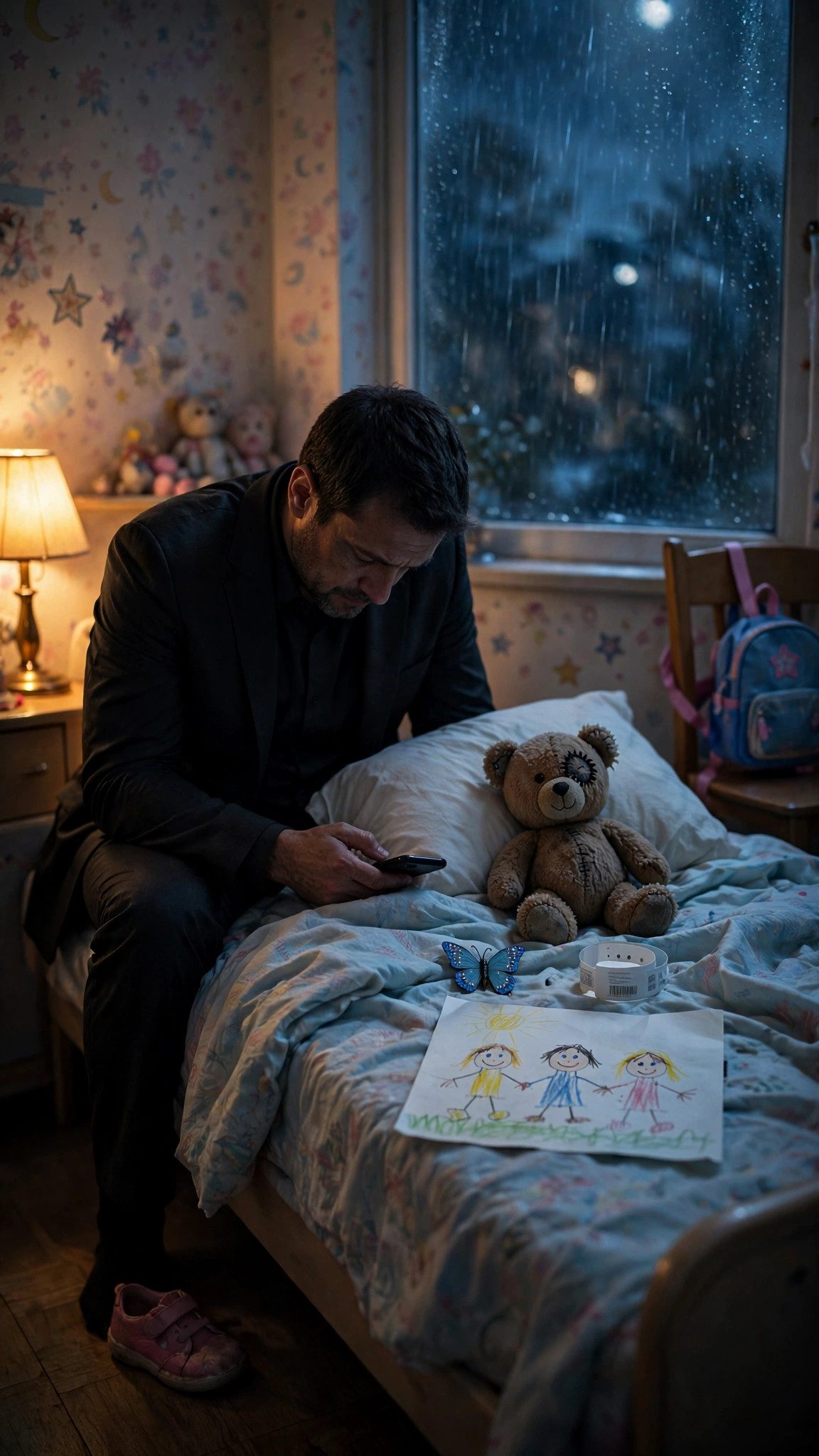
I met Damian Moreland on a Tuesday in March, in the emergency department of St. Margaret's Hospital, where I worked as a pediatric nurse. He came in carrying a boy of about nine, a nephew, I learned later, who had fallen off a bicycle and split his forehead open on the curb. The boy was screaming. Damian was not. He stood in the middle of my trauma bay with blood on his white shirt and a calm on his face that did not match the chaos around him, and he looked at me and said, "Fix him."
Not please. Not hello. Fix him.
I was twenty-five years old, and I had been a nurse for three years, and I had already learned that the men who gave orders in emergency rooms were usually the ones who were most afraid. So I looked at the boy first, and then I looked at Damian, and I said, "He'll be fine. Sit down before you fall down."
He stared at me for a long moment. Nobody, I suspected, had ever told Damian Moreland to sit down. Then he did something I did not expect. He laughed. A short, surprised sound, like a door opening in a house I had assumed was empty.
He sat down. I stitched the boy's forehead. Damian watched my hands the whole time, the way a man watches something he does not understand but respects. When I finished, he stood up, and he looked at the boy, and he looked at me, and he said, "You're not afraid of me."
"Should I be?" I asked.
"Most people are."
"I'm a pediatric nurse," I told him. "The only people I'm afraid of are toddlers with fevers and mothers who read the internet."
He came back the next day with flowers. Not roses. Lilies. White lilies, a whole armful of them, and he stood in the doorway of the nurses' station looking profoundly uncomfortable, a man who had clearly never brought flowers to anyone in his life, and he said, "For the boy's nurse."
I took them because the boy had liked me and because the flowers were beautiful and because, if I am honest, because I was curious. There was something about Damian Moreland that did not fit the stories people told about him. Everyone in Chicago knew the name. Shipping companies. Luxury properties. An empire built on freight and concrete and money that moved in the dark. Men like him did not bring lilies to nurses. Men like him did not sit in waiting rooms. Men like him did not laugh, surprised, when a twenty-five-year-old girl told them to sit down.
He asked me to dinner. I said no. He asked again the following week. I said no again. The third time, he showed up at the hospital at the end of my shift with a car and a driver and no flowers at all, and he said, "I am not good at this. I have never been good at this. But I would like to take you to dinner, and I will keep asking until you say yes or until you tell me to stop for good."
I said yes. I told myself it was only dinner. I told myself I was only curious. I told myself that a man who could be gentle with a frightened nine-year-old could not be entirely what the newspapers said he was.
Dinner was at a small Italian restaurant on Taylor Street, the kind of place with checkered tablecloths and candles in old wine bottles, and he ordered for both of us in Italian, and he told me about his mother, who had died when he was sixteen, and his father, who had built the shipping company with his bare hands and a single freighter, and his younger brother, who had died in a car accident when Damian was twenty-two. He told me these things quietly, without drama, the way a man tells a stranger the facts of his life because he has never told anyone else. And I told him about my mother, who had raised me and my sister Sarah alone after my father left, and about nursing school, and about the little girl with leukemia who had taught me that bravery has nothing to do with size.
We talked for four hours. When he drove me home, he walked me to my door, and he did not try to kiss me, and he said, "May I see you again?"
I said yes again. And then I said yes a third time, and a fourth, and by the summer I was in love with him, and by the autumn I had stopped pretending that I was not.
People warned me. My mother warned me. Sarah warned me. The other nurses warned me. They told me what Damian Moreland was, what his family did, what kind of men surrounded him. I listened, and I believed them, and I loved him anyway, because the man I knew was the man who brought lilies to a hospital and who called his housekeeper's mother every Sunday and who once spent an entire afternoon building a bookshelf for a children's ward because I had mentioned, in passing, that the old one was falling apart.
He proposed on a cold night in December, on the roof of his building, with the whole city spread out below us and snow coming down in slow, fat flakes. He did not get down on one knee. He just took my hands in his, and he said, "Claire, I am not a good man. I have done things I am not proud of. But I want to be better, and I think I could be, with you. Marry me."
I said yes. We were married in the spring, in a small chapel with white flowers everywhere, and Sarah cried, and my mother cried, and Damian's men stood at the back in their dark suits, looking like a wall of winter, and when the priest asked if anyone objected, nobody said a word.
The first years were good. I will not pretend otherwise. Damian was a devoted husband in his way. He was home for dinner most nights. He learned to cook, badly, and he burned things, and he laughed about it. He built me a garden behind the mansion, because I had told him once that I missed having dirt under my nails. He came to every prenatal appointment when I was pregnant with Lily, and he held my hand during the twenty-two hours of labor, and when our daughter was born, he wept. Damian Moreland, the most feared man in Chicago, wept like a child, holding a six-pound baby girl in his hands, and he whispered, "She's perfect. Claire, she's perfect."
Lily was perfect. She had his brown eyes and my stubborn chin, and from the moment she could walk, she followed her father everywhere. She sat on his lap during meetings and drew pictures on his important papers, and his men pretended not to notice, and he pretended not to mind. She called his office "Daddy's castle" and his drivers "the knights," and when she was four, she announced that she was going to marry him when she grew up, and Damian told her, very seriously, that she would have to ask her mother first.
Those were the good years. And then, slowly, the way a tide goes out so gradually you do not notice until the boats are sitting on mud, the good years began to end.
It started with the trips. At first they were short. A day in New York. Two days in Miami. Then a week in London. Then two weeks, and the calls home grew shorter, and the gifts he brought back grew more expensive, as if diamonds could make up for empty chairs at dinner. Lily would wait by the window for him, her little face pressed to the glass, and when his car finally came up the drive, she would run to the door, and he would sweep her up and spin her around, and for an evening, everything would be all right again.
Then one night, when Lily was five, I found a receipt in his suit jacket. A hotel in Monaco. Two guests. A woman's perfume on the collar that was not mine.
Her name was Sabrina Voss. She was twenty-nine years old, blonde, beautiful, and she worked in public relations for one of Damian's shipping partners. I learned all of this the way wives always learn these things: a photograph on a gossip website, a friend of a friend who had seen them at a restaurant, a credit card statement I was never supposed to see. I confronted him in our bedroom on a Thursday night while Lily slept down the hall, and I asked him if it was true, and he did not lie to me. That was the worst part. He did not lie. He looked at me with those brown eyes, the same eyes as our daughter, and he said, "It's a mistake, Claire. It means nothing. You are my wife. Lily is my daughter. That is what matters."
But it was not a mistake. A mistake is something that happens once. Sabrina went to Monaco with him. She went to Capri with him. She went to Paris with him, and she wore a dress I had seen in a magazine, and she smiled for the cameras as if she belonged at his side, as if she had always belonged there.
I stayed. I stayed because of Lily. I stayed because I believed that a man who loved his daughter the way Damian loved Lily would come back to us eventually, that the affair would burn itself out, that he would remember who he was. I stayed because leaving felt like giving up, and I had never given up on anything in my life. I stayed because every time I thought about packing a suitcase, Lily would climb into my lap and ask me to read her a story, and I would think: not yet. Not yet. Give him one more chance.
The last time I saw him before the accident, he was standing in the front hall with his suitcase, on his way to the airport, and Lily was clinging to his leg, begging him not to go.
"Daddy, stay," she said. "Stay for my ballet recital. Please."
"I can't, sweetheart," he said, and he bent down and kissed the top of her head. "But I'll be back on Sunday, and we'll go to the park, and I'll push you on the swings until you touch the sky."
"Promise?" she said.
"I promise," he said.
He did not come back on Sunday. He went to Monaco instead. With Sabrina.
And on Tuesday afternoon, on the way home from ballet class, a truck skidded across the road in the rain, and our car spun twice, and the airbags exploded, and my daughter looked at me with blood on her forehead and asked me the first of seven questions.
Where's Daddy?
I did not know then that it would be the first of seven. I did not know that I would spend the rest of that day lying to her, or that by 11:07 that night, she would be gone, and I would be standing in a hospital corridor with a butterfly clip in my pocket and a phone full of unanswered calls. I only knew that my daughter was hurt and frightened, and that the one person she wanted most in the world was not there.
That is how the story began. Not with the accident. Not with the hospital. It began years earlier, on a Tuesday in March, in an emergency room, when a man with blood on his shirt looked at me and said, "Fix him." And I fixed the boy. And then, without meaning to, I spent nine years trying to fix the man.
I could not fix him. In the end, no one could. Not even our daughter, who loved him more than anyone in the world, and who asked for him seven times while she was dying, and who waited for him until there was nothing left to wait with.
There was one night, a few months before the accident, when I almost left. Lily had turned six that week, and Damian had promised to be home for her birthday party. He had promised her a pony. Not a real pony, he had explained carefully, but a ride on a pony at the party, and a cake shaped like a butterfly, and all her friends from school. Lily talked about that party for a month. She drew pictures of the cake. She practiced blowing out the candles.
On the morning of the party, Damian called from the airport. A deal in Monaco had gone wrong, he said. He had to go. He would make it up to her. He would bring her something wonderful. I held the phone and watched Lily in the garden, wearing her birthday dress, a pink dress with a sash, arranging the party hats on the table all by herself, and I said the only thing I could say.
"All right."
He did not come. The pony came. The cake came. The children came, and they sang, and Lily blew out six candles and wished for something she would not tell me, because if you tell your wish, it does not come true. That night, after the children had gone home and the balloons were drooping from the ceiling, I found her sitting on the stairs in her birthday dress, holding the one-eyed teddy bear, staring at the front door.
"Is Daddy coming home tonight, Mommy?" she asked.
"I don't know, baby."
"Do you think he forgot my birthday?"
"No," I said, and I sat down beside her, and I pulled her into my lap, and she was getting too big for my lap but I held her anyway. "Daddy never forgets you. He just had to work."
"Work is far away," she said. "Work is always far away."
I should have left that night. I should have packed a suitcase and taken my daughter and gone somewhere Damian's money and his empire and his mistress could not reach us. But I stayed, because she fell asleep in my arms on the stairs, and because I carried her to bed, and because in the morning she woke up and asked if Daddy had called, and I told her he had, and she smiled, and the smile was worth all the waiting in the world.
I stayed for the smile. I stayed for the mornings when she ran down the stairs and shouted his name. I stayed because I believed, right up until the very last day, that a father who loved his daughter would always come home in the end.
He did not come home. Not when it mattered. Not when she needed him most. And that is the truth I have to live with now: that I stayed, and I waited, and I believed, and my daughter paid the price for my faith in a man who had already left us long before the accident, long before the yacht, long before Monaco. He left us the day he decided that his empire mattered more than his family. I just did not see it until it was too late.