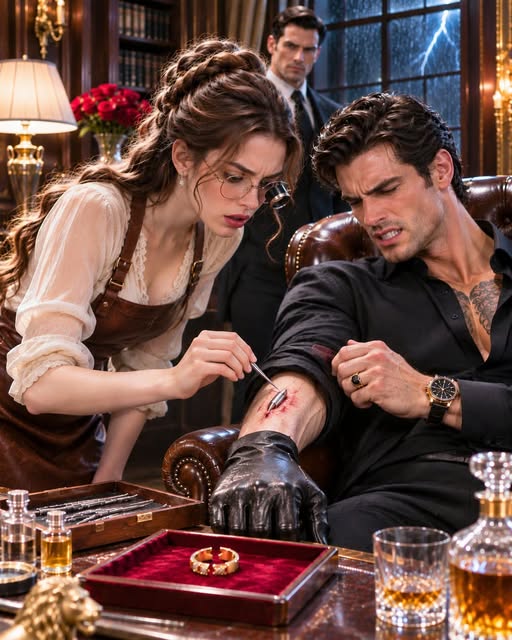
The Man Who Never Left His Side
I didn't sleep that night.
Orson insisted that returning to my apartment was unsafe.
I insisted that staying at his mansion sounded like the opening scene of every bad decision a woman ever made.
He won.
Mostly because two unidentified men had been caught on camera entering my building fifteen minutes before we arrived.
So at one in the morning, I found myself standing barefoot in a guest bedroom larger than my entire apartment, wearing a borrowed robe while rain streaked the windows.
I should have been terrified.
I was.
But beneath the fear was something worse.
Curiosity.
The message wouldn't leave my mind.
Ask her what her grandfather hid inside the ring.
The ring sat downstairs in Orson's office.
We had examined it for almost an hour.
Nothing.
No opening.
No hollow section.
No obvious compartment.
The band was solid gold.
Or at least it appeared to be.
At two seventeen, I gave up pretending I could sleep.
I went downstairs.
The mansion was quiet.
Two security men nodded as I passed.
Orson's office door was open.
He was inside.
Alone.
He had removed his black glove.
I stopped.
He didn't notice me immediately.
His right hand rested beneath the lamp.
The damage was worse than I'd realized.
Scar tissue crossed the back of his hand and wrist. His ring finger curled inward. The middle finger barely moved.
The skin looked tight over old injuries.
For the first time, Orson Dramore didn't look dangerous.
He looked tired.
Human.
He noticed me in the doorway.
His instinct was immediate.
He reached for the glove.
“Don't.”
His eyes narrowed.
I almost regretted saying it.
Then I stepped closer.
“You don't have to hide it from me.”
“I don't hide it.”
“You literally wear a glove every waking minute.”
A pause.
“Fair point.”
I sat opposite him.
The ring lay between us.
“Does anyone else see your hand?”
“Doctors.”
“That's not what I meant.”
“No.”
“Why?”
He looked at the scars.
“People stare.”
“So?”
“People who fear you look for weakness.”
The answer was so simple that it hurt.
I touched the magnifying loupe hanging around my neck.
“My grandfather lost two fingers in a machine accident.”
Orson looked up.
“He still worked?”
“Until he died.”
“How?”
“Badly, at first.”
That almost-smile again.
“He designed his own tool grips. Changed the angle of his bench. Learned to hold things differently.”
I watched Orson's thumb move.
“He used to say damage changes the job, not the value of the hand.”
Orson was quiet for a long moment.
“You loved him.”
“Very much.”
“And now he may have helped someone shoot me.”
The words hit hard.
“He didn't know.”
“You don't know that.”
I stiffened.
“No.”
Orson leaned back.
“I'm not accusing him.”
“It sounded like it.”
“I'm reminding you that we don't know the whole truth.”
I hated him for being right.
The grandfather I remembered had been patient and gentle.
But people were more complicated than memory.
Maybe Arthur Fenimore had made mistakes he'd never confessed.
Maybe guilt had been part of the reason he raised me so carefully.
I picked up the ring.
“Let's find out.”
For the next hour, I studied every millimeter.
Inside surface.
Outer engraving.
Old solder seam.
New break.
Then I noticed something.
The ring weighed too much.
Not much.
Maybe half a gram.
But enough.
I fetched a small digital scale from my toolbox.
Orson watched.
“What?”
“The density is wrong.”
“Meaning?”
“Either the gold isn't the purity it appears to be, or there's another metal inside.”
I tapped the band.
A faint sound.
Not solid.
My pulse quickened.
“I need heat.”
“No.”
I looked up.
“No?”
“It was my mother's.”
“I know.”
“And you want to burn it.”
“I want to soften one old solder seam.”
“No.”
“You hired a jeweler.”
“I hired you to repair it.”
“This is part of the repair.”
“It sounds like destruction.”
I stared at him.
“Do you interrogate your doctors like this?”
“Yes.”
“That explains why six of them gave up.”
For three seconds, we stared at each other.
Then Orson laughed.
Actually laughed.
Low.
Brief.
Almost rusty, as if he hadn't done it often.
It changed his entire face.
I forgot what I was saying.
That annoyed me.
“Stop distracting me.”
“I didn't do anything.”
“You laughed.”
“Terrible crime.”
“Coming from you, probably.”
His smile disappeared slowly.
But the warmth stayed in his eyes.
“Do it.”
I heated the seam carefully.
The old solder softened.
A section of the inner band shifted.
My breath caught.
A thin gold strip lifted.
Inside was a hollow channel no wider than a matchstick.
And inside that—
A piece of rolled paper.
Orson stopped breathing.
I removed it with tweezers.
The paper was brittle.
Nine years old, maybe older.
I unfolded it.
Numbers.
Dates.
Names.
Payments.
One set of initials appeared repeatedly.
K.P.
Beside them were freight route numbers.
Halstead.
South Dock.
West Rail.
And a word written in my grandfather's hand.
POISON.
Orson's face changed.
“You recognize this.”
“Yes.”
“What?”
“The freight numbers.”
His voice went cold.
“They were the routes I shut down.”
I looked at the page.
“Kellen was moving drugs.”
“Looks that way.”
“And Grandpa found out.”
Orson stared at the ring.
“How did this get inside my mother's ring?”
That was the question.
The ring had been in Orson's possession.
My grandfather had repaired it long before the shooting.
Unless—
“When did your mother die?”
“Twenty-two years ago.”
“When did my grandfather repair this?”
“We need to find the repair record.”
We returned to my shop at dawn with security.
I found it within twenty minutes.
Dramore, Evelyn.
Twenty-three years ago.
Simple band repair.
But a second entry was attached.
Nine years ago.
Private adjustment.
Client initials: K.P.
My hands went cold.
“Kellen brought your mother's ring to my grandfather nine years ago.”
Orson stared at the page.
“That ring was in my safe.”
“Who had access?”
“Three people.”
“Kellen?”
“Yes.”
The truth assembled itself piece by piece.
Grandpa had discovered what Kellen was doing.
He needed a place to hide evidence.
Something Kellen would never destroy because it belonged to Orson's dead mother.
So he placed the ledger fragment inside the ring.
Then returned it.
Kellen probably never knew.
Until the ring broke.
And then he panicked.
That explained why I had been brought to the mansion.
Kellen knew Fenimore Jewelry had once handled the ring.
He wanted me away from the shop while his men searched for my grandfather's records.
He probably expected me to repair the band and leave.
Instead, I noticed Orson's wrist.
And the whole plan began to collapse.
Orson looked toward the front window.
“He chose your shop.”
“Yes.”
“He had you brought to me.”
“Yes.”
“To control what you might find.”
“And because he assumed I was stupid.”
Orson looked at me.
“No.”
I frowned.
“He assumed you were desperate.”
That hurt more.
Because it was true.
I had accepted a suspiciously high payment because I needed money.
Kellen had seen my overdue rent.
My failing business.
My empty bank account.
He'd calculated my vulnerability like a number.
Orson noticed my expression.
“What?”
“Nothing.”
“Rosie.”
“I hate that he was right.”
“About what?”
“That I'd come for the money.”
“You repair jewelry for money.”
“You know what I mean.”
He stepped closer.
“Kellen paid attention to your circumstances.”
“Yes.”
“He did not understand you.”
I looked at him.
“How do you know?”
“Because if he had, he never would have brought you near me.”
The words settled between us.
Something shifted in my chest.
I looked away.
Orson's phone rang.
He answered.
His face became colder with every second.
“Where?”
Pause.
“How many?”
Another pause.
“Don't touch anything. I'm coming.”
He hung up.
“What happened?”
“One of my warehouses was hit.”
“Kellen?”
“Maybe.”
“What kind of hit?”
“Records stolen. Two guards injured.”
My stomach tightened.
“The freight records?”
“That would be my guess.”
He reached for his jacket.
I caught his arm.
“Wait.”
His eyes dropped to my hand.
I released him immediately.
“Sorry.”
“You don't have to apologize for touching me.”
The statement was too personal.
Too quiet.
I pretended not to notice.
“If Kellen is destroying records,” I said, “then the paper from the ring matters even more.”
“I know.”
“So don't take it with you.”
“Where should I leave it?”
“With me.”
“No.”
I stared at him.
“You trust me enough to keep me in your house.”
“I trust you enough to know you're becoming a target.”
“I already am.”
“Exactly.”
“Then let me help.”
His jaw tightened.
“This isn't your world.”
“No. But the evidence is.”
That stopped him.
I pointed toward the workbench.
“You know guns, warehouses, money, loyalty. I know metal, marks, repairs, hidden compartments, and my grandfather.”
Orson watched me for several seconds.
Then he took out his phone.
“What are you doing?”
“Changing your security.”
“I didn't agree to security.”
“You also didn't agree to armed men searching your apartment.”
“Fair.”
He made the call anyway.
Two hours later, we were at the Halstead warehouse.
The place smelled of wet concrete and diesel.
One guard had blood on his shirt but insisted it wasn't serious.
A steel filing cabinet had been forced open.
Papers covered the floor.
Orson walked through the damage silently.
People moved differently around him here.
No one joked.
No one questioned him.
A man twice my size stepped aside when Orson looked at him.
That was the feared Mafia boss everyone talked about.
But now I had seen him laugh.
That was dangerous knowledge of a different kind.
I crouched beside the broken cabinet.
Something glinted beneath it.
A small brass disc.
I picked it up.
Broken crown.
My pulse jumped.
“Orson.”
He came over.
The symbol matched.
Exactly.
Someone had left it deliberately.
A message.
Or a warning.
On the back were scratched four numbers.
11-19.
Orson's expression changed.
“What?”
He didn't answer.
“Orson.”
“Nine years ago, November nineteenth was the date I was supposed to meet Kellen after the shooting.”
“About what?”
“The name of the man he claimed had ordered the hit.”
My skin chilled.
“Who?”
“He never showed.”
“Why?”
“Kellen told me the man was killed.”
“Convenient again.”
“Yes.”
I turned the brass disc over.
“What was his name?”
Orson looked toward the dark warehouse.
“Arthur Fenimore.”
For a moment, the world stopped.
“My grandfather?”
“Kellen told me your grandfather arranged the shooting.”
I couldn't breathe.
“You believed him?”
“I had no reason not to.”
My eyes burned.
“All these years?”
“Yes.”
“You thought my grandfather tried to kill you.”
“Yes.”
“And you still let me into your house?”
His voice softened.
“You are not your grandfather.”
I stepped back.
The floor felt unstable.
Then another thought hit me.
“If Kellen blamed Grandpa nine years ago, why didn't you kill him?”
Orson's face became unreadable.
“Because Arthur Fenimore disappeared before I could find him.”
I stared.
“He didn't disappear.”
Orson frowned.
“He moved to Milwaukee for eighteen months after my grandmother got sick.”
Something dark passed through Orson's eyes.
“Kellen told me he'd fled the country.”
My anger turned cold.
“He lied.”
“Yes.”
“About everything.”
“Looks that way.”
My phone buzzed.
Unknown number.
One photograph.
My grandfather.
Taken through a window.
He looked older than in the workshop photo.
The timestamp was three weeks before his death.
Below it was a message.
YOUR GRANDFATHER DIDN'T DIE OF A HEART ATTACK.
I stared at the screen.
Orson read over my shoulder.
Then another message arrived.
KELLEN MADE SURE HE COULDN'T TALK.
My hands began shaking.
For the first time since this started, I didn't feel curious.
I felt rage.
And beside me, Orson Dramore became terrifyingly still.
—