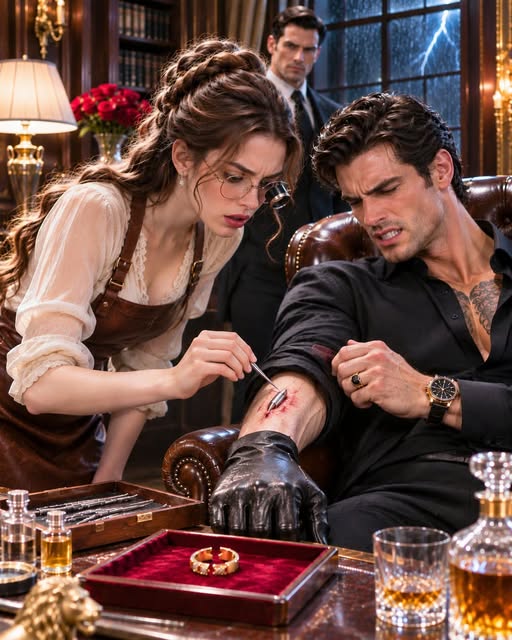
The Hand He Chose to Hold
Six months later, Fenimore Jewelry had a new front window.
That mattered to me more than it probably should have.
Same gold lettering.
Same old wooden door.
Same brass bell that rang when customers entered.
I refused to turn the shop into one of those cold modern boutiques where everything looked like it belonged inside a museum.
Grandpa would have hated that.
I repaired the floors.
Rebuilt the workshop.
Replaced the burned wiring in the basement.
Kept his old bench exactly where it had always been.
Above it, I framed one sentence from his final recording:
METAL REMEMBERS THE HANDS THAT TOUCHED IT.
Underneath, I added:
SO DO PEOPLE.
The legal cases surrounding Kellen Price became national news.
He eventually pleaded guilty to multiple federal charges rather than face trial on every count.
The reopened investigation into Grandpa's death found enough evidence to prove Kellen had ordered a medication overdose through a corrupt employee at the hospital.
The employee testified.
Grandpa hadn't died naturally.
That truth hurt.
But strangely, knowing hurt less than wondering.
Arthur Fenimore's name was formally cleared of any connection to Orson's shooting.
He had made the engraving tool.
That part remained true.
He had accepted money.
That remained true too.
Grandpa wasn't perfect.
I had stopped needing him to be.
What mattered was what he did after understanding the truth.
He collected evidence.
He protected me.
He tried, in the only ways he knew, to correct a terrible mistake.
That was the version of him I chose to remember.
Not flawless.
Brave enough to regret.
Orson understood that better than anyone.
His empire changed.
Slowly.
Painfully.
Not everyone stayed.
Some of his businesses were sold.
Others shut down.
Several men were arrested after records from Kellen's operation became public.
Orson cooperated where he had to.
Protected people where he could.
Paid penalties.
Lost money.
A lot of money.
He transformed most of what remained into legitimate freight, property, hospitality, and security companies.
People still called him a Mafia boss.
Maybe they always would.
He didn't seem interested in arguing.
“I've been called worse,” he once told me.
“By me.”
“Frequently.”
“And accurately.”
“Debatable.”
His surgery lasted seven hours.
I waited through every one of them.
When the surgeon came out, I stood so fast I spilled terrible hospital coffee over my jeans.
The fragment had been removed.
So had three smaller pieces.
Two damaged tendons were reconstructed.
One nerve graft had been attempted.
There were no promises.
Just possibilities.
For Orson, possibilities were enough.
Rehabilitation was miserable.
He complained constantly.
Not to the physical therapist.
Never.
He complained to me.
“I hate this.”
“I know.”
“This exercise is stupid.”
“Do it again.”
“My hand hurts.”
“Do it again.”
“You have no compassion.”
“Do it again.”
He glared.
Then did it again.
Two months after surgery, his index finger moved farther than it had in nine years.
He stared at it.
I cried.
He pretended not to notice.
Three months later, he could hold an empty glass.
Four months later, a coffee cup.
Five months later, my hand.
Not strongly.
Not perfectly.
But enough.
And he stopped wearing the black glove.
That became the biggest change.
The first time he entered a restaurant without it, people stared.
I watched his jaw tighten.
Under the table, I touched his knee.
“You okay?”
“No.”
“Want to leave?”
“No.”
He stayed.
Ten minutes later, nobody was staring anymore.
Or at least nobody important.
One Friday evening, I was closing the shop when the brass bell rang.
“We're closed,” I called.
“No, you're not.”
I recognized the voice.
I turned.
Orson stood inside the doorway.
Dark suit.
No tie.
No glove.
His right hand rested naturally at his side.
He still had scars.
Always would.
I loved seeing them.
Not because of what they represented.
Because he no longer hid them.
“You're late,” I said.
“I own the building where the meeting was.”
“So?”
“I couldn't leave.”
“You're the boss.”
“Apparently that creates more meetings, not fewer.”
“You should quit.”
“I considered it.”
He approached the counter.
There was something different about him.
Nervous.
Orson Dramore nervous was a rare event.
I narrowed my eyes.
“What did you do?”
“Nothing.”
“That is exactly what guilty people say.”
“I brought something.”
He placed a red velvet box on the counter.
My heart gave one hard beat.
“Orson.”
“Open it.”
I did.
Inside was his mother's gold ring.
The ring I had repaired.
The ring that began everything.
The hidden compartment had been permanently sealed after police documented the evidence.
The gold had been polished lightly but not enough to erase the years.
I smiled.
“You brought it back.”
“You repaired it.”
“Months ago.”
“I know.”
“Then why—”
“Look inside.”
I lifted the ring.
A new engraving ran along the inner band.
R.F.
I looked at him.
“Rosie Fenimore.”
“Yes.”
“You engraved my initials inside your mother's ring?”
“Yes.”
“Why?”
He stared at me like the answer should have been obvious.
I waited.
His right hand moved onto the counter.
The movement was still slightly stiff.
But deliberate.
“I spent most of my life believing people stayed because they were afraid of me, needed something from me, or wanted something I had.”
His voice was quiet.
“You didn't.”
I swallowed.
“You argued with me within ten minutes.”
“You were being annoying.”
“You insulted my security.”
“They insulted my toolbox first.”
“You ignored almost every order I gave you.”
“You gave bad orders.”
“Rosie.”
I smiled.
“Sorry.”
“No, you're not.”
“No.”
His mouth moved.
Then he became serious again.
“When you found the fragment in my hand, I thought you were a problem.”
“Romantic start.”
“I told you I'm bad at this.”
“Continue.”
“You became the person I trusted when almost everyone around me had reasons to lie.”
My eyes burned.
“You saw the worst parts of my life. You saw what I had done. What had been done to me.”
His right fingers slowly curled.
“You never confused scars with character.”
I couldn't speak.
He pushed the velvet box toward me.
“I don't want you to wear my mother's ring.”
I blinked.
“That speech went somewhere unexpected.”
He almost smiled.
“She had her life.”
He reached into his jacket.
Another small box.
“This one is yours.”
My heart stopped.
He opened it.
Inside was a ring unlike anything I had expected.
No giant diamond.
No absurd display of wealth.
A warm gold band.
A small oval diamond.
Beautiful.
Elegant.
And beside the setting was a tiny leaf pattern copied from the engraving on his mother's ring.
I touched my mouth.
“Who made this?”
“You're going to be angry.”
“Who?”
“Your competitor on Wabash.”
I stared at him.
“Orson Dramore.”
“I couldn't ask you to make your own engagement ring.”
“You could have asked me to recommend someone.”
“Then you would know.”
“I hate that man.”
“He gave me a discount.”
“You're lying.”
“Yes.”
I laughed.
Then cried.
Then laughed again.
Orson came around the counter.
He didn't kneel immediately.
Instead, he stood in front of me.
Close.
The way he had in his office six months earlier when everything between us was still dangerous and undefined.
“There is something I need you to understand before I ask.”
I nodded.
“I can't promise you my past disappears.”
“I know.”
“Some people will always hate my name.”
“I know.”
“I'll probably always have enemies.”
“Not a great sales pitch.”
“Rosie.”
“Sorry.”
“I am trying.”
“I know.”
His expression softened.
“I can promise that the life I'm building now is real.”
My throat tightened.
“I can promise I will never lie to you to protect my pride.”
He took a breath.
“I can promise that if you tell me I'm wrong, I'll listen.”
I raised an eyebrow.
“Eventually.”
“That sounds more believable.”
He nodded.
“And I can promise you will never be trapped in my world.”
That mattered.
More than the diamond.
More than the mansion.
More than the money.
“If you stay,” he said, “I want it to be because you choose me.”
I reached for him.
“You still haven't asked.”
“Yes.”
He finally lowered himself to one knee.
I had seen men tremble when Orson entered rooms.
I had seen armed guards obey him without hesitation.
I had watched him stand in front of a loaded gun without blinking.
But now his hand shook slightly as he held the ring.
“Rosie Fenimore.”
“Yes?”
“I would appreciate it if you stopped interrupting.”
I laughed through tears.
His eyes warmed.
“Will you marry me?”
For one second, I thought of Grandpa.
I imagined him behind the workbench.
Magnifying loupe in one eye.
Complaining that Orson's ring sizing was probably wrong.
Then I looked at the man in front of me.
At the scars on his right hand.
At the hand he had once hidden from the world.
At the fingers that could now hold a ring.
“Yes.”
His breath left him.
I smiled.
“Yes, Orson.”
He stood.
I kissed him before he could say anything else.
When we separated, he slid the ring onto my finger using his right hand.
It took longer than it would have with his left.
His fingers weren't perfect.
They never would be.
Neither were we.
That was the point.
He got the ring over my knuckle.
Then stared at it.
“You're crying.”
“So are you.”
“I am absolutely not.”
“There is literally a tear on your face.”
“Dust.”
“In a jewelry shop?”
“Very dusty profession.”
I kissed his cheek.
The brass bell rang.
Mara entered.
Behind her were Tessa, two of Orson's business partners, and half a dozen people who were clearly pretending they hadn't been waiting outside.
I stared at Orson.
“You told them?”
“I told no one.”
Mara raised her hand.
“I told everyone.”
“You're fired,” Orson said.
“You've fired me fourteen times.”
“Fifteen.”
Tessa screamed when she saw the ring.
The shop filled with laughter.
Champagne appeared from somewhere.
Someone turned on music.
For the first time in years, Fenimore Jewelry didn't feel like a business I was desperately trying to save.
It felt alive.
Later, after everyone left, Orson and I stood alone in the workshop.
Rain had begun outside.
Soft this time.
Nothing like the storm from the night we met.
He studied the framed words above Grandpa's bench.
Metal remembers the hands that touched it.
So do people.
“You added that?”
“Yes.”
“It's good.”
“High praise.”
He looked down at his right hand.
Then slowly placed it on Grandpa's wooden workbench.
“I spent nine years believing this hand was proof that someone beat me.”
I stepped beside him.
“And now?”
He flexed his fingers.
“Now I think it proves I survived long enough to learn something.”
“What?”
He looked at me.
“That protecting something isn't the same as controlling it.”
I smiled.
“That lesson only took you forty-six years?”
“I'm a slow learner.”
“Apparently.”
He reached for my hand.
With his right one.
The grip was gentle.
Warm.
Real.
“Rosie.”
“Hmm?”
“If your grandfather could see us, do you think he'd approve?”
I pretended to consider it.
“No.”
Orson frowned.
“No?”
“He would make you sit through a three-hour lecture about solder temperature first.”
Orson laughed.
That same quiet laugh I'd heard for the first time while a storm raged outside his mansion.
Only now there was no gun behind me.
No secret fragment beneath his skin.
No trusted man waiting to betray him.
Just us.
A repaired ring.
A restored shop.
A truth that had finally been allowed into the light.
I rested my head against his shoulder.
Outside, Chicago moved around us.
Cars passed.
Rain fell.
People lived lives that had nothing to do with Mafia betrayals, hidden bullets, secret freight routes, or men who spent nine years wearing black gloves.
I was grateful for that.
Orson lifted my hand and looked at the engagement ring.
“Still angry I used your competitor?”
“Yes.”
“I knew it.”
“I'll forgive you eventually.”
“How long?”
“Nine years.”
He stared at me.
I grinned.
Then he kissed me.
And the hand he'd hidden from the world rested gently against my cheek.
No glove.
No shame.
No fear.
For the first time, Orson Dramore wasn't holding onto an empire.
He was holding onto a future.
And this time, neither of us intended to let go.