We married again in the garden of Elena's house, on a warm afternoon in June, with white roses everywhere and only thirty guests, the way we had married the first time.
Only this time, I wore a veil, because Leo insisted. "Daddies are supposed to lift the veil, Mommy," he had told me very seriously, while I was trying on the dress. "That's the rule. I saw it on television."
So I wore a veil, and Matthew lifted it, and Leo stood between us holding the rings on a small velvet pillow, with Rex tucked into the pocket of his little suit, because Rex was the ring bearer too, and that was also the rule, according to Leo.
Rosie came, in a blue dress she had bought specially for the occasion, and she cried through the entire ceremony and then pretended she had something in her eye. Mr. Henderson came, and Eddie, and Dr. Patel, and half the town of Millbrook, because that was what Millbrook did — when one of their own came home, they all came to see it.
Elena, Matthew's mother, took my hands before the ceremony and said, "You are the best thing that has ever happened to my son. Don't let this life change you." And this time, I knew what she meant, and I knew I could keep the promise, because this time the life was different. This time, the life was ours.
The trial had ended in April. Vincent Castellano was sentenced to life in federal prison on racketeering, conspiracy, and attempted murder charges. Tony Russo testified for the prosecution and received eight years. The docks, the warehouses, the trucking routes — all of it was now part of Vieri Shipping, a legitimate company with real employees and real payrolls and a sign on the door that said "Vieri Shipping" in plain black letters. Matthew had done what he promised. He had made the business clean. He had made the family clean.
He had kept his word. That was the thing I had forgotten about Matthew Vieri — that when he gave his word, he kept it, no matter what it cost him.
After the ceremony, we danced in the garden, under strings of small white lights, while Leo ran around with the other children, chasing fireflies and shouting, and Rosie danced with Mr. Henderson, and Eddie ate three pieces of cake, and the whole world felt soft and golden and safe.
The first dance was ours — Matthew and me, slow and close, under the lights, while the band played a song I had loved when I was twenty-three and had not heard in six years. He held me the way he used to hold me, before the big house and the guards and the study door, and he whispered, "Do you remember the first time we danced? In Elena's kitchen, after Sunday dinner, with the radio on low so no one would hear?"
"I remember," I whispered back. "You stepped on my foot twice."
"Three times," he said. "And you forgave me every time."
"I'm still forgiving you," I said. "I think I'll be forgiving you for the rest of my life."
"Good," he said. "That's the best news I've heard in six years."
Then Leo climbed onto a chair — with a great deal of ceremony and a great deal of help from Rosie — and he tapped a spoon against his juice glass until the whole garden went quiet, and he stood up very straight, in his little suit, with Rex in his pocket, and he said, in his clearest, loudest voice, "I want to make a toast. To Mommy and Daddy. Mommy is the best mommy in the whole world. Daddy is the best daddy in the whole world. And Rex says we are the best family in the whole world."
The garden erupted. People clapped. Rosie cried. Mr. Henderson wiped his eyes with his napkin and pretended he had something in them. And Matthew knelt down and held out his arms, and Leo ran into them, and Matthew picked him up and held him high, and Leo laughed, and the white lights glowed above us, and for one perfect moment, the whole world was exactly as it should be.
Later, Elena took me aside, into the shade of the old oak tree, and she pressed something into my hands. It was a small gold locket, old and worn, with a tiny photograph inside — a young woman with dark hair and a brave smile, holding a baby.
"That was me," Elena said, "with Matthew, when he was six months old. I wore this locket every day until he was grown. Now I want you to have it. Because you are the mother of my grandson, and you kept him safe when no one else could, and that makes you family. Not by marriage. By courage."
I closed my fingers around the locket, and I felt the weight of it — small, warm, and more precious than anything I had ever owned — and I said, "Thank you, Elena. For everything. For Sunday dinners. For the lasagna. For never giving up on him, even when he gave up on himself."
"He never gave up on you," Elena said softly. "He just didn't know how to find you. There's a difference. Men like my son don't know how to ask for help. They have to be taught. You're going to have to teach him, Sofia. Every day, for the rest of your life."
"I can do that," I said. "I think I've already started."
Matthew held me close, and he whispered in my ear, "Do you remember what you wrote in your note? That you couldn't live in this life anymore?"
"I remember," I said.
"You were right," he said. "You couldn't live in that life. Neither could I. So I built a new one. For you. For Leo. For us."
"And Vivian?" I asked quietly, because I had been wondering, and because it mattered to me that she had been treated kindly.
"She came to the trial," Matthew said. "She testified for the prosecution. She told the court that Castellano had tried to use her, too — that the marriage was part of his plan to take the family. She was braver than anyone expected. She's in London now, running her father's company. She sent a gift for Leo. A book about dinosaurs."
I smiled. "She sounds like a good woman."
"She is," Matthew said. "And she deserves someone who loves her the way I love you."
We danced, and the music played, and the lights glowed, and I thought about the long road that had brought us here — the flower shop in the rain, the white roses, the big house, the bullet through the kitchen window, the bus to Millbrook, the diner, the small apartment, the boy with the grey eyes who pressed leaves in books and named worms on the playground.
Six years. Six years of running, six years of hiding, six years of telling myself that distance would protect us and silence would protect us and that loving Matthew Vieri meant losing myself.
It had taken six years to learn the truth: loving him had never meant losing myself. It had meant finding the part of myself I had been too afraid to claim — the part that was brave enough to stay, brave enough to fight, brave enough to come home.
Leo ran up to us then, out of breath, his hair sticking up, his little suit covered in grass stains, and he tugged on Matthew's sleeve. "Daddy," he said — and the word still made my heart stop every time he said it, because he said it so easily now, as if he had been saying it all his life — "Daddy, can we go home now? Rex is tired."
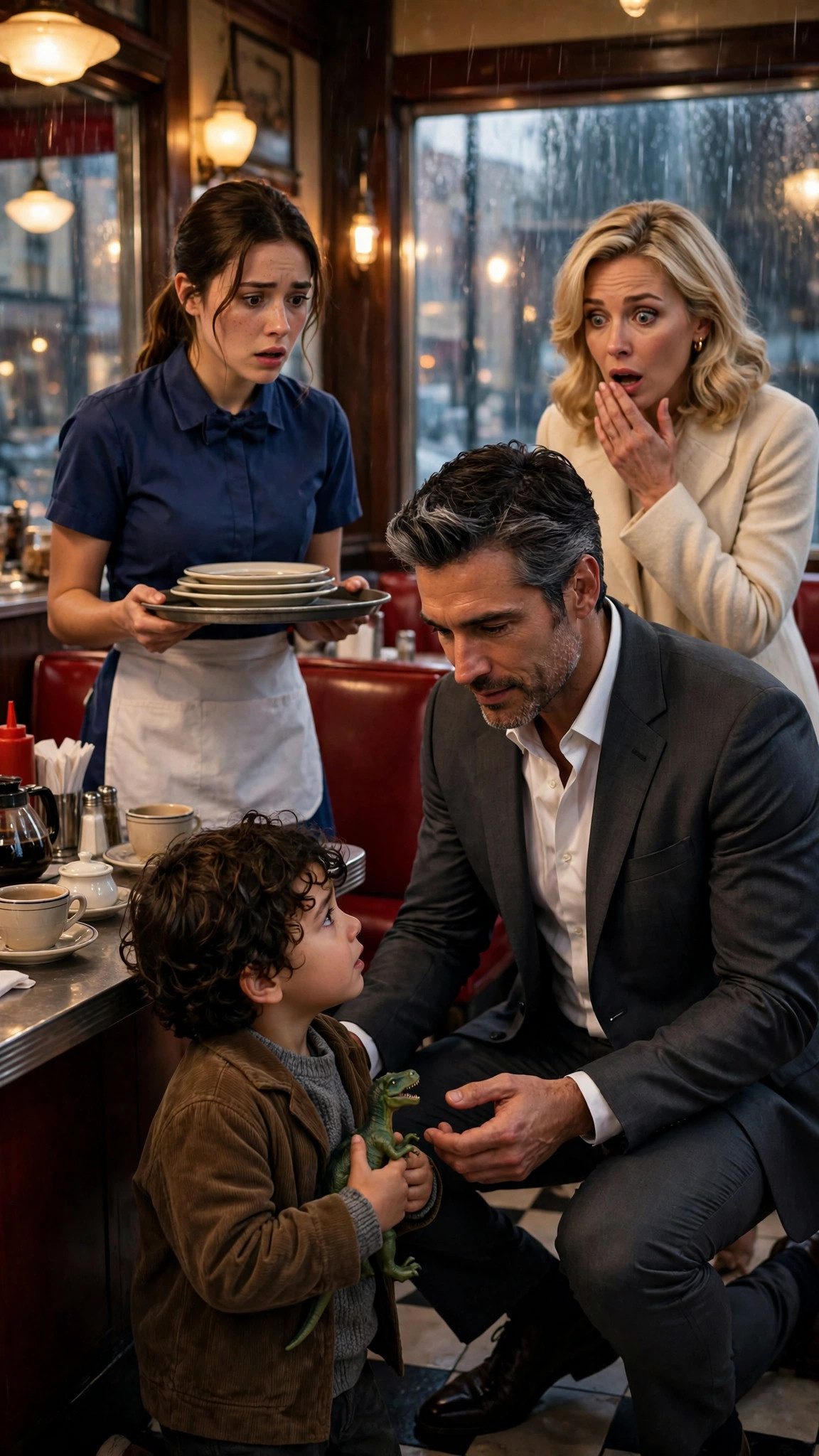
Matthew knelt down, the way he had knelt in the diner that rainy afternoon, and he put his hands on Leo's shoulders, and he said, "Yes, son. Let's go home."
We drove home that night — to our home, the house on the hill, only now the gate stayed open, and the guards were gone, and the cameras had been taken down, and the garden was full of white roses, and the windows were lit warm and gold. Leo fell asleep in the back seat with Rex in his arms, and I sat beside Matthew, and I held his hand, and I watched the road unwind in front of us, and I thought about the card he had left on the counter at the diner, with a phone number written in black ink, and the words he had said when he set it down.
"When you're ready. Not before. When you're ready."
I had been ready. I just hadn't known it yet.
That night, after Leo was asleep in his new room — a room with a bed shaped like a race car and a shelf full of dinosaur books and a window that looked out over the garden — Matthew and I stood on the terrace, under the stars, and he put his arms around me, and I leaned back against him, and we listened to the quiet.
"Do you ever think about Millbrook?" he asked.
"Every day," I said. "I think about Rosie, and the diner, and the small apartment, and the mornings I walked Leo to school. I think about the life I built there. It was a good life, Matthew. A small life, but a good one."
"It was a hiding place," he said gently. "And you don't need to hide anymore."
"No," I said. "I don't."
He kissed the top of my head. "Then stay," he whispered. "Stay, and find out."
I turned in his arms and looked up at him — at the sharp cheekbones, the steel-grey eyes, the dark hair greying at the temples, the face I had loved for six years and run from for six years and finally, finally come home to — and I said the words I had not said in six years, not to anyone, not even to myself.
"I'm home, Matthew," I said. "I'm home. And I'm not running anymore."
One year later, on a warm afternoon in June, Leo started first grade.
He walked into his new school with his blue backpack — the same one, with the zipper I had finally replaced — and his lunchbox, and his hair combed flat with water, and he turned at the gate and waved at us, and then he ran inside without looking back. Matthew put his arm around me, and we stood there for a moment, watching the door close behind him, the way parents do.
"He's brave," Matthew said.
"He's a lion," I said. "That's what his name means."
That same summer, I opened a small library in Millbrook — not a big one, just a room above the hardware store, with donated books and a painted sign that said "Leo's Library" in bright blue letters. Rosie helped me paint the shelves. Leo helped me sort the books, mostly by color, which made no sense at all and was exactly right. On the first day, eleven children came. By the end of the month, there were forty. I read to them on Saturday mornings, the way I used to read to Leo, and I watched their faces light up, and I thought about the librarian I used to be, before the big house and the guards and the six years of running, and I realized she had never really gone away. She had only been waiting for me to come home.
Matthew learned to ride a bicycle that summer, too — or rather, Leo taught him, in the driveway of our house, with a great deal of patience and a great deal of shouting. "Pedal, Daddy! Pedal! Don't look down! Look where you're going!" Matthew fell off twice, and Leo laughed so hard he nearly fell off his own bike, and by the end of the afternoon, Matthew was riding in circles around the garden, wobbling and triumphant, while Leo cheered from the grass.
On our first anniversary — one year after the garden wedding, one year after the white roses and the veil and Leo's toast — Matthew took me to dinner at a small restaurant in town, and he ordered my favorite food, and he remembered that I take my coffee with one sugar and no milk, and he danced with me in the parking lot afterward, under the streetlights, while nobody watched and nobody cared.
"I have something to tell you," I said, as we swayed in the empty parking lot, under the stars.
"What is it?" he asked.
I took his hand and placed it very gently on my stomach, and I watched his face change — the same way it had changed in the diner, a year ago, when he saw Leo for the first time. Not anger. Not surprise. Recognition. Joy.
"Are you—" he started.
"Eight weeks," I said. "I found out this morning. I was going to tell you tonight, over dinner, with candles. But the parking lot seemed better."
He laughed then — a real laugh, sudden and unguarded, the kind of laugh that changed his whole face — and he picked me up and spun me around, right there in the parking lot, under the streetlights, while I laughed too, and the whole world spun with us.
"Leo is going to be a big brother," Matthew whispered, setting me down gently, his hands still on my waist. "Rex is going to be an uncle."
"Rex is going to be thrilled," I said.
That night, we told Leo together, sitting on his bed with Rex between us, and Leo thought about it very seriously for a long moment, and then he said, "Can the baby have my old dinosaur pajamas? The ones that are too small for me now?"
"Yes, baby," I said. "The baby can have your pajamas."
"Good," Leo said, satisfied. "And can the baby be a girl? Girls are good at reading. I can teach her."
"We'll see, baby," Matthew said, laughing. "We'll see."
Six years. Six years to come home.
It had taken six years, a rainy afternoon, a little boy with a green dinosaur, and a question whispered in a diner full of strangers.
"Are you my daddy?"
Yes, baby. Yes, he is.
And he is home now. We all are.
The End.
THE END