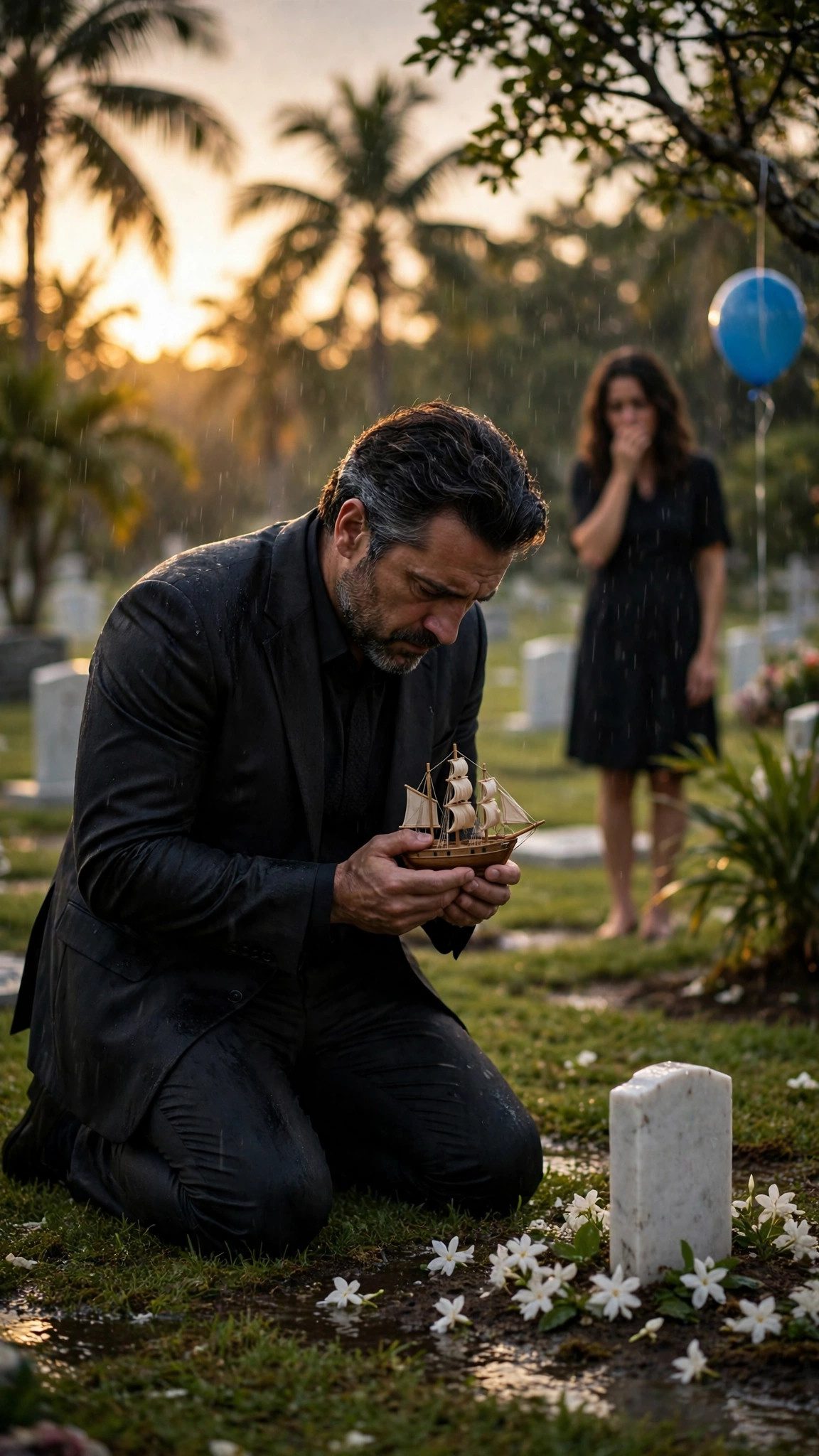
I met Damian Moretti in the emergency room of Jackson Memorial Hospital, on a Tuesday night in October, when his younger brother Matteo was brought in with a gunshot wound to the shoulder and a joke on his lips.
I was a pediatric nurse. I had been a pediatric nurse for six years, and I had chosen that work on purpose, because children are honest in a way adults never are, and because a child's hand in yours is the most truthful thing in the world. I worked the night shift in the children's ward, but that Tuesday I had been pulled down to the ER to cover for a colleague, and I was standing at the nurses' station, trying to read a chart under fluorescent lights that made everything look slightly unreal, when the doors crashed open and they wheeled Matteo in.
He was twenty-nine then, all dark hair and easy charm, bleeding through a white shirt and grinning like a man who had just won a bet. Behind the gurney came his brother.
Damian Moretti was forty years old that night, and I knew who he was before anyone said his name. Everyone in Miami knew who he was. He was the head of the most powerful family in the city, a man whose name made waiters stand straighter and made grown men lower their voices. He was tall, broad-shouldered, with dark hair going gray at the temples and cold gray eyes that seemed to take in the entire room in a single glance and find it wanting.
He looked at me, and for one second, the whole emergency room went quiet.
"Is he going to be all right?" he asked. His voice was low and calm, the voice of a man who had given a thousand orders and expected every one of them to be obeyed.
"He's stable," I said. "The bullet went through the muscle. No major vessels. He'll need surgery, but he'll be fine."
"You're sure."
"I am sure," I said, and I met his eyes, because I had learned a long time ago that you do not look away from frightened men, even powerful ones, especially powerful ones. "He is going to be fine. You can sit with him when he wakes up."
He nodded once, and then he did something I did not expect. He said, "Thank you, Nurse…?"
"Claire," I said. "Claire Bennett."
"Thank you, Claire."
He stayed all night. That was the first thing I learned about Damian Moretti: when something mattered to him, he was there. He sat in the waiting room in his charcoal suit, refusing coffee, refusing to leave, his phone buzzing constantly in his pocket, and every time it buzzed he looked at it and put it away without answering. Matteo woke up at four in the morning, groggy and in pain, and Damian was at his bedside before the nurse could even call him, holding his brother's hand.
"He's awake," I told him, and Damian looked up at me, and his eyes were not cold anymore. They were wet.
"I owe you," he said.
"You don't owe me anything," I said. "I did my job."
Three days later, he sent flowers to the nurses' station. Not roses. White lilies, because he had asked someone what I liked, and I had once told a colleague that lilies were the only flowers that smelled like clean air. There was a card, written in a strong, slanting hand.
"Thank you for my brother. Dinner, if you will allow it. — D.M."
I almost threw the card away. I knew who he was. I knew what he was. I had grown up in Miami, and I had heard the stories at every family gathering, whispered over coffee: the Morettis, the docks, the men who disappeared, the money that moved in the dark. My father had been a police officer, a good one, and he had taught me to stay far away from men like Damian Moretti.
But my father had also been dead for three years, and I was twenty-nine years old, and tired of being careful, and there was something in the way Damian had sat in that waiting room all night, refusing to leave his brother, that would not leave me alone.
I went to dinner.
He took me to a small restaurant in Coral Gables, not one of the grand places with chandeliers and men in tuxedos, but a quiet family place with checkered tablecloths and a woman in the kitchen who called him "Damiano" and kissed his cheek like he was her own son. He ordered for both of us in Italian, and he asked me about my work, and he listened. Really listened, in a way I had never seen a man listen before, leaning forward, his gray eyes fixed on my face, asking questions about the children in my ward, about the little boy with leukemia who had taught me to play chess, about the girl with the broken arm who had been brave enough to make the nurses laugh.
"Why children?" he asked.
"Because they don't pretend," I said. "A child either trusts you or he doesn't, and you can see it in his face. Adults spend their whole lives learning to hide. Children haven't learned yet."
He was quiet for a long time. Then he said, "My mother died when I was twelve. She was the only honest person I ever knew. After her, everyone wanted something from me. Everyone except Matteo." He looked down at his hands. "You remind me of her. Not your face. Your… clarity. You see things the way they are."
That was the beginning. He courted me the way men in his world court women, I suppose: with flowers and quiet dinners and a patience I did not expect. But he also courted me the way no one ever had: he came to the hospital to pick me up after my shifts, sitting in his black car outside the emergency entrance at three in the morning, reading a book, waiting. He learned the names of my patients. He brought toys to the children's ward, not expensive ones, but the right ones — a stuffed elephant for a boy who was afraid of the dark, a set of colored pencils for a girl who missed her mother.
Six months later, he asked me to marry him. We were walking on South Beach at dawn, the sky turning pink over the water, and he stopped, and he took both my hands, and he said, "Claire, I have spent my whole life building an empire out of fear. I want to build something else with you. Something clean. Will you marry me?"
I said yes. I said yes because I loved him, and because I believed that love could be stronger than the life he had been born into, and because I was twenty-nine and foolish enough to think that a man could outrun his own name.
Our wedding was small, by Moretti standards. Fifty people in a church in Coral Gables, my mother crying in the front row, Matteo standing as best man with his arm still stiff from the surgery. Damian cried when I walked down the aisle, and I had never seen him cry before, and I thought, this man will be a wonderful father. A man who cries at his own wedding will not be afraid to love his children.
For the first year of our marriage, he was everything he had promised to be. He came home for dinner almost every night. He called me from the car on his way home. He asked about my day, and he told me about his, in careful, edited pieces, the way a man in his world tells his wife about his work. I did not ask questions I did not want answered. That was our arrangement, unspoken but clear: I would not ask about the business, and he would always come home.
Then, in October, two years after we married, I told him I was pregnant.
He was sitting at the kitchen table, reading the newspaper, when I put the little white test stick down beside his coffee cup. He stared at it for a long time, and then he looked up at me, and his face did something I had never seen before. It broke open. All the coldness, all the control, all the careful power, just fell away, and underneath it was a boy of twelve who had lost his mother and had just been told he was going to be a father.
"A baby," he whispered. "Our baby."
He stood up so fast his chair fell over, and he lifted me off my feet, spinning me around in the kitchen, laughing, and I laughed too, and Rosa, who was making breakfast, clapped her hands and cried, and for a moment, everything in the world was perfect.
The pregnancy was not easy. I was sick for four months, so sick I could barely keep water down, and Damian was there for all of it. He held my hair back. He brought me crackers at three in the morning. He read every book about pregnancy he could find, underlining passages about what to eat and what to avoid, and he argued with my doctor about my vitamin levels like a man negotiating a treaty.
He talked to my belly. Every night, he would put his hand on my stomach, and he would say, "Hello, little one. This is your daddy. I am going to be there for everything. Your first laugh. Your first tooth. Your first steps. Daddy won't miss a thing."
I believed him. God help me, I believed him, because he said it with such conviction, with such tenderness, that it never occurred to me that a man could mean something so completely and still fail to do it.
Noah was born on February 14, at 6:18 in the morning, after nine hours of labor. He weighed just 3.1 kilograms, small and perfect, with dark curls already on his head and his father's gray eyes and my smile.
Damian stood beside me through all nine hours. He held my hand until his own fingers went numb. He wiped my forehead with a cool cloth. He whispered to me, "You are the bravest person I have ever known," and when the nurse placed Noah in his arms, he cried.
Not the quiet tears of a man trying to hold himself together. Great, shaking sobs, the kind that come from somewhere deep and unguarded. He held our son against his chest, and he looked down at that tiny face, and he whispered, "Daddy won't miss a thing."
I believed him. I believed him with my whole heart, because in that moment, he believed it too.
For the first month, Damian came home almost every night. He changed diapers, badly at first, and then with a concentration that made me laugh. He walked the floor with Noah at two in the morning, singing him an old Neapolitan lullaby his mother had sung to him, off-key and beautiful. He took a thousand photographs. He called me from work just to hear Noah cry in the background.
The second month, he came home less often. There were meetings in New York. A problem at the docks. A shipment that needed his personal attention. He called, but the calls got shorter. He sent flowers instead of coming home. He sent a diamond necklace for our anniversary, and I wore it to dinner alone.
By the third month, Sofia Bellini appeared.
She was thirty-one. The daughter of Henri Bellini, the head of a powerful Marseille family. Beautiful in the way of women who have never once doubted that the world was made for them: blonde, elegant, with dark eyes and a laugh that carried across rooms.
Damian claimed their meetings were necessary to maintain peace between their organizations. He said it the way he said everything about business: calmly, reasonably, as if it were a fact of nature and not a choice.
"She's the Bellini heir, Claire. Her father controls the Marseille docks. If we don't keep that alliance warm, there will be a war, and wars get people killed. You understand that, don't you?"
I understood that my husband was asking me to understand why he needed to have dinner with another woman. I understood it, and I hated that I understood it.
Then business meetings became dinners. Dinners became weekends. Geneva. Monaco. Paris. Saint-Tropez.
And I became the mother who recorded her son's childhood for a father who was always somewhere else.
I did not confront him, not at first. I told myself it was business. I told myself the alliance mattered. I told myself that a man like Damian could not simply walk away from a table where peace was being negotiated. I told myself all the things a wife tells herself when she is afraid of what she will find if she looks too closely.
But late at night, when Noah was asleep in his crib and the house was quiet, I would stand at the window and look out at the dark street, and I would think about the man who had sat in a hospital waiting room all night for his brother, and I would wonder where that man had gone.
And then one night, when Noah was three months old, I picked up my phone, and I pressed record, and I filmed him laughing for the first time, a real, bubbling, delighted laugh, and I sent it to Damian with shaking hands, because I thought, surely, surely this will bring him home.
That was video number 223.
It did not bring him home. Nothing ever did, after that.
But I kept recording. I kept recording because somebody had to remember. Somebody had to be there. And if Damian would not be the one who was there, then I would be the one who made sure there was a record, so that one day, when Noah was old enough to ask where his father had been, I could show him.
I did not know then that there would be no one day. I did not know that 1,907 videos would be the whole of my son's life.
I only knew that my husband had promised he would not miss a thing, and that he was missing everything, one video at a time.