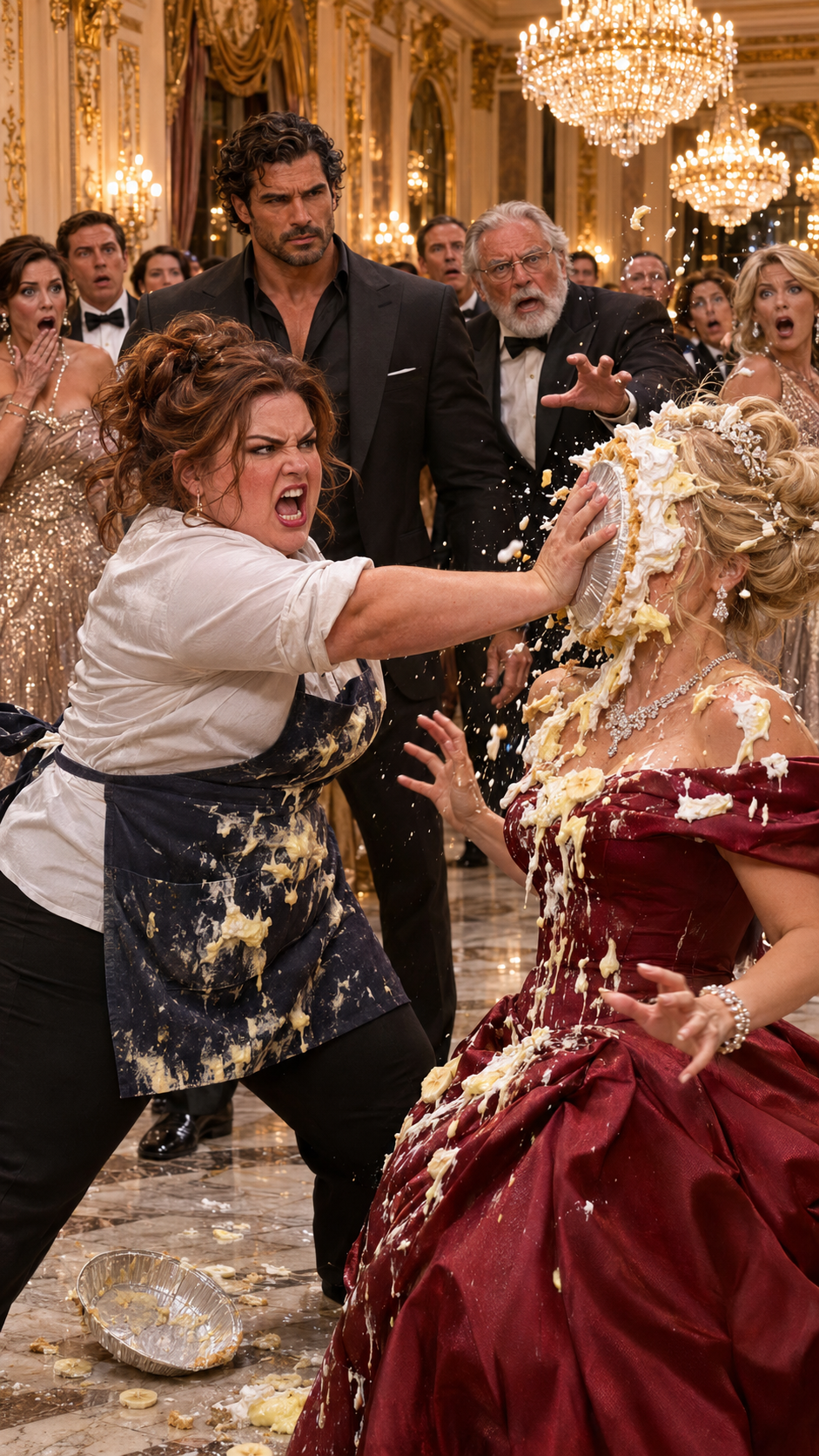
"Perhaps someone should remind the bakery girl that this is a charity gala, not a place for people like her to parade around."
Serena Vance's voice carried across the magnificent Pfister Ballroom.
Conversations stopped.
A waiter froze beside a table of champagne glasses. Two women in evening gowns exchanged uncomfortable glances. Near the enormous windows, an elderly gentleman with silver hair and a white beard reached forward in disbelief, his expensive black suit catching the light from the crystal chandeliers.
Rose Kowalic stood beside the dessert table.
Her white blouse had its sleeves rolled to her elbows. Her black pants were practical rather than fashionable, and her dark navy bakery apron was stained with banana cream from the thirty-six pies she had personally helped prepare.
Her chestnut-brown hair was loosely pinned into a messy updo.
She looked tired.
She also looked furious.
Serena, meanwhile, looked as though she had stepped out of a luxury magazine. Her burgundy satin gown hugged her elegant silhouette, and a magnificent diamond necklace rested against her collarbone.
She lifted her champagne glass.
"Honestly, Roz. You should be grateful we invited you. It's not every day someone from a little neighborhood bakery gets to stand beneath chandeliers like these."
Roz said nothing.
Serena smiled.
"Although I suppose you probably feel more comfortable around ovens than people."
A few guests shifted uncomfortably.
"That's enough," Roz said quietly.
Serena tilted her head.
"What was that?"
"I said that's enough."
"Oh, darling. Don't become sensitive. We all know you have a problem with people commenting on your appearance."
Roz looked at her.
For eight years, she had swallowed insults from this woman.
For eight years, Serena had walked into her bakery, smiled at customers, and found some new way to humiliate the woman who owned it.
And now, in front of hundreds of people, Serena was doing it again.
"Perhaps you should consider ordering two portions of everything," Serena continued. "You know, just in case the first one disappears."
A man near the head table muttered, "That's enough."
Serena ignored him.
"Really, Roz. Some people have no sense of presentation. Imagine wearing an apron to an event like this."
Roz looked down at the banana cream pie on the table.
Then she looked back at Serena.
Something inside her finally settled.
Not anger.
Not embarrassment.
A decision.
"Call me fat again."
Serena laughed.
"What?"
"Go ahead. Call me fat again."
Serena opened her mouth.
Roz picked up the banana cream pie.
And before the socialite could finish her next cruel sentence, Roz thrust it directly into Serena's face.
The pie exploded across the burgundy satin gown.
Banana cream covered Serena's cheeks, her perfectly styled hair, and the expensive diamond necklace around her neck.
For one magnificent second, the entire ballroom went silent.
Then the aluminum pie tin slipped from Roz's fingers.
It struck the polished marble floor with a sharp metallic clatter and spun beneath the dessert table.
Serena stood motionless.
Her mascara began running.
A small piece of banana slid down her chin.
Arthur Whitmore stared with his mouth open.
Somewhere behind him, a champagne glass shattered.
Serena slowly wiped cream from her eyes.
"You'll pay for this."
Three men in black suits moved immediately.
They weren't ordinary hotel security.
They belonged to Luca Benedetti.
One reached for Roz's arm.
Another stepped between the dessert table and the ballroom entrance.
Then a low voice cut through the commotion.
"Stop."
Luca Benedetti stood at the far end of the ballroom.
Forty years old, tall and muscular, he wore a perfectly tailored black luxury suit over an open-collar black shirt. His thick curly black hair framed a defined jawline, and short rugged stubble sharpened the severity of his expression.
His dark eyes moved from Serena to Roz.
He didn't raise his voice.
He didn't need to.
The guards stopped.
Luca began walking toward them.
"Who touched her?"
Nobody answered.
Then an elderly woman stepped forward.
Carmela Benedetti, eighty-two years old, stood between Roz and the approaching guards.
Her silver hair was arranged neatly, and a string of pearls rested against her elegant dark dress.
Her hands trembled slightly.
Her voice did not.
"She was protecting me."
Luca stopped.
"Nonna?"
Carmela looked at her grandson.
"Tell your men to step away from this woman."
"Grandmother, you were sitting at the head table. What happened?"
"What happened is that this young woman did something I should have done twenty-five years ago."
Serena's expression changed.
For the first time that evening, the socialite looked genuinely frightened.
"Carmela," she whispered. "You don't know what you're saying."
Carmela turned toward her.
"I know exactly what I'm saying."
Luca's eyes narrowed.
He had spent his entire life believing he knew the people closest to him.
He had trusted his grandmother.
He had trusted his uncle.
He had trusted the family history that had been repeated at every holiday dinner, every anniversary, and every memorial service.
But something in Carmela's voice made him question everything.
He looked at Serena.
Then at the elderly woman.
"Then I want the truth."
Carmela closed her eyes.
When she opened them, she looked older than she had a moment earlier.
"First," she whispered, "tell me something."
"What?"
She looked around the ballroom.
"Where is Enzo?"
***
Eight hours earlier, Rose Kowalic had been standing in the kitchen of her bakery, arguing with a delivery driver about a missing box of butter.
"Thirty-six pounds," she said, checking the invoice. "Not thirty. Thirty-six."
The driver scratched his head.
"Maybe the warehouse shorted you."
"The warehouse has shorted me three times this month."
"Then you should call them."
"I have. They stopped answering."
Behind her, Mia Collins laughed.
Mia was twenty-four, energetic, and had been working at the bakery for almost two years. She considered Roz both her employer and the older sister she had never had.
"You know," Mia said, "most people start their mornings with coffee."
"Most people don't run a bakery."
"Most people also don't threaten to send a butter company a handwritten letter."
"It's going to be a very strongly worded letter."
Roz signed the delivery receipt.
The bakery was called Aniela's Oven, a small family business on a quiet Milwaukee street.
Its windows were painted cream. The front counter was old oak, and the smell of cinnamon, vanilla, and fresh bread seemed permanently embedded in the walls.
Roz had inherited the business from her mother, Aniela Kowalic, who had opened it decades earlier.
Aniela was the sort of woman who remembered everyone's birthday and never allowed anyone to leave without eating something.
She had also taught Roz that a good bakery was built on three things.
Patience.
Honesty.
And enough butter.
"Your mother called," Mia said.
Roz glanced toward the stairs.
"She's upstairs?"
"Yes. She said you need to come up before the afternoon delivery."
Roz sighed.
"Did she say why?"
"She said it was important."
"That's never good."
Aniela was sitting at the small kitchen table when Roz climbed the stairs.
At sixty-seven, she still had the posture of a woman who had spent most of her life working beside hot ovens.
Her silver-streaked brown hair was tied in a loose bun.
A cup of tea sat untouched in front of her.
"Sit down," she said.
Roz pulled out a chair.
"What happened?"
Aniela slid a cream-colored envelope across the table.
"The Benedetti Foundation."
Roz opened it.
She read the letter once.
Then again.
"They want thirty-six banana cream pies?"
"Yes."
"For a gala?"
"At the Pfister."
Roz stared at her mother.
"The Pfister Ballroom?"
Aniela nodded.
"That's what the letter says."
Roz examined the attached contract.
The Benedetti Foundation was one of Milwaukee's wealthiest charitable organizations. It funded shelters, food programs, scholarships, and community projects.
Its annual gala was attended by business leaders, politicians, wealthy families, and people whose names appeared regularly in the newspapers.
Roz looked at the payment.
It was generous.
Much more generous than she expected.
"Who contacted us?"
"Serena Vance."
The name landed between them like a stone.
Roz slowly lowered the contract.
"Of course."
Aniela watched her carefully.
"Do you want to decline?"
Roz considered the question.
Serena had been making her life miserable since college.
They had attended the same university.
Roz had studied culinary arts and business management while working part-time to help her mother.
Serena had been the daughter of a wealthy businessman. She had designer clothes, expensive cars, and a talent for making people feel insignificant.
During their second year, Roz had entered a student musical audition.
She had spent weeks preparing a dress herself, using inexpensive fabric and the sewing skills her mother had taught her.
Serena had examined it in the dining hall.
"Is that what you're wearing?"
Roz had smiled nervously.
"I made it."
Serena had laughed.
"It looks like a tablecloth."
Several students had laughed with her.
Later, Serena had stolen Daniel, Roz's boyfriend at the time.
Not because she loved him.
Because she enjoyed proving she could take whatever she wanted.
Daniel had eventually apologized, but by then the damage had been done.
Roz had left college with a broken heart and a determination never to let Serena control her life again.
Eight years ago, when Roz opened the bakery, Serena discovered the address.
She began appearing occasionally.
Sometimes she purchased pastries.
Sometimes she brought friends.
Sometimes she simply stood at the counter and made comments about Roz's clothes, her business, or her appearance.
Once, she had told a customer that the woman behind the counter was probably the last person who should be selling cakes.
Roz had endured it.
Not because Serena deserved her patience.
Because Roz had customers to serve and a business to protect.
Now Serena wanted thirty-six pies.
"She probably chose us because she thinks she can humiliate me in front of everyone," Roz said.
Aniela folded her hands.
"Then don't let her."
Roz looked at the contract.
"The money would help us repair the ovens."
"It would."
"And Mia could finally get the hours she wants."
"It would."
Roz picked up the pen.
"Then we'll make the pies."
Aniela smiled faintly.
"That's my girl."
But when Roz signed the contract, her mother didn't smile anymore.
She was staring at the foundation's letterhead.
Specifically, at the name Benedetti.
***
That evening, the kitchen became a production line.
Mia prepared the crusts.
Roz made the custard.
Aniela supervised the cream, insisting that nobody was allowed to use shortcuts.
"Banana cream pie is simple," Aniela explained. "But simple things reveal whether someone knows what they're doing."
Mia looked at the enormous mixing bowl.
"How many bananas?"
"Enough."
"That's not a measurement."
"It's the correct measurement."
Roz laughed.
For several hours, the bakery felt peaceful.
Then Serena called.
Roz answered on speakerphone while washing a mixing bowl.
"Hello?"
"Rose."
Serena's voice was smooth and polished.
"Hello, Serena."
"I wanted to confirm that the pies will be delivered by six."
"Yes."
"And I expect them to look presentable."
"They will."
"Good. I would hate for the foundation's guests to think we hired some amateur operation."
Mia rolled her eyes.
Roz ignored her.
"We've been operating for decades."
"Yes, yes. Your mother started it. Very charming."
Roz dried her hands.
"Is there anything else?"
"Actually, I have one request."
"What?"
"Please wear something appropriate when you deliver them. The event is formal."
"I'll wear what I normally wear when I work."
There was a pause.
"Of course you will."
Serena ended the call.
Mia stared at the phone.
"I don't understand how people like her exist."
Roz returned to the mixing bowl.
"Some people are raised to believe money gives them permission to be cruel."
Aniela looked at her daughter.
"And some people spend their entire lives learning that it doesn't."
***
At six that evening, Roz arrived at the Pfister Hotel with Mia and the carefully packed pies.
The ballroom was breathtaking.
Enormous crystal chandeliers hung above cream-and-gold Baroque walls. Towering windows overlooked Milwaukee's evening skyline, while white floral arrangements decorated the banquet tables.
The polished marble floors reflected the lights.
David Foster, the hotel coordinator, met them near the service entrance.
"Ms. Kowalic?"
"Yes."
"Wonderful. We have been expecting you."
He inspected the pies.
"Thirty-six?"
"All thirty-six."
"Excellent. Serena Vance has been asking about them all afternoon."
Roz almost laughed.
"I can imagine."
David led them toward the dessert area.
As they worked, Roz noticed an elderly gentleman examining the room.
He had silver hair, a white beard, and expensive glasses.
David introduced him as Arthur Whitmore, a retired judge and longtime friend of the Benedetti family.
"Your mother is Aniela?" Arthur asked when he saw Roz's name tag.
"Yes."
His expression changed.
"Aniela Kowalic?"
"That's right."
He looked at her for a long moment.
"Good heavens."
"Have we met?"
Arthur seemed about to answer.
Then someone called his name from across the ballroom.
He turned away.
Roz returned to arranging the pies.
A few minutes later, Serena appeared.
Her burgundy satin gown was immaculate. Her diamond necklace sparkled beneath the chandeliers.
She looked over the dessert table.
"Well. At least the pies look decent."
"Thank you," Roz replied.
Serena examined Roz's navy apron.
"You really couldn't find anything better to wear?"
"I came to deliver pies."
"Of course."
Serena moved closer.
"Remember, tonight is important. Don't embarrass me."
Roz looked at her.
"You're the one who hired me."
Serena smiled without warmth.
"Yes. And sometimes I wonder why."
The first guests began arriving.
Roz had finished her work and was preparing to leave when she noticed an elderly woman sitting alone near the head table.
Carmela Benedetti.
Her face was familiar from newspaper photographs.
Carmela had founded several charitable programs alongside her late husband. Everyone spoke about her with affection and respect.
Roz approached.
"Would you like some water, ma'am?"
Carmela looked up.
For a moment, her eyes seemed to search Roz's face.
Then she noticed the silver bracelet on Roz's wrist.
It had a delicate rose design.
Carmela's fingers tightened around her glass.
"Where did you get that?"
Roz glanced down.
"My mother gave it to me."
"Your mother?"
"Aniela Kowalic."
Carmela went completely still.
Before she could speak, Serena appeared behind Roz.
"Oh, Carmela. I see you've found our baker."
The elderly woman turned.
Her expression hardened.
Serena leaned closer.
"Perhaps you should let the staff handle the desserts. It's not very comfortable having everyone standing around the head table."
Carmela looked at her.
"I invited her to stand here."
Serena smiled.
"Of course."
The next few minutes unfolded exactly as they had in the ballroom.
The insults.
The humiliation.
The pie.
And the silence afterward.
Now, as Luca stood before his grandmother, Roz finally understood that the pie had not been the only thing that had exploded that evening.
Something much older had just broken open.
Carmela looked at her grandson.
"Where is Enzo?"
Luca's expression became unreadable.
"My uncle was supposed to be here."
"Was?"
"He left before the speeches."
Carmela gripped her pearl necklace.
"Then he knows."
"Knows what?"
Her eyes filled with tears.
"That after twenty-five years, the woman who has been protecting his secret is finally ready to speak."
Luca stared at her.
"Grandmother, what secret?"
Carmela looked at Roz.
Then she whispered a name.
"Matteo."
Luca's face changed.
His father had been dead for twenty-five years.
And for the first time in his life, Carmela looked as though she was about to tell him why.