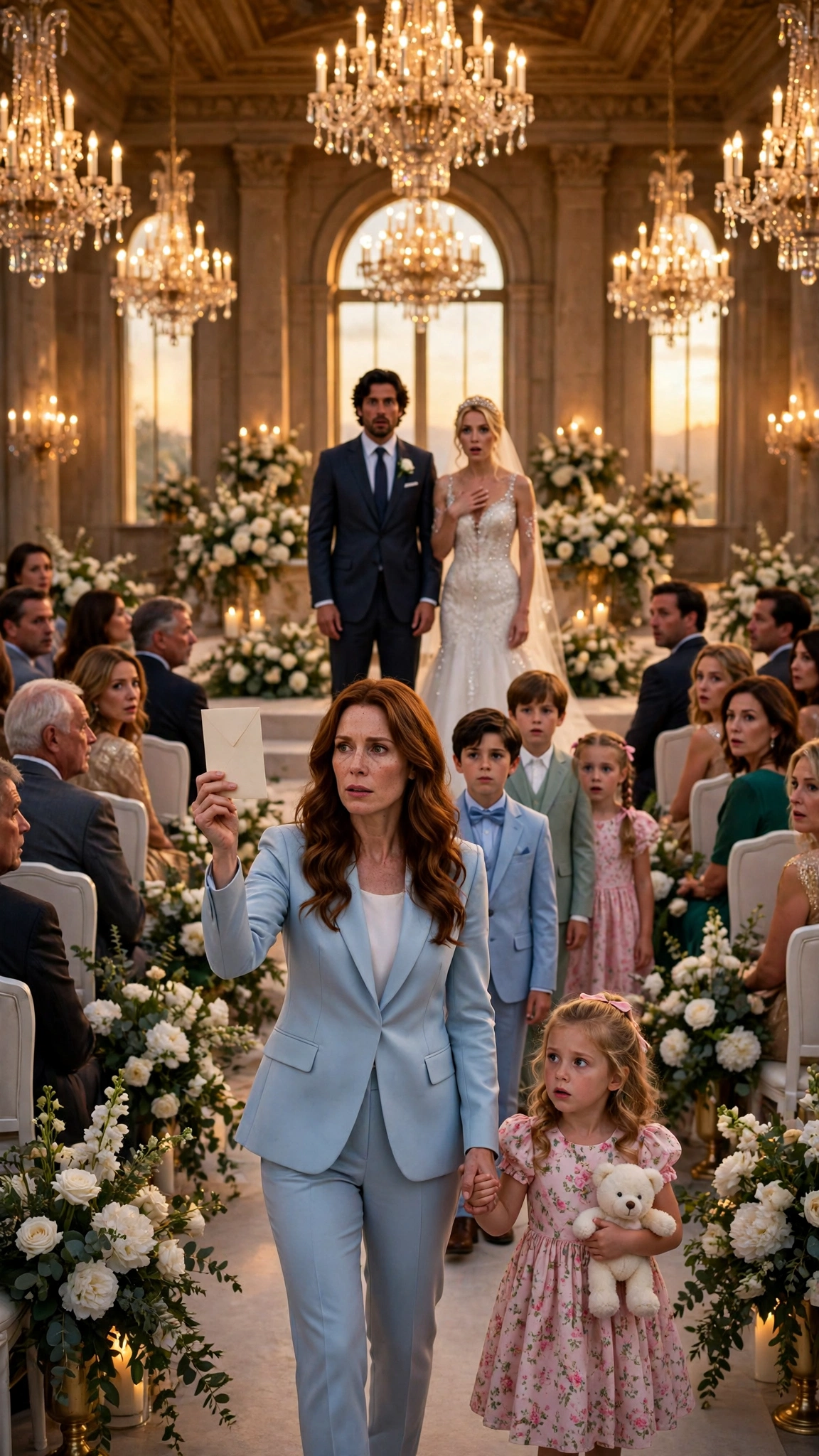
The doors of the grand wedding hall swung open, and every head turned.
Evelyn Hart stood in the doorway with her hand wrapped around her daughter's small fingers, and for one long second the whole glittering room seemed to hold its breath. Golden light poured through the tall windows and fell across the white chairs, the crystal chandeliers, the banks of white roses. At the far end, beneath an arch of white flowers, Dominic Castellano waited at the altar in a dark navy suit with a navy tie and a white rose in his buttonhole — and the color drained from his face the moment he saw her.
She had not been invited. Everyone in the room knew it.
Evelyn walked forward. Her light blue tailored suit was immaculate, her white silk blouse crisp, her cream satin scarf knotted at her throat. Her long auburn wavy hair fell over her shoulders, and her face was calm — so calm that it frightened her more than tears would have. Her small black handbag hung from her arm. Behind her, in a neat line, walked four small children with near-identical faces: Noah in a light blue suit with a bow tie, Leo in a sage-green suit, Mia in a pink dress with a white collar, and Layla — the eldest by three minutes — in a pink floral dress, clutching a small white teddy bear to her chest.
Layla walked beside her mother, her light-brown wavy hair loose around her shoulders, her large fawn eyes wide. She looked up at her mother and whispered, "Mommy, I'm scared."
Evelyn squeezed her daughter's hand. "Hold my hand, baby," she whispered back. "Just hold my hand. Whatever happens, hold my hand."
She kept walking, all the way down the aisle, until she stood in the center of the hall with two hundred guests staring at her in stunned silence, and Dominic frozen at the altar, and the bride — young, beautiful, bewildered in her white gown — standing beside him with her bouquet shaking in her hands.
Dominic took a step toward her. His voice, when it came, was rough with disbelief. "Evelyn, what are you doing here? Who are these children?"
Evelyn lifted her chin. She reached into her handbag and took out the cream envelope, and she held it up for the whole room to see. "Your wedding gift," she said.
Dominic stared at the envelope. He came down from the altar, slowly, like a man walking toward his own execution, and he took it from her hand. His fingers shook as he opened it. The paper inside was thick and official, stamped and signed. He read the first page. He read the second. The color drained from his face. His knees buckled, and he caught himself on the back of a chair.
"They're mine?" he whispered. He looked at the children — at Layla's large fawn eyes, at Noah's watchful face, at Mia clinging to her sister's hand, at Leo standing small and brave — and he looked at Evelyn, and for the first time in five years, he saw her. Really saw her.
Then his gaze moved past her, to the altar. To the bride. To Vanessa.
"Vanessa," he said, and his voice had changed — it was quiet now, and terrible in its quietness. "Vanessa, why are you afraid? What haven't you told me?"
The bride's bouquet trembled in her hands. A white rose slipped from it and fell, soundlessly, onto the marble. Her face had gone white beneath her veil. And in that moment, Evelyn understood that the story she had come to tell was not the only story in the room — and that the woman at the altar was hiding one of her own.
It had taken her five years to learn how to walk into a room like this without breaking. It had taken her five years to understand that the story everyone believed about her was a lie — and that the only way to kill a lie was to walk into the room where it had been born and speak the truth out loud, in front of everyone.
But the story did not begin in a wedding hall. It began on a summer night, six years earlier, on a rooftop in Queens, with a boy she had loved since she was seventeen and a sky full of stars that neither of them knew would be the last they would share for a very long time.
—
Evelyn had met Lucas Papadopoulos when she was seventeen and he was eighteen, in the kitchen of a neighbor's house during a birthday party that neither of them had wanted to attend. He was tall and lean even then, with short black hair and warm brown eyes, and he had spent the entire evening hiding by the refrigerator, eating cake straight from the box with a fork. She had laughed at him, and he had offered her the fork, and that was the beginning of everything.
They grew up together in the way that only people who have known each other since childhood can. Lucas went to architecture school. Evelyn went to work for a small gallery in Manhattan, selling paintings she could never afford. They were poor and happy and certain — the way young people are certain — that the world would make room for them.
In the spring of the year Evelyn turned twenty-nine, Lucas won the commission of his life: a museum in Milan, a project that would put his name on the map. The firm wanted him there for six months. He would come home for Christmas, he said. He would write every day. They celebrated on the rooftop of his building with cheap champagne and a sky full of stars, and he held her hand and told her that when he came back, they would get married.
"I'll write to you every day," he said.
"Every day," she agreed.
He left on a Tuesday morning in June. She stood at the airport until his plane was a speck in the sky, and then she went home and waited for the first letter.
It never came.
She wrote to him — ten letters, then twenty, then thirty. She called his office in Milan and was told, politely, that Mr. Papadopoulos was very busy, that he was traveling, that he would call back. He never called back. By September, she understood what she was supposed to understand: he had left her. He had gone to Milan and found a new life, and she was a girl he had outgrown.
What she did not know — what she would not learn for five years — was that Lucas had written to her every single day. His letters had been taken from the mail room of her building by a man paid in cash by Gabriel Castellano, and locked in a drawer in Gabriel's office, where they gathered dust like evidence in a crime that no one had yet named.
Gabriel Castellano had known Evelyn since she was a girl. He was Dominic Castellano's cousin, the second son of a second branch of the family, a man with slicked-back silver hair and cold calculating eyes who had spent his whole life standing one step behind Dominic and hating it. He had watched Dominic build an empire. He had watched Dominic's first wife die young. And he had decided, long before Evelyn ever met Dominic, that the Castellano fortune would one day be his — if only Dominic could be kept childless, distracted, and alone.
When Lucas left for Milan, Gabriel saw his chance. A heartbroken girl, alone in the city, with no family and no money, was easy to steer. All it took was a few quiet words in the right ears: a gallery owner who suddenly had no work for her, a landlord who suddenly needed the apartment, a friend who mentioned, casually, that a very rich man named Dominic Castellano was looking for someone to run his charitable foundation.
Dominic was thirty-two then, a widower of three years, tall and muscular, with thick dark wavy hair and piercing gray eyes that made strong men look away. He was the kind of man who filled a room without trying. When he met Evelyn at a charity gala — she was serving drinks, because the gallery had let her go and she needed the work — he asked her to dance, and she said yes because she was tired and sad and he was kind.
He courted her the way a man like Dominic courts a woman: with flowers every morning, with dinners in quiet restaurants, with long conversations in which he listened more than he spoke. He told her about his late wife. He told her about his father, Ambrose, a stern old man with white hair and piercing dark eyes who ran the family like a general. He told her he had always wanted children and had never had them.
Evelyn did not love him — not then, not the way she had loved Lucas. But she liked him. She respected him. And she was tired of being alone in a city that had taken everything from her. When he proposed, three months after they met, on a terrace overlooking Central Park with a ring the size of a small moon, she said yes. She told herself that love could grow. She told herself that Lucas was gone and Dominic was here, and that was enough.
She did not know she was pregnant.
She had not known on the night Lucas left — the last night they spent together on that rooftop, the night he held her and promised to come back. She did not know until a month after her wedding to Dominic, when the nausea started and the doctor smiled and said, "Congratulations, Mrs. Castellano. You're going to be a mother."
Evelyn sat in the doctor's office with her hands folded in her lap and did the math, and the math told her the truth: the baby had been conceived before her wedding. Before she had ever met Dominic. The baby was Lucas's.
She went home that night and stood in the doorway of the bedroom she shared with her new husband, and she looked at Dominic — kind, powerful, proud Dominic, who had told her he had always wanted children — and she could not say the words. She was afraid. She was afraid he would leave her. She was afraid he would hate the child. She was afraid of being alone again, of losing the roof over her head and the ring on her finger and the only security she had ever known. So she said nothing. She smiled. She told him the baby was his, and she let him believe it, and she told herself that the lie would not matter, because love was love, and Dominic would love the baby no matter what.
It was the worst mistake of her life. Not because Dominic would not have understood — he might have, and she would never know — but because a lie, once told, belongs to everyone who hears it. And there was one man in the Castellano family who was listening very carefully.
The pregnancy was not easy. By the fourth month, the doctors were using a word Evelyn had never expected to hear: quadruplets. Four babies. Four heartbeats on the monitor, flickering like small stars. Dominic wept when he heard it. He bought a house in the Hudson Valley with a nursery the size of a ballroom. He hired nurses and nannies. He talked to Evelyn's belly every night, his big hand resting gently on the curve of it, telling his children about the world they would inherit.
Ambrose came to the hospital the night the babies were born. He was sixty then, already white-haired, already stern, but when the nurse placed the first tiny bundle in his arms, something in his face cracked open. He held the baby — Layla, the firstborn, with her father's dark wavy hair already curling at the edges — and he looked at Evelyn, and he looked at the date on the chart, and he did the math. He was an old man who had lived a long life, and he understood numbers. He said nothing. He took out his silver pocket watch — the watch his own father had given him, the watch he wound every morning — and he looked at the time. Three-fourteen in the morning. Then he took a photograph: Evelyn in the hospital bed, pale and exhausted and radiant, holding two of the babies, while beside her stood a young man with short black hair and warm brown eyes, holding the other two.
Lucas had come back. He had heard — from a friend of a friend, through the thin grapevine of people who still remembered them — that Evelyn had given birth to four babies in a hospital upstate. He had flown home that night, walked into the hospital, and found the woman he loved holding his children in her arms.
Evelyn looked at him, and her whole body went cold. "They're Dominic's," she whispered. "Go away, Lucas. Please. They're Dominic's, and you have to go."
He went. He believed her, because he loved her and because she was crying, and because he thought she had chosen a better life. He flew back to Milan the next morning, and he did not come home again for four years.
Ambrose kept the photograph. He put it in his desk, under a stack of papers, and he wound his watch every morning and never told a soul what he knew. His watch stopped that night — the mechanism, worn thin after fifty years, gave out at three-fourteen in the morning, the hour of the children's birth — and he never had it repaired. He kept it in his pocket, silent and still, like the secret it measured.
Evelyn went home to the house in the Hudson Valley with four babies and a husband who loved them all fiercely, and for a little while — for a year, almost two — she was happy. Dominic was a good father. He came home early to bathe the babies. He read them stories in his deep voice. He taught Layla to say his name, and she said it with her whole heart: "Daddy."
And then Gabriel came to Dominic's office one rainy afternoon with a manila envelope in his hand, and the lie that Evelyn had told in fear became the weapon that destroyed her life.