The laboratory was on the third floor of a plain brick building in Brooklyn, above a laundromat, with a sign so small that Evelyn walked past it twice before she found the door. Inside, it smelled of disinfectant and coffee. A woman with tired eyes and a kind face took the swabs from the four children — a quick, painless brush inside each small cheek — and from Lucas, who sat very still and held Layla's hand while the nurse worked.
"How long?" Evelyn asked.
"Two weeks," the nurse said. "Maybe three. And Mrs. Hart —" She paused. "Whoever you use, make sure it's a lab that will stand behind its results in court. There are labs in this city that will write anything for the right price."
Evelyn thought of Gabriel's envelope, with its stamps and signatures and official-looking numbers. "I know," she said.
She paid with money she had saved for six months — money that should have gone to new shoes for the children, to winter coats, to the dentist. Lucas tried to pay. She refused. This was hers to do. She had waited five years to buy the truth, and she would pay for it herself.
The two weeks stretched into three. Evelyn went to work. She came home. She cooked and cleaned and read four children to sleep, and every morning she checked the mailbox, and every morning there was nothing. Lucas came every evening, and they sat at the kitchen table after the children were asleep, and they did not talk about the test, because talking about it made the waiting worse.
On the twenty-third day, the envelope came. It was cream-colored, thick, sealed with wax. Evelyn sat at the kitchen table with Lucas across from her, and her hands shook so badly that he had to open it for her.
She read it once. She read it twice. Then she put her face in her hands and cried — not with grief, but with relief so enormous that it felt like grief, because for five years she had carried a question she had been too afraid to ask, and now she had the answer, printed in black and white, signed by three doctors and a judge's clerk.
The children were Lucas Papadopoulos's. The probability was 99.99 percent. And attached to the report, on a separate page, was a medical statement: based on the children's date of birth, conception had occurred in the first week of June — five years ago. Before her wedding. Before she had ever met Dominic Castellano.
"You're free," Lucas said quietly. "Evelyn, you're free. This proves you never cheated on him. This proves the other report was a lie."
She looked at him across the table, and for the first time in five years, she let herself feel the full weight of what had been done to her. Not just the lie. Not just the divorce. The years. The nights cleaning offices. The babies crying in a room above a bakery. The little girl who had asked her mother why everyone was looking at them — no, that had not happened yet. That was still to come. But the years that had already happened were enough. Someone had stolen five years of her life, and five years of her children's childhood, and she was going to get them back.
"What do we do now?" Lucas asked.
Evelyn folded the report carefully and put it back in its envelope. "We go to the wedding," she said.
Lucas stared at her. "Evelyn —"
"He's marrying her in three weeks," she said. "In the grand hall. Two hundred guests. His father will be there. His whole family will be there. Gabriel will be there." She said the name like a stone dropping into water. "If I send this to a lawyer, it will take a year. If I send it to the newspapers, they'll call it a scandal and forget it in a week. But if I walk into that hall, with the children, in front of everyone who watched him throw me out — then the truth will be heard. And Gabriel will have to answer for it in front of his own family."
"It's dangerous," Lucas said. "Gabriel is not a man who likes to lose. If he knows you're coming—"
"He doesn't know," Evelyn said. "And he won't. Ambrose is the only person I've told, and Ambrose is on our side."
But Gabriel did know. Gabriel always knew.
Gabriel Castellano had built his life on knowing things before other people knew them. He had a man in the laboratory — not the laboratory Evelyn had used, but the laboratory he had used five years ago, the one that had written the forged report. And when Evelyn's test was ordered, when a woman named Hart requested a paternity test for four children with the same birth date, the man in the laboratory made a phone call. He did not know who Evelyn Hart was. But Gabriel did. Gabriel had been waiting five years for her to fight back, and now she was.
He did not panic. Gabriel never panicked. He sat in his office on the fortieth floor of the Castellano building, looking out over Manhattan, and he thought about what to do. He could have the test destroyed — but it was already done, and there would be copies. He could threaten Evelyn — but she had nothing left to lose, and a woman with nothing to lose is the most dangerous person in the world. He could threaten the children — but even Gabriel, for all his coldness, understood that some lines, once crossed, could never be uncrossed.
So he chose a different weapon: doubt. He called Dominic.
"Dominic," he said, in his smoothest voice, "I have some news. Your ex-wife has been asking questions. She's had some kind of test done. I think she's planning to make a scene at the wedding."
Dominic was silent for a long time. When he spoke, his voice was flat. "What kind of test?"
"A DNA test," Gabriel said. "She's going to claim the children are someone else's — some Greek she knew before you. She's going to try to humiliate you, Dominic. In front of two hundred people. In front of Vanessa's family." He paused, and let the silence do its work. "I can stop her. I can have the lawyers send her a letter. I can make sure she doesn't get within a mile of that hall."
Dominic closed his eyes. He thought about the children — about Layla's small hand in his, about the way Noah had looked up at him. He thought about the night he had thrown them out, and the rain, and the sound of the babies crying. And he thought about the report in his desk drawer, the one Gabriel had given him, with its numbers and its stamps.
"No," he said at last. "No lawyers. No letters. If she comes, she comes. I'll deal with it myself."
Gabriel smiled, though Dominic could not see it. "You're a better man than she deserves, cousin," he said. And he hung up, and he called the man in the laboratory back, and he said, "Find out everything. Who ordered the test. Who paid for it. Who the father is."
The answer came back the next day: Lucas Papadopoulos. The Greek architect. The boy from Queens.
Gabriel sat back in his chair and laughed, very quietly, to himself. It was perfect. The children were the Greek's — which meant that Evelyn had been pregnant when she married Dominic, which meant that in a way, Gabriel's lie had only been half a lie. The dates were the problem. The dates were the only thing that could hurt him. And the dates were on a hospital record, and a photograph, held by an old man who was dying.
He needed to deal with Ambrose.
He drove to his uncle's house on the hill that evening, and he found the old man sitting by the window, looking out at the garden, with his silver pocket watch in his hand.
"Uncle," Gabriel said, "we need to talk about the wedding."
Ambrose did not turn around. "What about it?"
"Evelyn is planning something," Gabriel said. "She has a test. She has a photograph — your photograph, I think. She's going to use it to make a scene, and she's going to hurt this family. I need you to give me the photograph, Uncle. For the good of the family."
Ambrose turned then, slowly, and looked at his nephew with his piercing dark eyes. "The good of the family," he repeated. "You have spent your life talking about the good of the family, Gabriel. And all you have ever done is serve yourself."
Gabriel's face did not change. But his hands, folded in his lap, tightened. "I forged nothing," he said. "I only showed Dominic a report. If the report was wrong, that is the laboratory's fault, not mine."
"You paid the laboratory," Ambrose said. "I know you did. I have known for a year. I have a copy of the payment, Gabriel. A bank record. I have kept it, the way I kept the photograph. I keep everything, nephew. It is the habit of an old man who has seen too much."
For the first time in his life, Gabriel Castellano was afraid. Not of the law — the law could be managed. But of the old man in the chair, who had nothing left to lose and who had finally decided to speak.
"You wouldn't," Gabriel said.
"I would," Ambrose said. "And I will. On the day of the wedding, if that girl walks into the hall, I will stand up, and I will show them the photograph. And then I will show them the bank record. And then, Gabriel, you will answer for what you did — not to me, but to your cousin, and to those four children, and to God."
Gabriel left the house without another word. He drove back to the city in the dark, and he thought, and he thought, and what he thought was this: if Ambrose was going to speak, then the wedding had to be stopped — or the girl had to be stopped. And he had three weeks to decide which.
He chose to do nothing. It was the cleverest thing he could do, and the cruelest. He would let her come. He would let her walk down the aisle. He would let her hold up her envelope. And then, in front of two hundred people, he would destroy her — not with threats, but with doubt. He would ask one question, very calmly, in front of everyone: if the children were conceived before the wedding, why had she waited five years to say so? Why had she let Dominic believe they were his? Why had she lied?
It was a good question. It was the kind of question that could turn a room against a woman in seconds. And Gabriel was very good at asking questions.
He did not know that Ambrose had already prepared the answer.
Three weeks passed. The hall was decorated. The flowers arrived. The guests sent their replies. Vanessa tried on her dress, and cried a little, because she was twenty-eight years old and she was marrying a man who did not love her, and she knew it, and she did not know how to stop it.
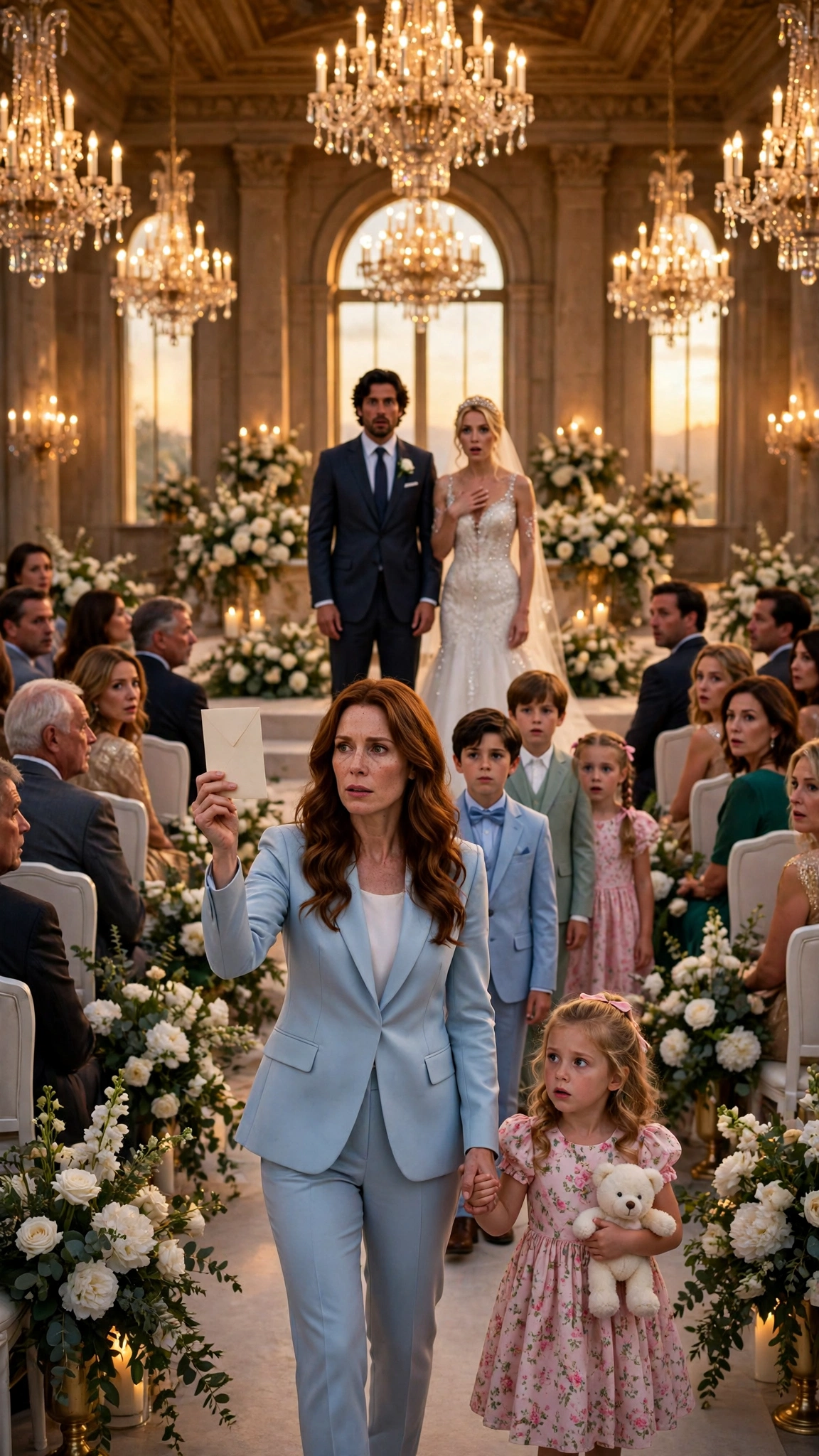
And in Queens, in a two-room apartment above a bakery, Evelyn dressed her children. She put Layla in her pink floral dress and fastened the small pearl earrings, and tucked the white teddy bear under her arm. She put Mia in a pink dress with a white collar, Noah in a light blue suit with a bow tie, and Leo — the smallest — in a sage-green suit. "Hold hands," she told them. "Whatever happens in there, hold hands."
"Mommy," Layla said, "where are we going?"
"We're going to a wedding," Evelyn said. "And when we get there, I need you to be very brave. Can you do that?"
Layla nodded. She was four years old, and she did not understand what was happening. But she understood her mother's face. And her mother's face said: be brave.
They took the train to Manhattan. They walked through the golden afternoon light to the grand hall. And at the doors, Evelyn stopped, and she looked down at her four children, and she said, "Whatever happens in there — whatever anyone says — you are loved. Do you understand? You are loved."
"We understand, Mommy," Layla said. And she took her mother's hand.
Evelyn pushed the doors open. The organ was playing. The guests were standing. The bride was at the altar. And every head in the room turned to look at the woman in the light blue suit, walking down the aisle with four small children behind her, holding a cream envelope in her hand.
The wedding could start now.