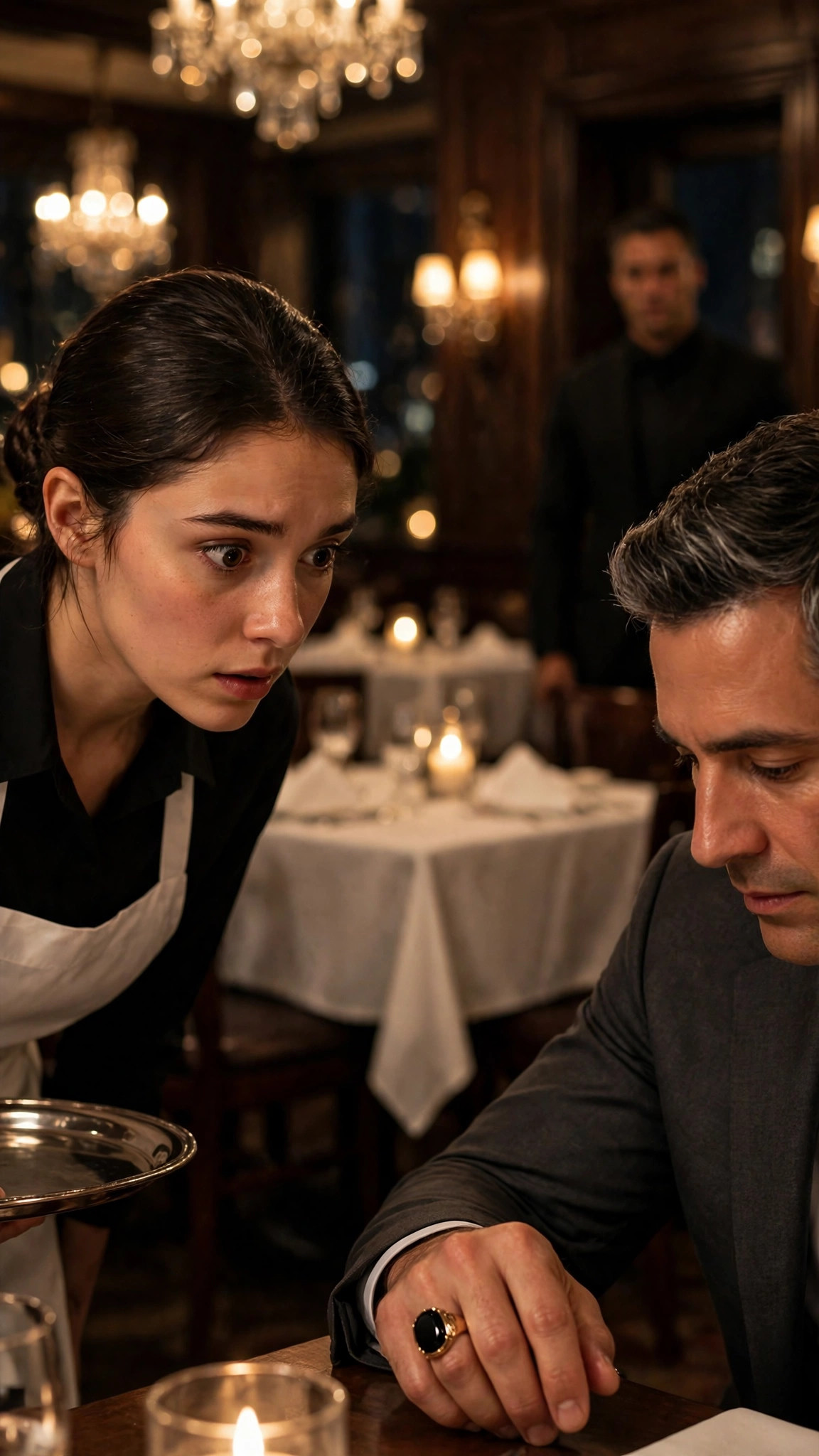
No one in that elegant Boston restaurant seemed to recognize the most feared mafia boss in New England when the hostess told him he had nowhere to sit.
Every crystal glass gleamed under the chandeliers at Lumière. Servers wove through the crowd with silver trays balanced on their palms. The regulars sipped their champagne quietly, confident that nothing unusual would happen tonight, that the world outside the tall windows would stay outside where it belonged. The string quartet in the corner played something soft and old, and the smell of butter and white truffle drifted from the kitchen in warm waves.
Nathaniel Caldwell crossed the floor with slow, deliberate steps.
His tailored charcoal suit fit him the way armor once fit kings. His shoes were polished to a black mirror shine. His dark hair, greying at the temples, was combed back with the care of a man who never hurried and never had to. He drew attention the way a storm draws attention through a window — people felt him before they understood him — yet no one knew his name. That was how he liked it. In his world, a name spoken aloud in the wrong room was a kind of death.
He stopped at the front desk and asked for a table.
The hostess, a slim woman named Simone with her hair pulled back so tightly it looked painful, gave him the smile she gave everyone who arrived without a reservation. It was a practiced smile, polished and empty, the kind of smile that had turned away senators and brides and men who owned half the city.
"We're fully booked, sir," she said. "If a table opens, I can have a server ask if she can squeeze you in beside the kitchen."
At the nearest table, a couple laughed softly. Their whispers drifted across the room like smoke. A man in a navy blazer lifted his glass and said something to his wife that made her cover her mouth with her napkin. None of them looked at Nathaniel twice. To them he was only a tall man in an expensive suit who had made the mistake of coming to Lumière on a Friday night without calling first.
He glanced at a table beside an overflowing trash can. Its uneaten food and crumpled napkins made its neglect obvious. A half-finished plate of duck sat congealing under the chandelier light, and a wine glass stood tipped on its side, a thin red line crawling toward the edge of the white cloth. Someone had left in a hurry, or been asked to leave, and the staff had not yet had time to clear it.
Viviana Marchetti set a tray down at the next table and noticed the ring on his fourth finger.
It was black onyx, set in heavy gold, catching the light in a way that made the stone look wet. She had seen a ring like that only once before in her life, and the memory of it hit her so hard that her hand stopped halfway to the tray.
Her father had been a jeweler in the North End. Giovanni Marchetti had repaired watches and reset stones for forty years in a shop no bigger than a pantry, and he had known every family in the neighborhood by the rings on their hands. One afternoon, when Viviana was sixteen and sweeping the floor of his shop, a man had come in with a ring just like this one — black onyx, heavy gold, worn on the fourth finger — and asked her father to tighten the setting. Her father had done the work in silence, his hands steady, his eyes down. After the man left, Giovanni had locked the shop door, turned to his daughter, and said the words she had never forgotten.
"Viviana," he had said, "that ring is a promise. It is the mark of loyalty among the mafiosi, worn only by men who have earned their place. When you see that ring, you walk away. You do not look at it. You do not speak to the man who wears it. You walk away, and you do not look back."
She had not walked away. She was standing ten feet from the man who wore it, holding a tray of champagne, and her feet would not move.
Before she could say a word, one of the bouncers walked over.
Asher Kane was built like a doorframe, broad and solid, with scarred knuckles and a face that had forgotten how to smile years ago. He had worked the door at Lumière for three years, and in all that time Viviana had never seen him hurry, never seen him raise his voice, never seen him touch a guest. He was the kind of man other men stepped around without knowing why.
He did not look at Nathaniel. He looked at Viviana.
"Come with me," he said quietly, and took her by the arm — not roughly, but firmly, the way a man takes someone out of the path of a falling beam — and gently dragged her into the supply room behind the kitchen.
The supply room smelled of bleach and folded linen. Shelves of white tablecloths rose to the ceiling. A single bulb hung from a wire, swaying slightly, throwing Asher's shadow across the stacked crates.
Viviana's heart was hammering against her ribs. "What are you doing?" she whispered. "I have tables. I have a full section tonight. Let go of me."
Asher closed the door. Then he held up his own hand, and Viviana saw the ring on his fourth finger.
It was black onyx too, set in darker gold, the stone cut in a different shape — flatter, harder, the kind of stone that did not catch the light so much as swallow it.
"This is the ring of the enforcers," he said, his voice low and steady. "And the man out there wears the ring of the boss."
Viviana stared at the ring, then at Asher's face. "What does that mean?"
"It means someone must have betrayed you," she said, the words coming out before she could stop them, because her father's voice was suddenly loud in her head. "Someone must have betrayed him. He walked in here alone. A man like that never walks anywhere alone."
Asher's jaw tightened. For a moment, something moved behind his eyes — surprise, and then a grim kind of respect.
"This is not a group of chefs," he said. "They have no menus. Things have been tense in the organization."
"I don't understand what you're talking about," Viviana said. Her voice was shaking now. "What did you mean?"
He pointed toward the dining room, toward the closed door and the music and the laughter beyond it.
"You need to get away from that table," he said.
Viviana's mouth went dry. "What table?"
"The man with the black ring," Asher said. "He is sitting at the table by the trash can. The one nobody wanted. He is sitting there because the hostess told him there was nowhere else, and he did not argue, and that should tell you everything. A man like Nathaniel Caldwell does not argue about a table. He sits where he is put, and he waits, because he already knows what is coming."
"Nathaniel Caldwell," Viviana repeated. The name meant nothing to her, and everything. "Who is he?"
"The most feared mafia boss in New England," Asher said. "And tonight, someone in his own organization sold him to the people who want him dead."
Before Viviana could answer, the door of the restaurant swung open, and five armed people came into the room to stop the man in black.
She heard it through the supply room door — the sudden change in the music, the quartet faltering mid-note, a woman's gasp, the clatter of a fork hitting a plate. Then silence. The kind of silence that falls over a room when every person in it realizes, at the same instant, that something terrible is about to happen.
Asher pushed the supply room door open a crack, and Viviana saw them through the gap.
Five men, moving with the calm precision of men who had done this before. Dark jackets. Hands inside their coats. They did not run. They did not shout. They spread out across the dining room floor like ink spreading across paper, and every guest at every table went very still, their champagne glasses frozen halfway to their lips.
The leader was a man with a shaved head and a scar that ran from his eyebrow to his jaw. He stopped in the middle of the room and looked slowly around, the way a man looks around a house he intends to buy.
Nathaniel Caldwell slowly walked toward his table.
He did not hurry. He did not look at the five men. He crossed the dining room floor with the same slow, deliberate steps he had used when he entered, and he pulled out the chair at the table beside the overflowing trash can, and he sat down, and he folded his hands on the white tablecloth, and he waited.
The room had gone completely silent, as if time itself had stopped.
He looked at the five men standing before him.
Calmly, he said, "Sit down, amateur."
The scarred man blinked. One of the other men shifted his weight. A woman at the nearest table began to cry silently, her shoulders shaking, her hand pressed hard over her mouth.
Asher, who had just come out of the supply room, turned to Viviana and whispered, "Boss… you need to get away from that table. Now."
Viviana looked at the man in the charcoal suit sitting calmly at the worst table in the finest restaurant in Boston, with five armed men standing over him and a black onyx ring gleaming on his finger, and she understood, with a clarity that felt like cold water down her spine, that whatever happened in the next sixty seconds would decide whether she lived or died — and that the man who had told her to run was the only person in the room who could help her survive it.
She did not run.
She stayed in the doorway of the supply room, her hand gripping the frame so hard her knuckles went white, and she watched.
Nathaniel Caldwell lifted one hand, slowly, the black onyx ring catching the chandelier light, and pointed at the empty chair across from him.
"Sit," he said again, softer this time, and somehow more dangerous. "We are going to talk about who sent you. And then we are going to talk about who told them I would be here."
The scarred man looked at his four companions. One of them, the youngest, barely more than a boy, swallowed hard enough that Viviana could see his throat move from across the room.
And in that moment, Viviana Marchetti understood the second thing her father had never told her about the black onyx ring — that the promise it marked was not only loyalty.
It was also a warning.
And the five men standing in the dining room of Lumière had just walked straight past it.
Three hours earlier, Viviana had woken up in the small apartment above a bakery in the North End, made coffee in a chipped blue pot, and counted the money in the envelope on her kitchen table for the third time that week. Rent. Her mother Elena's heart medication. Her brother Matteo's tuition at Boston University. The numbers never quite added up, and every month she made them add up anyway, the way her father had taught her — a little from here, a little from there, never a dollar spent twice.
She had not known, when she tied her apron that evening and walked to Lumière, that by midnight she would know the name of the most feared man in New England, or that he would know hers.
She had not known that the ring her father had warned her about would be the reason she was still alive.
The evening had begun like any other Friday at Lumière, and Viviana had been grateful for the ordinary rhythm of it. She had arrived at four, tied her apron, and checked her section — six tables by the tall windows, the best section in the house, earned after three years of never missing a shift. Table six was celebrating a fiftieth wedding anniversary, an old couple who came every year on the same date and ordered the same meal, and Viviana had set their table herself, with the good candles and the small vase of white roses Madame Colette kept for occasions that mattered.
Simone, the hostess, had been in a mood all evening. She had snapped at a busboy for stacking the menus crookedly, and she had told Viviana, twice, to hurry, though Viviana was not slow — she was never slow. "Friday nights are not for dreaming, Viviana," Simone had said, tapping her pen against the reservation book. "The book is full. Every table is promised. If someone walks in without a reservation, they wait, or they leave. That is the rule."
Viviana had nodded, because that was what you did with Simone, and she had gone back to her tables. She had served the anniversary couple their champagne, and the old man had taken his wife's hand across the table and said, "Fifty years, and you still steal the whole room," and his wife had laughed like a girl, and Viviana had felt the small, warm ache she always felt when she saw love that had lasted — the ache of knowing how rare it was, and how much she wanted it for herself one day, and how little time she had to think about such things between rent and pills and tuition.
At seven-thirty, Madame Colette had done her inspection, walking the floor with her hands clasped behind her back, straightening a fork here, a glass there, her eyes missing nothing. She had stopped at Viviana's station and looked at her for a long moment.
"You are tired," Madame Colette had said. It was not a question.
"I am fine, Madame," Viviana had said.
"You are tired, and you are working anyway," Madame Colette had said. "That is the difference between a waitress and a professional, Viviana. Remember it." She had moved on, and Viviana had stood a little straighter, and the evening had gone on, ordinary and golden, until a tall man in a charcoal suit crossed the floor with slow, deliberate steps, and asked the hostess for a table, and everything changed.