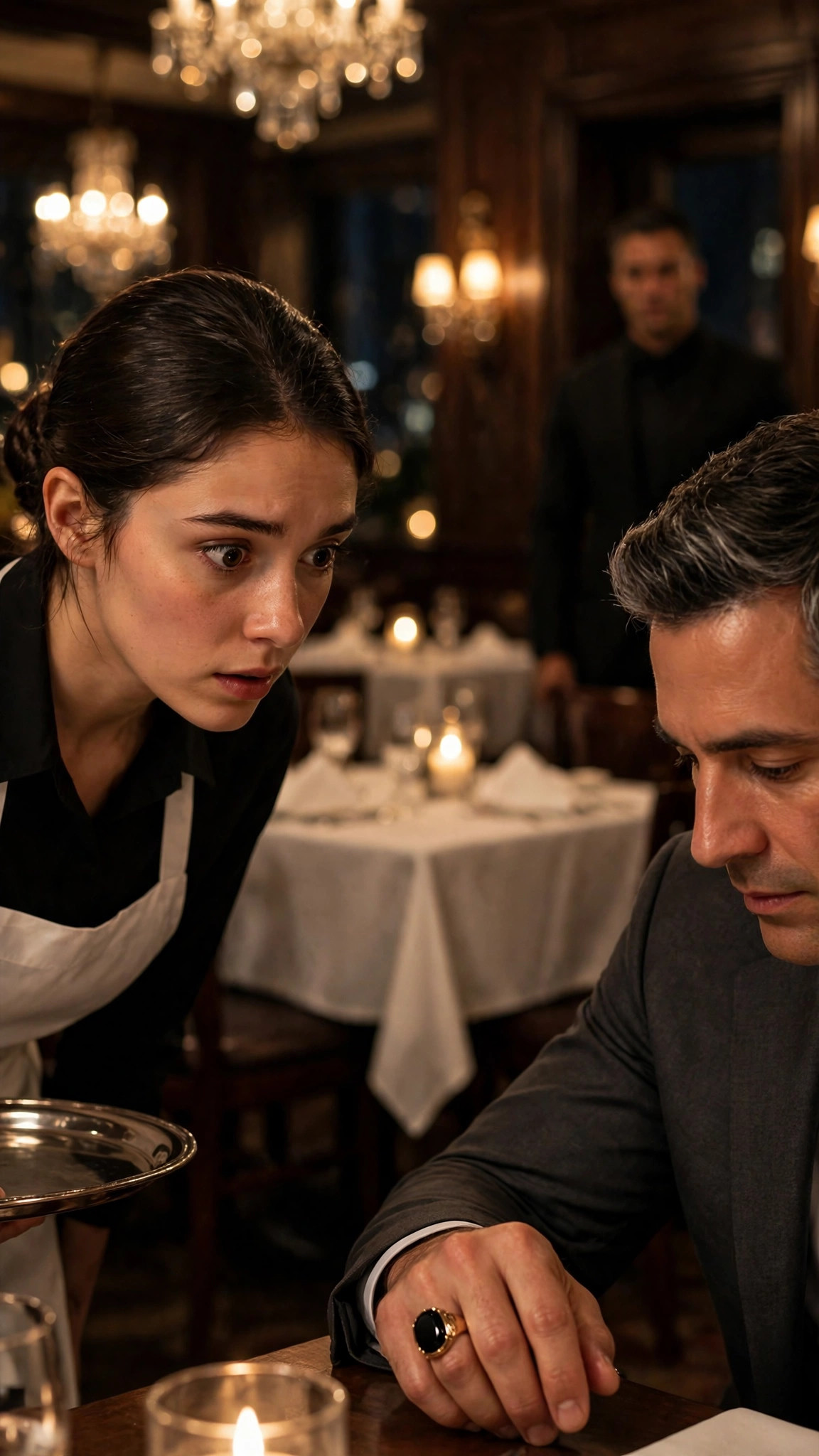
Viviana Marchetti did not fall in love with Nathaniel Caldwell all at once.
She fell in love with him the way winter turns to spring in Boston — slowly, and then all at once, and then you could not remember exactly when the cold had ended, only that the air smelled different, and the light lasted longer, and you had stopped bracing yourself against the wind.
It began with dinner.
He came back to Lumière the next evening, and the evening after that, and the evening after that. He always sat at the same table by the window. He always ordered the same thing — the roast chicken, the way his mother used to make it, he told her once, and then looked surprised at himself for saying it. He always tipped too much. And he always stayed until the last table had gone, sitting quietly with his coffee, watching the room empty out, as if he were memorizing it.
Viviana learned him the way she learned all her tables — from the hands, and from the eyes.
His hands were still. He never fidgeted. He never drummed his fingers or checked his phone. When he ate, he ate slowly, as if the food deserved his attention. When he listened, he listened with his whole body, leaning forward slightly, his grey eyes fixed on the person speaking, as if nothing else in the world existed in that moment.
His eyes were the color of the harbor on a cloudy day. They had seen things, those eyes — things she could not imagine and did not want to — but they were not cold. That was the surprise. Everyone in Boston who whispered about Nathaniel Caldwell described him as cold, as feared, as untouchable. But Viviana, who had spent three years reading people for a living, saw something else in those eyes.
She saw a man who was tired of being alone.
On the third week, he asked her to sit down.
Not during service. After. The restaurant was empty. The chairs were up on the tables. Madame Colette had gone home. The kitchen was dark. Viviana was wiping down the bar, and Nathaniel was sitting at his table by the window with an empty coffee cup, and he said, very quietly, "Viviana. Would you sit with me for a moment?"
She sat. Her apron was still on. Her hair was coming loose from its bun. Her feet ached. And she looked at the most feared mafia boss in New England, sitting across from her in the empty restaurant, and she waited.
"I want to buy Lumière," he said.
Viviana blinked. "What?"
"The restaurant," he said. "I want to buy it. The owner is an old man in Florida who has not set foot in this kitchen in ten years. He will sell. I have already spoken to him. And I want you to run it."
She stared at him. "Me? Run Lumière? I am a waitress."
"You are the best waitress in Boston," he said. "And you are the woman who pulled a fire alarm and saved lives when five armed men walked into this room. You did not run. You did not hide. You acted. That is what running a restaurant is, Viviana. It is acting, when everyone else is frozen. It is seeing what needs to be done, and doing it."
"I don't know anything about running a restaurant," she said.
"Then you will learn," he said. "Madame Colette will stay, as long as she wants. She will teach you. And I will be here, as long as you want me to be. That is the offer. Not charity. A job. A real one. With a real salary. And a share of the business, so that it is yours too, not just mine."
Viviana's hands were shaking. She put them flat on the table to steady them, and she looked down at them — a waitress's hands, red from hot water, with no ring on any finger — and she thought about her mother, and her brother, and the envelopes on the kitchen table, and the numbers that never quite added up.
"Why?" she asked. "Why me? Why this?"
Nathaniel was quiet for a long moment. He turned his left hand over on the table, slowly, so that the black onyx ring caught the last of the evening light through the window.
"Because my father told me," he said, "that a promise is not a word. A promise is a weight. You carry it every day, or it crushes you. I have carried this ring for eighteen years, Viviana. I have carried the weight of a family, and a name, and a hundred men who look to me. And I have carried it alone, because I believed that was what the ring required."
He looked at her.
"But that night, in this room, you showed me something I had forgotten. You showed me that a promise is not only something you carry. It is something you share. Your father taught you what this ring meant, and you stayed anyway. You pulled the alarm. You saved lives. You did not walk away."
He reached across the table, slowly, giving her time to pull back if she wanted to, and he took her hand in his. His hand was warm. Hers was cold. He held it gently, the way a man holds something precious and fragile, and he did not let go.
"I am not asking you to carry my weight, Viviana. I am asking you to let me carry some of yours. Your mother's medicine. Your brother's tuition. The envelopes on the kitchen table. Let me help. Not because you are weak — God knows you are the strongest person I have ever met — but because that is what a promise is for. It is not a chain. It is a choice. And I am choosing you."
Viviana looked at their hands on the table — his, with the black onyx ring; hers, bare and work-worn — and she felt tears come into her eyes, and she did not try to stop them, because she was tired of being strong alone, and because, for the first time in three years, someone was offering to help her carry the weight, and not asking for anything in return except her company.
"Yes," she whispered. "Yes. I will run the restaurant. And yes — I will let you help."
It was the beginning of everything.
The next six months passed like a dream Viviana was afraid to wake up from.
She learned to run Lumière — really run it, not just serve in it. She learned the books, the suppliers, the wine cellar, the payroll. Madame Colette taught her with the patience of a woman who had been waiting thirty years for someone worthy of teaching, and who had finally found her. The staff, who had watched Viviana pull the fire alarm on the worst night of their lives, followed her without question, because they had seen what she was made of.
Nathaniel was there every day. Not as an owner who hovered, but as a man who had found a place where he was welcome — a table by the window, a cup of coffee, a quiet hour at the end of the day when the restaurant emptied out and Viviana would sit with him, and they would talk.
They talked about everything. About her father, and his shop, and the bell over the door. About his father, and the ring, and the weight of a promise. About her mother, who was doing better now — the new medication was working, and she had started walking to the bakery in the morning again, and she had taken to asking, with increasing directness, when Viviana was going to bring "that nice man from the restaurant" home for dinner.
About Matteo, who had graduated — no, who was going to graduate, in the spring, with honors, and who had already been offered a job at an engineering firm in Cambridge, and who had called his sister, crying, to tell her that he had done it, that they had done it, that the envelopes had finally added up to something.
And slowly, without either of them quite noticing when it happened, the table by the window became their table. The coffee became their ritual. The quiet hour became the best hour of the day.
And then, one evening in October, six months to the day after the night at Lumière, Nathaniel Caldwell did something he had never done in his life.
He got down on one knee.
It was after closing. The restaurant was empty. The chairs were up on the tables. The chandeliers were dimmed. Viviana was wiping down the bar, and Nathaniel was sitting at their table by the window, and he stood up, and he walked to where she stood, and he knelt — the most feared mafia boss in New England, in a tailored suit, on the marble floor of a restaurant, in front of no one but her — and he took her hand, and he held out a small velvet box.
Inside the box was a ring.
It was black onyx, set in gold — but smaller, finer, made for a woman's hand. And beside it, in the same box, was a second ring, plain gold, with no stone at all.
"My father told me," Nathaniel said, looking up at her, "that the black onyx ring is a promise. Loyalty, earned and kept. I have worn mine for eighteen years. And tonight, I am asking you to wear one too — not because you have earned a place in my family, Viviana, but because you have earned a place in my life. The gold ring is for me, if you will have me. The onyx ring is for you, if you will have it. And the promise is the same one my father made me, all those years ago."
He took a breath.
"A promise is not a word. A promise is a weight. You carry it every day, or it crushes you. Viviana Marchetti — will you carry it with me?"
Viviana looked down at him, at the man who had walked into her restaurant alone, and sat at the worst table in the house, and refused to run, and who had spent six months proving, day after day, that the calmest man in the room was also the kindest.
She thought about her father, and his shop, and the words he had said to her when she was sixteen.
"When you see that ring, you walk away."
Her father had been right about almost everything. But he had been wrong about one thing.
Some rings are not a warning.
Some rings are a promise.
And some promises are worth staying for.
"Yes," Viviana said, and her voice did not shake at all. "Yes. I will carry it with you."
She held out her hand, and Nathaniel Caldwell slid the black onyx ring onto her fourth finger — the finger closest to the heart — and then she took the plain gold ring from the box, and she slid it onto his finger, beside the onyx, and the two rings caught the light together, black and gold, dark and bright, the way they were always meant to.
They were married in the spring, in the garden behind Lumière, under a sky so blue it looked painted. Elena Marchetti cried through the entire ceremony, and Matteo gave his sister away, and Asher Kane stood as best man, his scarred knuckles wrapped around a glass of champagne, his enforcer's ring gleaming on his finger, smiling for the first time in years. Madame Colette cooked the dinner herself, and the string quartet played, and the guests danced until midnight, and no one — not one person in that garden — was afraid.
Viviana wore the black onyx ring on her fourth finger, and the gold band beside it, and when the priest asked her if she took this man, she did not hesitate, not for a single second.
"I do," she said. "I promise."
And Nathaniel Caldwell, the most feared mafia boss in New England, looked at his wife, and smiled — a real smile, the first one anyone had seen on his face in years — and said the words he had been waiting his whole life to say.
"I promise too."
Lumière is still there, on its quiet street in Boston, its chandeliers gleaming, its crystal catching the light. If you go there on a Friday night, you will find the best table in the house is always taken — the table by the window, where a man in a charcoal suit sits with a woman in a black dress, drinking coffee, talking quietly, their hands resting together on the white tablecloth.
And if you look closely, you will see it: on her fourth finger, and on his, the black onyx rings, catching the light.
A promise, kept.
A weight, shared.
And a story that began with a hostess, a table beside a trash can, and a waitress who refused to walk away.
The morning of the wedding, Viviana woke before dawn in the small apartment above the bakery, and for a moment she did not know where she was — and then she smelled the bread rising through the floorboards, and she heard the brass bell by the window ring softly in the breeze, and she remembered everything, and she laughed out loud, alone in her room, because her father would have loved this day more than anyone.
Elena helped her dress, her hands steady for once, her eyes bright, and when Viviana turned to look in the mirror, her mother put a hand on her shoulder and said, "Your father is here. I can feel him. He is standing right behind you, telling you to stand up straight."
Matteo gave the toast, standing on a chair in the garden with a glass of champagne in his hand, his voice shaking only a little. "My sister," he said, "counted money in envelopes on a kitchen table for three years so that I could go to college. She never asked for anything. She never complained. And tonight, I want everyone here to know — the numbers finally added up. They added up to this." The garden erupted, and Viviana cried, and Nathaniel held her hand, and Asher — big, scarred, silent Asher — danced with Madame Colette until midnight, smiling for the first time in years.
The End.
THE END