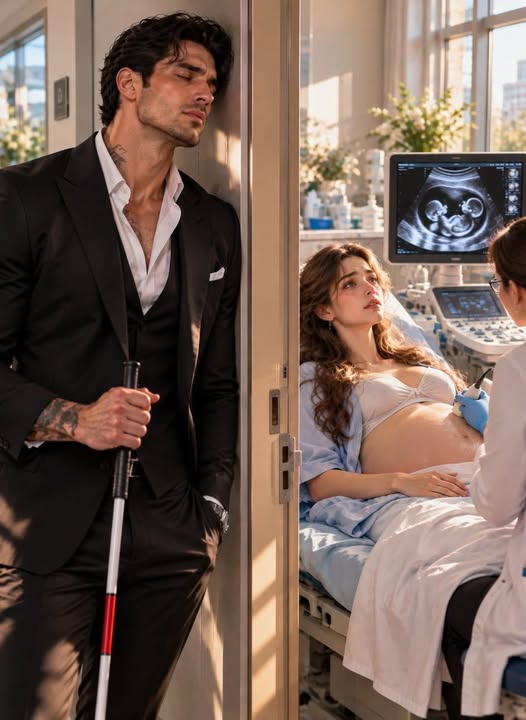
The door opened at last on soft shoes, and a woman's voice I knew — Dr. Marsh, who did not waste other people's time with weather — said: "Mr. Romano. Your wife is stable. The bleeding was a threatened miscarriage, and 'threatened,' tonight, is the word you get to keep. The baby's heartbeat is strong. Would you like to hear it?"
I have been offered many things in my life — money, territory, mercy, men's lives in both directions — and I tell you honestly that no offer ever made my knees unreliable. I followed her voice down twenty feet of corridor like a man being led out of a burning building.
Emma's hand found mine in the dark by the bed and put it, without ceremony, against the warm slope of her belly, and the nurse set the little speaker where it belonged, and there it was again: that galloping, impossible, brave-hearted sound — but this time I was *invited*, this time my palm was on the door instead of my ear, and Emma's fingers were laced through mine holding me there like an anchor holds a ship. My child. Running toward me through the dark, exactly as she had the first time, in a corridor, when she was a secret and a scandal and a reason for men to die. She was, Dr. Marsh informed us, a girl. The measurements were where they should be. Sixteen weeks, and furious about something, from the sound of her.
"A girl," Emma said, and I could hear the exhausted wonder in it, the whole nine weeks cresting and breaking at once. "Luca, I have a name. I've had it since the third week, since before — I used to say it in that room in Astoria so she'd know somebody was glad. Lucia."
"Lucia." Light. She had named our daughter Light, in a one-room exile, while married to a man who lived in darkness, and the joke of it — the grace of it — went through me so completely that I laughed out loud in that hospital room, with a bullet-graze wrapped on my shoulder and six years of night behind me, laughed like a boy. "Lucia Romano. Let her be light for all of us. God knows the family has the darkness covered."
Later — much later, when the monitors had settled into their slow green patience and Emma slept with her hand still trapping mine against her like a bookmark — Marco came in and stood where I could hear him, and gave me the rest of it, quietly, the way you read a will.
The council had decided before dawn. In our world there are sentences worse than death and Dante, I think, would have voted for death by the end. He was stripped of the name Romano — struck from the family's rolls, his accounts seized, his men reassigned and his mother's portrait, my aunt's portrait, taken down from the gallery wall in a ceremony of silence none of my people will describe to me. He was put on a plane to Palermo with one suitcase and a sum of money calculated by Castellano himself to be exactly enough to live on and never enough to build with, and armed men of the families — not ours; that was deliberate, and everyone understood it — would know his face at every port and airport on two continents for the rest of his life. He would grow old in exile, a man with my father's surname struck off him like a burned brand, listening for footsteps of his own. I found I could not hate him in that hospital room, with my daughter's heartbeat still echoing in my palm. Hate is a lamp; it burns the oil a man needs for other things. I let it go out.
The leak, Marco had found too — how the gunmen had known Emma's pharmacy, her stairwell, her garage. A receptionist at the clinic, a woman with a brother's debts, had sold Dante the day's appointment lists for cash across nine weeks, watching for a name: a wife registered under her maiden name, paying cash, always alone. She had flagged Emma's file the afternoon of my own quarterly appointment — the collision of our two schedules in that corridor, which had felt to me like God's hand, had been arranged by nobody. It was chance. Dante's woman merely reported that the runaway had surfaced, and the rest followed. I ordered the receptionist handled the new way: no visit in the night, no fear for her family. A word to the clinic's board, evidence of the sales, her license and livelihood gone by paperwork — ruin by daylight, in documents, the kind of ruin a person survives. Emma, when I told her, was quiet a long moment and then said, "Who taught you that?" and I said, "A heartbeat, mostly."
The two weeks of bed rest that followed were their own small war, fought in whispers and won by Rosa.
Emma was sentenced to the sofa in the drawing room by day and our room by night — *our* room; the migration of her things back across the corridor had happened while she slept in the hospital, directed by Rosa with the quiet ruthlessness of a general relocating a capital, and Emma, presented with the accomplished fact, had only said, *Well. I suppose the rooms are warmer on that side.* She hated the idleness the way I hate a locked door. She was allowed books, and visitors, and rage in moderation. She was not allowed the stairs alone, the garden in the rain, or news of Dante, and on the fourth day she threw a paperback at the wall and announced to the house at large that captivity had been more comfortable in Astoria, where at least the warden had the decency to be imaginary.
I did the one useful thing I have ever learned to do in a sickroom. I read to her. It is an arrangement with a long memory in our marriage: in the first year after the explosion, when my eyes were bandaged and then unbandaged into nothing, Emma had read me the whole of the Sunday papers, the contracts I pretended not to need, three novels, and once, memorably, the manual for a boat neither of us owned. Now the debt came due. She chose the books — her childhood copy of a fat Italian novel, a biography of a woman restorer in Florence, the letters of a painter — and I read with pages a company in Boston prints for me, the raised dots flowing under my fingertips, my voice doing the work my eyes used to do. She listened with her head on the arm of the sofa and her feet in my lap, and sometimes she fell asleep mid-chapter, and I would finish the page anyway, quietly, for the baby — who had strong opinions about my voice by then, and voted for it with her whole body whenever I began.
On the ninth night a car backfired on the avenue beyond the garden wall — one flat, ugly crack — and I was out of the chair before the echo finished, and Emma's hand was around my wrist hard enough to bruise, and her breathing had gone back to the place it lived in the garage. It took twenty minutes to bring her down, both of us sitting on the bedroom floor like shipwrecked people, her back against my chest, my voice in her ear counting the real sounds of the house one by one — the clock, the radiator, Rosa's radio, the rain starting — until the city's lies ran out of ammunition. *It isn't finished in me,* she said at last, furious at herself. *You finished it in a room full of men and it's over, and I'm still in the garage.*
"It finished in that room because I had six years of practice at being afraid in the dark," I told her. "You've had nine weeks. The debt isn't comparable, Emma. Take the time. The house has nowhere to be."
She slept, eventually, with her head on my shoulder and her hand fisted in my shirt like a child's, and I sat awake until the rain stopped, being a wall — the only trade, in the end, that I have ever been any good at — and I thought about how love, in my old life, had been a thing I *provided*, like security, like money, like fear. It turns out it is mostly a thing you *withstand*, in a room, at floor level, in the rain.
I stepped back from the chair, in the end, the way a man steps back from a ledge he has stood on too long — not off it, but back, into the house, into the light I couldn't see and intended to live in. The families were called again, to a room where I did not bleed, and I told them: the Romano operations would be run, day to day, by Marco Vitale, whose name I will put against any man's in this city; the ports would go legitimate inside five years or go to whoever wanted the smell of them; and my daughter would inherit an empire of clean paper or she would inherit a house and a name and nothing else, and either way the choice would be hers at twenty-five, sworn in front of witnesses, because no Romano child of mine would ever be a piece on anyone's board. Castellano, who is old enough to have buried every principle he ever had and grown new ones, laughed into his wine and said the blindness had made me the only honest thief in New York. It was, from him, a blessing. It held.
Emma's recovery was measured in small sounds coming back. First her laugh, in the garden, at something Rosa said in Italian that Rosa will not translate. Then the piano — I came down one morning in the seventh month and stopped on the stairs with my hand on the rail, because the drawing room was full of Chopin again, slightly rusted, entirely unrepentant, and underneath it Rosa was humming in the hall and would not stop when she heard me, and that, in my house, was a greater treaty than the one the families had signed. Then, one night, Emma moved her things back across the corridor — not with a speech; I woke at three in the morning to the small negotiations of a woman settling into the other side of a bed she had left nine weeks and a lifetime ago, and I lay perfectly still, the way you do when a deer comes into a clearing, until her hand found my chest in the dark and her head came down beside mine, and the untouched pillow was untouched no longer.
"What did the dark teach you?" she asked me once, in that bed, in the last weeks, when her belly was a hill between us and Lucia practiced her whole future against my palm. "Six years of it. You never say."
"It taught me that a voice is a face, if you listen properly," I said. "That men lie with their mouths and tell the truth with their feet. It taught me the exact sound of a house with no love in it — I never want to be able to recognize it again. And it taught me—" I found her face in the dark, the way I have a thousand times, by the geography my hands learned years ago. "It taught me that I stopped seeing you long before the explosion, Emma. I saw the Don's wife. I saw the chair's ornament. The woman I married was standing in my house playing Chopin at seven in the morning and I was already in three meetings in my head. The dark gave you back to me. I would not trade— no. I won't make poetry of it. It cost too much. But I will say this: whatever I am now, I am awake in it, and I was not awake before."
She was quiet. Then she took my hand and set it high on her belly, where our daughter obligingly kicked, hard, a whole opinion, and Emma said, "She's awake too. God help us both, Luca. She's going to be exactly like you."
"Then let her be like you where it counts," I said, "and we'll survive her."
The room smelled of rain coming through the garden window, and the long-case clock in the library struck one, and my house — my tomb that served dinner, my fortress, my battlefield — ticked and breathed and settled around us like what it had finally, finally become again. A home, rehearsing.