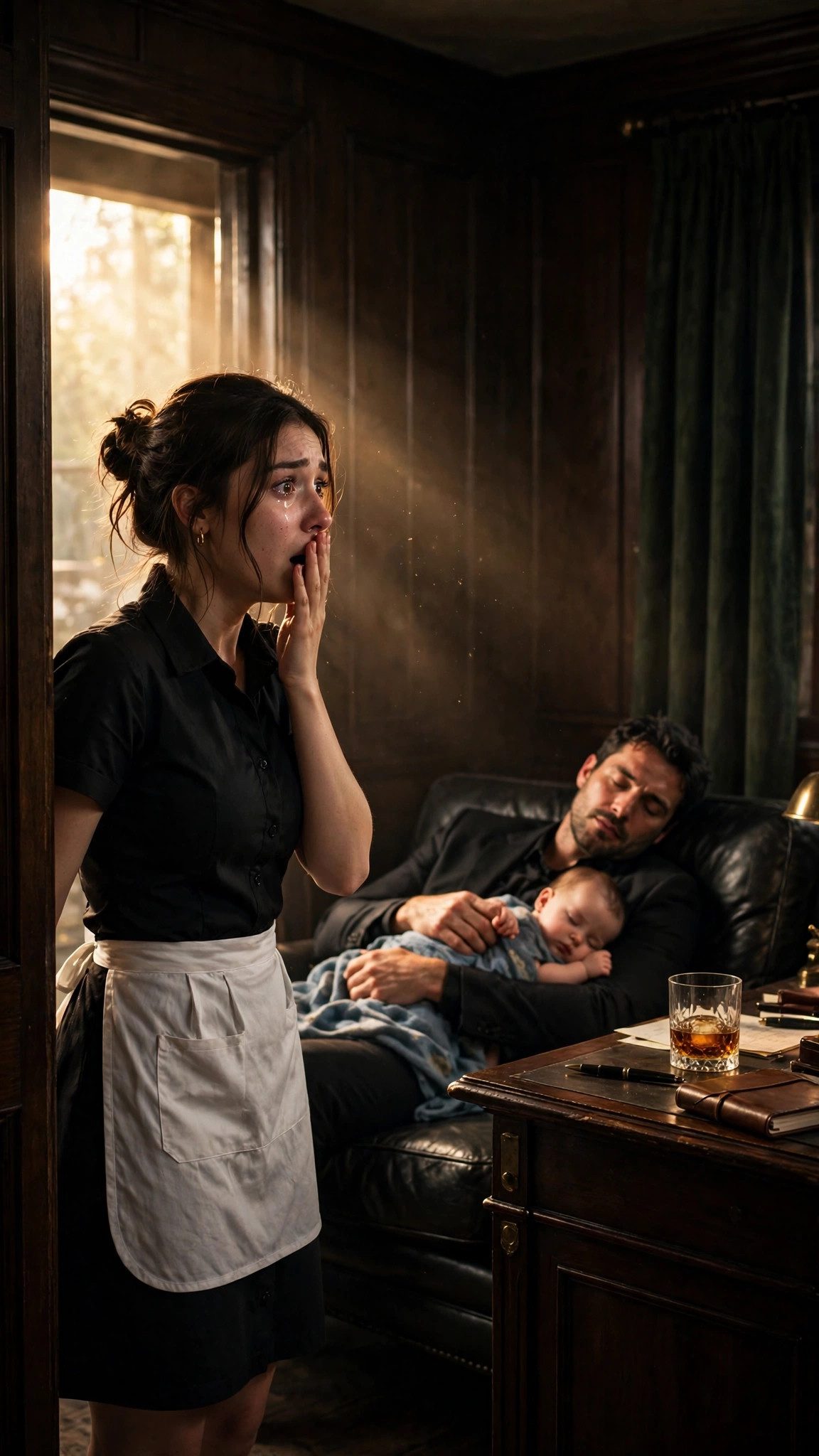
The night my baby disappeared, the restaurant was full of people in black ties and diamonds, and every single one of them was watching me fall apart.
It was the busiest night of the year at Casa Vale, the most exclusive Italian restaurant in Manhattan, and I was supposed to be invisible. That was the job. A good waitress is a ghost in a black dress. She appears with the bread, she disappears with the empty plates, and nobody ever has to think about her at all. I had learned to be a ghost. I had learned to move through candlelight and crystal without making a sound.
But ghosts do not have babies. And my baby was gone.
"Ellie?" I whispered it first, because saying it out loud would make it real. I was standing in the service corridor with a tray of champagne balanced on my palm, and my hands had gone so cold that I could not feel the silver anymore. "Ellie?"
The carrier was empty. I had set it down behind the hostess stand not twenty minutes earlier, tucked into the little alcove where the coats hung, where Ellie always slept in her faded blue blanket while I worked the floor. She had been asleep when I checked on her between courses. Her cheeks had been pink. Her tiny fist had been curled against her chin. And now the blanket was there, folded and warm, and my daughter was not.
I set the tray down on a sideboard. I do not remember setting it down. I remember the glasses chiming against each other, and someone turning to look, and my own voice coming out of my throat like it belonged to a stranger.
"Where is Ellie?"
Grant was standing by the bar with his clipboard, watching me the way he always watched me, like I was a spill he was waiting to mop up. He was the floor manager, forty-something, thinning hair combed back with too much product, a smile that never reached his eyes. He enjoyed humiliating everyone beneath him, and I was beneath everyone.
"Grant," I said, and my voice cracked on his name. "Where is Ellie?"
"I don't know," he said, and he shrugged, and he looked at his clipboard, and he did not even put it down. "She's with a stranger. She's with a man named Mr. Vale."
My breath froze in my chest. The whole room tilted. The candles blurred into long ribbons of light.
"He took her," Grant said, and there was something in his voice I had never heard before, something almost like pleasure. "What are you talking about, Ellie?"
I did not answer him. I was already running.
I searched the kitchen first. The line cooks stared at me over the steam. "Have you seen my baby?" I asked them, and they shook their heads, and one of them, Marco, put down his tongs and said, "Lena, breathe," but I could not breathe. I searched the walk-in, the dry storage, the bar. I searched the supply room with its towers of napkins and its smell of lemon polish. I searched the closets where the extra chairs were stacked. I searched the ladies' lounge, the coat check, the little office where the reservations book lived.
Ellie was nowhere.
The dining room was a sea of black ties and bare shoulders, and the band was playing something soft, and a woman at table six was laughing with her head thrown back, and all I could think was that my daughter was eight months old and she could not call for me, and if something had happened to her, she could not tell anyone my name.
I ran down the back stairs to the basement. The basement was where the wine lived, and the extra linens, and Mr. Vale's private office — the dark-wood room with the black leather couch where he did his business and where no one, not even Grant, ever went without being summoned. I had never been inside it. I had only ever stood at its door with a tray, waiting to be told to come in.
The door was open a crack. Warm light spilled out into the hallway, gold against the dark wood. And inside, on the black leather couch, under the heavy curtains, lay the most feared man in the city, fast asleep.
My daughter was pressed against his chest. Her tiny body rose and fell with his breathing. Her cheek rested on the white shirt he wore with the top button open. Her tiny fist was curled around his finger.
She was sleeping soundly. She was safe. She was held.
And I had never seen anything so terrifying in my life.
"Give me my baby back!" I said, and my voice came out loud and shaking and furious, and it did not sound like a ghost at all.
His eyes opened.
They were green. Cold green, the color of deep water in winter, and they found my face in the doorway, and for a moment neither of us moved. The band upstairs played on. A glass clinked somewhere above us. Ellie's fist tightened around his finger, and he looked down at her, and then back at me, and something crossed his face that I could not read at all.
"Mr. Vale," I said. "Give me my baby back."
He did not move. He did not let go of her. He just looked at me, and in that moment, with my heart hammering against my ribs and my daughter asleep on the chest of the most dangerous man I had ever met, I understood something that would change everything.
He had not stolen her. He had been holding her like she was the only safe thing in the world.
But I did not know that yet. All I knew was that I had come from a small farming town with nothing, that I had already lost my mother, that my father had never come back, and that Ellie was the only thing I had ever truly owned. And I was not going to lose her to a man in a black suit, no matter how feared his name was.
"Lena," he said quietly. His voice was low and rough with sleep. "I can explain."
"Then explain," I said. "Explain why the most feared man in the city is asleep with my daughter pressed against his chest."
He looked down at Ellie again. His thumb moved, just once, against her tiny curled fist. And when he looked back up at me, his face was different from anything I had ever seen on him. Not cold. Not frightening. Just tired. Just human.
"Lena," he said. "There's something about Ellie—"
And that is where I have to stop, because to understand what he said next, you have to understand how I got there. You have to understand the gala, and the locket, and the night I met a stranger on a terrace and never learned his name. You have to understand the babysitter, and the bottle, and the wallet, and the letter from my lawyer that I carried in my apron pocket for three months like a shield.
My name is Lena Carter. I am twenty-six years old. I am a waitress. And this is the truth I never wanted to tell.
I come from Millbrook, a farming town three hours north of the city, the kind of place where everybody knows whose truck is whose and the high school graduates about forty kids a year. My mother raised me alone in a house with a roof that leaked every spring. She cleaned other people's houses and took in sewing, and she saved every dollar she could in a coffee tin on top of the refrigerator. "For your future," she would say, tapping the tin. "For the day you get out of here."
My father never returned. He left when I was four, for a job in another state, and the letters stopped after a year, and then the phone calls stopped, and then my mother stopped waiting by the window. She never said a bad word about him. She just worked harder.
I studied long hours. I worked part-time jobs through high school and college — the diner on Route 9, the library desk, the farm stand in the summer. I got a scholarship to a small college and I studied business, because business sounded like a door. I did not know what was on the other side of the door. I only knew I wanted out of Millbrook, and I wanted my mother to be proud, and I wanted, someday, to be able to buy her a house with a roof that did not leak.
She died the spring I graduated. A stroke, sudden, in the kitchen, with the coffee tin still on top of the refrigerator. I buried her in the churchyard in Millbrook, and I took the train to the city with two suitcases and the coffee tin and her silver locket — a small oval locket with a tiny rose engraved on the front, the only pretty thing she had ever owned. I have worn it every day since.
The city was bigger and louder and colder than I had imagined. I rented a room above a laundromat. I worked catering jobs. I carried trays at weddings and galas and charity dinners, and I learned to be invisible, and I learned to smile while my feet ached, and I learned that in this city, nobody asks a waitress her name.
Thirteen months ago, I worked a charity gala at the Plaza. It was a spring night, warm for April, and the terrace doors were open, and the air smelled like rain and lilies. I was carrying a tray of champagne when a man stepped out onto the terrace, and I nearly walked straight into him.
He was tall and broad-shouldered, in a black suit, and his eyes were green — cold green, the color of deep water in winter. He had light stubble along his jaw, and his white shirt was open at the top button, and he looked at me like he was seeing something he had not expected to see.
"I'm sorry," I said. "I didn't see you."
"Neither did I," he said, and his voice was low and rough, and something about it made my hands stop shaking. "You, I mean. I didn't see you coming."
I laughed, because I was nervous, and because nobody ever talked to me like that at a gala, and because he was beautiful in the way a storm is beautiful. He asked me my name. I told him. He told me his was Damian, and nothing else, and I did not ask for more, because at a gala, a waitress does not ask a guest for his last name.
We talked on the terrace for an hour. He asked me about Millbrook, and about my mother, and about the locket — he noticed it, the little silver oval at my throat, and he touched it with one fingertip, so lightly I barely felt it, and he said, "Your mother had good taste." He told me he owned a restaurant, and that he lived alone above it, and that he had not talked to anyone like this in a long time. He did not tell me his last name. I did not tell him mine mattered.
When the gala ended, he walked me to the service elevator. He kissed me, once, in the dark hallway behind the kitchens, and it was the kind of kiss that makes the whole world go quiet. Then he was gone. I never saw him again. I never learned his last name. I never even learned the name of his restaurant.
Nine months later, I gave birth to a daughter in a small hospital uptown, alone, holding my mother's locket in my fist. I named her Ellie, after my grandmother, and when the nurse laid her in my arms, I saw her eyes. They were green. Cold green, the color of deep water in winter. And I knew, with a certainty that settled in my bones like cold, exactly whose daughter she was.
I never tried to find him. I did not know his last name. I did not know where his restaurant was. And even if I had, what would I have said? I was a waitress. He was a man in a black suit at a gala. Men like that do not marry girls like me. Men like that forget.
So I raised Ellie alone. I worked catering jobs with her strapped to my chest in a carrier, until she got too big, and then I found a babysitter, a woman named Dora Keane, who was cheap and kind and, I learned too late, drank. I saved every dollar. I told myself that someday, when Ellie was older, I would tell her about her father. I told myself that the green eyes were just a coincidence. I told myself a hundred lies, and I believed almost none of them.
Three months ago, I saw a notice in a shop window: Casa Vale, an exclusive Italian restaurant in Manhattan, hiring waitstaff. The pay was better than anything I had ever earned. The hours were nights, which meant I could be with Ellie during the day. I applied the same afternoon.
On my first shift, I noticed a tall, broad-shouldered man standing near the mahogany doors of the private dining area, watching the waiters carry plates across the room. He wore a black suit. His cold green eyes seemed to take in every detail. People lowered their voices when his car pulled up outside.
It was only later that I learned he owned the building.
His name was Mr. Vale. Damian Vale. And when he looked at me across the dining room on that first night, his face did not change at all. But his eyes stayed on mine for one second too long. And then they dropped, very slowly, to the silver locket at my throat.
I told myself it was nothing. I told myself he was just a strict boss, famously strict, the kind of man who had fired cooks for dropping a plate and waiters for hesitating with an order. I told myself that the most feared man in the city had no reason to remember a waitress from a gala thirteen months ago.
But every night after that, I felt his eyes on me. And every night, I checked Ellie's carrier twice as often as I needed to, and I told myself I was being foolish, and I did not sleep well at all.
That was the beginning. The night Ellie disappeared was the end of the beginning. And what happened in that basement office, with my daughter asleep on his chest and his green eyes open and looking at me, was the moment everything I thought I knew about my life turned out to be wrong.