I signed the contract on a Tuesday, in Andrea's office, with Ellie asleep in her carrier at my feet and the rain coming down outside in gray sheets.
Andrea read it first, all four pages, slowly, with her reading glasses on the end of her nose. She checked every clause twice. She asked me questions I had not thought to ask. "Does it say you can leave whenever you want?" she asked, and I pointed to the line near the bottom, the one that said either party could end the arrangement with thirty days' notice. "Does it say he can touch the baby?" she asked, and I pointed to the line that said all childcare decisions remained mine. "Does it say what he wants from you?" she asked, and I shook my head, because it did not. It said nothing about what he wanted. It only said what he would give.
"Lena," Andrea said, and she took off her glasses, and she looked at me the way she had looked at me the day Ellie was born, "I have been a lawyer for twenty-eight years, and I have never seen a contract like this. A man does not offer a stranger a year of food and shelter and childcare for nothing. Men always want something. The question is what, and whether you can live with it."
"I know," I said. "But Dora is gone, and the daycare costs more than I make in a week, and Ellie nearly choked on a bottle because I left her with a woman who drinks. I can't keep doing this alone. I can't."
Andrea was quiet for a moment. Then she said, "Then sign it. But sign it with your eyes open. And keep a copy. And if he ever asks you for something this contract doesn't promise, you call me the same day."
I signed it. My hand was shaking so badly that my signature looked like a child's drawing. Andrea signed as witness. Ellie woke up and cried, and I picked her up, and I held her against my chest, and I told myself that I had just done the smartest thing I had ever done, and the most dangerous thing, and that they might be the same thing.
The next morning, I brought the signed contract to the restaurant, and I gave it to Mr. Vale in the hallway outside his office, and he took it, and he read my signature, and he nodded once, like a man who had just closed a deal.
"Thank you," he said.
"That's it?" I asked. "Thank you?"
"What else would you like me to say?" he asked, and there was something almost like amusement in his voice, almost like a smile trying to get out.
"I don't know," I said. "Maybe tell me why. Why me? Why Ellie? Why this?"
He looked at me for a long time. His green eyes were steady, and I thought, for one wild moment, that he was going to tell me the truth — whatever the truth was. And then he looked down at the contract in his hands, and he said, "Because you remind me of someone I used to know. And because I have a large apartment above this restaurant, and it is empty, and empty rooms are a waste."
It was not an answer. But it was the only one I was going to get.
The move took two days. The apartment was on the third floor, above the restaurant, and it was bigger than any place I had ever lived — a living room with tall windows and a fireplace that actually worked, a kitchen with a stove that had six burners, a nursery painted the softest yellow I had ever seen, with a crib and a rocking chair and a mobile of little silver stars hanging over it. Ellie stared at the stars for a long time, and then she reached for them with both hands, and she laughed, and I stood in the doorway with my suitcase in my hand, and I cried.
There was a nurse, too — a kind woman named Mrs. Alvarez, sixty years old, with gray hair in a braid and hands that had held a hundred babies. She came every morning at seven, and she stayed until six, and she taught me things about Ellie I had not known — that she liked to be sung to while she ate, that she hated the feel of wool against her skin, that she calmed down fastest when you walked her in a circle, counterclockwise, near a window. Mrs. Alvarez never asked me questions about Mr. Vale. She just smiled, and she said, "He is a good man, underneath. You will see."
I kept my job. I kept my tables. I kept my black dress and my white apron, and I kept my tips, and every night I went downstairs to work the floor, and every night Mrs. Alvarez stayed with Ellie in the yellow nursery, and every night, when my shift ended, I came upstairs to find my daughter asleep in her crib, and the apartment quiet, and the city glittering outside the tall windows.
And every night, I felt like I was living someone else's life.
Mr. Vale did not come upstairs. He did not knock on my door. He did not ask me to eat with him, or to sit with him, or to do anything at all. He stayed in his office, or in the dining room, or in his own apartment on the fourth floor, and the only time I saw him was at work, across the room, watching. He watched me carry plates. He watched me smile at guests. He watched me check on Ellie between courses. He watched, and he said nothing, and I began to wonder if the contract had been a mistake — not because he wanted something from me, but because he wanted nothing at all, and I did not understand a man who gave everything and asked for nothing.
Grant understood it even less. Grant had heard about the contract — everyone had heard about it, because in a restaurant, secrets last about as long as a soufflé — and Grant could not understand why the most feared man in the city would offer a waitress a year of safety. He decided there had to be a reason, and he decided the reason had to be dirty, and he started watching me the way a man watches a crime he is waiting to catch.
He timed my breaks. He counted my trips upstairs. He wrote notes on his clipboard whenever I spoke to Mr. Vale, whenever Mr. Vale spoke to me, whenever we were in the same room for more than a minute. He started telling the other waiters that I had "bought" my job, that I had "earned" the apartment in ways he was too polite to describe, and he said it with a smile, and the other waiters laughed, because Grant was the manager and it was easier to laugh than to argue.
I ignored him. I had learned to ignore men like Grant. But at night, in the yellow nursery, with Ellie asleep in her crib and the silver stars turning slowly above her, I lay awake and I thought about what Andrea had said. Men always want something. The question is what.
One night, late, after the last guest had gone and the dining room was dark, I came downstairs to get a glass of water, and I found Mr. Vale standing in the hallway outside his office, looking at the door to the basement stairs. He was not wearing his jacket. His white shirt was open at the top button. His hair was a little messy, like he had been running his hands through it.
"Mr. Vale," I said. "Is everything all right?"
He turned around. For a moment, he looked startled, like he had forgotten I lived upstairs now, like he had forgotten anyone lived upstairs at all. Then he said, "I was just checking the locks."
"At one in the morning?"
"I don't sleep well," he said. "I never have."
I stood there in my bare feet, in my old t-shirt and my sweatpants, holding an empty glass, and I looked at him, and I thought about the terrace at the Plaza, thirteen months ago, and the stranger who had said he had not talked to anyone like that in a long time. And I thought about the green eyes, and the locket, and the way he had touched it with one fingertip. And I thought about Ellie, asleep upstairs, with eyes the exact same color as his.
"Mr. Vale," I said, and my voice was quiet, "have we met before? Before Casa Vale. Before I worked here."
He went very still. His face did not change. But his hand, the one hanging at his side, curled into a fist, and then opened again, slowly, like he was forcing himself to let go of something.
"No," he said. "We have not met before."
It was a lie. I knew it was a lie the moment he said it, because his eyes moved away from mine when he said it, and Mr. Vale never looked away from anyone. He was a man who held your gaze until you looked away first. But that night, in the hallway, he looked at the floor, and he said no, and I knew.
I did not push him. I went back upstairs, and I got my glass of water, and I sat in the rocking chair in the yellow nursery, and I watched Ellie sleep, and I thought about the stranger on the terrace, and the green eyes, and the locket, and the contract, and the empty apartment, and the man who gave everything and asked for nothing.
And for the first time since I had signed that contract, I was afraid — not of Mr. Vale, but of what he knew, and of what he was not telling me, and of what it would mean when he finally did.
The next day, a Saturday, the restaurant was full, and Grant was in a worse mood than usual. He had heard that I had been seen in the hallway at one in the morning, talking to Mr. Vale, and he had decided that this was proof of whatever he had already decided about me. He gave me the worst tables. He sent back two of my orders for no reason. He stood near the bar with his clipboard, watching me, and every time I looked at him, he smiled.
That night, after my shift, I went upstairs, and Mrs. Alvarez was gone, and Ellie was asleep, and there was a note on the kitchen counter in Mr. Vale's handwriting. It said: *Ellie laughed today. She laughed at the mobile. I heard her from the hallway. Thank you for letting me hear it.*
I stood in the kitchen with that note in my hand, and I read it three times, and I cried, because it was the kindest thing anyone had said to me in a year, and because it was also the strangest, and because I did not understand the man who had written it at all.
I put the note in the drawer with the contract. I told myself I would ask him about it in the morning. I told myself I would demand the truth, all of it, no more half answers.
But in the morning, there was a black-tie gala to prepare for, and the restaurant ordered a large amount of wine from the dining room, and every waiter was on duty, and the day went by in a blur of polished glasses and folded napkins, and by the time the evening came, I had forgotten to ask him anything.
There was one more thing I learned that week, and it was the thing that stayed with me longest. It happened on the second night after we moved in, when Ellie would not sleep. She cried, and cried, and nothing I did helped — not the rocking chair, not the song my mother used to sing, not the warm milk. Mrs. Alvarez had gone home. The apartment was quiet except for Ellie's crying, and I was so tired I could barely stand. I walked her in a circle near the window, counterclockwise, the way Mrs. Alvarez had taught me, and I whispered to her, and I told her I was sorry, and I told her I did not know what else to do.
And then, from the hallway outside my door, I heard it. A low voice, humming. Not a song I recognized — just a slow, soft tune, the kind of tune a man hums when he is trying not to wake someone. It went on for a long time, patient and steady, and Ellie's crying slowed, and then it stopped, and her head grew heavy against my shoulder, and she slept.
I opened the door a crack. The hallway was empty. But on the floor, just outside my door, there was a small wooden toy — a little carved horse, old and smooth, the paint worn down at the edges, the kind of toy that had been loved by a child a long time ago. I picked it up, and I turned it over in my hands, and I did not know what to think. I put it on Ellie's dresser, next to the silver stars, and I never asked anyone about it. But every night after that, when Ellie was fussy, I would hear the humming from the hallway, and she would calm, and I would stand in the dark nursery with my daughter in my arms, and I would think about the man on the fourth floor, alone in his big empty apartment, humming a lullaby to a baby that was not his — or so I thought then.
I asked Mrs. Alvarez about the horse once, casually, while she was folding Ellie's blankets. She looked at it for a long time, and then she said, "That belonged to Mr. Vale, when he was a boy. His mother gave it to him. He has kept it in his desk drawer for thirty years." She said it like it was the most ordinary thing in the world. She did not explain why it was now on my daughter's dresser. She did not have to. I understood enough.
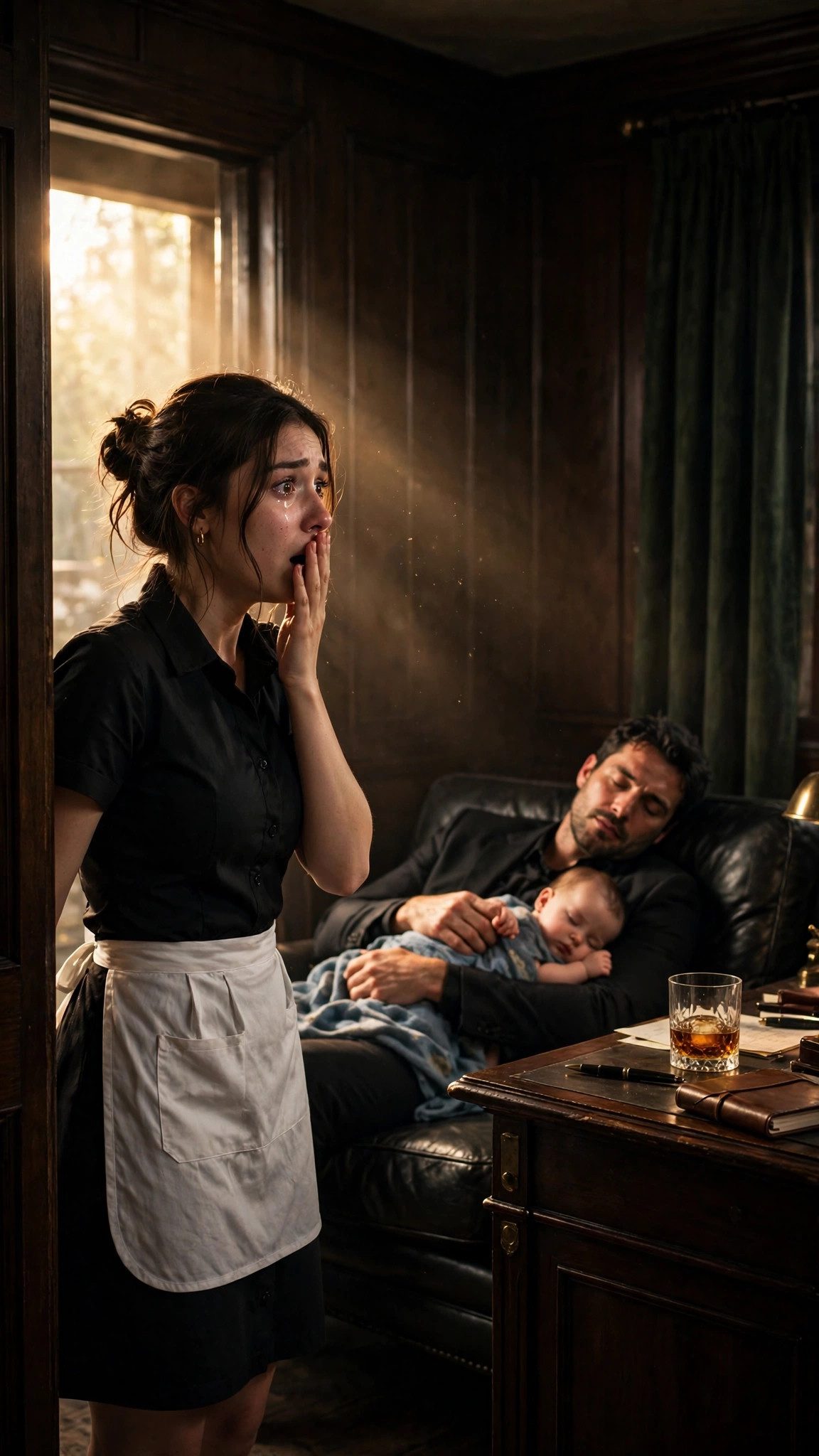
That was the night Ellie disappeared. That was the night I found him asleep on the black leather couch with my daughter pressed against his chest. That was the night everything I thought I knew about my life turned out to be wrong — and the night I finally understood what he had been trying to tell me all along, without ever saying a word.