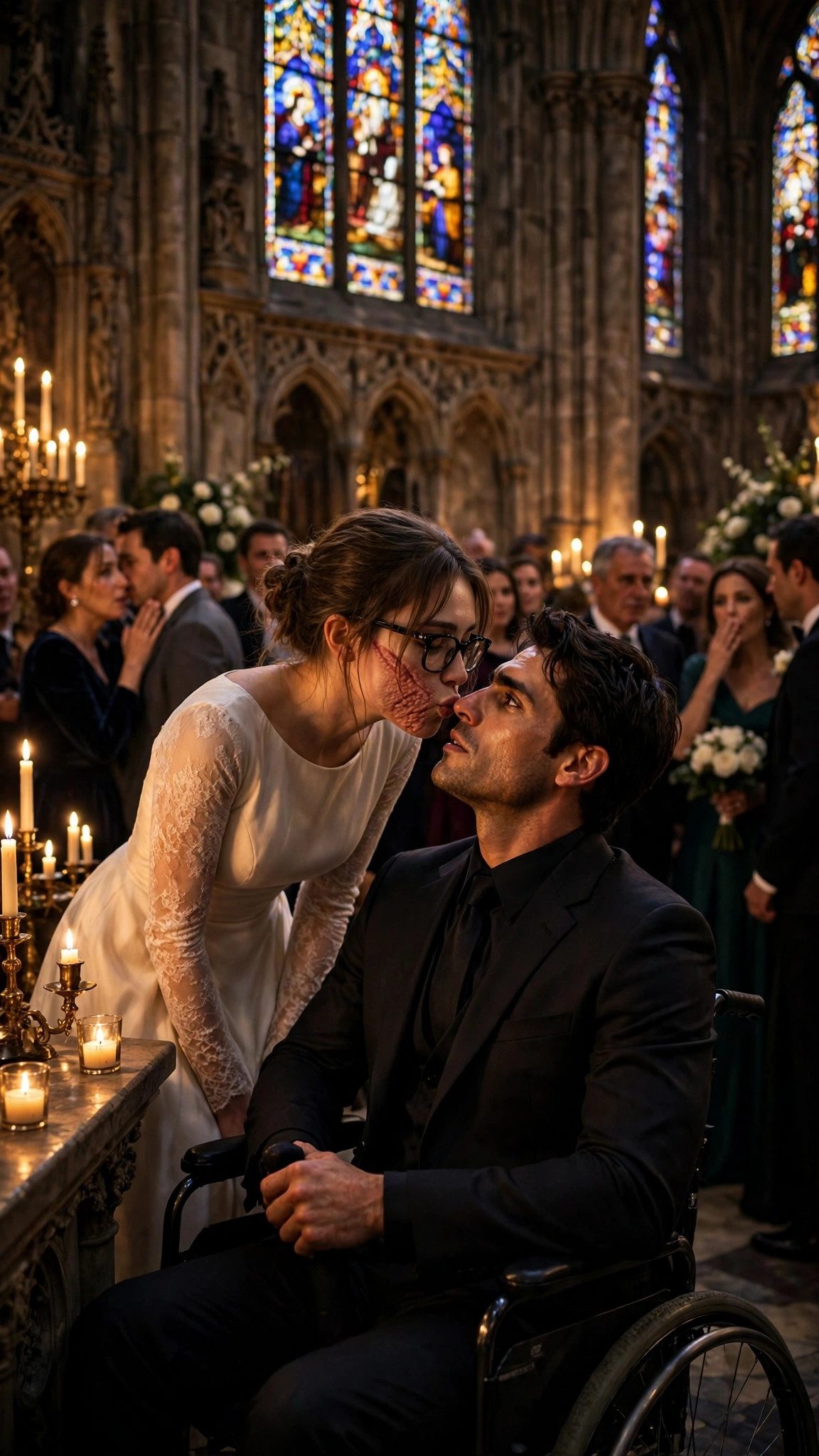
One hundred and twenty people tried not to laugh when I bent down to kiss the most feared man in Chicago.
They thought a crippled mafia boss marrying a scarred, ugly bride was some kind of cruel joke, and the whispers followed me down the aisle like insects, brushing against my skin, impossible to swat away. "Barone really gave him that daughter?" someone muttered behind a gloved hand, while others coughed into their fists to hide their laughter. A woman in pearls leaned toward her husband and whispered something that made his shoulders shake. A young man near the back did not even bother to hide his grin.
Adrian Vitali sat perfectly still in his wheelchair at the foot of the altar, dressed in black, his broad shoulders making him look dangerous even though everyone in that cathedral believed a bullet eleven months earlier had destroyed the nerves in his legs. The newspapers called him a businessman, a philanthropist, a quiet investor in Chicago real estate. Everyone in Chicago knew exactly what kind of man he was, and nobody in that room said it out loud.
And then there was me.
A thick, puckered scar covered the right side of my face from temple to chin. Heavy glasses distorted my eyes into something small and nervous. Dull brown hair hung around my shoulders like a curtain I could hide behind, and my wedding dress, ivory and plain, had been chosen by a woman who hated me, in a size that was almost right and a style that was almost kind.
Some guests openly stared while others looked away, as though ugliness might somehow be contagious, as though if they looked at me too long, some of it might rub off on them.
The priest cleared his throat. The organ had gone silent. The whole cathedral seemed to be holding its breath, waiting to see what the monster and the freak would do next.
I leaned down because Adrian could not stand. I kissed him quickly, the way a girl kisses a stranger she has been ordered to marry, and I whispered the words I had been trained to say whenever my existence became inconvenient.
"I'm sorry."
His fingers tightened around the armrest of his wheelchair.
"Say that again."
My stomach clenched so hard I thought I might be sick right there on the altar, in front of one hundred and twenty people and God and everyone.
"What?"
"What you just said."
"I said I'm sorry."
Something strange flashed across his face before disappearing, and for one terrifying second, it felt as if he could see straight through everything I was hiding. Not just the scar. Not just the glasses. Everything. Ten years of it, all at once, laid bare under those dark eyes.
Then the priest said something about man and wife, and the organ started again, and the guests rose, and the moment passed, and I told myself I had imagined it. Men like Adrian Vitali did not see through people. Men like Adrian Vitali saw what they wanted to see, and what he wanted to see was a crippled boss with a ruined bride, a joke of a wedding, a marriage that meant nothing.
What Adrian did not know was that the scar everyone mocked was not real.
What Adrian did not know was that my marriage was a setup, arranged by a father who had never once called me his daughter, to put a spy and a poisoner inside his house.
And what nobody in that cathedral knew — not Adrian, not my father, not even me, not yet — was that someone in that room was hiding an even darker lie, and before the night was over, it would come out, and nothing would ever be the same.
I should start at the beginning. My name is Mara Barone, and I am twenty-seven years old, and for most of my life, I did not exist.
I was born to a woman my father never married, in a small apartment above a bakery on the west side of Chicago, and my mother died when I was four years old. I do not remember her face. I remember the smell of flour. I remember a lullaby in Italian that I can still hum but whose words I have forgotten. I remember a social worker with kind eyes telling me I was going to live with a nice lady named Ruth, and that my father was a very important man who was too busy to raise a little girl.
Ruth Delaney raised me. She was forty-one when I came to her, a widow with no children of her own, a woman who cleaned offices at night and made soup on Sundays and taught me to read by sounding out the words on cereal boxes. She braided my hair. She mended my dresses. She told me I was beautiful, and for the first few years, I believed her, because children believe the people who love them.
Then, when I was seventeen, my father came back into my life.
Salvatore Barone did not knock. He walked into Ruth's little kitchen one Tuesday evening as if he owned the house, the street, and the air inside it, and he looked at me for a long time without speaking. I was standing at the sink, washing dishes, my hair in a braid, and I remember the way his eyes moved over my face — not like a father looking at a daughter, but like a man checking a painting for damage.
"You look like her," he said at last.
"Like who?" I asked.
"Like Celeste," he said. "My daughter."
That was the first time I learned I had a half-sister. Celeste Barone, legitimate daughter of Salvatore Barone and his wife, Alessandra, born into silk sheets and private schools and a house with a garden. And I, the other girl, the unwanted one, had been given the same eyes, the same cheekbones, the same mouth — as if God had made a copy and then forgotten to change anything.
Celeste had never wanted anyone asking why her father's unwanted daughter looked so much like her. So Salvatore had a solution, and he explained it to me the way a man explains a business arrangement, calmly, without cruelty, as if it were the most reasonable thing in the world.
For ten years, I would wear three pieces of Hollywood-quality silicone, made by a makeup artist in Los Angeles who worked on films. A thick, puckered scar across the right side of my face, from temple to chin. A piece that changed the shape of my nose. A piece that thickened and dulled my jaw. Heavy glasses with plain lenses. My hair dyed a flat, dull brown and cut without style. I would become ugly on purpose, so that no one would ever look at me twice, so that no one would ever say the words Celeste could not bear to hear.
And in exchange, Salvatore would pay for Ruth's care. Ruth was sixty-eight by then, and her memory had begun to slip — she forgot where she put her keys, then she forgot the names of her neighbors, then she forgot that she had already eaten lunch — and the doctors said she needed a memory-care facility, a good one, with nurses around the clock. A place like that cost more money in a month than Ruth had earned in a year of cleaning offices.
Salvatore paid for it. He paid for the facility, for the nurses, for the medicine, for the little room with the window that looked out on a garden. And I understood the threat without him ever having to say it out loud.
Obey, and Ruth stayed safe. Disobey, and she paid the price.
So I obeyed. For ten years, I wore the scar. I wore the glasses. I wore the dull hair and the dull clothes and the dull name — Mara, the quiet girl, the ugly girl, the girl nobody looked at. I worked in the back room of a florist's shop on Division Street, arranging flowers for other people's weddings, and I went to see Ruth every Sunday, and I told her about my week, and she smiled at me, and sometimes she remembered my name, and sometimes she called me by my mother's name, and I never corrected her.
I thought that was my life. I thought it would always be my life. And then, on a Tuesday morning in October, eleven months after a bullet put Adrian Vitali in a wheelchair, my father called me to the big house on Astor Street, and everything changed.
The big house was the kind of house that makes you feel small just by standing in front of it — limestone, iron gates, a garden behind walls. I had never been inside it before. A maid led me to the breakfast room, where Celeste was sitting at a long table in a silk robe, picking at a plate of fruit, and my father was reading a newspaper, and the air smelled like coffee and money.
Celeste looked up when I came in, and her eyes went straight to my scar, the way they always did, as if checking that it was still there, still ugly, still doing its job.
"I've decided something," she said, not to me, to her father. "I'm not marrying him."
Salvatore lowered his newspaper, slowly, the way a man lowers a weapon he has not yet decided to use.
"Celeste," he said.
"I'm not standing beside some breathing corpse in a wheelchair," she snapped. "I don't care about the alliance. I don't care about the docks. Find someone else."
My father was quiet for a moment. Then he calmly lowered his coffee cup, set it down on its saucer with a small, precise click, and looked at me.
"Then send the other girl."
That was how I became engaged to Adrian Vitali. Not with a proposal. Not with a question. With a sentence, spoken over breakfast, as if I were a parcel to be redirected.
Celeste smiled then, a slow smile that did not reach her eyes, and she stood up and walked past me, close enough that I could smell her perfume, and she said, "Don't worry, little sister. He won't look at you for long. Nobody ever does."
She was wrong about that. Adrian Vitali looked at me for a very long time, on the day we were married, in front of one hundred and twenty people who were trying not to laugh. And when I whispered "I'm sorry," he heard something in those two words that I did not know was there, and his fingers tightened on the armrest of his wheelchair, and he said, "Say that again."
I did not know then what he had heard. I did not know then that the man in the wheelchair was not what he seemed, or that my marriage was not what my father had told me it was, or that the dark bottle of amaro Celeste would press into my hands before the ceremony was meant to kill us both.
I knew only that I was standing at an altar in a dress I had not chosen, married to a man I had never met, wearing a face that was not mine, and that somewhere behind me, in the pews, someone was hiding a lie darker than all of mine put together.
The priest was still talking. The guests were still watching. And Adrian Vitali, the most feared man in Chicago, was looking at me as if I were the most interesting thing he had ever seen.
The car that took me from the cathedral to Lake Forest was long and black and silent, and I sat in the back seat with my bag on my lap, and the bottle of amaro inside it, and I watched Chicago slide past the window in pieces — a church, a grocery store, a man walking a dog, a woman pushing a stroller — ordinary things, ordinary people, living ordinary lives, and I wondered what it felt like to be ordinary.
Marco Santini was driving. I did not know his name yet. I knew only that he was the man with grey hair and working hands, and that he kept looking at me in the rearview mirror, not unkindly, but carefully, the way a man looks at something fragile that he has been told to deliver in one piece.
"You all right back there, miss?" he asked, after a while.
"I'm fine," I said, because that was what I always said. It was the second most practiced sentence in my life, after "I'm sorry."
"You don't look fine," he said. "You look like a girl who just married a man she never met."
"That's because I am," I said.
He was quiet for a moment, and then he said, "Mr. Vitali is a good man. People say a lot of things about him. Most of them are true. But the good part is true too. He takes care of his own."
"Am I his own?" I asked. "I just met him an hour ago."
"You married him," Marco said, simply. "That makes you his. That's how he sees it. And God help anyone who hurts what's his."
I looked out the window again, at the houses getting bigger and the trees getting taller, and I thought about what Marco had said, and I thought about the bottle in my bag, and I thought about Ruth, sitting in her room at Sunrise Gardens, doing a jigsaw puzzle, waiting for Sunday, and I wondered if she would be proud of me, or frightened for me, or if she would even remember who I was when I saw her next.
The estate appeared around a bend in the road, behind iron gates and a wall of hedges, and the car rolled through the gates, and the house rose up in front of us, limestone and glass, with a garden that went on forever, and I thought, this is where I live now. This is my house. This is my husband's house. And I have never been further from home in my life.
Marco opened my door for me, and he offered me his hand, and I took it, because my legs were shaking, and he walked me to the front door, and he said, very quietly, so only I could hear:
"Whatever happens tonight, miss — be honest with him. He can smell a lie a mile away. But the truth? The truth he respects."
Then he went back to the car, and I walked into the ballroom, and the reception began, and the rest of the night unfolded the way nights do when you are living someone else's life — one moment at a time, and all of them too fast.