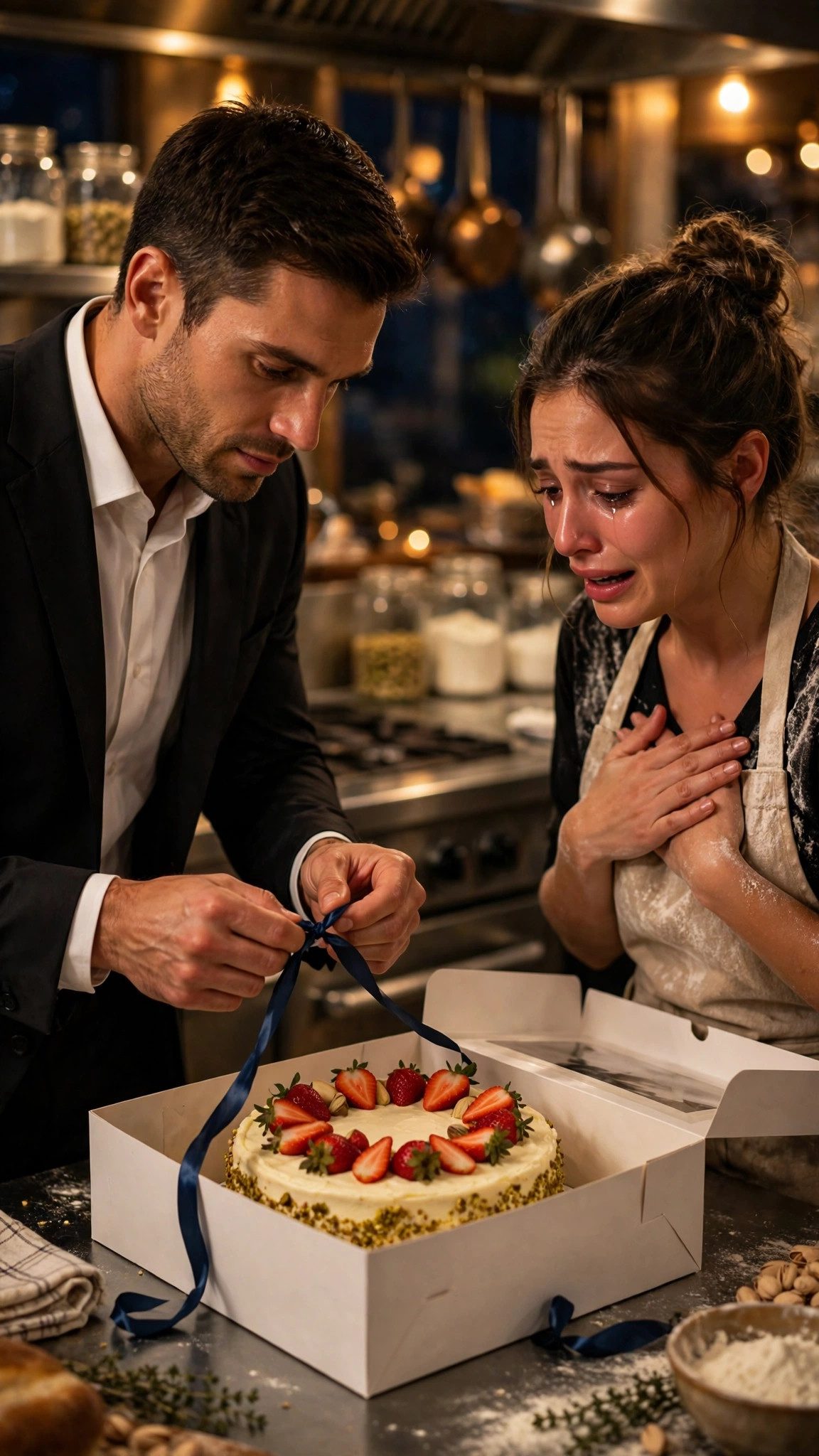
The morning after my birthday, I woke up in my small apartment above the laundromat to the sound of the radiators clanging and the smell of coffee from the shop downstairs, and for one disorienting second I thought I had dreamed the whole thing. The cake. The receipt. Adrian Vale standing in my kitchen, watching me cry into a slice of my father's birthday cake. It felt like the kind of dream you have when you're lonely and thirty-two and everyone forgot your birthday, the kind of dream that dissolves the second you open your eyes.
Then I saw the white bakery box on my kitchen counter, tied with dark blue ribbon, and I knew it had been real.
Half the cake was gone. I had eaten two slices standing up in Sable's kitchen, and Theo had eaten one, and Carmen had come in after close and eaten one with her fingers, standing at the counter in her coat, and said, "Whoever made this cake loves you, honey. Whoever it was, they love you." And then she had looked at me, and I had looked at her, and neither of us had said Adrian Vale's name out loud, because saying it out loud would have made it real in a way I wasn't ready for.
I carried the box to the refrigerator like it was made of glass. I stood there for a long time with my hand on the refrigerator door, thinking about the way he had said "I remember most things you say," and about the ninety-second conversation in January that I had forgotten completely, and about all the small kindnesses he had listed, one by one, like beads on a string. My boss's anniversary cake. Carmen's baby-shower pastries. Eddie's daughter's birthday cake. He knew about all of them. He had been there. He had seen me.
I had spent three years making myself invisible in that kitchen, and the most feared man in Chicago had been watching me the entire time.
I went to work that afternoon with my stomach in knots. The kitchen felt different. The ovens sounded louder. The fluorescent lights seemed brighter. Every time the kitchen doors swung open, my head came up, and every time it wasn't him, I felt something I refused to name. Relief? Disappointment? Both at once?
Theo cornered me by the walk-in before service. "So," he said, with the enormous, unsubtle grin of a twenty-four-year-old who has been waiting all day to ask a question. "Are we going to talk about last night?"
"There is nothing to talk about," I said.
"Ella." He leaned against the doorframe, arms crossed, enjoying himself far too much. "Adrian Vale stood in our kitchen for twenty minutes. He brought you a cake. A cake, Ella. From a bakery in Lincoln Park. With your dead father's recipe. Do you have any idea how insane that is?"
"Yes," I said. "I have some idea."
"And then he just left? He didn't say anything else? He didn't ask you out, or threaten you, or propose marriage, or anything?"
"He asked me a question," I said, before I could stop myself.
Theo's eyes went wide. "What question?"
I shook my head. "I don't remember."
That was a lie. I remembered perfectly. "Why were you noticing me?" I had asked, and he had looked at me for a long moment, and then he had said, "Because you were worth noticing," and then he had put on his coat and walked out of my kitchen, and his three men had risen from their table and followed him, and the dining room had exhaled like a held breath finally let go.
I had stood there for a long time after he left, staring at the cake box, and then I had gone home, and I had not slept, and now here I was, pretending to check the berries, pretending my hands weren't shaking.
Service that night was brutal. A party of twenty in the main room, a tasting menu at the chef's table, and a groom who sent back his dessert twice because it wasn't "romantic enough," whatever that meant. I worked the way I always worked, fast and clean and focused, but my mind kept sliding back to Adrian. To the cake. To the way he had looked at the candle, unlit, beside the chocolate thirty-two. To the way he had said, "Try," when I told him wishes didn't work anymore.
At nine forty-five, Mr. Cross came into the kitchen, and my stomach dropped, because Mr. Cross never came into the kitchen during service unless something was wrong.
"Ella," he said, in a low voice. "Mr. Vale is here. He would like to speak with you. After service. In the dining room."
The kitchen went quiet. Theo stared at me. Carmen stared at me. Even the dishwashers stared at me. I wiped my hands on my apron and nodded, because what else was I supposed to do?
The last hour of service crawled by. I burned a tart and had to start over. I dropped a spoon and it clattered across the floor like a gunshot. When the final dessert went out and the dining room settled into its soft, murmuring hour, I took off my apron, washed my hands, and walked through the kitchen doors with my heart hammering so hard I was sure the whole restaurant could hear it.
He was sitting at table twelve, alone this time. No three men. No wine. Just Adrian Vale in a black suit, sitting in the low light, watching the door as if he had been waiting for it to open.
"Sit," he said, and gestured to the chair across from him.
I sat. My knees were shaking. I put my hands in my lap so he wouldn't see.
"I owe you an explanation," he said. "And an apology. Last night was not fair. I surprised you, and I don't like surprising people. It was selfish. I wanted to see your face when you opened that box, and I didn't think about what it would cost you."
"It didn't cost me anything," I said, and then, because I was tired of lying, I added, "It was the best birthday I have had in four years. Thank you."
He nodded, slowly, like a man accepting something he wasn't sure he deserved. "I have a request," he said. "My mother would have been seventy-three next Tuesday. She died when I was twenty-four. Every year on her birthday, my family has a small dinner, just us, and there is always a cake. This year, I would like you to make it."
I stared at him. "Me? You want me to make your mother's birthday cake?"
"Yes."
"Mr. Vale, I make desserts in a restaurant kitchen. I'm not—"
"You are the only person I trust to do it right," he said, and the way he said it, flat and certain, left no room for argument. "She liked lemon. Lemon cake, with raspberry filling, and not too sweet. She hated anything too sweet, same as me. I suppose I get it from her."
I swallowed. "What was she like? Your mother?"
Something crossed his face then, so fast I almost missed it. Grief, maybe. Or something older and deeper than grief. "She was kind," he said. "In a family like mine, kindness is a dangerous thing. She was kind anyway. She used to say that a man is measured by what he remembers, and by what he does when no one is watching." He paused. "I think you would have liked her."
I thought about my father, who had said almost the same thing, in different words, in a bakery in Milwaukee. The cake doesn't care. The people eating it don't care. Only the baker cares, and the baker should learn to forgive himself.
"I'll do it," I said. "I'll make the cake."
"Thank you," he said. And then he leaned forward, just slightly, and his voice dropped, and he said, "Ella, I have been coming to this restaurant for six months. I have watched you work. I have watched you stay late for other people's celebrations. I have watched you give away your time and your talent and your kindness like they cost you nothing, when I know they cost you everything. I know about the anniversary cake. I know about the baby-shower pastries. I know about the dishwasher's daughter. I know that you made a birthday cake on your day off for a seven-year-old girl you had never met, and you left it at the back door so no one would know it was you."
"How—" I started, and then I stopped, because I already knew the answer. He was here. He had always been here.
"I notice things," he said. "It is my job to notice things. But you are the first thing I have noticed in years that had nothing to do with business."
The dining room was empty around us. The lights were low. The candles on the tables had burned down to stubs, and the air smelled like wine and woodsmoke, and I sat across from the most feared man in Chicago and felt, for the first time in my life, like someone was looking at me and actually seeing me.
"Have dinner with me," he said. "Not here. Not at table twelve. Somewhere quiet. Tomorrow night, after your shift. I will send a car. You can say no. If you say no, I will not come back to this restaurant, and I will not bother you again. I promise you that."
I should have said no. Every sensible part of me was screaming to say no. He was dangerous. He was powerful. He was everything my careful, quiet life had been built to avoid.
But I thought about the cake. I thought about the strawberries in crooked circles. I thought about the way he had eaten that first panna cotta, slowly, like it mattered. And I thought about my father, who had believed that the best things in life were worth the risk of getting your hands dirty.
"Yes," I said. "I'll have dinner with you."
He nodded, once, like a man who had expected the answer and was still relieved to hear it. "Tomorrow," he said. "After your shift. Silas will bring the car at eleven. Wear whatever you like. I don't care about that. I care that you come."
Then he stood, and put on his coat, and walked out of the dining room, and I sat at table twelve for a long time after he left, staring at the empty chair across from me, wondering what in the world I had just done.
I walked home that night through streets that smelled like rain, and when I got to my apartment, I did the only sensible thing I could think of. I called my sister.
Claire answered on the third ring, her voice thick with sleep. "Ella? It's midnight. Is everything okay?"
"No," I said. "Everything is not okay. Everything is completely, totally, wonderfully not okay, and I need you to wake up and listen to me."
So she did. She woke up, and she listened, and I told her everything. The cupcake. The receipt. The cake box. The strawberries in crooked circles. The ninety-second conversation in January. The list of kindnesses. The mother's birthday cake. The dinner invitation. All of it, spilling out of me in a rush, while the radiators clanged and the rain tapped against my windows.
When I finished, there was a long silence on the other end of the line.
"Ella," Claire said finally, very carefully, "do you know who Adrian Vale is?"
"Yes," I said. "I know who he is. Everyone knows who he is."
"Then you know he is dangerous. You know what people say about him."
"I know what people say," I said. "But Claire, he brought me my father's cake. He remembered a conversation I forgot. He has been watching me for six months, and the only thing he has ever done is notice me. He didn't threaten me. He didn't demand anything. He asked me to make a cake for his dead mother, and he asked me to dinner, and he told me I could say no."
Claire was quiet for another moment. Then she said, in a different voice, a softer voice, "Dad would have liked him."
"What?" I said. "Claire, Dad would have—"
"Dad would have liked him," she repeated. "Not the dangerous part. The noticing part. Dad always said the world is full of people who look and almost nobody who sees. This man sees you, Ella. He has seen you for months. I have been trying to get you to notice that you deserve to be seen for years, and you never listened to me. Maybe you should listen to him."
I sat there in the dark with the phone against my ear, and I thought about my father, and about crooked strawberries, and about a man who had eaten a panna cotta he never ordered and come back every Tuesday and Thursday for six months just to be in the same room as me.
"I'm scared," I whispered.
"Good," Claire said. "Being scared means it matters. Just be careful, okay? Promise me you'll be careful."
"I promise," I said, and I meant it, even though I had no idea what being careful even looked like anymore.
After we hung up, I stood at my kitchen window and watched the rain for a long time. Tomorrow night, after my shift, a car would come at eleven. Silas would open the door. And I would get in, and I would go to dinner with Adrian Vale, and whatever happened next would happen, and there would be no going back to the girl who made cakes for other people and never once asked for anything for herself.
I thought about the candle, unlit, beside the chocolate thirty-two. I thought about the wish I had made, and how it had already come true months ago, and I had been too busy and too tired and too used to being invisible to see it.
Tomorrow, I would stop being invisible. Tomorrow, I would let myself be seen.