The second time Marcus Vale came to St. Catherine's Hospital, he did not bring a wounded man. He brought flowers.
White roses. A dozen of them, wrapped in plain brown paper, no card. He left them at the nurses' station with a quiet word to the receptionist, and by the time Elena found them, he was gone.
She stared at the roses for a long time. In her four years as a nurse, grateful families had sent flowers before. But no one had ever sent white roses with no card, as if the flowers themselves were the message.
The third time, he was waiting in the hospital parking lot at the end of her shift, standing beside his black car in the rain, holding an umbrella he did not seem to be using for himself.
"You will catch cold," Elena said.
"I have been cold before," Marcus said. "May I drive you home?"
She should have said no. She had a bus pass. She had pepper spray in her coat pocket. She had a mother in Columbus, Ohio, who had raised her to be careful with strange men, and a father who had taught her to change her own tires and never accept rides from men she did not know.
But there was something in the way he stood in the rain, patient and unhurried, as if he had all the time in the world and would spend every minute of it waiting for her answer, that made her say yes.
He drove carefully, both hands on the wheel, and he asked her about her day, and she found herself telling him about the little boy with leukemia who had finally gone home, and about the new resident who was terrified of needles, and about the old man on the fourth floor who pretended to be asleep whenever it was time for his medicine.
Marcus listened as if every word mattered. When she finished, he was quiet for a moment, and then he said, "You love them. The children. I can hear it in your voice."
"They are easy to love," Elena said. "They are brave in a way most adults never learn to be."
"And the adults?" he asked.
"The adults are harder," she said. "They pretend not to be afraid. The children admit it, and then they are brave anyway."
He pulled up outside her apartment building in Lincoln Park, and turned off the engine, and looked at her in the dim light of the dashboard.
"Elena," he said, and her name sounded different in his voice, like something precious being handled with care. "I know what people say about me. I know what you have heard. I will not insult you by pretending it is all lies. But I want you to know that the man sitting in this car is not the man in those stories. The man in those stories does not stand in the rain holding an umbrella. He does not listen to a nurse talk about her patients and wish the drive would never end."
She looked at him for a long moment. His face was all hard lines in the dark, the scar through his left eyebrow, the grey eyes that had seen too much. But there was something else there too, something she recognized, because she saw it every day in her smallest patients.
Loneliness. The deep, bone-worn loneliness of a person who has been brave for so long that he has forgotten how to ask for comfort.
"One dinner," she said. "That's all I'm promising."
"One dinner," he agreed. "And if you are bored, I will drive you home and never trouble you again."
She was not bored. Not that night, and not in any of the nights that followed.
He took her to the symphony, and he knew the music, really knew it, and he told her about the composers as if they were old friends. He took her to a tiny bookstore in Wicker Park, and he bought her a first edition of her favorite novel, and when she protested at the price, he said, "Some things are worth what they cost."
He took her to the lake at midnight, when the city was quiet and the water was black glass, and he told her about his father, Vincent Vale, who had been murdered when Marcus was twenty-four, shot outside a restaurant on Rush Street while Marcus waited for him in the car.
"I held his hand while he died," Marcus said, staring out at the water. "And I promised him I would take care of our family. I have kept that promise. But it has cost me everything else."
Elena took his hand. His fingers were cold. She held them until they were warm.
"You don't have to carry it alone anymore," she said.
He looked at her then, and something in his face broke open, and he kissed her for the first time, slowly and carefully, like a man touching something he was afraid to break.
The courtship lasted three months, and in those three months Elena learned the two truths of Marcus Vale that would shape the next six years of her life.
The first truth: in private, with her, he was the gentlest man she had ever known. He cooked for her, badly, and laughed at himself. He read to her in bed, his voice low and warm, doing all the voices for the children's books she loved. He remembered everything she told him — the name of her childhood dog, the way her mother used to sing while she cooked, the fact that she was afraid of thunderstorms and loved the smell of rain on hot pavement.
The second truth: in public, he was a wall. His face closed. His voice flattened. His men moved around him like shadows. And Elena understood, without anyone telling her, that the tenderness was something he showed only to her, because tenderness was a weakness in his world, and weakness got people killed.
She told her parents about him in February, on a phone call that lasted two hours.
Her father, Thomas Carter, a high school history teacher in Columbus, was silent for a long time, and then he said, "Elena Grace, I have read about the Vale family in the newspapers. I want you to be careful."
"Dad," she said, "he is not what the newspapers say."
"Then tell me what he is."
"He is a man who stood in the rain to drive me home," she said. "He is a man who cried when I told him about a little boy who died on my ward. He is a man who wants to be better, and he is trying, and I love him."
Her mother, Grace Carter, who had survived breast cancer when Elena was nineteen and had taught her daughter that courage was not the absence of fear but the decision to love anyway, said simply, "Then bring him home for Easter, and let us meet him."
Marcus came to Columbus for Easter, and he sat at their kitchen table, and he ate her mother's ham, and he answered her father's questions honestly, and when her father asked him what he did for a living, Marcus looked him in the eye and said, "I run my family's businesses, sir. Some of them are not businesses I am proud of. I am working to change that. Your daughter is the reason I want to."
Her father studied him for a long moment, and then he nodded, once, and said, "Then you had better not disappoint her."
"I won't," Marcus said. And he meant it. Elena could see that he meant it with his whole heart.
He proposed in April, on the rooftop of the Drake Hotel, with the whole of Chicago spread out below them and a ring with a diamond the size of a tear. He went down on one knee, and his hands shook, and this man who frightened grown men to silence looked up at her like she was the only verdict that mattered.
"Marry me," he said. "Let me spend the rest of my life trying to deserve you."
She said yes, and she cried, and the city glittered, and for one perfect moment the whole world seemed to make sense.
The wedding was in June, at a cathedral on the Gold Coast. Elena wore her mother's lace veil, and her father walked her down the aisle, and Marcus waited at the altar in a black suit, and when she reached him, he took her hands and whispered, "You are the most beautiful thing I have ever seen."
The reception was at the mansion on Lake Shore Drive, under strings of lights in the garden, and for one evening, everything was perfect. Marcus danced with her until her feet hurt. Sara, her college roommate, flew in from San Diego and cried through the whole ceremony and danced on a table. Her father made a toast that made everyone laugh and then made everyone cry.
Only one shadow fell across the day. Vivian Vale, Marcus's mother, swept into the reception in a black gown — black, at her son's wedding — and took Elena's hands in hers, and smiled a smile that never reached her eyes.
"Welcome to the family, my dear," Vivian said. "I do hope you understand what you are marrying into. The Vale name is not a romance. It is a responsibility."
"I love your son," Elena said.
"Yes," Vivian said. "They all do, at first."
Elena told herself it was only a mother's nerves. She told herself Vivian would soften with time. She told herself that love would be enough.
The first year of their marriage was the happiest year of Elena's life, and she told herself, every day, that she had been right.
They honeymooned on the Amalfi Coast, where the sea was the color of sapphires and Marcus bought her a silver bracelet from a street vendor and told her she was the best thing that had ever happened to him. They came home to the mansion, and Elena decorated it room by room, and planted a garden full of white roses, and hung her own paintings in the hallway, and for a while it felt like a home.
She kept working at the hospital, three days a week, because the children needed her and because she needed to be more than Mrs. Vale. Marcus drove her to work himself, sometimes, when his schedule allowed, and he would wait in the car until she was safely inside, and he would call her at lunch, every day, just to hear her voice.
"I miss you," he would say.
"You just saw me this morning," she would laugh.
"That was hours ago," he would say, and she could hear the smile in his voice.
At night, he would come home, and they would cook together, and he would tell her about his day in the careful, edited way he always did, and she would tell him about hers, and they would read in bed, and he would fall asleep with his head on her shoulder, and Elena would lie awake in the dark and think that she was the luckiest woman in Chicago.
She did not know then that happiness, in the Vale family, was something you borrowed, and that the debt always came due.
She did not know that Vivian Vale had already begun keeping a list of Elena's failures: the charity gala where Elena wore the wrong dress. The dinner party where Elena laughed too loudly. The Sunday lunch where Elena, asked when the family might expect an heir, had said, lightly, "When we're ready," and Vivian had smiled her cold smile and said, "A wife who cannot give her husband a son is a wife who has not yet understood her duty."
Elena had laughed it off, that day. She had gone home and told Marcus, expecting him to laugh too.
He had not laughed. He had gone very quiet, and he had said, "My mother speaks for the old ways, Elena. Don't listen to her."
But he had not defended her, either. Not then. And Elena, who loved him, had let it go, because love, she believed, could wait for a man to find his courage.
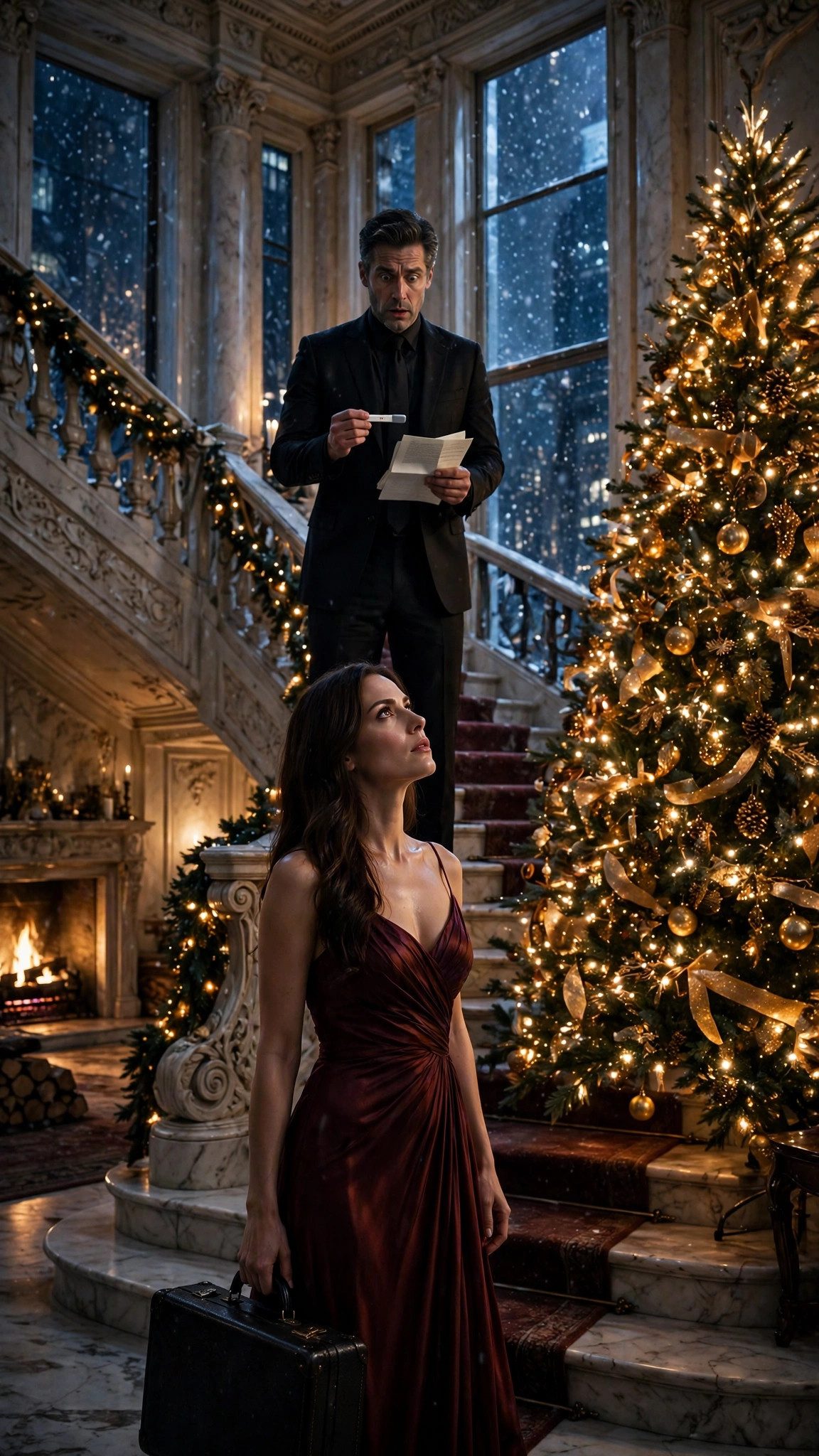
She was wrong about many things in those years. But that was the first time she was wrong about Marcus Vale, and she would remember it later, on Christmas Eve, standing at the top of the grand staircase with three suitcases and a positive pregnancy test, and thinking about all the small silences that had added up to an ending.
In the first year, though, there was only happiness. And if she had known how brief it would be, she would have held it tighter.
She would have held it with both hands, and never let go.
Their first Christmas as a married couple, Marcus surprised her.
Elena had assumed they would spend it at the mansion, with Vivian presiding over a formal dinner and the whole family watching her every move. Instead, Marcus woke her on Christmas morning with coffee in bed, and he told her to dress warmly, and he drove her to St. Catherine's Hospital, to her old ward, where a van was waiting in the parking lot, piled high with gifts.
"For the children who can't go home for Christmas," he said, almost shyly. "I asked the nurses what they needed. There are books, and toys, and warm blankets, and a television for the playroom. I didn't know what to buy, so I bought a little of everything."
Elena stared at him, and then at the van, and then she laughed, and she cried, and she threw her arms around him in the hospital parking lot, in the snow, in front of everyone.
"You did this?" she said. "You did all of this?"
"I asked Rosa what the children wanted," he said. "She gave me a list. I may have gone overboard."
He had gone overboard. There were so many gifts that it took the nurses an hour to carry them all inside. And Marcus stayed for all of it. He carried boxes. He helped set up the television. He sat on the floor of the playroom with a little girl who had lost her hair to chemotherapy, and he let her put a paper crown on his head, and he wore it for the rest of the morning, the most feared man in Chicago, wearing a paper crown, reading a story about a brave little dragon.
On the drive home, Elena held his hand, and she said, "That is who you are, Marcus. Not the man in the newspapers. The man in the paper crown."
He was quiet for a long moment, and then he said, "I want to be that man more often, Elena. With you, I think I can be."
That Christmas, they decorated the tree together, and they hung stockings for children they did not yet have, and Marcus put his hand on her stomach, over her dress, and said, "One day, Elena. One day, there will be a child here, and I will be the kind of father who wears a paper crown."
She believed him. She believed him with her whole heart.
It was the last Christmas they spent together before the silence began. She did not know that then. She only knew that the tree glittered, and the fire burned low, and the man beside her was the best thing that had ever happened to her.