For several seconds, I could only stare at the forged signature.
It looked like mine. The same slant. The same narrow capital E. Even the little mark at the end of Cross, where my pen sometimes caught against the paper. Whoever had copied it had studied my handwriting carefully.
But I had not signed that form.
“I want the original,” I said.
Dr. Avery Lang kept the scanned document on her phone. “The hospital's compliance officer has secured it. The original was submitted electronically, but the authorization was accompanied by a scanned identity document and a medical transport release.”
“Whose identity document?”
“Yours.”
“I haven't given anyone my identification.”
Damian stood beside the table, his expression frighteningly still. Noah was already calling the hospital security director. Neither man spoke over me.
That mattered. I was beginning to understand that the difference between being protected and being controlled would not be measured by what Damian promised. It would be measured by what he did when he was frightened.
“Read the second authorization,” I said.
Dr. Lang looked at the document again. “It grants the medical transport company permission to receive your appointment schedule, current clinical status, and planned delivery location. It also requests notification if you are transferred to another facility.”
My hand moved to my stomach.
“They wanted to know where I would give birth.”
“Yes,” she said quietly.
“And they wanted to know when I was moved.”
“Yes.”
Damian's jaw tightened. “Who approved it?”
“The authorization was accepted by an automated portal using a valid patient identity token. The compliance team caught it during a routine review because the signature did not match the consent form Elena signed when she began prenatal care.”
“Can you revoke it?” I asked.
“Immediately. We can also place a restriction on all external record requests and require direct confirmation from you for every disclosure.”
“Do that.”
Dr. Lang nodded. “I will.”
Damian leaned forward. “I want the company blocked from every hospital system.”
Dr. Lang looked at me instead of him. “Elena, I can request a security hold and notify the relevant privacy officers. The hospital's legal team and police will handle any broader restrictions.”
“That's what I want.”
Damian stepped back. He had heard the decision and allowed it to stand.
Noah ended his call. “The hospital has locked the authorization record. They're preserving the IP logs, the device certificate, and the submitted identity documents. The police are on their way.”
“Can they tell where it came from?” I asked.
“They're tracing the submission route,” Noah said. “The first connection came through the medical transport company's portal. The final authentication was made using a token registered to the old Cross household office.”
Damian looked at him. “That token was supposed to be destroyed.”
“It was. Someone kept a copy.”
“Who had access?”
“Marcus Bell, Peter Vale, and the administrator who managed the household's emergency identity records.”
I turned toward Damian. “Who was the administrator?”
He hesitated.
“Tell me.”
“Lydia Mercer was never an employee of the household,” he said. “But before our divorce, she was listed as an approved personal contact. She helped coordinate some of your appointments and social arrangements when you were busy.”
I stared at him. “You knew she had access to my schedule?”
“She was added to the contact system because you trusted her. I approved the access at your request.”
“I asked you to let her coordinate a charity event. I didn't ask you to give her access to my medical records.”
“I didn't authorize medical access. The old system allowed approved contacts to submit certain requests. It should never have granted her the ability to access your clinical information.”
I remembered the printed schedules in the penthouse. The driver arrangements. The appointment reminders. At the time, I had thought Lydia was simply helping me keep track of an increasingly complicated life.
“Why didn't you tell me she was in the system?”
“I should have.”
I looked away. Every answer seemed to uncover another layer of a life I had not understood while living inside it.
Dr. Lang touched my arm. “Elena, I want to check the baby's heart rate again. The discussion has been stressful, and I don't want you sitting with unanswered medical concerns.”
I nodded.
She adjusted the monitor and watched the reading. The heartbeat was steady, though the Doppler assessment still required close monitoring. She explained that the forged authorization did not itself mean anyone had interfered with my treatment. The hospital had not released the records, and no change had been made to my care plan.
I closed my eyes with relief.
“Your daughter is still responding well,” she said. “We'll continue the monitoring schedule. If the placental blood-flow measurements worsen, we will discuss delivery. Nothing about this security incident changes that medical decision.”
“Thank you.”
Damian remained by the window while Dr. Lang finished. He did not ask to see the chart. He did not demand the next scan results. He waited until I looked at him.
“May I ask you something?” he said.
“Yes.”
“Do you want me to stay while the police speak with you?”
“I want you there, but I want to answer their questions myself.”
“Of course.”
“And I want Noah to be present only if I agree.”
Noah nodded. “Understood.”
Damian looked as though he wanted to object. He glanced at me, then at the papers.
“All right,” he said. “You decide how.”
***
The police arrived twenty minutes later.
Detective Mara Collins introduced herself and explained that she was investigating the attempted access to my medical records alongside the earlier abduction plot. She was direct, calm, and careful not to treat me as an accessory to Damian's business.
She asked me to describe every contact I had received from Lydia after the divorce. I told her about the apartment, the café, the rides home, and the phone call in which Lydia admitted giving Peter Vale my schedule.
Then I told her about the photograph from the basement.
“Did you recognize the woman?” she asked.
“Yes.”
“Are you certain it was Lydia?”
“I'm certain it looked like her. I can't be certain of the date or what she was doing there.”
“That's fair,” Detective Collins said. “We have a clearer image from another camera. It shows her entering the building carrying a small case. She left without it.”
“What was in the case?”
“We don't know yet.”
Damian shifted beside me. “The building was a former residence connected to Elena's family. Why would Lydia have access?”
I turned toward him. “It wasn't connected to my family. It was the building where I rented my first apartment before we met.”
He nodded. “I understand.”
Detective Collins continued. “We found a medical transport badge in the basement. It was issued to a company called Northstar Patient Logistics. That company submitted the forged authorization this morning.”
“Peter Vale's company,” Noah said.
“Vale was listed as a director,” the detective replied. “But the company's registration records show another controlling party.”
She placed a document on the table.
The name was unfamiliar.
“Gideon Shaw,” she said. “He was a logistics consultant for several waterfront companies. He also had a financial relationship with one of the shell companies connected to the shipment in the original abduction report.”
Damian's face changed.
“Shaw worked for the people who wanted the container moved,” he said.
“Can you identify the shipment?” Detective Collins asked.
Damian looked at me before answering. “It was a container of restricted industrial components moving through one of the waterfront yards. The paperwork described ordinary equipment. The actual contents were more valuable, and the shipment was being disputed by two groups.”
“Why would they need Elena?”
“Because they believed I would surrender the container if they had leverage over my wife.”
I looked at him. “Would you have?”
He didn't answer immediately.
“Yes,” he said at last. “If I believed they would hurt you.”
The honesty hurt, but I appreciated it.
Detective Collins made a note. “That gives us a motive. It doesn't establish that the shipment was the only objective.”
“No,” Damian said. “It doesn't.”
The detective turned to me. “Did Lydia know about your marriage difficulties?”
“Yes.”
“Did she know you were afraid of Damian's security arrangements?”
“She knew I felt watched. She knew I wanted to leave. She didn't know the full details of the threat.”
“Did she ever tell you that someone from the security office had contacted her?”
“No. Not until I confronted her.”
Detective Collins closed her notebook. “We need to speak with her. We have already requested her phone and location records. She hasn't answered our calls.”
My stomach tightened. “Do you think she's running?”
“We don't know. She may be frightened. She may be involved. We won't decide that until we have evidence.”
Damian looked at Noah. “Find her.”
Detective Collins raised a hand. “Mr. Cross, the police will locate and interview her. Your people are not to approach her.”
Damian's expression cooled. “I wasn't going to interfere.”
“Then we agree.”
He nodded once.
I watched him accept the boundary. It was not easy for him. I could see that. But he did not challenge it.
The detective left after arranging another interview for the following morning. Noah went with her to provide the security records. Damian stayed.
For several minutes, neither of us spoke.
Then I asked, “What was in that container?”
He looked at the rain beyond the window.
“Equipment used in port operations. Some of it was restricted because it could be repurposed for surveillance and communications interception.”
“Surveillance?”
“Yes.”
“Could it be used to track people?”
“Potentially. The shipment included signal equipment and encrypted communications hardware. The buyers wanted it because it could give them access to private channels.”
I remembered the old security system, the copied credentials, and the messages sent under my name.
“Was the shipment connected to the system that tracked me?”
“We don't know. But the people involved had access to both.”
“Then the shipment wasn't just a way to make you surrender something. It may have been how they got the tools to watch me.”
Damian looked at me. “That's possible.”
“And the person who kept my schedule was helping them understand where I would be.”
“Yes.”
I pressed my hand to my stomach. “They knew where I worked. They knew when I went to the clinic. They knew when I moved. They knew when I was pregnant.”
His expression tightened. “I'm sorry.”
“I don't need another apology. I need to know what you're going to do differently.”
He pulled the chair closer.
“I will tell you what we learn. I will not use your name or your records to authorize anything. I will not send people to your apartment or your workplace without telling you. If I believe there's a danger, I'll explain it and ask what you want to do.”
“And if I disagree?”
“Then I'll listen. If there's an immediate threat, I'll tell you what I believe is safest, but I won't pretend that my fear gives me ownership of your decisions.”
I studied him.
“That's a difficult promise for you.”
“Yes.”
“Why?”
“Because my first instinct is still to take control. It's what I've done for years. I have to learn that being afraid doesn't give me the right to decide for you.”
I looked down at my wedding ring finger. I had not worn the ring in six months. The pale line had almost disappeared.
“Then start by not hiding things.”
“I will.”
***
The next morning, Lydia Mercer was found.
She was at a small hotel near the ferry terminal, using a reservation under her mother's maiden name. The police asked me whether I wanted to speak with her in person. I said yes, but only at the station, with Detective Collins present.
Damian asked whether I wanted him to accompany me.
I thought about it.
“Yes,” I said. “But you stay beside me, not between us.”
He nodded.
At the station, Lydia looked smaller than I remembered. Her hair was pulled into a loose knot, and her eyes were swollen. When she saw me, she stood so quickly that her chair scraped against the floor.
“Elena.”
I did not hug her.
Detective Collins explained that the interview was being recorded. Lydia agreed to answer questions.
“Why were you in the basement?” I asked.
She looked down at her hands.
“Because Peter told me Marcus had been hurt.”
“Did you know Marcus?”
“No. I had only heard the name.”
“Then why did you go?”
“He said he had information about the person who had been following you. He said he needed me to bring the access badge so he could get into the building.”
“You knew the badge was connected to the medical transport company?”
“I thought it was a visitor badge.”
I stared at her.
“Lydia, you were carrying a medical access card.”
“I didn't know what it opened.”
“Why did you take it?”
She began to cry.
“Because Peter told me you were in danger. He said the people who had tried to take you before had found out about the baby. He said they were going to get your delivery location and that he needed to stop them.”
“By giving him access to my medical records?”
“He said the badge would let him see whether the hospital had received a request. He told me he could cancel it.”
I felt anger rise through the shock.
“You believed him?”
“I wanted to.”
“That isn't the same thing.”
She nodded, crying harder.
Detective Collins leaned forward. “Did Peter tell you who was paying him?”
Lydia shook her head. “He said Gideon Shaw was involved. He said Shaw had hired people to collect information about Elena because Damian had taken something from him.”
Damian's voice was quiet. “What did I take?”
Lydia looked at him. “The container.”
He stared at her.
“He said you had changed the shipping records and kept the equipment. He said the shipment belonged to his people.”
“The container was held because the documentation was fraudulent,” Damian replied. “It was not stolen.”
“I don't know the details. That's what Peter told me.”
“Did you know about the planned abduction?” I asked.
Lydia wiped her cheeks. “Not at first. I found out after the charity dinner. Peter said the men had been paid to take you, but the plan failed. He said they would try again if Damian didn't release the shipment.”
My throat tightened.
“You knew someone had tried to abduct me, and you kept giving them my schedule?”
“I thought Peter was trying to protect you from them.”
“You gave him the exact information they needed.”
“I know.”
“Why didn't you tell me?”
She looked at me, desperate. “Because I was afraid you would tell Damian. Peter said Damian would make everything worse. He said the people behind the shipment had people inside the police and the port authority. He said if Damian knew, he would start a war.”
I looked at Damian.
He did not move.
“Did you believe that?” I asked.
“I believed everyone was dangerous. I thought I could help you without making it worse.”
“You made it worse.”
“I know.”
Detective Collins asked about the forged authorization. Lydia said Peter had asked her to scan an old copy of my signature from a document she had kept from the time she helped organize my appointments. She claimed she had not known the form would authorize access to my delivery location.
“Why did you keep a copy of my signature?” I asked.
“It was on the event paperwork. You signed the vendor agreements, and I kept the folder because I thought you might need it.”
“You used it.”
She covered her face.
“I was told the form would let them confirm your records were protected. Peter said the hospital had already been compromised.”
“You could have called me.”
“I was ashamed.”
I stared at her for a long moment.
“You were my friend.”
“I know.”
“No. You knew my schedule. You knew where I lived. You knew when I was alone. You knew how afraid I was of being controlled. And you used that knowledge to give someone access to me.”
“I thought I was saving you.”
“You never asked what I wanted.”
She had no answer.
Detective Collins ended the interview after Lydia agreed to provide her phone, the badge, and every message she had received from Peter. She would remain available for further questioning. The police would determine whether her actions amounted to criminal involvement or whether she had been manipulated into assisting the scheme.
Outside the interview room, I leaned against the wall.
Damian stood a few feet away.
“Do you want to leave?” he asked.
“Yes.”
“Would you like my arm?”
I looked at him. Then I nodded.
He offered it without pulling me toward him.
We walked slowly through the corridor.
“I don't know whether I can forgive her,” I said.
“You don't have to decide today.”
“I trusted her.”
“I know.”
“And she was afraid of you.”
Damian stopped.
I turned toward him.
“She believed you would make everything worse. Maybe because she had seen how you treated me.”
He looked down. “I can't blame her for recognizing what I refused to see.”
It was the first time I had heard him acknowledge that his behavior had affected other people's judgment of him.
“Lydia made her own choices,” I said. “You made yours. I made mine.”
“Yes.”
“I don't want to spend the rest of my life deciding which one of you was more afraid.”
He nodded.
“Neither do I.”
***
That afternoon, Dr. Lang called with the latest scan results. The placental blood flow remained reduced, but the measurements had not worsened. The specialist recommended continued monitoring and another scan the next morning. If the readings remained stable, I could stay in the hospital under observation. If they deteriorated, the team would discuss delivery.
I listened carefully, asked questions, and signed the updated monitoring consent.
Damian waited until I finished.
“Do you want me to call anyone?” he asked.
“No.”
“Do you need anything?”
“A quiet room.”
He almost smiled. “I can manage that.”
“You can ask the nurses whether there's a quieter room available. Don't demand one.”
“I'll ask.”
He went to the nurses' station himself. When he returned, he told me the charge nurse would move me if a suitable room became available. He had not mentioned his name or his business. He had simply asked.
I watched him sit beside the bed.
“Thank you,” I said.
He looked surprised.
“For asking.”
“I should have done it years ago.”
“Yes.”
He reached for my hand, then stopped.
“May I?”
I looked at his open palm.
“Yes.”
His fingers closed gently around mine. For a moment, we sat without speaking.
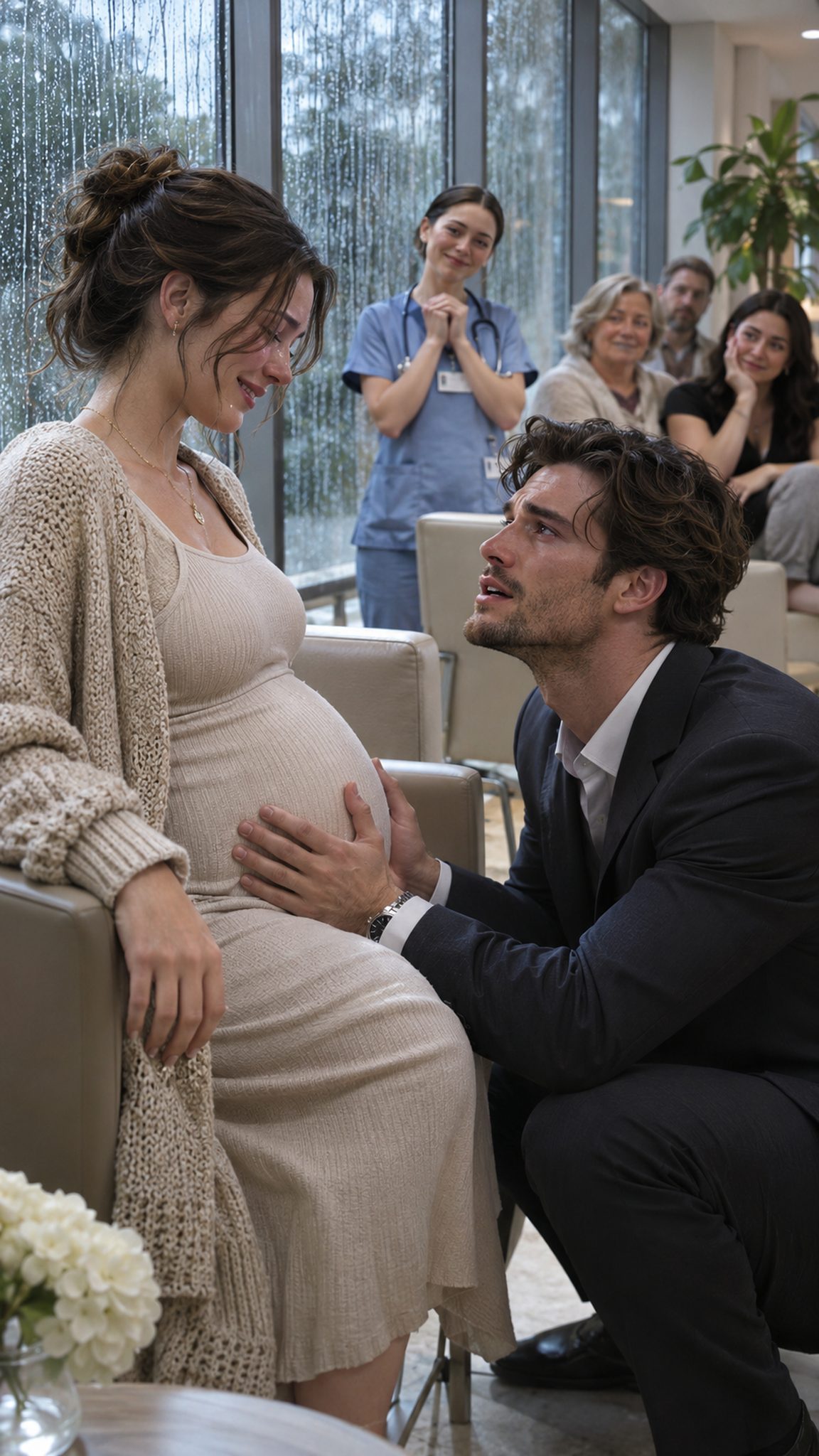
I remembered the man who had proposed on the penthouse terrace, promising me a safe life. I remembered the husband who had canceled my plans, monitored my movements, and signed the divorce papers without a fight. I remembered the man kneeling on the clinic floor, trembling beneath the movement of a daughter he had never known existed.
They were all Damian.
I did not know which one would remain when the danger passed.
But I knew I could not build a future with a man who only changed when he was afraid of losing me.
“I want our daughter to know you,” I said.
His grip tightened slightly, then relaxed.
“I want that too.”
“But she needs to know that love isn't ownership.”
“I agree.”
“She needs a father who can hear no.”
“I'll learn.”
“You can't promise me you'll never be afraid.”
“No. I can't.”
“But you can promise me you won't turn fear into rules.”
He looked directly at me.
“I promise.”
I did not tell him I believed him completely. Trust was not a switch. It was something that would have to be rebuilt through ordinary moments, repeated decisions, and the freedom to disagree.
For now, I let him hold my hand.
***
That evening, Noah arrived with an update from the police.
Gideon Shaw had been located.
He was staying at a waterfront hotel under his own name. Investigators had obtained a warrant to search his suite and his business records. They believed he had financed the original abduction attempt and the later surveillance operation.
But there was a problem.
The container at the center of the dispute had never been recovered.
The shipping records showed that it had been moved from the original yard to a temporary holding facility shortly before the charity dinner. Then the trail stopped.
“Could the equipment still be inside?” I asked.
Damian nodded. “Possibly.”
“Could it be used to access the old security system?”
“The equipment could be used to intercept communications. It wouldn't automatically grant access to the system, but it could help someone capture credentials.”
Noah placed a second document on the table.
“The police found a transfer order in Lydia's phone. It was sent the morning after the charity dinner. It lists a second destination for the container.”
Damian read the address.
His expression changed.
“What is it?” I asked.
“An old private medical storage facility.”
I looked at Dr. Lang, who had just entered to check my monitor.
“Why would a shipping container go to a medical storage facility?”
Damian turned the paper over. “It was owned by a company that handled emergency supplies for private clinics.”
Noah pointed to a line at the bottom.
“The company closed two years ago. But the building is still active. Someone has been paying the utilities.”
I felt the old fear returning.
“Could they have been storing medical equipment there?”
“Maybe,” Noah said. “But the police found something else in the transfer order.”
He placed a photograph on the table.
It showed a small metal case, the same type that had been seen in Lydia's hand outside the basement.
Damian stared at it.
“Where was this taken?”
“Inside the storage facility. The police haven't entered yet. They found the image on a phone recovered from Peter Vale.”
Dr. Lang looked closer.
“That symbol,” she whispered.
A small white emblem was printed on the side of the case: a circle divided by a narrow vertical line.
“What is it?” I asked.
Dr. Lang's face had gone pale again.
“It's the old mark used by a private maternal research program.”
Damian turned toward her.
“What research program?”
She hesitated.
“I thought it had been closed.”
“Dr. Lang,” I said. “What program?”
She looked at me, then at the photograph.
“Before I joined this clinic, I worked briefly with a private research group that studied placental blood-flow disorders. They collected anonymized patient data from several hospitals.”
My stomach tightened.
“Was my information part of it?”
“I don't know. I never enrolled you in any research program.”
Damian's voice became dangerously quiet. “Then why is that symbol connected to the facility holding the container?”
Dr. Lang swallowed.
“Because the company that managed the research program was owned by Gideon Shaw.”
The room seemed to tilt.
I looked at the photograph again. The metal case. The old medical facility. The forged authorization. The request for my prenatal records.
Then I remembered the line from the note Peter had delivered.
SHE DESERVES TO KNOW WHAT YOU DID TO KEEP HER QUIET.
“Damian,” I whispered. “What if the shipment wasn't the only reason they wanted me?”
He looked at me.
Dr. Lang slowly opened the medical file.
“There is one more thing I need to check,” she said. “Your pregnancy records contain a laboratory reference number I have never been able to match to our hospital system.”
She turned the page toward us.
The reference number was followed by a date.
The date was two weeks before I discovered I was pregnant.
And beneath it was a notation that had not appeared in any of my previous appointment summaries:
PRIOR MATERNAL SAMPLE — EXTERNAL HOLD.
I stared at the words.
“I never gave anyone a sample.”
Dr. Lang's face tightened.
“Then someone collected it without your knowledge.”
Damian rose slowly.
Outside the window, the rain had begun again.
And for the first time, I wondered whether the people watching me had known about my daughter before I did.