The hospital called me at 4:12 that afternoon, and by 4:13 my whole life was already over. I just did not know it yet.
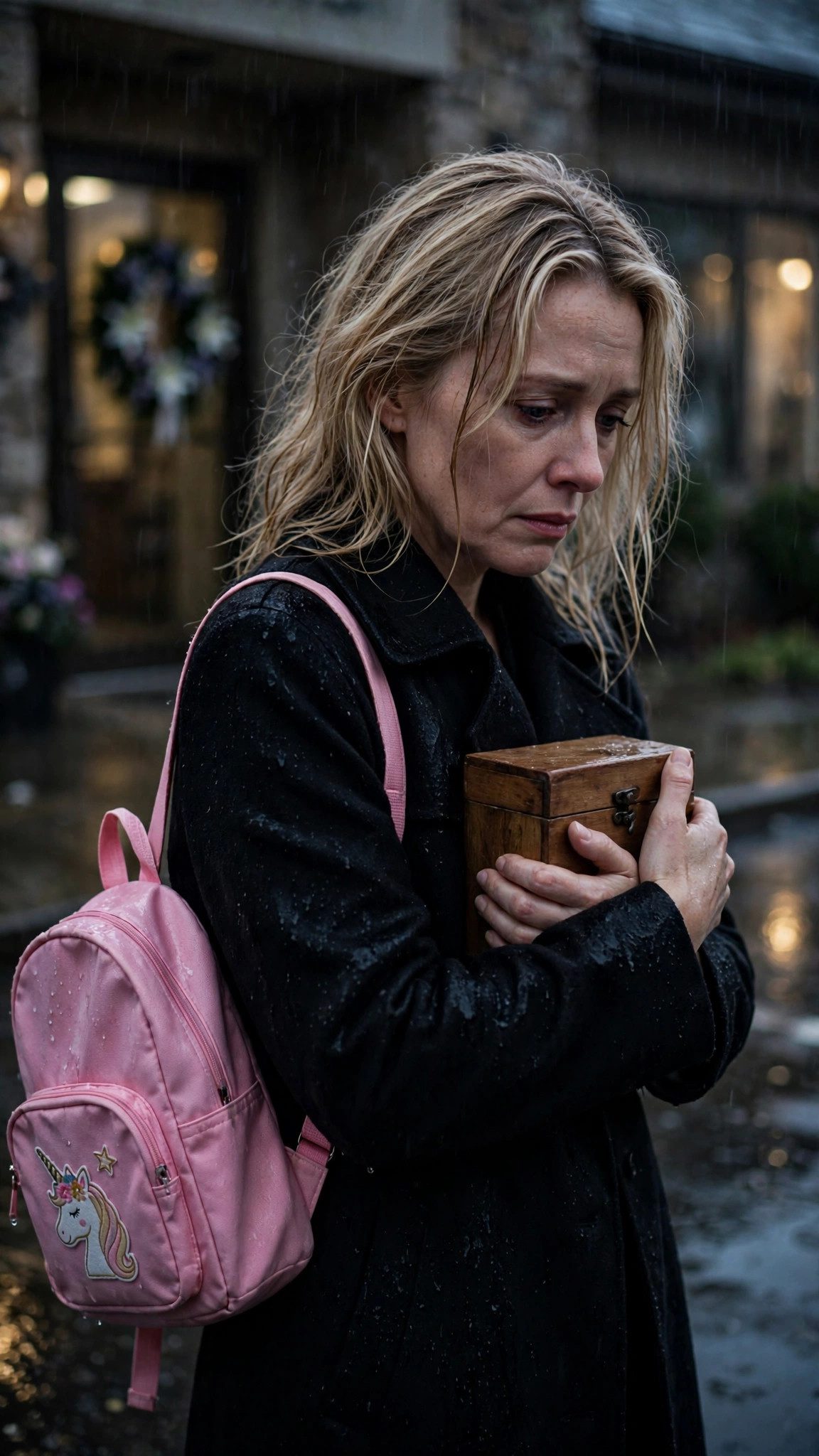
I was standing in the kitchen of our house on Astor Street, peeling apples for a pie Sophie had asked for that morning, when the phone rang. Sophie was seven years old, blonde, and so full of light she could make an entire room smile without even trying. That morning she had climbed onto a stool beside me, her chin on her hands, and said, "Mama, can we make the apple pie with the crisscross top? The pretty one." I had promised her the pretty one. The apples were in a bowl. The dough was resting in the refrigerator. Her backpack was by the door, pink, with a unicorn patch she had sewn on herself, slightly crooked, which she loved precisely because it was crooked.
The phone rang, and I wiped my hands on a dish towel and answered it with a smile still on my face.
"Mrs. DeLuca?" a woman said. Her voice was calm in the way that only trauma nurses are calm, and I knew before she said another word. "This is St. Anthony's Hospital. Your husband has been in an automobile accident."
Everything inside me froze. My first thought was a single desperate question: was Sophie thrown from the SUV? Because that was the only thing that mattered, the only question that had ever mattered since the day she was born. I had given birth to her in this same city, in a hospital not far from St. Anthony's, and from the first second I held her I had understood that my heart no longer lived inside my own body. It lived in hers.
"Is my daughter all right?" I asked. "Is Sophie with him? Please tell me Sophie is all right."
There was a pause. I can still hear that pause. It lasted perhaps two seconds, and it has lasted nine years.
"Mrs. DeLuca," the nurse said, "your husband is alive. He is asking for you. But your daughter—"
I do not remember dropping the phone. I do not remember the drive. I remember the apples rolling across the kitchen floor, one by one, like small red planets falling out of orbit. I remember a neighbor's hand on my shoulder. I remember the automatic doors of St. Anthony's opening in front of me like the mouth of something that wanted to swallow me whole.
Adrian was sitting in a plastic chair in the emergency department, his suit torn, his hands covered in blood. Not his blood. Her blood. He looked up at me, and in his eyes I saw something I had never seen in nine years of marriage. It was not grief. Grief I could have understood. It was guilt. Raw, animal guilt, the kind that lives in a man who knows exactly what he has done.
"Claire," he said.
I went past him. I did not touch him. I walked to the room where they had put my daughter, and I held her cold hand, and I understood that the pie would never be finished, and the unicorn backpack would stay by the door forever, and that the light had gone out of every room in the world.
They told me later that Adrian's SUV had gone off a mountain road and slammed into a tree. They told me he had been driving too fast on a curve he knew was dangerous. They told me Sophie had died in his arms, that he had held her and told her he loved her while her blood soaked into his shirt.
What they did not tell me that day — what I learned at her funeral, standing beside a small white coffin that should never have existed — was the truth. Adrian had not been driving Sophie anywhere near that dangerous curve for any reason a father would understand. He had used our daughter as cover. He was taking his mistress, Vivian Cole, to the airport. They were going to disappear together, just for a weekend, just for a secret trip, and he had taken our seven-year-old daughter along so that no one would ask questions. A man driving his little girl to the mountains looks like a father. A man driving his mistress to the airport looks like exactly what he is.
Sophie died because her father needed an alibi.
That is the sentence I have carried for nine years. I have said it to myself in the dark a thousand times, and it has never once become easier to carry. Sophie died because her father needed an alibi.
My name is Claire DeLuca. For nine years I was married to Adrian DeLuca, one of the most powerful men in Chicago. People who did not know him called him a businessman. People who did know him called him nothing at all, because you did not say his name aloud unless you had to. He owned restaurants and warehouses and a fleet of trucks that moved through the city at night, and everyone in Chicago understood that the trucks did not only carry restaurant supplies. But in our house, in the beginning, he was only Adrian. He was the man who had met me when I was twenty-six and working the front desk of a hotel on Michigan Avenue, and who had looked at me the way a man looks at a door he did not expect to open.
I was not born into his world. I was born in a two-bedroom apartment above a bakery in Pilsen, the daughter of a schoolteacher and a bus driver. I had a small life and I liked it. I liked the smell of bread in the morning and the sound of the bus brakes outside and the way my mother hummed while she graded papers at the kitchen table. Adrian came into that life like weather. He was thirty-four, already powerful, already feared, and he pursued me with a patience I mistook for love. Flowers every Friday. Dinner reservations I could never have afforded. A ring with a diamond so large I laughed when I saw it, because it looked like something from a movie, and he laughed too, and said, "Then let us live in a movie."
We married in a church with two hundred guests and a string quartet. I wore my mother's veil. Adrian cried when I walked down the aisle, and I believed those tears for nine years. I believed them when Sophie was born, when he held her against his chest in the delivery room and whispered, "She has your light, Claire. She has all your light." I believed them on every birthday, every Christmas morning, every night he came home and read Sophie a story in the armchair by the fire, doing all the voices, making her laugh so hard she would fall off his lap.
Sophie was the best of both of us and none of the worst. She had my blonde hair and his dark eyes, and she had a way of looking at people as if she could see straight through to whatever was good in them. She made friends with the mailman and the woman who swept the church steps and the old man who sold newspapers on the corner. She once gave her birthday money to a girl at school whose shoes had holes in them, and when I asked her why, she said, "Mama, her feet were cold. I have warm feet. It was only fair."
I look back now at those nine years and I try to find the moment when it all went wrong, and I cannot find a single moment, because there was no single moment. There were only small ones. Adrian staying late at the office more often. Adrian taking calls in the study with the door closed. Adrian coming home smelling faintly of a perfume that was not mine, and when I asked him about it, he said it was a client's wife, a hostess, a woman from the restaurant, and I believed him, because believing him was easier than the alternative, and because I had a daughter who needed her father to be a good man.
Vivian Cole. I know her name now the way you know the name of a disease. She was thirty-one, dark-haired, beautiful in the sharp way that cuts. She worked in one of Adrian's restaurants, then she did not work in the restaurant anymore, and then she had an apartment Adrian paid for, and then she had a car Adrian paid for, and then she had my husband. I found out all of this later, piece by piece, the way you find out about a fire after the house has already burned down — from the neighbors, from the bank statements, from the phone records, from the silence of men who had once called Adrian their friend and now would not meet my eyes.
But on the day Sophie died, I did not know any of it. On the day Sophie died, I only knew that my daughter was gone and my husband was sitting in a plastic chair with her blood on his hands, and that something in his eyes was wrong in a way I could not yet name.
At the funeral, three days later, I learned the rest. I learned it from a woman I had never met, a nurse from St. Anthony's who came to the funeral home and found me in the hallway and said, "Mrs. DeLuca, I thought you should know. Your husband was not alone in that car." And then she told me about Vivian Cole. She told me Vivian had been in the passenger seat. She told me the airport. She told me everything the police report had left out, because the police report had been written by men who owed Adrian DeLuca favors, and favors in Chicago are worth more than truth.
I stood in that hallway and I felt something inside me go very still and very cold. I looked through the doorway at the small white coffin, and at Adrian sitting beside it with his head in his hands, performing grief for the room, and I understood that the man I had married had used our daughter as a shield for his sin, and that shield had shattered, and my little girl had paid for it with her life.
That night, after the funeral, I took Sophie's ashes and I disappeared.
I did not leave a note. I did not take the jewelry or the money in the safe. I took a suitcase, my daughter's ashes in a small wooden box, and the unicorn backpack, because I could not bear to leave it by the door. I drove north, out of Chicago, into the dark, and I did not look back.
Within days, my husband was tearing Chicago apart trying to find me. His men knocked on doors. His lawyers called my mother. His money bought eyes on every street. But I was gone, and I intended to stay gone, because I had one thing left in this world that was mine, and it was the truth about what had happened to my daughter, and I was going to find all of it, every last piece of it, before Adrian DeLuca ever found me.
I was forty-three years old. I was no longer the naive wife I used to be. And I was not afraid anymore, because the worst thing that could ever happen to me had already happened, and a woman who has buried her seven-year-old daughter has nothing left to lose.
That was the last thing I ever expected to say about myself. But it was the truth. And the truth, I was about to learn, was only the beginning.
That night, after the hospital, I did not sleep. I sat in Sophie's bedroom, on the floor beside her small bed, with her stuffed rabbit in my lap. The rabbit was gray and worn, missing one button eye, and Sophie had named him Mr. Buttons even though he only had one button left. She had carried him everywhere. She had slept with him every night since she was three. I held him against my chest and I could still smell her on him — baby shampoo and strawberry jam and the clean, sweet smell of a child who has spent the day running in the sun.
Adrian came home at midnight. I heard his key in the door. I heard him walk through the house, slow and heavy, like a man twice his age. He stood in the doorway of Sophie's room and looked at me sitting on the floor, and he said, "Claire." Just my name. Nothing else. He did not come in. He did not kneel beside me. He stood there, and I looked up at him, and I saw the blood was still on his shirt, dried now, dark brown, and I thought about how he had held her, and how her blood had soaked into him, and I wondered if he would ever be able to wash it out.
"Go to bed, Adrian," I said. "There is nothing to say tonight."
He went. I stayed. I stayed in Sophie's room until the sun came up, and when the light came through the window and fell across her empty bed, I understood something I had not understood before. The worst thing in the world had happened, and I was still alive, and being alive meant I had a job to do. I did not know what the job was yet. I only knew that it involved the truth, and that I would find it, no matter how long it took or how far I had to go.
In the morning, the neighbors came. Mrs. Delgado from next door brought a casserole and cried on my shoulder. The mailman left a card in the mailbox. The woman from the church brought flowers. Everyone said the same thing — I am so sorry, I am so sorry, if there is anything I can do — and I nodded, and I thanked them, and I felt nothing, because grief had hollowed me out and there was nothing left inside to feel with. I was a house with the lights off. I was a room with the furniture covered in sheets. I was a mother without a daughter, and I did not know how to be anything else.