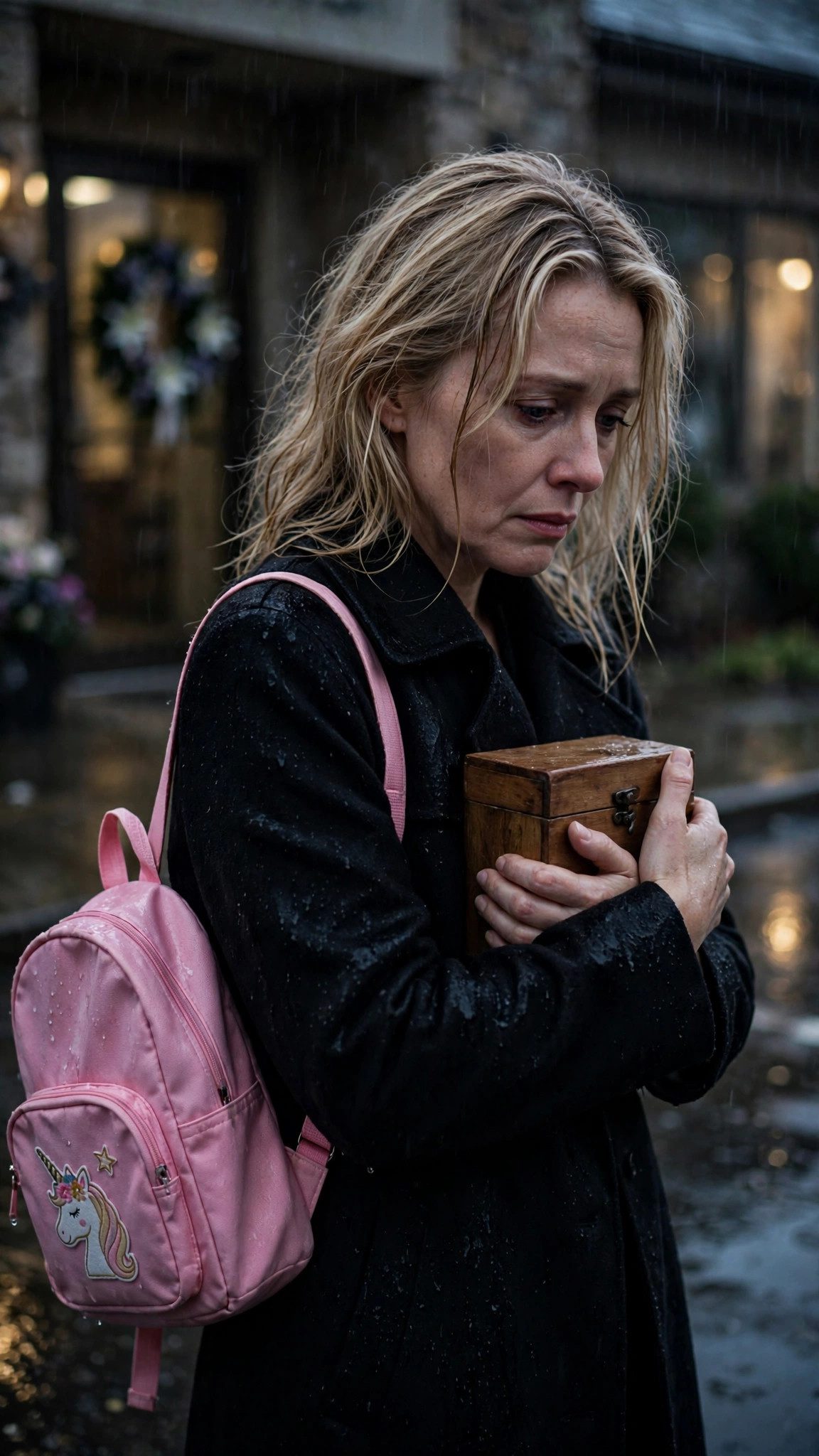
Detective Hale arrived before dawn, with two uniformed officers and a crime scene team. They went down to the rocks below the cliff, and they brought Nicholas Cole's body up in a bag, and Hale stood beside me on the porch of the cabin and said, "Tell me everything again. Slowly. From the beginning."
So I told him. I told him about the hospital call at 4:12. I told him about the funeral, and the nurse, and Vivian Cole, and the airport. I told him about the photographs Frank had sent, and the brake lines cut clean by hand. I told him about Nicholas coming to the cabin, and his confession, and the chase, and the cliff. I told him everything, and I did not leave anything out, because I had learned that secrets were what had killed my daughter, and I was done with secrets.
Hale listened without interrupting. When I finished, he was quiet for a long time. Then he said, "Mrs. DeLuca, I believe you. And I am going to prove all of it. But I need you to come back to Chicago with me. I need you to be safe. And I need you to testify."
I looked at Sophie's ashes on the windowsill. "I will come," I said. "But I am not hiding anymore. If Adrian wants to find me, let him find me. I am not afraid of him. I am not afraid of anyone anymore."
The drive back to Chicago took four hours. I sat in the back of an unmarked police car with Sophie's ashes in my lap, and I watched the cornfields give way to suburbs, and the suburbs give way to the city, and I thought about how strange it was to be coming home to a place that was no longer home.
Hale had already been working. While I was hiding in Cedar Falls, he had been building a case — quietly, carefully, the way a man builds a house, one brick at a time. He showed me the file in his office at the precinct, and it was thicker than a phone book.
The brake lines. Frank's photographs were the beginning, but Hale had gone further. He had gotten a warrant for Nicholas Cole's garage, and in a locked drawer he had found a set of cutting tools, and on one of them, a pair of heavy shears, there were traces of brake fluid and metal shavings that matched the SUV. He had found Nicholas's calendar, and on the day of the crash there was a single entry, written in Nicholas's handwriting: "A. — airport run, 2 PM." He had found phone records showing that Nicholas had called Vivian forty-seven times in the week before the crash, and that she had not answered a single one.
"Vivian knew," Hale said. "She knew Nicholas knew about the affair. She was terrified of him. That is why she wanted to leave for Miami with Adrian. She was not running toward a new life. She was running away from her husband."
And then there was Adrian. Hale's file on Adrian was even thicker. The police report on the crash, written by Sergeant Doyle, who had been on Adrian's payroll for six years. The bank records showing payments from Adrian's companies to Doyle, to the tow truck driver, to the impound lot manager. The phone records showing that Adrian had called Doyle seventeen minutes after the crash — before the ambulance had even arrived. The airport records showing that Vivian Cole had a ticket to Miami on a flight that left at 5:40 that afternoon, a flight she never took.
"He knew," I said. "Adrian knew the brakes had been cut. He knew Nicholas had done it. And he covered it up."
"Yes," Hale said. "He covered it up because if the truth came out, everyone would know he had taken his seven-year-old daughter on a drive to the airport to cover up his affair. And he covered up Vivian's murder because if the police investigated her death, they would investigate the crash, and if they investigated the crash, they would find the brakes. Adrian DeLuca was not protecting Nicholas. He was protecting himself."
I sat in Hale's office and I felt something I had not felt in weeks. It was not happiness. It was not peace. It was clarity. For the first time since the hospital called at 4:12, I could see the whole picture, and the picture made sense. My daughter had died because her father needed an alibi. Vivian had died because her husband wanted revenge. And Adrian had buried the truth about both of them because the truth would have destroyed him.
"Arrest him," I said.
"We will," Hale said. "But I need your testimony. I need you to tell a grand jury everything you told me. I need you to tell them about the funeral, and the nurse, and the airport. I need you to be brave one more time."
I thought about Sophie. I thought about the apples. I thought about the promise. And I said, "I will testify. I will tell them everything."
The arrest happened three days later, at dawn, at the house on Astor Street. I was not there — Hale did not want me there — but he told me about it afterward. Adrian was in the kitchen, making coffee, wearing a robe, and when the officers came through the door, he did not run. He did not fight. He looked at them and said, "I know why you are here." And then he asked one question. "Where is Claire? Is she safe?"
Hale told him I was safe. Hale told him I was the one who had brought him down. And Adrian — this man who had ruled Chicago for twenty years, this man who had never once admitted to being wrong — put his head in his hands and wept.
I do not know if those tears were real. I hope, for Sophie's sake, that they were. Because if they were real, then somewhere inside that man, there was still a father who loved his daughter. And if they were not real, then he was exactly what I had come to believe he was: a man who had used his own child as a shield, and who would use anything, anyone, to save himself.
The charges were read out on the television that night. Reckless driving causing death. Obstruction of justice. Conspiracy to conceal a crime. Bribery of a police officer. The news anchors said his name over and over again, and for the first time in nine years, I heard Adrian DeLuca's name spoken aloud without fear. It was just a name. A name attached to a man who was going to prison.
Sergeant Doyle was arrested the same day. The tow truck driver. The impound lot manager. All of them, one by one, like dominoes falling. Hale called it "cleaning house." I called it justice. It was not enough — nothing would ever be enough, because nothing would ever bring Sophie back — but it was something. It was a beginning.
And then Hale took me to the hospital morgue. I had asked to see Vivian Cole. I needed to see her, not because I loved her, but because I needed to understand her. She had been my husband's mistress. She had been in the car when my daughter died. She had been strangled in her own home. And in the end, she had been a victim too — a woman who had made terrible choices, and who had paid for them with her life.
I walked into the morgue as fast as I could, knowing that she was lying in a drawer. I stood in front of it, and I said, "Vivian. I cannot believe you died. I need you to know something. I do not forgive you. But I understand you. You were afraid. You were running. And I am sorry that no one saved you. I am sorry that I could not save you, and I am sorry that I could not save my daughter. I am sorry for all of it."
And then I turned around, and I walked out, and I did not look back, because looking back was what had kept me trapped for nine years, and I was done looking back.
The truth was out. The brakes had told it. The photographs had told it. Nicholas had told it, with his dying breath on the edge of a cliff. And now it was time for the last chapter — the chapter where I stopped being the wife of Adrian DeLuca, and started being Claire again.
The grand jury met on a Tuesday. I remember that it was a Tuesday because Tuesdays had always been the slowest days at the hotel, and now they were the days when my life changed.
The prosecutor's name was Angela Torres. She was forty, sharp, with dark hair pulled back and eyes that missed nothing. She met me in her office the day before I testified, and she said, "Mrs. DeLuca, I need you to understand something. This case is not just about Adrian. It is about a system. It is about men who believe they can buy the truth, and bury it, and walk away. Your testimony is the thing that breaks that system. Are you ready?"
I said I was ready. I was not ready. No one is ever ready to stand in front of strangers and tell them the worst thing that ever happened to her. But I did it anyway, because Sophie deserved it, and because the truth deserved it, and because I had come too far to stop now.
Angela showed me the evidence, piece by piece, so I would understand what the jury would see. The bank records, showing payments from Adrian's companies to Sergeant Doyle — twelve payments, over six years, totaling more than four hundred thousand dollars. The phone records, showing Adrian's call to Doyle seventeen minutes after the crash. The tow truck driver's statement, given to Hale in exchange for immunity, saying that Adrian had told him, "Take the car to the south lot. Do not let anyone look at the brakes." The impound lot manager's statement, saying the same thing.
And then there was Vivian's phone. Hale's team had found it — not in her apartment, where Nicholas had said he took it, but in a locker at Nicholas's garage, wrapped in a plastic bag, hidden behind a stack of tires. The phone had photographs on it. Photographs of Vivian and Adrian together. Photographs of the apartment on Wacker Drive. And a voice memo, recorded the night before the crash, in which Vivian said, "If anything happens to me, it was Nicholas. He knows. He has been following me. I am afraid of him. I am leaving with Adrian tomorrow, and I am never coming back."
I listened to that voice memo in Angela's office, and I cried for the first time in weeks. Not for Adrian. Not for myself. For Vivian. For a woman who had been afraid, who had been running, who had known she was in danger, and who had died anyway. She had made terrible choices. But she had not deserved to die. No one deserves to be strangled in her own home by a man she once loved.
"She was a victim too," I said to Angela.
"Yes," Angela said. "She was. And the jury needs to hear that from you. They need to hear that you understand it. Because it makes your testimony stronger, not weaker. It shows them you are not here for revenge. You are here for the truth."
The media found out about the case the week before the trial. There were cameras outside the courthouse. There were reporters who wanted to talk to me. I did not talk to them. I had nothing to say to the cameras. I had everything to say to the jury, and that was enough.
On the morning I testified, I woke up at 4:12, the way I always did. I made coffee. I put on the navy dress. I put Sophie's ashes in my purse. And I drove to the courthouse with Detective Hale, and I walked through the doors, and I told the truth. And the truth, as it always does, stood still, and everything else fell down around it.
Hale's investigation did not stop with Adrian and Doyle. Once the first domino fell, the rest followed, faster and faster, the way dominoes always fall.
The tow truck driver, a man named Eddie Marsh, came forward on his own. He walked into the precinct one morning, sat down across from Hale, and said, "I want to make a deal." He told Hale everything — about the phone call from Adrian, about the money, about the instructions to take the car to the south lot and not let anyone look at the brakes. He told Hale that he had known it was wrong, and that he had done it anyway, because Adrian DeLuca had paid him ten thousand dollars, and ten thousand dollars was more money than he had ever seen at one time. He cried when he told Hale. He said, "I have a daughter too. She is nine. And every night since that crash, I have dreamed about her in the back seat of that car."
The impound lot manager, a man named Carl Whitfield, was next. He did not come forward. Hale went to him, with a warrant and a team, and found the records — the real records, hidden in a safe behind a false wall in his office — showing that the SUV had been moved three times in the first forty-eight hours, each time to a different bay, each time further from the entrance, each time harder to find. "Adrian's people told me to lose it," Whitfield said. "They told me to make it disappear. I did what they told me. I am sorry. I am so sorry."
And then there was the airport. Hale's team pulled the records from O'Hare, and there it was, in black and white: Vivian Cole, ticket to Miami, flight 1847, departure 5:40 PM, the day of the crash. Seat 14A. A window seat. She had chosen a window seat, because she liked to look at the clouds. She had packed a bag. She had told her neighbor she was going on vacation. She had been ready to disappear with Adrian, to start a new life in Miami, to leave Nicholas and Chicago and all of it behind.
She never got on that plane. She died on a mountain road instead — not in the crash, but because of it. Because the crash broke her arm and her spirit, and because Nicholas found her afterward, and because she was afraid, and because she was going to tell the truth. And the truth, in Adrian DeLuca's world, was the most dangerous thing of all.
I read all of this in Hale's file, sitting in his office, with a cup of coffee going cold in my hands. And I thought about how many people had known. How many people had taken money. How many people had looked the other way. And I thought about how alone Sophie had been, in the back seat of that car, with no one to protect her. And I made a promise to myself, right there in that office: I would never look the other way. Not again. Not ever. No matter what it cost me.