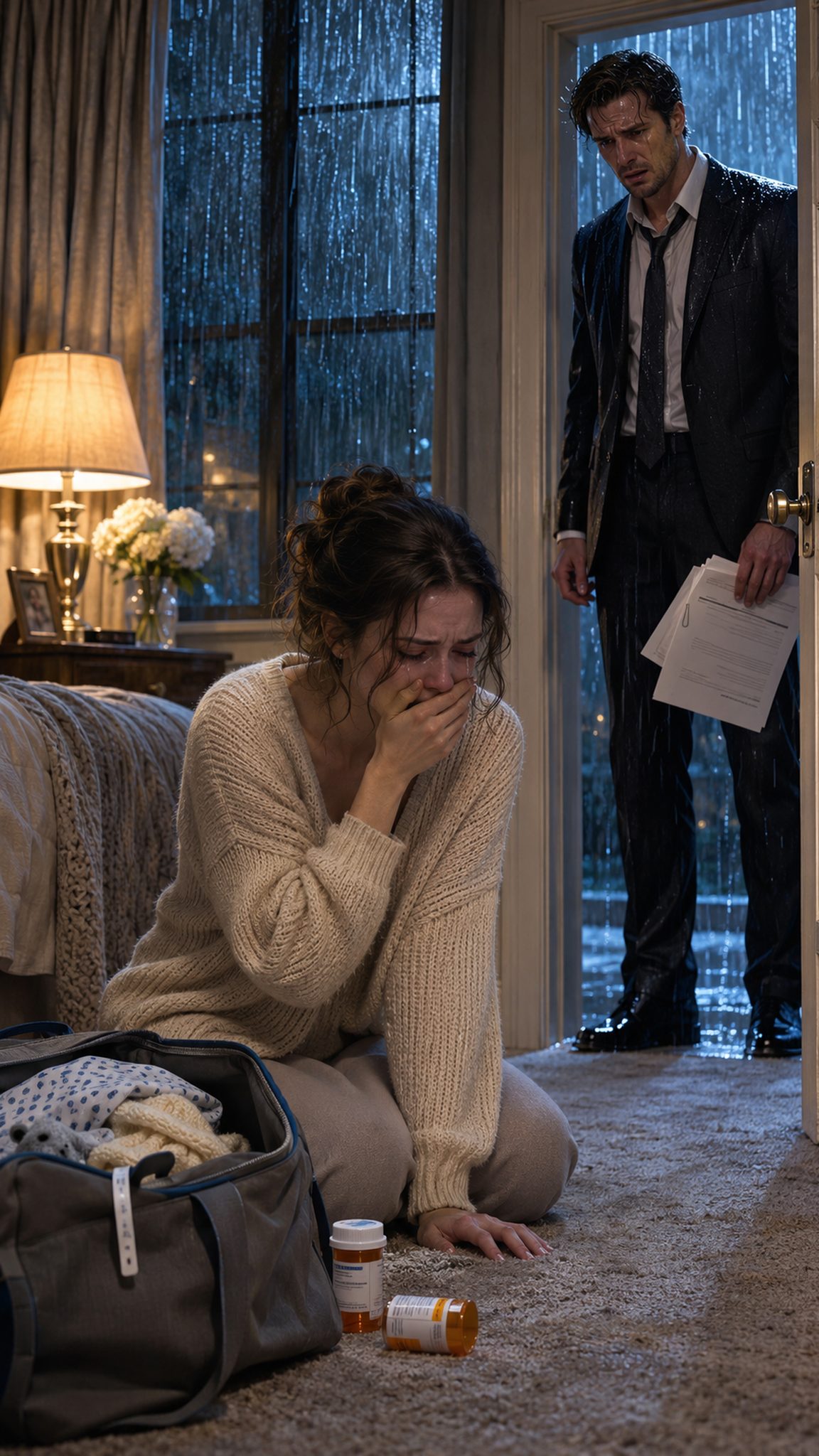
The doctor returned shortly after Claire had finished resting.
He reviewed the latest observations, asked whether the dizziness had returned, and listened while Claire described how she had felt since arriving at the hospital. She answered carefully. Adrian sat beside the window, the medical folder closed on his knees. He did not interrupt or answer for her.
The doctor explained that the team wanted to postpone the infusion until they had completed a little more assessment. The decision was precautionary, not a declaration that the treatment had failed. They would review her symptoms, compare the current results with the previous records, and agree on the safest timing for the next session.
Claire asked what she should watch for after leaving.
The doctor went through the warning signs and the contact procedure. He made sure she understood when to call the treatment team and when to seek urgent care. Claire asked two more questions, then repeated the instructions in her own words to make sure she had understood.
Adrian listened.
When the doctor finished, he asked, "Would it help if I had a copy of the routine instructions, so I can support her at home?"
The doctor looked at Claire.
"If Claire wants you to have them," he said.
Claire considered it. "Yes. He can have the routine instructions. My full medical record stays with me unless I decide otherwise."
"Of course," the doctor replied.
Adrian nodded. "That is fine."
The distinction mattered. Claire was not handing him control of her treatment. She was choosing to let him understand the practical parts of the routine.
The doctor explained the next appointment arrangements and left them with the nurse. Claire was stable enough to go home after the remaining checks, with the infusion rescheduled for a later date.
Adrian helped gather the papers only after she asked. He placed the current instructions in the front of the folder and returned the older documents to their section. Claire checked the order herself.
On the ride home, she rested her head against the window. Adrian sat beside her, leaving the silence undisturbed. When they reached the house, he offered his arm. She accepted it for the short walk from the car to the door.
Inside, he set her bag near the bedroom.
"Would you like something to eat?" he asked.
"Tea first."
He went to the kitchen and made it the way she liked. When he returned, Claire was sitting on the edge of the bed, taking off her shoes.
He put the cup on the bedside table.
"Thank you."
"Do you want me to stay?"
"For a little while."
He sat in the chair.
The room was quiet. The hospital folder lay between them, and the sight of it seemed to pull Claire back toward the conversation they had begun that morning.
"Do you want to know why I didn't tell you everything at first?" she asked.
Adrian looked up. "Yes. If you want to tell me."
"I didn't understand everything myself. At the beginning, there were tests and appointments. The doctors were trying to work out what was happening. I knew something was wrong, but I didn't know how serious it might become."
"You could have told me that."
"I tried."
He lowered his eyes.
"I told you I was tired. I told you I had more tests. I said the doctor wanted to see me again. You asked whether I had scheduled the appointment, and then your phone rang. I thought I'd explain after you finished."
"I didn't come back to the conversation."
"No. And the next time I tried, there was another meeting. Then another call. I began to feel as though I needed to choose the perfect moment to tell you something difficult."
"There shouldn't have been a perfect moment."
"I know that now. But at the time, I was embarrassed. I didn't want to become the wife who was always asking you to come home because she had another appointment or another frightening result."
Adrian listened without looking at his phone or trying to finish her sentences.
Claire continued. "I was also afraid. The doctors were explaining a disease I had never expected to have. I didn't know how it would affect my body or how much treatment I would need. I didn't want to say the worst thing I could imagine before I knew whether it was true."
"You were trying to protect me from being frightened."
"I was trying to protect myself from having to manage your reaction as well as my own."
He absorbed that.
"I understand," he said.
"Do you?"
"I'm beginning to."
Claire took a sip of tea. "There were days when I came home from an appointment and wanted to tell you everything. Then I'd see you working, and I'd tell myself it could wait. Sometimes you were already angry about something at the office. Sometimes you were on the phone before I had taken off my coat. I didn't want to add another problem."
"You weren't a problem."
"I know you don't believe that now. But that's how it began to feel."
Adrian's expression tightened.
"When I finally understood that the treatment would be ongoing, I tried to reach you through the office. I thought Daniel could arrange a time. I didn't want to discuss my medical details with your staff. I wanted to speak to you privately. When the first message went nowhere, I told myself it was a mistake. When the second one disappeared, I stopped trying."
"Why didn't you call my personal phone?"
"I did. More than once."
He looked at her.
"Sometimes it rang until voicemail. Sometimes I sent a message. I know you had a lot happening, but after a while I couldn't bear to leave another message and wait. I didn't want to keep measuring my importance by whether you called back."
Adrian's voice was low. "I am sorry."
"I know. But there's another part. I didn't want to be a burden. I had always been proud of managing my own life. I didn't want to become dependent on you for every appointment, every ride, every difficult day. I wanted to keep some part of myself that wasn't defined by being ill."
"You should have been able to do that."
"I still want to. I don't want you to take over because you're frightened."
"I won't."
"And I need you to understand that asking for help is hard now. Even when I want you here, sometimes I hesitate because I remember how it felt when I asked before."
Adrian leaned forward, resting his forearms on his knees. "Then I need to show you that asking is safe again. I can't demand that you believe me because I say it."
Claire looked at him for a long moment.
"That's the first thing you've said tonight that feels useful."
He nodded.
The next morning, Adrian changed his schedule before leaving the bedroom. He moved two routine meetings to his operations managers and kept the afternoon open for Claire's follow-up call with the treatment team. He told his assistant that the appointment was protected time and that any genuine business emergency should go through the revised escalation process.
The assistant confirmed the arrangement.
"Do you want me to block the whole day?" she asked.
"No. Block the appointment and the travel time. The rest of the day stays available for the team to manage."
"Understood."
"And make sure the new family-message procedure is circulated today. No one screens a medical or urgent family message according to their own opinion about whether I should be interrupted."
"I'll send it."
"Have every person acknowledge it. If a message cannot reach me directly, the sender must be told who has received it and what the next step is. No message is marked resolved simply because it has been moved to another folder."
"Understood."
Adrian paused. "And if someone is unsure whether a message is urgent, they pass it on and ask. They don't decide in silence."
The assistant confirmed that she understood.
The procedure was more detailed than the old one. It included a dedicated family and emergency contact channel, a clear backup person when Adrian was unavailable, a record of every transfer, and a requirement that the person responsible confirm receipt. Medical messages were never to be placed in routine scheduling simply because they were personal. Claire could contact Adrian directly, but she would not be forced to depend on a single phone or a single employee.
Adrian also made the arrangement available to senior staff for their own families. He did not want a system in which only his household mattered. Employees were entitled to raise urgent family needs without being treated as disloyal or undisciplined.
Daniel came to the house that afternoon with the completed chronology.
Adrian met him in the study. The attorney placed the report on the desk and explained that the audit history had been preserved. It showed the first message, the deferred status, the second message moved by the shared intake account, the calendar appointment deleted from Adrian's schedule, and the later household message closed without confirmation that it had been handled.
"Have you spoken to the office manager?" Adrian asked.
"Yes. She accepts that she repeated the instruction too broadly and failed to verify the household message. She says she believed the assistant had handled the medical note because it had left the urgent queue."
"Did she know Claire was at the hospital?"
"She saw the wording on the later message."
"And she closed it."
"Yes."
Adrian opened the report. "What about the assistant?"
"She accepts moving the second message. She says she was following the instruction she had been given and was afraid of interrupting you."
"She knew it was medical."
"Yes."
"And you?"
Daniel did not look away. "I deferred the first message, deleted the appointment, and failed to follow up on the household note. I made assumptions about what Claire wanted and about what you meant by keeping personal calls off the schedule."
"Those assumptions cost her the chance to speak to me."
"Yes."
Adrian closed the report. "Your screening responsibility is removed permanently. You will continue the legal work that is properly yours, but you will not control incoming personal or family messages. Your performance review will include this failure. The office manager and assistant will receive formal warnings and retraining. Their access will be adjusted so that no single person can silently recategorize or close a medical message."
Daniel nodded. "That's fair."
"This isn't about making an example of people. It's about making the process reliable. I don't want anyone dismissed to satisfy my anger, and I don't want anyone protected because they work for me."
"I understand."
"Then put the changes in writing."
Daniel gathered his papers. Before leaving, he said, "I am sorry, Adrian. I should have called you the first time."
"You should have."
"I don't expect you to forgive me."
"This isn't about whether I forgive you. It's about whether you understand what your job requires."
Daniel nodded and left.
Adrian remained in the study for several minutes. He had spent years treating his calendar as a shield. If something did not fit into the time he had allocated, he expected other people to make it disappear. The office had learned to anticipate his impatience. He had called that efficiency.
Now he understood that a system designed to protect him from interruption could also isolate him from the people who needed him.
That evening, Claire found him reviewing the new procedure at the kitchen table.
"Is that work?" she asked.
"Partly."
"Should I come back later?"
"No. You're not interrupting."
She sat opposite him. "What are you changing?"
He explained the dedicated message channel, the backup contact, and the confirmation process. He told her that medical messages would be escalated immediately and that no employee would be permitted to decide that a family message could wait without checking.
Claire listened.
"Does the hospital know about this?" she asked.
"No. This is an office procedure. Your hospital contact arrangement remains your decision."
"Good."
"I also want you to have the direct number for the office manager who handles the backup channel, if you ever need it. But you don't have to use it. You can call me directly."
She considered that. "Give me the number, but don't make it another responsibility for me to manage."
"I won't."
He wrote it on a card and handed it to her. Claire placed it in her folder.
"Thank you."
The next appointment took place several days later. Claire's doctor reviewed the assessment from the stormy night and the results of the additional checks. The team agreed that the infusion could be rescheduled under the plan they had discussed, with monitoring during and after the treatment.
Adrian drove her to the hospital. He carried the folder only after she handed it to him. At reception, Claire checked in herself and confirmed her details. Adrian waited beside her.
In the treatment room, a nurse reviewed the medication list and explained the sequence of the visit. Claire asked about the timing, what she should expect, and what she should report if she felt unwell. The nurse answered each question.
Adrian watched carefully.
When the nurse prepared the area, Claire glanced toward him. "You can sit down. You're making me nervous by standing there."
He moved to the chair.
"Sorry."
"You're allowed to be here without supervising every movement."
He gave a small, embarrassed smile. "I'm learning."
The infusion began according to the team's plan. Claire settled back while the nurse monitored her. Adrian kept his phone on silent and placed it face down. He did not take a call when it vibrated. The operations manager could handle the issue unless the agreed escalation conditions were met.
After a while, Claire looked toward him.
"Is something happening?"
"Nothing that needs me."
"You checked?"
"The team handled it. They sent a note that the issue was contained."
She nodded and closed her eyes.
The treatment continued. The nurse checked Claire's observations at the scheduled intervals and asked how she was feeling. Claire answered honestly, including when she felt tired. The team remained attentive and made no promises beyond what the medical plan supported.
Adrian learned the rhythm of the visit: the initial review, the checks, the quiet periods, the questions, and the time needed afterward. He learned that Claire sometimes wanted conversation and sometimes wanted silence. He learned not to treat every pause as a sign that something was wrong.
When the infusion was complete, the nurse explained the monitoring period and the instructions for the rest of the day. Claire listened and repeated the key points. Adrian asked one question about who to contact if the symptoms she had described returned. The nurse gave him the information with Claire's agreement.
On the ride home, Claire looked tired but calmer.
"How was it?" Adrian asked.
"Manageable."
"Did anything feel different?"
"Not in a way I can judge yet. The doctor said we'll watch how I respond."
"All right."
She looked out the window. "You didn't answer your phone."
"The team handled it."
"That must have been difficult."
"It was."
She smiled faintly. "At least you're honest."
He smiled too.
Over the following weeks, treatment continued according to the medical team's plan. Claire had days when she felt stronger and could manage a walk in the garden or prepare a simple meal. She also had days when fatigue returned without warning and she needed to rest. The doctors monitored her symptoms and results. They adjusted the schedule when appropriate and reminded her that progress could be uneven.
Adrian learned the difference between being attentive and being intrusive.
He asked whether she wanted company before appointments. He offered to drive but did not assume she needed him. He kept the home quiet after treatment when she asked, and he stopped bringing work into the bedroom. If he needed to take a call, he explained when he would be available again.
One afternoon, Claire found him in the kitchen preparing a simple meal.
"You don't have to cook," she said.
"I know."
"There's food already."
"I wanted to make something."
She looked at the cutting board. "Are you following a recipe?"
"Approximately."
"That sounds dangerous."
He laughed. "You can supervise if you want."
She came closer and looked at the vegetables. "You've cut those too large."
"I can fix them."
"Let me."
He handed her the knife, then stepped back. She adjusted the pieces and showed him how she wanted them. They finished the meal together, with Claire doing only what she felt comfortable doing.
It was a small afternoon. No emergency, no confrontation, no dramatic declaration. Adrian realized that these were the moments he had missed most: the ordinary exchanges that made a house feel like a shared life.
A few days later, Claire had a difficult morning. She woke exhausted and frustrated that she could not keep the plans she had made. Adrian found her sitting at the edge of the bed.
"Do you want to cancel today?" he asked.
"I already did."
"Would you like me to call anyone?"
"No. I just need to be disappointed for a while."
He sat in the chair.
After a few minutes, she said, "I hate that I can't predict how I'll feel."
"I can imagine."
"You don't have to imagine. You can listen."
He nodded. "Tell me."
She spoke about the frustration of making plans and having to change them, about the way people sometimes treated a better day as proof that she was well again, and about how tiring it was to explain that improvement did not mean the illness had disappeared.
Adrian listened until she finished.
"Would you like me to tell the office not to schedule anything at home today?" he asked.
"Yes, please."
He made the call from the hallway, then returned.
Claire looked at him. "Thank you for not telling me to be positive."
"I don't think you need another person telling you how to feel."
She smiled a little. "You're learning."
That evening, they spoke about the months when she had stopped asking for help.
"I was proud," Claire admitted. "I didn't want to depend on anyone. I thought if I kept everything organized, I could manage without needing to explain myself."
"That wasn't wrong."
"Maybe not. But I also used it as a way to avoid being disappointed. If I arranged the ride, packed the bag, and kept the records, then I didn't have to ask you and wait for an answer."
Adrian looked at her. "I made that feel safer than asking me."
"Yes."
"I wish you hadn't needed to become so independent of me."
"I needed to remain independent of the illness. That's different."
He nodded. "I understand."
She reached for her tea. "I don't want to lose that independence now just because you're trying to be present."
"You won't."
"And if I tell you I want to go alone, you don't take it as rejection."
"I'll try not to."
"Don't try. Ask me what I need."
"All right. I'll ask."
A week later, Adrian received a call from one of the freight-yard managers about a problem with a shipment. The manager explained the issue and the options available. Adrian listened, asked two questions, and approved the course of action within the authority the manager already held.
The call lasted less than five minutes.
Claire had been reading nearby. When he returned, she looked up.
"Was that serious?"
"It needed a decision. The manager had the facts, and he handled it."
"You didn't have to go there?"
"No."
"How does it feel?"
"Strange. But I think strange is better than necessary."
She smiled.
Later that month, the doctor told Claire that some of her observations were encouraging. The treatment appeared to be helping in certain respects, though the disease remained active and required continued care. The doctor emphasized that the team would judge progress over time and that Claire should continue reporting symptoms rather than assuming every difficult day was harmless.
Claire left the appointment with a new set of instructions and a cautious sense of relief.
In the car, Adrian asked, "How are you feeling?"
"Hopeful. Carefully hopeful."
"That sounds good."
"It means I know there is still a long way to go."
"I know."
She turned toward him. "I want to celebrate a little. Not a big dinner. Just something nice at home."
"What would you like?"
"Fresh flowers. And that cake from the bakery near the river."
"I can arrange that."
"Together," she added.
He looked at her and smiled. "Together."
That evening, they ate at the kitchen island with flowers in a glass vase. Claire had a small slice of cake and stopped when she was satisfied. Adrian did not comment on how much she ate. They talked about the appointment, then moved on to a story about one of the staff members at the private club who had accidentally sent a delivery to the wrong address.
Claire laughed.
Adrian watched her, grateful for the sound but careful not to turn it into evidence that everything was fixed.
After dinner, Claire walked to the bedroom and looked at the medical folder on the bedside table.
"I want to keep this here for now," she said.
"Of course."
"But I don't want it to be the only thing we talk about."
"It won't be."
She turned toward him. "And I don't want you to think that one good appointment means I have forgiven everything."
"I don't."
"Trust will take longer."
"I know."
She studied his face. "You seem to be accepting that."
"I have no right to set a deadline for you."
Claire nodded. She placed the new instructions inside the folder and closed it.
Adrian reached for her hand, then waited. She took it.
They stood together for a moment, neither trying to make the gesture mean more than it did.
The next morning, Adrian left for an early meeting. Before he went, he told Claire when he expected to return and gave her the direct number for the office backup contact again. She reminded him that she had already put it in her folder.
"I know," he said. "I just wanted to make sure."
"I'll call if I need it."
He kissed her forehead, then left.
At the office, Daniel delivered the final revised procedures. The new system required a message to remain open until receipt was confirmed or a documented backup action had been taken. Medical and urgent family communications could not be downgraded to routine scheduling without the sender's explicit confirmation. The calendar system now flagged family medical appointments separately from ordinary personal events, and any removal required confirmation from Adrian himself.
Daniel's legal responsibilities were clearly defined. He no longer screened Adrian's personal communications. His professional review recorded the earlier failure and the corrective action. The office assistant and manager completed retraining and signed acknowledgments of the revised process.
Adrian read the final document.
"Send a copy to every department head," he said. "I want the same principle applied across the businesses. People should be able to report a genuine family emergency without being afraid that they'll be punished for interrupting someone."
Daniel nodded. "I'll distribute it."
"And make sure the procedure is tested. A policy that looks good on paper is useless if nobody knows how to use it."
"We'll run a test this week."
Adrian signed the approval.
When he returned home that evening, Claire was sitting by the window. She looked up as he entered.
"You're home early."
"I finished what needed to be done."
"How was work?"
"Busy. Manageable."
She closed her book. "I have something to tell you."
He sat opposite her. "I'm listening."
"The doctor called. The next appointment is confirmed, and they want to keep the current plan. There are still things to watch, but nothing in the call suggested an urgent change."
Adrian felt relief, but he kept his response measured.
"That's encouraging."
"It is."
"Do you want me to come?"
"Yes."
"I'll be there."
She studied him. "I want you there because I want you there. Not because you think you have to prove something."
"I understand."
Claire looked toward the window, where the evening light was fading.
"I think that's what I'm beginning to learn too," she said. "That I can ask for you without giving up the parts of myself I had to protect."
Adrian moved his chair a little closer.
"Then we'll keep learning."
She rested her hand on the arm of the chair. He placed his beside it, close enough for her to choose.
After a moment, Claire reached across the small space between them.
It was not forgiveness. It was not a promise that the difficult months were behind them. It was a small decision to let him sit beside her while they faced what came next.
The treatment would continue. Her health would still require attention. There would be more appointments, more questions, and days when hope felt easier than others.
Adrian had begun to change the way he worked, but changing a schedule was only the beginning. He would have to keep listening when there was no crisis to force him to pay attention. He would have to accept that Claire's independence was not a rejection of him. And he would have to earn, one ordinary day at a time, the trust he had allowed to disappear.
For now, he stayed beside her.
And when the phone rang in the next room, neither of them moved immediately.
The call could wait.
Claire was speaking, and Adrian was listening.