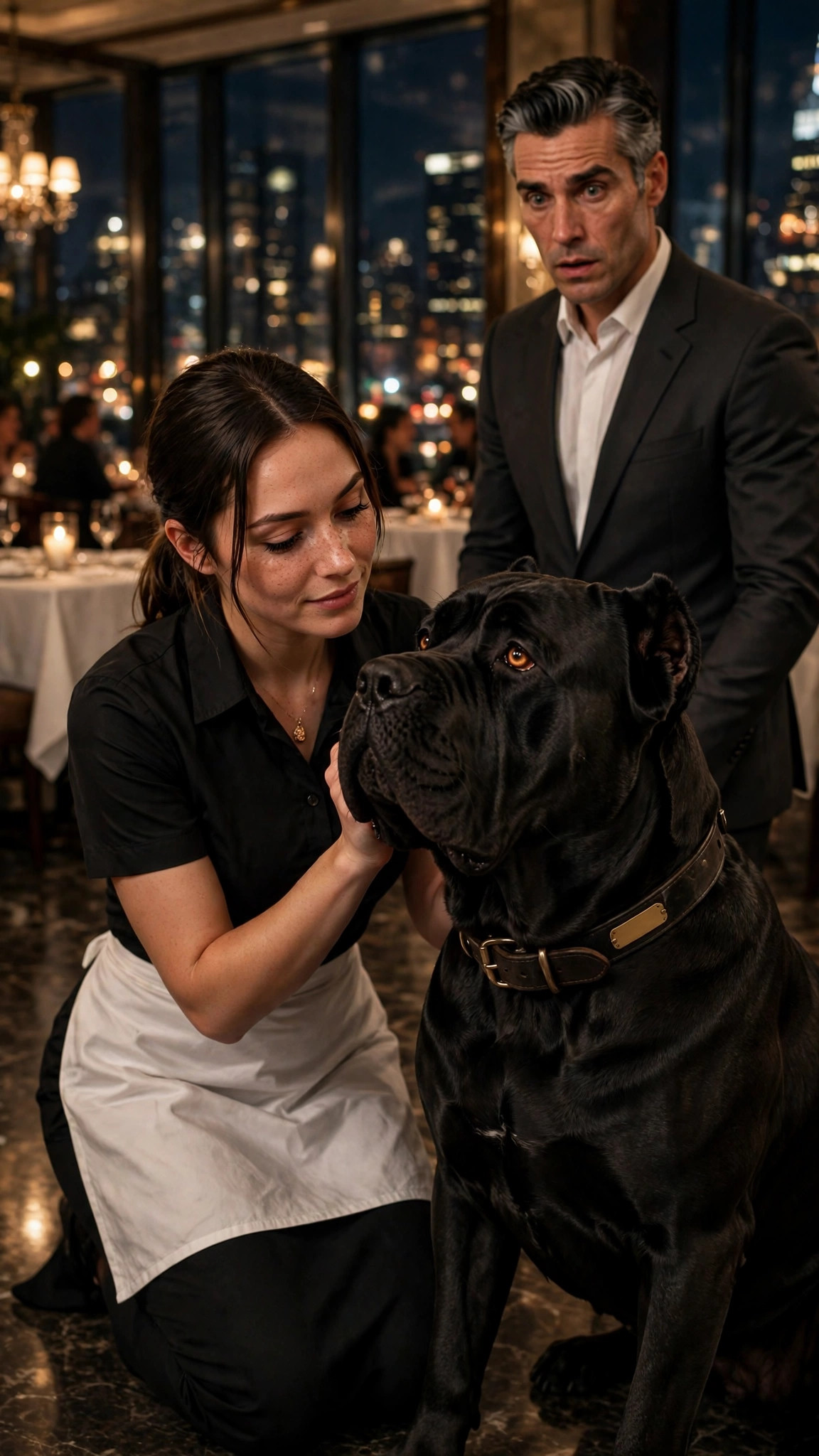
The moment I touched the enormous black dog, a glass shattered behind me.
Every conversation in the Manhattan restaurant stopped. A woman froze with her wineglass halfway to her lips. Two men guarding the entrance moved their hands toward their jackets. And the stranger seated beside the dog stared at me as though I had just crossed a line no one had ever survived crossing.
I was only trying to be kind. I didn't know the dog belonged to New York's most feared mafia boss. I didn't know people had been badly hurt for getting that close to him. All I knew was that his huge, warm head had pressed against my leg — and for one exhausted second, he had made me feel less alone.
My name is Olivia Marshall. I'm twenty-six, and that evening I'd been on my feet so long that every step sent pain up my calves.
But that was later. That was after. To understand why a waitress would reach out her hand to a stranger's dog in the most expensive restaurant in Manhattan, you have to understand the day I'd already had — and the life I'd already lived — before I ever reached table twelve.
The morning had started at five forty-five, with the alarm on my phone buzzing against the chipped nightstand and my cat Miso kneading my ribs as though he were trying to wake the dead. My apartment was a fourth-floor walk-up in Queens, one room and a kitchen the size of a closet, and the radiator clanked all night in winter and the pipes groaned all summer, but it was mine. The rent was eleven hundred a month, which was exactly two hundred more than I could comfortably afford, and the landlord had taped a notice to my door the week before reminding everyone that the rent was due on the first and late fees started on the third. It was the twenty-seventh.
I made coffee in the pot with the cracked handle, fed Miso, and stood under a shower that took three minutes to run warm. My mother used to say that a person could tell everything about a life by the way they started their mornings. My mother had been dead for fourteen years. She had been a nurse, and she had believed in small kindnesses the way other people believed in God — a hand on a shoulder, a glass of water for a stranger, a name remembered. She had died of an aneurysm on a Tuesday, in the middle of a shift, in the middle of saving someone else's life, and I had learned at twelve years old that the world did not reward goodness. It just kept turning.
My father had died when I was eight. Thomas Marshall. A dockworker. A good man with rough hands and a laugh that could fill a room. I remembered almost nothing about him except the smell of sawdust and coffee on his jacket, and the way he used to lift me onto his shoulders so I could see over the crowds at the pier. The official story was that he had been killed in an accident at the docks. My mother never talked about it. When I asked, her mouth would go thin and she would change the subject, and after a while I stopped asking. Children learn what not to ask the way they learn what not to touch.
After my mother died, I lived with my aunt for two years, then in a group home, then on my own at seventeen with a job at a diner in Brooklyn and a mattress on the floor of a room I shared with three other girls. I had worked in restaurants ever since. I knew how to carry four plates on one arm and a tray of drinks on the other. I knew how to smile at people who never looked at me. I knew how to say "certainly, sir" and "right away, ma'am" in a voice that sounded like I meant it, even when my feet were screaming and my back was on fire and all I wanted was to sit down for five minutes and close my eyes.
The restaurant where I worked that night was called Aurelia. It sat on the fifty-second floor of a glass tower in Midtown, and the dining room looked out over the whole glittering city, and a single plate of pasta cost more than I spent on groceries in a week. The clientele were the kind of people who arrived in black cars and left in black cars, who ordered wine by the vintage and never looked at the prices. The waitstaff were not allowed to eat in the dining room, not allowed to sit, not allowed to take breaks longer than ten minutes, and not allowed — this was a rule the manager repeated every single night — to speak to a guest unless spoken to first.
I had worked a lunch shift that day at a café in Queens, then taken the subway to Manhattan for the dinner shift at Aurelia, and by the time the evening crowd arrived I had been on my feet for eleven hours. My shoes were the cheap black ones with the soles worn thin. My calves burned with every step. But I kept clearing tables and smiling until the smile didn't feel like mine anymore.
My friend Jasmine worked the same shift, and she caught my eye across the room and mouthed, "You okay?" Jasmine was twenty-four, from the Bronx, and she had been working at Aurelia for three years, which in restaurant years was practically a lifetime. She knew all the regulars by name, and she knew which ones tipped and which ones didn't, and she had taught me, on my first week, that the trick to surviving a double shift was to never look at the clock. "The clock is the enemy," she had said. "You look at it once, and the night gets twice as long."
There was a regular at table four that night — old Mr. Whitfield, who came every Thursday and ordered the same thing, the duck and a glass of red wine, and who always tipped in cash and always asked me how my day was, and actually waited for the answer. He was the only guest in the whole restaurant who looked at me like I was a person. When I cleared his plate that night, he pressed a folded twenty into my hand and said, "For the girl who never stops smiling," and I almost cried, because I had stopped smiling hours ago and he was the only one who hadn't noticed.
In the kitchen, the heat was a wall. The line cooks shouted in Spanish and English. The dishwasher, a boy named Luis who couldn't have been more than nineteen, handed me a tray of drinks with a look of sympathy. "Double shift?" he asked. I nodded. "You should sit down for a minute," he said. "Just one minute. Nobody will notice." But I didn't sit down. I had learned a long time ago that if you sat down, you might not get back up. So I picked up the tray, and I went back out into the dining room, and I kept going, because that was what I did. I kept going.
Then I reached table twelve.
The dog was enormous, with midnight-black fur, intelligent amber eyes, and a heavy, expensive collar. He sat perfectly still, as though the crowded restaurant meant nothing to him. Beside him sat a man I had not noticed before, tall and broad-shouldered even sitting down, dressed in a charcoal coat that looked impossibly expensive. Dark hair framed a face with sharp, severe features. But it was his eyes I remembered most: cold gray, steady, and impossible to read.
I approached with my tray, ready to clear the plates. Before I could reach for a glass, the dog moved his massive head and gently rested it against my leg.
I looked down, startled. His eyes lifted to mine. Just waiting.
Maybe exhaustion made me foolish. But I smiled for the first time all night without forcing it.
"Oh, you sweet boy," I whispered. I bent and scratched behind his ear.
He leaned his whole enormous head into my palm. For half a second, I forgot the aching in my feet.
Then the room changed. The soft murmur of conversation disappeared. A sharp crash rang out behind me, followed by the sound of glass scattering over the floor. When I straightened, nearly every face in the restaurant was turned toward me. Nobody looked amused. They looked frightened. Near the entrance, two men stood rigidly, hands hovering inside their jackets. One watched the dog. The other watched me.
My stomach tightened. What had I done?
I pulled my hand away so quickly that the dog lifted his head after it. "I'm sorry," I whispered, heat rushing to my face. "I thought he wanted me to pet him."
The man at the table rose slowly. He was tall and broad-shouldered, dressed in a charcoal coat that looked impossibly expensive. He didn't raise his voice. He didn't need to. The space around us seemed to contract as he stood. For one terrible moment, I thought he was going to have me fired. I imagined my manager apologizing to him, my name disappearing from the schedule, the rent coming due with nothing in my bank account to cover it.
Instead, the stranger studied the dog and said quietly, "You didn't disturb him."
Relief should have followed. It didn't. Because no one else in the restaurant had started breathing normally again. I glanced toward the guests. A woman quickly lowered her eyes. One of the guards was still watching my hands.
"Then why is everybody looking at me?" I asked.
The man's gaze moved across the room. Every person who caught it looked away. I had never seen a room obey someone without a single spoken order.
Then he looked back at me. "Because Orion doesn't allow strangers to touch him."
I stared at the dog. Orion. Even his name sounded powerful. At that very moment, he leaned against my leg again, perfectly content, as though he hadn't just frightened an entire restaurant.
"Really?" I said before I could stop myself. "He seems like a sweetheart."
"No," the man answered immediately. "He isn't."
His certainty should have warned me. He spoke as though I'd mistaken something deadly for something harmless. But Orion nudged my hand again. I hesitated, aware of the silent crowd and the hard gray eyes watching me. Then, slowly, I scratched behind his ear a second time. His eyes closed. His massive tail thumped once against the polished floor. Someone nearby drew in a sharp breath.
I should have stopped. I knew that. But the dog looked so ridiculously pleased that a nervous laugh escaped me. "Well," I murmured, "maybe he just has good taste."
Something flickered across the stranger's face. Almost a smile, gone before I could be sure. For an instant, he looked like someone witnessing the impossible.
I didn't know his name then. Dante Moretti. I would learn that he controlled a terrifying part of New York's criminal underworld. That the men at the door weren't restaurant security; they were his personal guards. And that Orion had once attacked a man who approached his owner without permission. Had I known any of that, I might never have bent down.
But standing there, I couldn't make the gentle animal against my knee fit the danger everyone else seemed to see.
"Good night, handsome," I whispered to Orion, giving him one final scratch. I picked up my tray and hurried toward the kitchen, my hands shaking. I just wanted my shift to end — and the awful feeling of being watched to disappear.
Just before the kitchen doors swung shut, I looked back. Orion was standing. His huge body faced the kitchen. The contented stillness was gone from him, replaced by an almost desperate attention. Then a low, heartbreaking whine slipped from his throat. It wasn't loud. Somehow that made it worse.
I looked toward the stranger, expecting him to call the dog back. But Dante Moretti wasn't looking at me. He was staring at Orion. The expression on his face stayed with me long after I got home: not anger, not annoyance, but something so close to disbelief that I wondered if I'd imagined it.
By morning, I'd convinced myself it was nothing. A dog had liked me. A stranger had been surprised. I still had bills to pay.
Then I arrived at the restaurant and saw my manager waiting for me. He was pale. His mouth looked dry, and he kept glancing toward the front windows instead of meeting my eyes.
"Olivia," he whispered, pulling me aside, "what exactly did you do to Mr. Moretti's dog last night?"
My heart gave a hard, confused beat. "I petted him. Why?"
My manager swallowed. "Because Mr. Moretti's people have been asking questions about you."
The restaurant suddenly seemed too quiet again. "What kind of questions?"
He opened his mouth, then stopped. Outside the window, a black SUV rolled to a halt. Two men in dark suits stepped out and remained beside it. I recognized the stillness in their posture. It was the same stillness I'd seen near table twelve.
My manager's phone rang. He looked at the screen and answered immediately. I couldn't hear the person speaking, only the thin sound of a voice. My manager's face drained of what little color it had left.
"Yes," he said. "She's here." He listened. His eyes flicked toward me, then toward the SUV. When he lowered the phone, his hand was trembling.
"Olivia… Mr. Moretti wants to see you."
"Why?" The word came out barely louder than a breath.
My manager looked at the waiting men as though they might hear us through the glass. "Apparently, his dog hasn't eaten, slept, or stopped staring at the door since you left."
I felt a cold pressure settle beneath my ribs. I could picture Orion's amber eyes and the way he'd pressed his head into my palm. None of it explained why a mafia boss would send men to find a waitress the following morning.
"That's not possible," I whispered.
My manager didn't disagree. He looked down at the phone in his hand, then back at me. For the first time, he seemed frightened of what he had to say next.
"And Mr. Moretti just discovered something in your background that he says is impossible…"