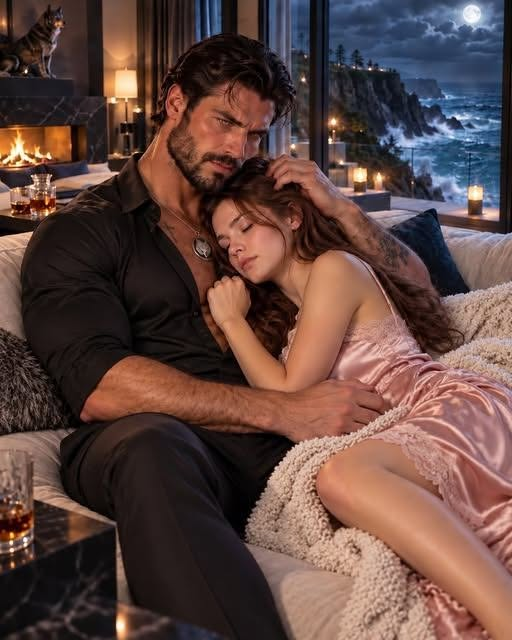
We signed the alliance on the first clear day of spring, on the terrace above the Pacific, because I insisted the most important document in either pack's history be executed somewhere with weather in it.
Both packs came. Cascade arrived in a convoy of dented trucks and one very clean minivan, our elders in their good coats, Chloe radiant in a dress she'd bought with her first nursing wages, my father walking a little stiffly, the way a man walks when he's proud and terrified in equal measure and determined to show only the first. Croft turned out in black and silver. A long table stood in the sun with two copies of the charter on it — identical, Chloe and I had checked, page by page, twice — and the pens were Gideon's, because he said if history was going to be written he intended it to be written legibly.
Clara Mercer came, too. She arrived in Vivian's car and walked the last stretch from the terrace doors on her sister's arm — slowly, with a cane, in a blue dress, with her hair done and her eyes clear. She was thinner than her photographs and braver than all of us. When she reached Kane, the terrace went very quiet, because here were the two poles of the old story standing face to face: the monster and the girl the story said he'd broken.
Clara looked up at him for a long moment. Then she said, clear enough for the front rows to hear, "You kept saying my name. On the path. All the way down. I remembered that before I remembered anything else." And she held out her hand, and the Alpha King of the Croft pack took it in both of his — gently, the way you'd take a bird — and his hands did not tremble at all. "I am sorry it took five years for anyone to tell you the rest," he said. "It won't take five minutes again."
I signed for Cascade. Kane signed for Croft. The charter bound two packs as allies and equals, protected Cascade's land in perpetuity, finished the marina with audited money, and in its fourth clause — mine, handwritten in the margin of the drafting copy and adopted unanimously — abolished forever the practice of candidacy by settlement. No daughters as clauses. Not in these packs. Not again.
There was a lunch after the signing, on the long terrace tables, with Cascade's casseroles conquering Croft's caterers by sheer seniority, and Chloe — who had appointed herself mistress of ceremonies by the ancient law of little sisters — climbed onto a chair with a glass of cider and made a toast that will outlive the charter. "To my sister," she said, "who went up a mountain to pay a debt and came down with the mountain. To Kane, who makes terrible tea and excellent terms. And to paperwork — " she raised the glass to scandalized laughter from the elders "— done properly, in daylight, with both copies identical. May we never again mistake a spreadsheet for a fate, or a frightened girl for a clause." She drank. Then, quieter, so only the head table heard: "You don't have to keep saving us, Harp. I said that the night you left, and I was wrong about one thing. You weren't saving us because you had to. You were saving us because it's your *craft*. There's a difference. A craft gets a seat at the table and its name in the record." She nodded at the charter. "There it is. In ink."
Clara found me by the terrace rail while the tables were being argued over by both packs' grandmothers, a demographic no charter can govern. She walked better than she had in the winter; the garden residence and her sister's ferocious attendance were doing their slow work. "I wanted to tell you myself," she said, "because you're the only person in this story who was handed the same night I was, and read it correctly. Vivian says you asked him if he was *tired*." She shook her head slowly, smiling with real wonder. "Nineteen years old, and I ran from a drowning man because a dossier told me he was the flood. You looked at the same man and asked about the water in his lungs." She took my hand with a grip stronger than it looked. "When they write this down — and they will, the packs write everything down — make sure they get that part right. The eighth woman didn't survive the Alpha King. She *asked him a question*. There's a difference large enough to build two packs on."
"I'll put it in the record myself," I promised her. "In ink. Both copies identical."
Then came the part that was not, strictly, in the charter.
Kane stood, and the terrace settled, and he did something no Alpha of his line had ever done in public: he asked a question he could not command the answer to. "Harper Hayes," he said, "you came to this house as a settlement. You've stayed as a negotiator, a councilor, and the author of everything good that's happened to either pack this year. I'm asking you now — in front of your father, your sister, both councils, and God and the Pacific — to stay as my partner. My equal. My chosen. Not because of any paper. Because of a question you asked me in a corridor that nobody had ever thought to ask."
My father was crying with the brazen shamelessness of a man who has stopped apologizing for it. Chloe had both hands over her mouth. Gideon stood at parade rest with the expression of a man watching his own chess resignation pay off.
"Yes," I said. "On the terms written. And one more." I took his hands — those enormous, scarred, steady hands — in front of everyone, because a bond by choice should be a public thing, witnessed, so that nobody could ever rewrite it into two lying sentences on a piece of paper. "You will sleep, Kane Croft. Properly. Like it's your job. That is a term."
"It is accepted," he said gravely, "into the record," and then he laughed — that rusty, unwilling, real laugh — and kissed my hands instead of my mouth, like a knight in a story much older than ours, and both packs made a noise that scared the gulls off the terrace rail.
The marina broke ground again in May. Real money, audited escrow, Cascade crews on Cascade wages, and a foreman's cabin with a kettle that Chloe claims is the true foundation of the alliance. The hall got its new roof. The teaching staff got paid out of a budget I no longer have to assemble at three in the morning — though I still do the final read of every page, because trust, like paper, has a basement, and somebody who loves a thing should look in it. My father fishes more and signs less, and when he signs, he reads, and once — only once, but I treasure it — he sent a contract back to a supplier with *my daughter will want the underlying transfers* written across the top in red.
In June, on the first Saturday of the marina season, the two packs held a workday that turned, by about eleven in the morning, into a festival wearing a hard hat. Cascade crews raised the new pier framing; Croft money — audited, countersigned, announced aloud by Chloe from the foreman's cabin steps like a town crier with a spreadsheet — bought lunch for a hundred and forty people. Kane worked. I want that in the record too: the Alpha King of the Croft pack, in rolled sleeves, up to his knees in harbor water with a mallet, taking instructions from a seventy-year-old Cascade foreman named Abe who called him "son" and corrected his grip twice. Children of both packs — who had never been told to fear him, because children are mercifully illiterate in dossiers — swarmed the shallows like gulls. By dusk the framing stood black against a rinsed and golden sky, and my father, smelling of sawdust, put his arm around my shoulders and said, "Your grandfather cut timber on this shore and dreamed in this direction. He just had the wrong century. You had the right one." It was the closest thing to a blessing the old man owns, and I have banked it accordingly.
And Kane sleeps. Not perfectly; five years of damage does not vanish like weather. There are still nights the storm gets into the glass and the gold gets into his eyes, and on those nights I make tea I still can't brew properly and I sit with the flood until it ebbs, and it always, always ebbs now — because the wolf learned what the man learned that first night: there is one person in the world whose fear it will never smell, and her presence is not a cage. It's a shore.
I tested the shore in November, when the first real storm of the winter came up the coast and the estate lost power for six hours, and the dark came back into the house the way it used to — total, oceanic, with the surf going mad below the cliff. I found him in the wing's living room at the height of it, standing at the black glass with his forehead nearly touching the pane, riding out a surge by main force; the pressure in the room was the old weather, the depth-charge kind, and his hands — I could see them in the firelight — were not steady. Old reflexes in the housekeeper staff had put candles in the corridor. Nobody had put attendants outside the door. Nobody had even thought of it, which tells you everything about the year.
I didn't say his name like a ledge-walker's name that time. I wasn't a visitor anymore, working a technique. I was his partner, and my job was not to talk the flood down but to stand in my own house, in my own nightdress, and be *known* to it. I put the kettle on the hearth, because the gas ring still worked and because some liturgies are load-bearing. I said, "Kettle's on. It'll be terrible. You've been warned." And I sat down in my chair — mine, by the fire, the one with my shawl over it, my grandmother's — and opened my book to where the ribbon was, and let my breathing do what it has always done, and let the room learn it again.
The surge crested. Somewhere in the rafters the old house sang. And then, the way a tide discovers it has run out of beach, the pressure ebbed — not because I had defeated anything, but because the wolf had come to the window and found, on the other side of it, not an enemy, not a victim, not a candidate: a woman reading a book badly by firelight, entirely at home. Kane turned from the glass with gold still filming his eyes, and looked at me, and said, in the wrecked and wondering voice of the first night, "You're reading."
"It's a very good chapter," I said. "Sit down before you fall down. Tea's coming."
He sat. The gold went down like a lamp being trimmed. We drank terrible tea by a dying fire in a dark house while the storm spent itself on the cliff, and it was — I want this understood by whoever keeps the record — *ordinary*. The miracle had become ordinary, which is the only kind of miracle worth building a life on. Miracles that stay miraculous are just emergencies with good PR. Ours had become a household. It had become Tuesday.
Last week, late, I found him in the kitchen of the private wing — barefoot, sleeves rolled, the fire low, the chessboard out with Gideon mid-ambush on the white side. He looked up at me with the chess clock ticking and the ocean muttering under the cliff, and I leaned in the doorway where the silver button used to be, on wood that is only wood now, and I asked him the question that started everything.
"Are you tired?"
Kane Croft smiled — the real one, the one with five years of sleep debt finally, finally being repaid — and he held out a mug of tea he'd made *for me*, badly, the way I make it, which is to say with love and no technique whatsoever.
"Not anymore," he said. "Sit down, Harper. You're just in time to watch me lose."