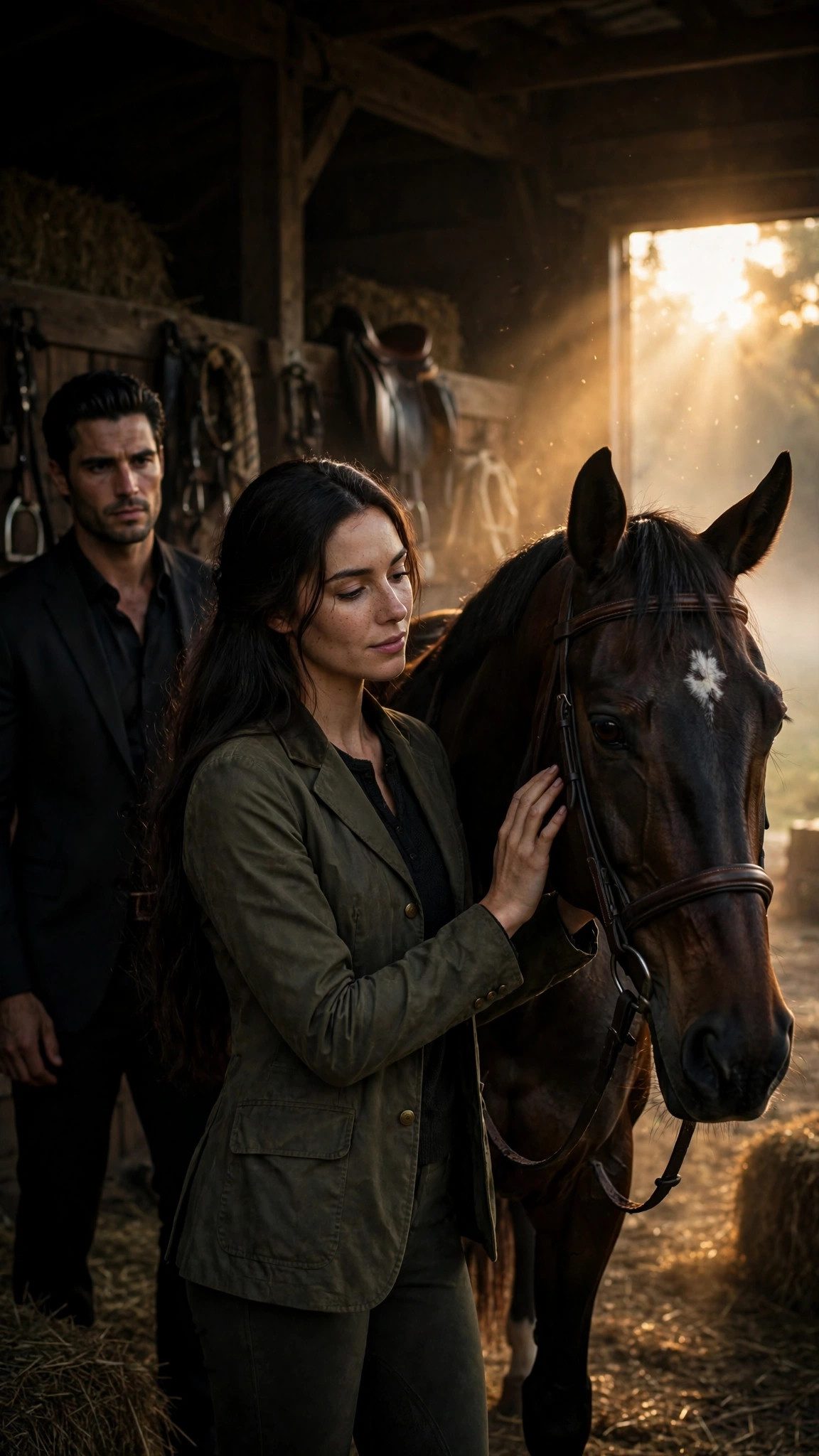
My father did not teach me about horses with books. He taught me with his hands.
I was six years old the first time he put my palm flat against a horse's shoulder and told me to close my eyes. "Feel it," he said. "Don't look. Looking is for people who want to be fooled. Feel where it's hot. Feel where it's tight. Feel where the horse is holding itself back."
The horse was an old mare named June, and under my hand her shoulder was warm on one side and cool on the other, and the muscle on the warm side jumped a little when I pressed it. My father nodded like I had just read a sentence out loud correctly.
"She's sore," he said. "She won't tell you. She'll just walk a little shorter on that side and hope you don't notice. But you noticed, didn't you?"
I nodded, and he smiled, and that was the first lesson. There were eleven years of lessons after that, one for every year I spent following him around racetracks and stables and paddocks, watching the way he watched horses, learning to see what other people walked straight past.
He taught me that a horse with a sore hoof will put its weight on the other three feet and pretend nothing is wrong. He taught me that a horse with a bad back will hollow itself away from the saddle and pin its ears when you tighten the girth. He taught me that the most dangerous horses are not the angry ones but the quiet ones, the ones that have learned to endure pain without complaining, because by the time they finally complain, the damage is already deep.
He also taught me that people are not so different from horses. "People lie, Hannah," he said once, when I was fourteen and a trainer at the track had told us a lame horse was just lazy. "People lie about pain more than horses do. A horse will at least limp. A man will stand up straight and smile while his leg is killing him, because he thinks pain is weakness. Watch how they move, not what they say."
My father was a good horseman and a bad gambler. The two things lived side by side in him for as long as I could remember, like a good horse and a bad habit sharing the same stable. He could look at a colt and tell you in five minutes whether it would win or break down, and he could sit at a card table and lose a month's wages in one night and come home smiling like he had done something clever.
My mother died when I was eleven. After that, it was just the two of us, and the horses, and the debts that grew quietly in the background like weeds. He never talked about the money. He talked about horses. He talked about the way Sovereign's grandsire used to move, about the filly that won at Saratoga with a cracked hoof because nobody believed she was hurt, about the old gelding that taught him everything he knew about patience.
When he died, three years ago, he left me a house with a leaking roof, a truck with a hundred and ninety thousand miles on it, a leather notebook full of horse notes, and a debt of one hundred and eighty thousand dollars to a man I had never met.
I sold the truck. I sold the tools. I kept the notebook. I kept my own notebooks too, eleven years of observations written in a cramped, hurried hand: which horses went short on the left, which ones flinched at the girth, which ones needed rest and which ones needed work. I did not know then that those notebooks would become the most valuable thing I owned.
The morning after my first dinner at Bellori Ridge, I went to the stables before dawn. The air was cold and clean, the way it gets in upstate New York in the fall, and the horses were still sleepy in their stalls, shifting and sighing. I started with Sovereign.
He was waiting at the front of his stall, his dark head over the door, his ears pricked forward. He was a beautiful animal, dark bay, almost black, with a white star on his forehead and a neck like a drawn bow. He was also, I could already tell, a horse that did not trust easily. He watched me the way Roman had watched me: carefully, measuring, deciding whether I was a threat.
"Easy," I said softly, and held out my hand. He sniffed it, blew warm air across my palm, and then, very deliberately, turned his head away.
I laughed. "Fair enough," I said. "We'll earn each other."
I led him out to the yard and walked him in a slow circle on the gravel, watching his feet. His left shoulder was still tight, the muscle bunched under my hand when I ran my fingers over it, but the rest of him moved well. He was strong. He was sound everywhere else. The shoulder was the only problem, and the shoulder was a problem because someone had kept running him through it.
"Two weeks of walking," I told Ellis, the head groom, when he came over with a bucket. "No gallops. No breezing. Walking only, and cold water on that shoulder twice a day, morning and night. If he rests now, he'll be faster in a month than he is today. If you run him now, you'll lose him for a year."
Ellis was a wiry man in his sixties with hands like knotted rope and a face that had spent forty years in the sun. He looked at Sovereign, then at me, then back at Sovereign.
"Mr. Bellori doesn't like resting horses," he said. "He likes winning horses."
"Then he should like resting this one," I said. "A winning horse is a sound horse. You can't win on three legs."
Ellis grunted, which I took for agreement, and went back to his work.
I spent the rest of that morning going through the other horses, one by one. Most of them were sound. A few had small problems: a mare with a tender mouth who needed a different bit, a gelding with a stiff hock who needed more warm-up time, a two-year-old who was growing too fast and needed his feed cut back. I wrote it all down in my notebook, the way my father had taught me, and by lunchtime I had a list of twenty-three horses and what each one needed.
That afternoon, Roman sent for me again.
I found him in the yard, standing beside the training track, watching two horses work. He did not turn when I approached. He kept his eyes on the track, his hands clasped behind his back, his weight on his left leg. From behind, the tilt was even clearer. His right hip sat higher than his left. His right shoulder dropped a fraction to compensate. It was the posture of a body that had been protecting itself for a very long time.
"Miss Peyton," he said, without turning. "Ellis tells me you want to rest Sovereign for two weeks."
"Yes," I said.
"Two weeks is a long time. The autumn races are coming."
"Two weeks now saves you a year later," I said. "His shoulder is guarding. If you push him through it, the muscle will tear. Then you'll have a horse that can't run at all."
He was quiet for a moment, watching the horses come around the far turn. Then he said, "Do it. But I want a report every morning. If he is not improving in a week, we will have a different conversation."
"Understood," I said.
He turned then, and looked at me, and for a moment his eyes dropped to my hands. I was holding my notebook, and my fingers were stained with liniment from Sovereign's shoulder. He looked at my hands the way he had looked at the folder on his desk that first morning: carefully, measuring.
"Your father," he said. "He was a good horseman."
"He was," I said. My throat tightened. "He was a better horseman than he was anything else."
Roman nodded once, slowly. "I know. That is why I am giving you this chance, Miss Peyton. Your father owed me money, but he also once saved a horse of mine from a bad trainer's hands. I do not forget debts, but I do not forget favors either. Do the work well, and we will have no problems."
He turned back to the track. The conversation was over.
That night, I was working late in the stable, checking Sovereign's legs by lamplight, when I heard voices outside. I stepped to the door and saw Roman walking across the yard toward the main house, with Dr. Malcolm Avery beside him.
Avery was a tall, thin man in his fifties with silver hair and a doctor's calm, practiced voice. I had seen him arrive that afternoon in a black sedan, carrying a leather bag. I had heard the grooms talking about him. He had been Roman's physician for years.
"Eight years," Roman was saying, his voice bitter in a way I had not heard before. "Three MRIs. Four rounds of steroids. And I'm still in pain."
"Spinal compression," Avery said, in the tone of a man who has said the same thing many times. "The imaging is clear, Roman. The disc is pressing on the nerve. Surgery is the answer. I have told you this for two years."
"My father died under anesthesia," Roman said. "I will not go under a knife and wake up vulnerable to my enemies. Find another way."
"There is no other way. The injections will only hold it for so long."
They went inside. The door closed. The yard went quiet again.
I stood in the stable doorway for a long time, thinking about what I had heard. Three MRIs. Four rounds of steroids. Eight years of pain. And a doctor who was certain it was the spine.
But I had watched Roman walk, and I had seen horses move that way after injuries around the hip. The shortened right stride. The uneven pelvis. The weight shifted strangely. The way he barely put weight on his right leg and rotated it outward when he walked.
Everyone was treating his back. Nobody was looking at his hip.
I went back to Sovereign's stall and sat down on a hay bale, and I opened my father's notebook to a page I had read a hundred times. It was about a mare named Clover who had gone lame in her hind end, and every vet had said it was her back, and my father had watched her walk for ten minutes and said it was her hip, and he had been right. Underneath the entry, in his cramped handwriting, he had written: "The back takes the blame for the hip. Always check the hip first."
I closed the notebook and sat there in the lamplight, listening to the horses breathe, and I thought about the man who owned this estate, the man who could destroy my life with a single order, and the thing I had seen that his doctors had missed.
I knew I should stay quiet. I knew that noticing things about Roman Bellori was dangerous. I knew that a horse trainer with a dead father's debt had no business telling a mafia boss that his doctors were wrong.
But I also knew what I had seen. And eleven years of listening to pain had taught me one thing above all else: pain does not care who you are. It does not care how feared you are. It just moves the way it moves, and if you know how to watch, it will tell you the truth.
The next morning, I was exercising Sovereign in the round pen when Roman appeared at the fence.
"Walk with me," he ordered.
We followed the gravel path behind the barns, past the paddocks where the mares grazed in the morning sun. I watched his shortened right stride out of the corner of my eye, counting the rhythm of it the way I would count a horse's gait. Left, right. Left, right. The right step was always a fraction shorter, a fraction lighter.
Then Roman spoke, and his voice was quiet and hard.
"You were watching last night."
My stomach tightened. "I noticed something."
His eyes hardened. "I don't appreciate pity."
"It's not pity." My mouth was dry. "Then what?"
I swallowed, and I said the thing I had been rehearsing all night, the thing that could get me thrown off this estate or worse.
"Confusion. Your doctor says your spine is causing the pain, but your right leg isn't moving the way I'd expect."
Roman stopped walking. The gravel crunched under his shoes as he turned to face me, and for a moment the morning seemed very still, and I could hear my own heartbeat in my ears.
"Your pelvis is uneven," I went on, because stopping now would be worse than finishing. "You barely put weight on your right leg, and you rotate it outward when you walk. I've seen horses move that way after injuries around the hip. Yet everyone is treating your back."
"Be careful, Hannah," he said. His voice was low, and there was something in it I had not heard before, something that was not anger, or not only anger.
My hands trembled inside my jacket pockets. I knew this man could destroy my life with a single order. But I also knew what I had seen, and eleven years of listening had taught me that the truth does not get less true just because it is dangerous to say.
"Mr. Bellori," I said, "after your accident eight years ago, did anyone actually examine your hip?"
His expression changed. The hardness in his eyes cracked, just a little, and underneath it I saw something I had never expected to see in the face of Chicago's most feared mafia boss.
Hope. Frightened, stubborn, exhausted hope. The look of a man who has been told for eight years that nothing can be done, and who has just heard someone say, for the first time, that maybe everyone has been looking in the wrong place.
And for the first time, the man everyone feared looked at me as though I might know something that could change his life.