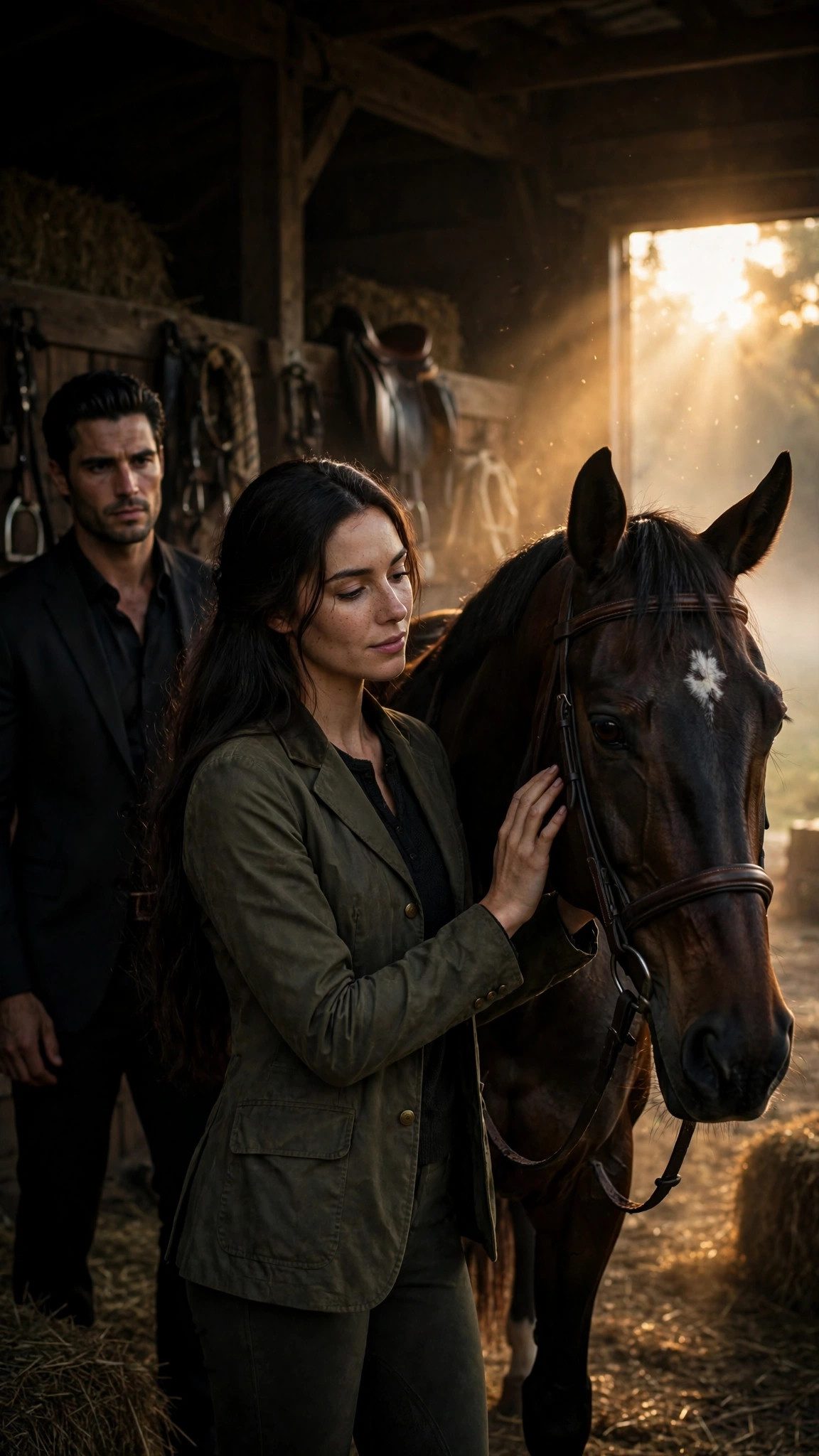
The first dinner was the strangest and the most wonderful thing I had ever seen.
Roman sat down at the head of the great oak table, in his own chair, the chair no one had ever seen him use, and he sat all the way back in it, and he picked up his knife and fork, and he ate his dinner sitting down, like an ordinary man. The twelve men at the table tried very hard not to stare. They failed. Every few minutes one of them would glance at him, and then look away quickly, as if he had caught himself looking at something private.
Halfway through the meal, Roman set down his fork and looked around the table.
"I have been standing for eight years," he said, "because I believed my spine was broken and could not be fixed. I was wrong. My hip was injured in the accident, and no one ever examined it. Miss Peyton examined it. She treated it for five days. And now I can sit."
He looked at me, across the long table, and he said, "Thank you, Hannah. In front of all of them. Thank you."
Nobody laughed. Nobody said anything. Garrett Sloan stared down at his plate, his face red.
After dinner, Dr. Avery arrived.
He came in his black sedan, carrying his leather bag, and he went straight to the study, where Roman was waiting. I was not invited. But Ellis told me later what happened, because Ellis hears everything in that house, and Ellis told me the way he tells everyone everything: slowly, and only when he thinks you need to know.
Avery had brought the surgical team with him, or so he said. He had brought papers for Roman to sign. He had brought a schedule, and a hospital, and a date: Friday, three days away. He spoke for twenty minutes about the nerve, and the disc, and the risk of permanent damage, and then Roman asked him one question.
"Doctor," Roman said, "in the original accident report, did it mention my hip?"
Avery went still. Ellis said the silence in that study was the longest silence he had ever heard.
"What do you mean?" Avery asked.
"I mean that Miss Peyton asked me whether anyone had examined my hip after the crash. I told her I didn't think so. But this morning I had Raphael pull the original hospital file. The emergency report from the night of the accident lists a hip contusion and a suspected labral tear. It recommends a follow-up examination of the hip joint within two weeks. That examination never happened. Do you know why?"
Avery's face, Ellis said, went the color of old paper.
"I don't recall that report," Avery said.
"You were the attending physician," Roman said. "It was your report."
"I may have missed it. There was a great deal going on that night. Your father was dying. The focus was on his condition."
"My father died," Roman said, his voice very quiet, "and my hip was forgotten. And for eight years, you treated my spine, and you never once looked at the report that said to look at my hip. Eight years of injections. Eight years of steroids. Eight years of telling me surgery was the only answer."
"Roman," Avery said, "I have served your family for twenty years—"
"And you will continue to serve it," Roman interrupted. "But not as my doctor. You are finished here, Doctor. You will send me your files, all of them, and you will not come back to this estate."
Ellis said Avery left without another word, his bag in his hand, his face grey, and that was the last anyone at Bellori Ridge ever saw of him.
I do not know whether Avery buried that report on purpose or whether he simply missed it in the chaos of that terrible night. I have thought about it many times since. A doctor who is certain is a dangerous doctor, because certainty stops you from looking again. Avery was certain it was the spine. He was certain for eight years. And certainty, I have learned, is just another way of not listening.
But Avery was not the only one who had been hiding something. The pain had been hiding something else, too, and it took Garrett Sloan to show me what it was.
Three nights after the dinner, I was working late in the stable when I heard a car on the gravel drive, too late for a delivery, too fast for a guest. I stepped to the door and saw headlights sweeping across the yard, and then I saw men moving in the dark between the barns, men I did not recognize, moving the way men move when they do not want to be seen.
I ran to the main house. Roman was in the study, sitting at his desk, reading. Sitting. The sight of him sitting down still surprised me every time.
"Men in the yard," I said, breathless. "Strangers. Four of them, maybe five, coming from the south gate."
He was on his feet in an instant, and he was not the man on the treatment table anymore. He was the head of the Bellori family, and he moved like it, fast and sure, his hand already on his phone.
"Raphael," he said. "South gate. Now."
The attack, when it came, was fast and ugly. The strangers were Castellano men, from the rival family that had been waiting for years for Roman to show weakness. They had heard, somehow, that Roman was receiving treatment in his barn, that he was lying down, that he was vulnerable. They had come to finish what the truck had started eight years ago.
But they had come too late. They had come for a man who could not sit down, a man in pain, a man who moved like a wounded animal. They found a man who could move freely for the first time in eight years.
Roman met them in the yard, and his men met them beside him, and the fight was short and brutal and over before I could even get to the window. When it was done, two of the Castellano men were on the ground, and the others were running for the gate, and Roman was standing in the middle of the yard, breathing hard, his suit torn at the shoulder, his hands steady.
And then Raphael came to him with a phone, and the phone belonged to one of the Castellano men, and on it was a message, sent three days earlier, from a number Raphael recognized.
It was Garrett Sloan's number.
Garrett had told the Castellanos about the treatments. He had told them Roman was lying down in a barn every morning at six o'clock, unguarded, vulnerable. He had sold his boss for money, or for revenge, or for the simple pleasure of watching a man who had once made him pick up a chair fall down at last.
Roman found Garrett in the tack room, packing a bag.
"How long?" Roman asked.
Garrett did not pretend he didn't understand. "Six months. The Castellanos approached me after the winter meeting. They said you were weak, and that weak men lose their empires, and that I should think about my future."
"And you believed them."
"I believed what I saw," Garrett said. "A boss who couldn't sit down. A boss who was in pain. A boss who let a stable girl put her hands on him. I thought you were finished, Roman. I thought I was getting out before the fall."
Roman looked at him for a long moment. Then he said, "You are finished here, Garrett. You will leave Bellori Ridge tonight, and you will not come back. If I ever see you again, I will not be as generous as I am being now."
Garrett left without another word. I watched his car disappear down the gravel drive, and I thought about the chair he had kicked across the dining room floor, and about the way he had looked at me in the yard, and about how a man who mocks a woman for her weight will sell his boss for money without a second thought.
That night, Roman came to my cottage. He knocked, and when I opened the door, he was holding a folder. It was the folder from my first morning, the one with my father's debts in it, the markers and the promises added up in neat columns.
"I have been thinking about your father's debt," he said.
My stomach tightened. "I know. I still owe—"
"No," he said. "You don't."
He opened the folder, and he took out a lighter, and right there on my doorstep, in the cold night air, he set fire to the papers. They burned quickly, the neat columns curling into ash, the numbers disappearing into smoke.
"Your father owed me money," Roman said, watching the papers burn. "But you saved me from eight years of pain, and you saved my life from the Castellanos, because you were the one who saw the men in the yard. A debt like that cannot be measured in dollars, Hannah. It is paid. It is finished. You owe me nothing."
He dropped the last burning corner of paper into the dirt and ground it out with his heel.
"From now on," he said, "you stay at Bellori Ridge because you choose to, not because you owe me anything. Do you understand?"
I understood. And for the first time since my father's funeral, I felt the weight I had been carrying lift off my shoulders, the way the pain had lifted off Roman's hip. It was gone. It was finished. I was free.
"Thank you," I said, and my voice broke a little. "Thank you, Roman."
He nodded, and he turned to go, and then he stopped, and he looked back at me, and he said the words that changed everything that came after.
"Hannah," he said, "tomorrow morning, will you ride with me? Not as my trainer. Not as my employee. As my guest. Sovereign is ready, and I would like to see him run. And I would like you beside me when he does."
The next morning I woke up before dawn, the way I always did, and for a moment I did not remember. I lay in bed listening to the wind in the maple trees, and then it came back to me all at once: the burning papers, the ash in the dirt, the words "you owe me nothing," and I sat up in bed and laughed out loud, alone in my cottage, because for the first time in three years, I was free.
I went to the stables early, before anyone else, and I found Ellis already there, mucking out Bishop's stall, his movements slow and steady in the lamplight.
"Morning, Miss Peyton," he said, without looking up. "You look different today."
"Do I?" I asked.
"Lighter," he said. "Like someone took a saddle off you that you'd been wearing so long you'd forgotten it was there."
I laughed. "Something like that."
Ellis leaned on his pitchfork and looked at me for a long moment, his weathered face thoughtful. "Can I tell you something? I've been at Bellori Ridge for twenty years. I've seen that man stand through dinners and meetings and funerals, standing because he thought sitting down was weakness. Yesterday, for the first time, I saw him sit down at his own table and eat a meal like a human being. And do you know what I thought? I thought, that girl did that. That horse trainer with the notebooks did what eight years of doctors couldn't do."
"I just watched him move," I said. "That's all I did. I watched the way his body moved, and I listened to what it was telling me."
"That's what your father used to say," Ellis said. "Horses don't lie. People lie. Horses just move the way the pain tells them to. Your father said that to me once, years ago, when he was working on a mare of ours. He was a good man, your father. A foolish man with money, but a good man with horses. And you're your father's daughter, Miss Peyton. Don't ever forget that."
"I won't," I said, and my throat tightened, because no one had said anything kind about my father in three years, and hearing it from Ellis, in the lamplight of the stable, felt like a gift I hadn't expected.
Later that morning, I watched from the yard as Roman came out of the main house and walked to the training track. He walked the way he had walked on Day Four, his pelvis level, his stride even, and when he reached the fence, he did something I had never seen him do: he leaned on it, casually, with one elbow, like a man with all the time in the world, and he watched the horses work.
I thought about the five days then, and about the man I had met on my first morning, the man who had stood behind a desk with all his weight on one leg and told me I owed him a hundred and eighty thousand dollars. That man had been a stranger, and a frightening one. The man leaning on the fence was someone else entirely: a man who could sit down, a man who could lean, a man who had been given back something he thought he had lost forever.
And I thought about the way he had looked at me across the dinner table when he said thank you in front of all his men, and the way he had called me Hannah for the first time, and the way he had asked me to ride with him tomorrow morning, not as his trainer, not as his employee, but as his guest.
I had come to Bellori Ridge to pay off a dead man's debt. I had stayed because I had nowhere else to go. But somewhere in those five days, between the liniment and the exercises and the crack in the barn, something had changed, and I was no longer sure what I was staying for.
I only knew that when I thought about leaving, about packing my duffel bag and driving away down the gravel drive, the thought felt wrong, the way a wrong stride feels wrong to a horse. It felt like walking away from something unfinished.
So I went back to Sovereign's stall, and I checked his shoulder, and I wrote in my notebook, and I waited for tomorrow morning, and for the ride, and for whatever came next.