The next morning, Martha came to work with a canvas bag she had not carried before. Inside it, folded beneath her lunch and a spare apron, were the tools of her old life: a reflex hammer with a red rubber head, a tuning fork, a handful of cotton balls, a safety pin sealed in a paper packet, and a small notebook with a blue cover.
She had kept them in a drawer for two years, the way some people keep a wedding dress after a divorce — not because they expected to use them again, but because throwing them away would have meant admitting it was over.
Miss Delaney gave her the day's list. The library. The dining room. The front hall. Nothing about the third floor. Martha worked through the list, and at eleven o'clock, when Miss Delaney went to the market and Rosa went to the cellar for potatoes, Martha took the narrow stairs to the third floor for the first time without being sent.
Maxwell's door was open. He sat in his wheelchair by the window, a book face-down on his lap, looking out at the water. He did not turn when she knocked.
"You came," he said.
"You asked me to," Martha said. She set the canvas bag on the floor and took out the notebook. "If we are going to do this properly, we do it like a rehabilitation plan. Assessment first. Then a baseline. Then a schedule. And everything gets written down, because a record is the only thing that protects both of us."
He turned the chair to face her. "You sound like a nurse."
"I was a nurse. For six years, I was a good one." She opened the notebook to a fresh page and wrote the date at the top. "Now. Tell me everything. Not the story you told the newspapers. The truth. When did you first feel something?"
Maxwell looked out the window for a long moment. When he spoke, his voice was quieter than she had ever heard it.
"Four months ago. I was in the bath — the same bath, the same tub — and the water was too hot. Not like last night. Just hot. And I felt it. Not pain, exactly. Warmth. A kind of pressure on the back of my right calf. I thought I imagined it. The next week, I felt it again. Then I felt the cold when Tony wheeled me past the open door in January. Then, two weeks ago, I moved my big toe. On purpose. I thought about moving it, and it moved."
"Both legs?"
"Right leg first. The left is slower. I can feel pressure on the left thigh now, and sometimes a tingling in the left foot, like the limb has gone to sleep. The doctors said the cord was bruised, not severed. They said the bruising could take a year to heal, or two, or never. I stopped going to the appointments six months ago. I told everyone the doctors had given up."
"And your uncle?"
"Victor comes every Tuesday. He sits in the study and tells me about the business. He tells me the docks are fine, the trucking is fine, the warehouses are fine. He tells me not to worry. He has been telling me not to worry for fourteen months." Maxwell's mouth hardened. "The night I was shot, I had just told the council I was shutting down the illegal side. All of it. The uninspected containers. The protection money. The loans. I gave them thirty days to wind it down. Two nights later, I was on Pier Nine at midnight, checking a shipment myself because I did not trust anyone else to do it, and someone put a bullet in my back and walked away without taking my wallet, my watch, or my phone."
Martha wrote it all down. "And the police?"
"Called it a robbery. Closed the file in six weeks." He laughed, a short sound with no humor in it. "A robber who shoots once, low in the back, and steals nothing. The detectives knew. They just could not prove anything, and nobody in this city was in a hurry to help them."
Martha set the notebook aside. "Take off your shoes and socks."
He looked at her. "What?"
"Assessment. Shoes and socks off. I need to see your feet."
Slowly, Maxwell bent forward in the chair and pulled off his shoes and his socks. His feet were pale, the nails trimmed short, the skin unmarked. A man's feet that had not walked in fourteen months.
Martha knelt in front of him. She took the tuning fork from her bag and struck it against her palm. The metal hummed. She pressed the base of it against the bone of his right big toe.
"Feel that?"
A pause. Then: "Yes. A vibration. Faint, but there."
She moved the fork to the left big toe. "And here?"
"Nothing."
She took a cotton ball and brushed it lightly across the top of his right foot. "Here?"
"Yes. Light. Like a feather through a glove."
"Left foot?"
"Nothing."
She took the safety pin from its packet and pressed the point, very gently, against the skin of his right calf. "Sharp or dull?"
"Sharp," he said, and his voice caught. "God. Sharp. I can feel sharp."
She moved the pin to his right thigh. "Here?"
"Dull. Pressure, but not sharp."
She worked her way up, methodically, the way she had been trained: dermatome by dermatome, right leg and then left, pinprick and cotton and the cold steel of the tuning fork. By the time she finished, her notebook held a map of a man coming back to life.
Right leg: sensation returning from the knee down, strongest in the foot. Left leg: pressure only, down to mid-thigh, with tingling in the foot. Both legs: no voluntary movement yet except the right big toe, which moved on command, twice, while she watched.
"This is real," she said quietly. "This is not wishful thinking. Your cord is healing. Slowly, but it is healing. With proper therapy — real therapy, not the exercises Cole has been doing half-asleep — you could be standing in six months. Walking with a cane in a year. Maybe more."
Maxwell stared at his own feet as if he had never seen them before. "Six months."
"But only if no one knows," Martha said. "The moment Victor finds out you are healing, you are in danger again. So we hide it. You keep the chair. You keep the story. And in this room, behind a locked door, we work."
"And the bath?" he asked. "Last night was not an accident, was it?"
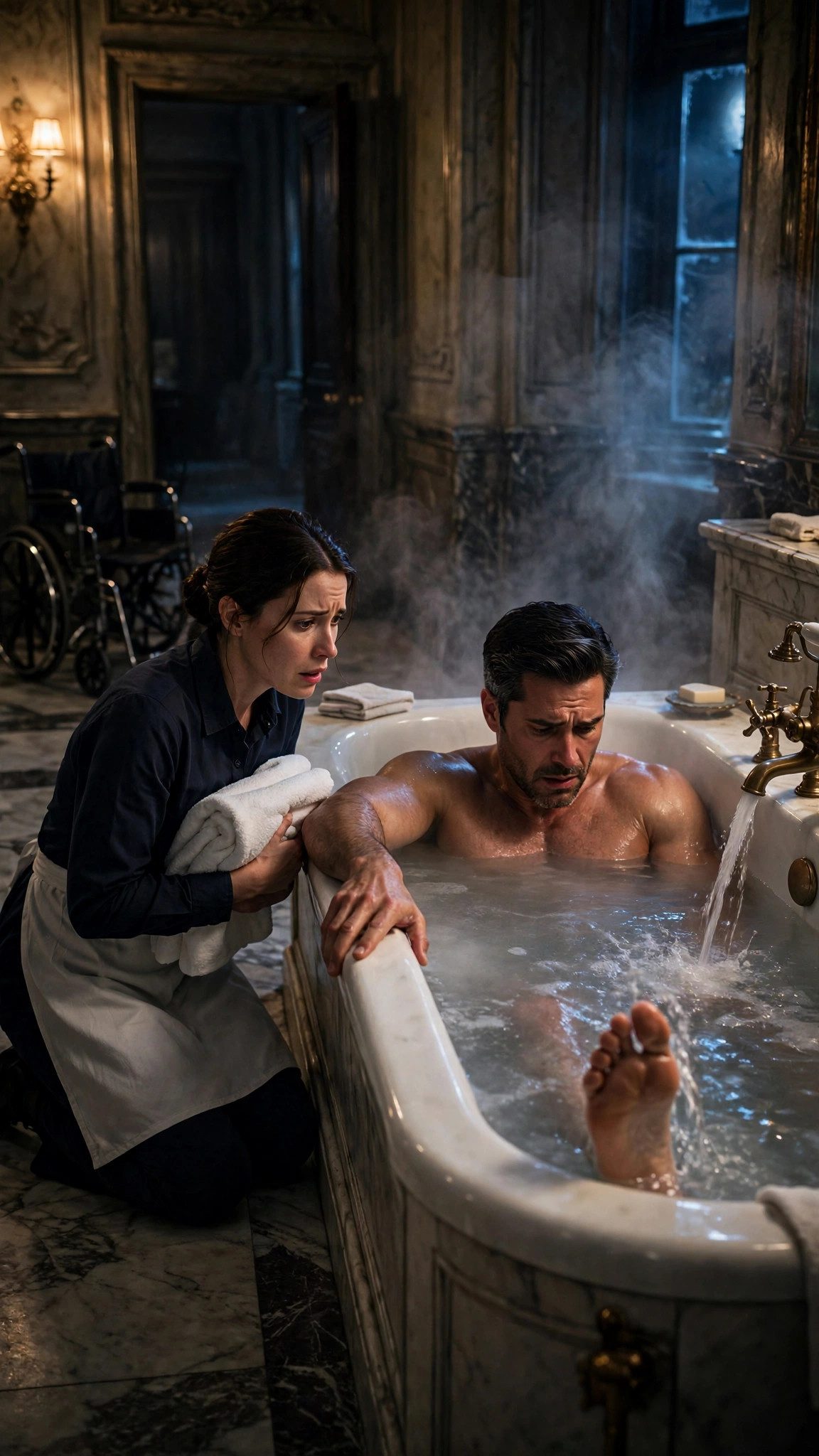
"No," Martha said. "Cole drew it too hot because Victor told him heat helps the circulation. That is not medicine. That is an excuse. A man who cannot feel his legs will sit in scalding water until his skin blisters, and then the blisters will get infected, and then he will die of something that looks like an accident. Your uncle did not need to shoot you twice. He only needed the water to be hot enough."
Maxwell was silent for a long time. Then he said, "Cole has been drinking for three weeks. He never drank before. Victor pays him extra now. I have seen the envelopes."
"Then Cole is afraid, or Cole is bought," Martha said. "Either way, he is not safe to draw your bath anymore. From tonight, I draw the bath. I test the water. I write down the temperature. Every night. In this notebook."
"Delaney will ask questions."
"Then Delaney will get an answer she can live with." Martha stood up and put her tools back into the canvas bag. "Tell her the doctor ordered a new routine. Tell her I am the only one with the training. It is true, and it is the kind of true that ends a conversation."
Maxwell looked at her for a long moment. Then he held out his hand. Not the hand of a man in a wheelchair asking to be helped. The hand of a man making an agreement.
"Four months ago, I thought I was imagining the warmth in my leg," he said. "Last night, a woman I had never spoken to walked into my bathroom and told me the water was too hot. Today, that woman mapped my legs and told me I might walk again." He closed his hand around hers. It was warm and strong. "Martha Kovak, I have trusted three people in my life, and two of them are dead. Do not make me regret the third."
"I won't," she said. "I have already lost everything once because someone else lied on a chart. I am not going to lose it again by staying quiet."
The next afternoon, Martha began the exercises.
She had cleared a space in the corner of Maxwell's bedroom, away from the window where anyone in the garden might see, and she had laid a folded blanket on the floor. Maxwell sat on the edge of the bed in a loose shirt and shorts, his legs stretched out in front of him, pale and still. Martha knelt beside him with the blue notebook open on the floor.
"Toe curls first," she said. "Think about curling the toes of your right foot. Do not force it. Just think about it, and let the thought travel down."
Maxwell stared at his right foot. His face tightened with concentration. For a long moment, nothing happened. Then the big toe twitched — a small, uncertain movement, like a man testing the weight of a door before he pushes it open.
"There," Martha said. "Again."
He tried again. This time the toe curled, just a little, and then relaxed. He laughed, a short, surprised sound.
"It listened," he said.
"It always listens," Martha said. "It just needed someone to ask it properly. Ankle circles now. Slow. Ten times, each direction."
The ankle moved. Not far — a few degrees, stiff and reluctant — but it moved, and Martha wrote it down, and Maxwell watched her write it down with the expression of a man watching someone record a miracle in a ledger.
They worked for twenty minutes. Toe curls. Ankle circles. Knee bends with Martha's hands guiding his lower leg, feeling the resistance in the joint, noting where the muscles had tightened from fourteen months of disuse. His right leg was stronger than his left, and both legs were weaker than they should have been, and Martha told him so, honestly, because a patient who is lied to about his own body cannot trust anything else you tell him.
"It will hurt," she said. "The muscles will ache. The nerves will tingle, and sometimes they will burn, and you will think something is wrong. It is not wrong. It is the cord waking up. Pain is information. Numbness is the enemy."
Maxwell nodded. He was sweating, and his hands gripped the edge of the bed, but his eyes were clear.
"How long did you do this?" he asked. "At Harborview. How many men like me?"
"Dozens," Martha said. "Young men from car accidents. Old men from strokes. A boy of nineteen who fell off a roof and a woman of seventy who slipped on ice. Some of them walked again. Some of them did not. The ones who walked had two things in common." She closed the notebook. "They had someone who believed them when they said they felt something. And they had a reason to get up in the morning that was stronger than the pain."
"And what is my reason?" Maxwell asked.
Martha looked at him — at the man in the wheelchair who had been shot for trying to make his family honest, who had hidden his healing for four months because the man who shot him ate dinner at his table every Tuesday.
"Justice," she said. "You are going to stand up in a courtroom one day, Mr. Rourke, and you are going to point at the man who did this to you. That is your reason. And it is a good one."
That evening, after the exercises, Martha walked to the public library on the East Side and sat for an hour in the medical section, reading about spinal cord bruises and the slow return of sensation. Everything she read confirmed what her hands had already told her: a bruise heals from the outside in, sensation returns before movement, the right side before the left, the foot before the knee. She copied the relevant passages into her notebook, in her clear, careful handwriting, because a record built on reading and observation was a record no lawyer could dismiss as a feeling.
On her way home, she stopped at the drugstore and bought a second thermometer, and a box of cotton balls, and a small flashlight for checking the color of skin in a dim room. She paid cash. She put the receipt in her pocket. She had learned, two years ago, that a woman without a record is a woman without a defense, and she was not going to be without a defense ever again.
That night, at seven-thirty, Martha drew Maxwell's bath herself. She ran the water at a hundred and two degrees, tested it with the thermometer, tested it again with her wrist, and wrote the number in her notebook in clear, careful handwriting.
One hundred and two. Safe. Documented.
She helped him into the tub the way she had helped a hundred patients before him — with her hands under his arms, with her knee braced, with her voice calm and steady, telling him where to put his weight and when to let go. His body was heavy, and his legs did not help her, but his arms were strong, and he followed her instructions exactly, like a man who had spent fourteen months learning to trust no one and was now learning, very slowly, to trust one person.
When he was settled in the water, she sat on the stool beside the tub and watched his right foot. It rested against the porcelain, still and pale. She thought about the map in her notebook, about the sharp pinprick on his right calf, about the toe that had moved on command.
"Tomorrow," she said, "we start the exercises. Small ones. Toe curls. Ankle circles. Ten minutes, twice a day. And every week, we test again, and we write it down."
"And Victor?" Maxwell asked.
"Victor comes on Tuesday," Martha said. "On Tuesday, you will be exactly what he expects. A man in a chair, getting weaker, no trouble to anyone. Let him believe it. Let him get comfortable. Comfortable men make mistakes."
Maxwell leaned his head back against the edge of the tub and closed his eyes. For the first time since Martha had met him, the hard line of his shoulders softened, just a little.
"Six months," he said quietly, as if testing the words. "A cane in a year."
"Six months," Martha agreed. "If we are careful. If we are patient. If no one in this house finds out."
Outside the bathroom window, the evening darkened over the water. Inside, the steam rose gently from a bath that was exactly the right temperature, and a woman who had lost her license sat beside a man who had lost his legs, and together they began the slow, secret work of getting them both back.