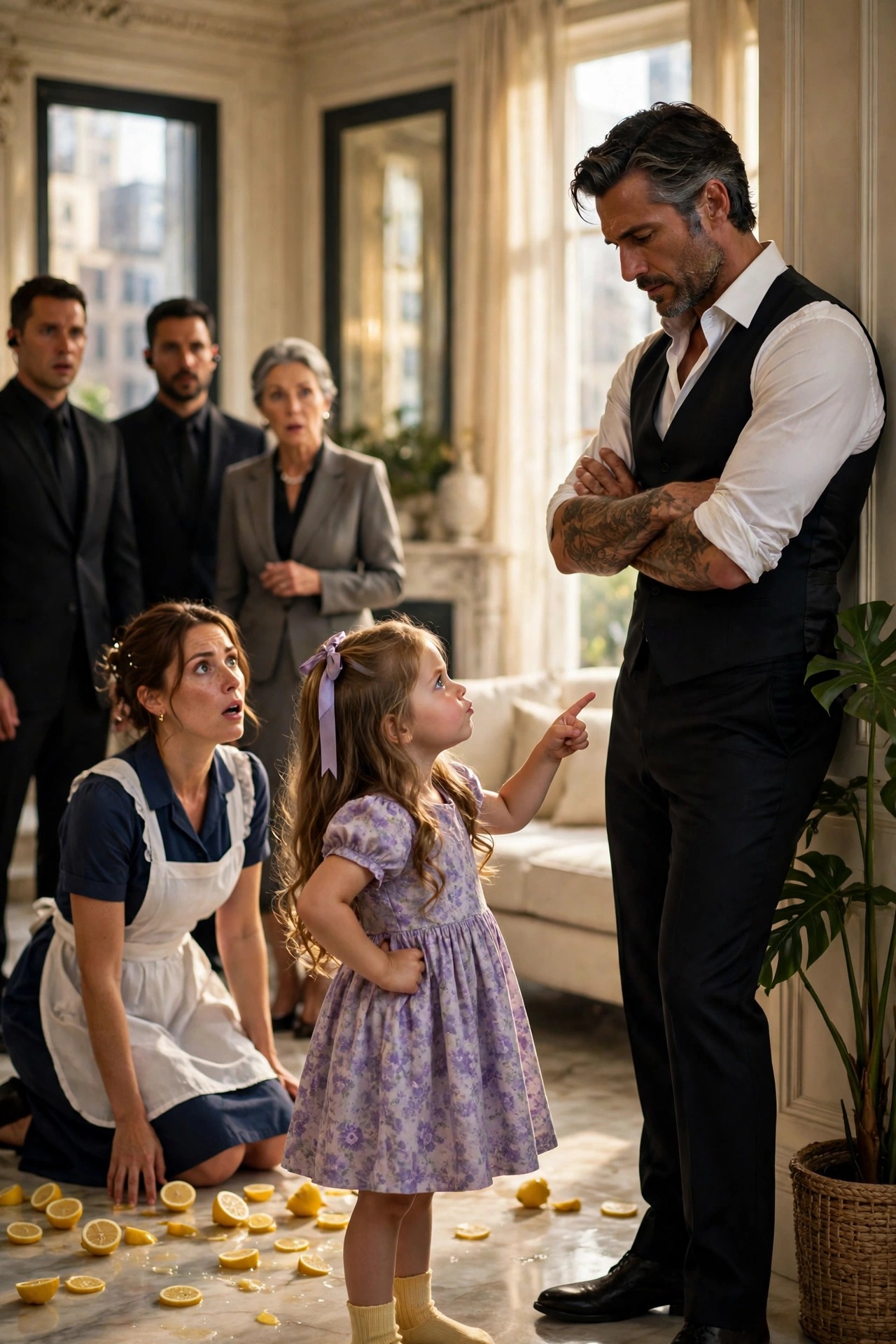
The message came at seven on Friday morning, while Lily was negotiating for a second piece of toast. It came on the kitchen house phone, in Mrs. Bell's own extension code, read to me by a man whose voice I did not know.
"Mrs. Reyes, this is Ray, from security. Mr. Marquetti has been hurt. He's asking for you — for both of you. A car is at the service gate. Do not telephone the study; the line is being kept clear for the hospital. Mrs. Bell says bring Lily's medicines."
Every word of it was a key cut to fit a lock in me. Hurt. Hospital. Lily's medicines. I had buried one man already; my body did not wait for my mind to catch up. Mrs. Bell was upstairs. The study door was closed for the Meridian lawyers' call at eight. And underneath my one clear thought — do not frighten Lily — came Daniel's voice, from the mornings after the bad fires: Move now. Shake later.
"Is Mister hurt bad?" Lily asked, already sliding down from her chair, because a four-year-old can hear a voice change the way a dog hears weather.
"We're going to go and see," I said. "Bring your ribbon. And the rules, in case he forgets to be brave."
Ray was not at the service gate. A driver I had never seen was — a polite man in a dark coat, holding the rear door of a black car. The gate stood open. Above it, the small red eye of the camera was dark. That is the detail I will see for the rest of my life. The camera was dark.
"Where is Ray?" I asked.
"Already gone ahead, ma'am. To the hospital."
Daniel had taught me how a person reads a building. "Look at what's wrong, Elena. A fire doesn't announce itself. It just makes one thing wrong at a time." A driver I did not know. A gate already open. A camera with its eye put out.
I picked Lily up, casually, the way a mother does, and turned back toward the house with my mouth opening to call for Tomas — and the polite man was no longer polite, and there was a second man I had not seen at all, and Lily's rules page fluttered down onto the wet gravel as I was lifted off my feet, and my daughter screamed once, in outrage, in a voice I pray I never hear again:
"That's not how you pick people up! That's not a rule!"
Then the door closed and the car was moving, and my arms were around her so tight she said, "Mommy, too tight," and I made myself loosen them by one breath, because terror is a thing you spend carefully when your child is watching how you spend it.
—
I did not know the driver's name and I never learned it. I knew the streets. Chicago is a city a widow memorizes in grief districts, and as the car turned east and then south I read it through the rain-streaked glass like a page I had already suffered. The water tower. The rail yard where Daniel's crew had staged on the night of the warehouse fire. A cross street whose name I had read a hundred times in a report I had read standing in a records office, full of rage and paperwork.
"Don't take us there," I said, quietly, to the glass. "Please don't take us there."
"Quiet," said the second man, not unkindly, which was worse. "Nobody's going to hurt the kid. Boss just wants the signature. Everybody goes home."
"People who mean that," I said, "don't need a car with no handles on the inside."
Lily, who had stopped crying with the terrible efficiency of children conserving themselves, looked up at me. "Mommy, is this a time-out car? Because I don't think we were naughty."
"We were not naughty," I said, and held her eyes so she would file it where the truth lives. "Listen to me. If I ever say 'run and shout,' you run and you shout and you do not stop for anybody who isn't Tomas or Nico or Mrs. Bell. Or Mister. Especially Mister."
The warehouse was disused but not abandoned — there is a difference, and the difference is intention. Someone had kept the power on in one office and swept one corridor. The office they put us in had a desk, two chairs, a cot, and a high window wired with mesh.
They took my bag. They left me my daughter, which tells you everything about the arithmetic of Salvatore Ricci: we were not prisoners. We were punctuation — the comma at the end of a sentence he intended Vincent to finish his way.
As the door shut I was already doing what Daniel taught me, half-laughing over burnt pancakes, the morning after a probationary firefighter froze in a stairwell. "Count the ways out, Elena. Count them before you need them, because when you need them you won't have time to shop."
Door one: the office door. Locked, guarded, useless — for now. Door two: a service door behind stacked crates at the corridor's end, its push-bar hanging crooked, which meant its latch was old, which meant it might be persuadable. I saw it for one second as they marched us past and put it in my pocket like a coin. Door three was not a door at all: on the office wall, under a yellowed plastic cover, a fire alarm — and beside the desk, half-buried under invoices, an old wired telephone.
I catalogued them the way I had once catalogued bills on our kitchen table — not because any of them could save us yet, but because a plan, even a bad one, is a wall between a mother and despair, and I intended to keep that wall standing for as long as Lily needed a mother who was not crying.
"Mommy," Lily said, in the new small voice, "I want breakfast. I want Mrs. Bell. I want—" She stopped, and rallied, and I watched my four-year-old do consciously what I was doing. "I want to tell the man the rules. Talking helps. That's a rule now. Sad is not bad. Talk about it."
"When the man comes back, you may tell him one rule," I said. "One. Then Mommy does the rest of the talking. Deal?"
"Deal," she said, and shook my hand solemnly, as if we were Vincent and her at a breakfast table in another life.
—
The man who came back was young, with a wedding ring he turned and turned and eyes that kept going to Lily and away again, as if she were a bright light he had not been briefed about.
"There's water," he said, and put a bottle on the desk too hard.
"Thank you," I said. "Mine is Elena. Hers is Lily. Names are free. They don't cost your boss anything."
He looked at the door. "…Pete."
Lily studied him with the full, devastating attention she usually reserved for Vincent. "Did you eat breakfast? You look like a person who skipped it. Skipping makes the angry voice come. It's a rule." She counted on her fingers, grave as a judge. "Wash your hands. Eat your breakfast. Say sorry when you use your angry voice. And sad is not bad — talk about it."
"I'm not sad," Pete said, too fast.
"Okay," Lily said, in the exact tone she used on Vincent when he was lying about his coffee. "But if you get sad later, it's not bad."
Something happened to his face then — a small structural failure, like a wall deciding. He unscrewed the bottle himself and gave it to her with both hands. "Drink, okay? Slow." And to me, under his breath: "I got a girl. Two. I didn't know there'd be a kid. They said paperwork. They said a witness."
"Now you know," I said evenly. "Now you're a man who knows."
"I can't open that door, lady."
"I haven't asked you to, Pete. I'm asking you to remember, later, exactly when you started wanting to."
He left quickly, but he left the bottle — and twenty minutes later, a folded blanket outside the door where the older guard wouldn't see it, still warm from some heating vent. Human cracks do not announce themselves. They let in weather, one draft at a time.
Ricci's terms arrived at noon, delivered by Pete reading from a note in a voice that shook.
"Mr. Ricci says: Mr. Marquetti signs the warehouse routes over to him. Not the company — to him. He comes tonight, midnight, alone, no police, with the papers signed. If he comes with anybody, or if there's police, the deal's—" Pete stopped.
"Finish it," I said, keeping my voice at room temperature for Lily's sake. "I'd rather hear it plainly than imagine it creatively."
"—the deal's off." Pete folded the note with hands that wouldn't behave. "That's all it says, ma'am."
I understood what "off" meant in that world. I also understood that Vincent would sign that paper in his own blood at eleven-fifty-nine and walk in smiling if smiling were required. Which was exactly the point of us. Ricci did not want the routes merely signed. He wanted Vincent on his knees delivering them.
"What ain't on the note," Pete whispered at the door, "is the boss has men flying in. Tonight ain't about paper for him, ma'am. Tonight is about there being one boss left in Chicago afterward. You hear me?"
"I hear you," I said. "Pete — if there is trouble, you take her. Not me. Her. To the service door at the end of the corridor, the one with the crooked bar. You run, and you tell the police her name is Lily Reyes and her breakfast is at seven."
He went white. Then he nodded, once — the smallest signature I have ever accepted on the most important contract of my life — and went out.
—
At the estate, Tomas was rebuilding the morning out of the pieces we had left behind, though I would learn all of this afterward, in fragments, across weeks.
He started with the camera with its eye put out — disabled from inside the security room, at 6:41, by a code belonging to Ray. Then the house phone log: the "hospital" message had come from no hospital; it had been patched through the security office. Then money, the confession nobody rehearses: three payments into an account in Ray's sister's name, on dates that matched, to the day, the followed car, the glitch, the lost ribbon returned by a stranger's helpful hands. And the forged message itself carried a routing stamp from one office only. Everett's.
"He lit the trail himself," Tomas told Vincent, with Ray already gone over the garden wall. "Ray was hired on Everett's signature three months ago. Everett vouched him past your own vetting. Sir — Everett sold the gate."
Mrs. Bell told me what she did next without adornment, weeks afterward, in the tone of a woman reporting a grocery order. "I packed a small bag, Elena. In case. Lily's medicines, in the blue case. Your telephone charger. A change of clothes for the child, because she will not be received anywhere in a dirty dress, not while I am alive. I put it by the front door. A house should be ready to welcome its people home at any hour. That is all. That is the whole of it."
And Vincent — who Tomas says did not sit down for eleven hours, and did not eat, and would have been fined by Lily for three broken rules before noon — went in the evening to Mrs. Bell and recorded a message on his phone and left it with her like a will.
"For Lily," he said. "In case. Play it in the morning if I am not at the table."
Mrs. Bell played me the beginning of it once, and only once. His voice, unbearably ordinary, a man leaving a note about groceries:
"Lily. It's me. If you are hearing this at breakfast, I want you to eat the yellow part of your eggs. Tell your mother—" A pause a man could fall into. "Tell her breakfast is at seven. Tell her I'll try."
He signed Ricci's papers at eleven. Tomas begged to come as far as the district gate; Nico simply wept with rage among the dark cameras. Vincent refused them both. "Alone means alone. He is counting." Then he drove out into the rain, unarmed, with Lily's rules folded in his breast pocket next to her thank-you note.
—
They brought us out at five minutes to midnight — not onto the main floor, but to the corridor door, propped open, where Ricci could display us like exhibits and where I could see the great rolling door across the dark. Pete stood at my shoulder, and I felt him shift his weight so his own body was between Lily and the older man. Lily had her ribbon around her wrist and my skirt in her fist and she did not make a sound, and I was prouder of her in that silence than I have ever been of anything.
"Remember," I breathed. "Run and shout is only if I say it."
"I remember. Mommy — is that him?"
The rolling door lifted, groaning, on a blade of wet streetlight, and a single car sat beyond it in the rain with its lights off. A man got out alone. No umbrella. He walked the length of that black warehouse floor the way he had once crossed his own sitting room to stand in a corner beside a houseplant — unhurried, entirely — and the silver in his dark hair caught what light there was, and he stopped in the open and raised both his hands, empty, where God and Ricci could see them.
"Lily," I said, not knowing if I was praying or telling her to watch, because a person should watch when a thing like this happens, even at four. "That's him."
Vincent Marquetti looked up, past Ricci's men, past the doorway, and found us — found her — the way a drowning man finds a shoreline, and he smiled his reluctant, learning smile into the dark, and he spoke, not loudly, in a voice that carried.
"Take me. Four minutes — that's all I'm asking."