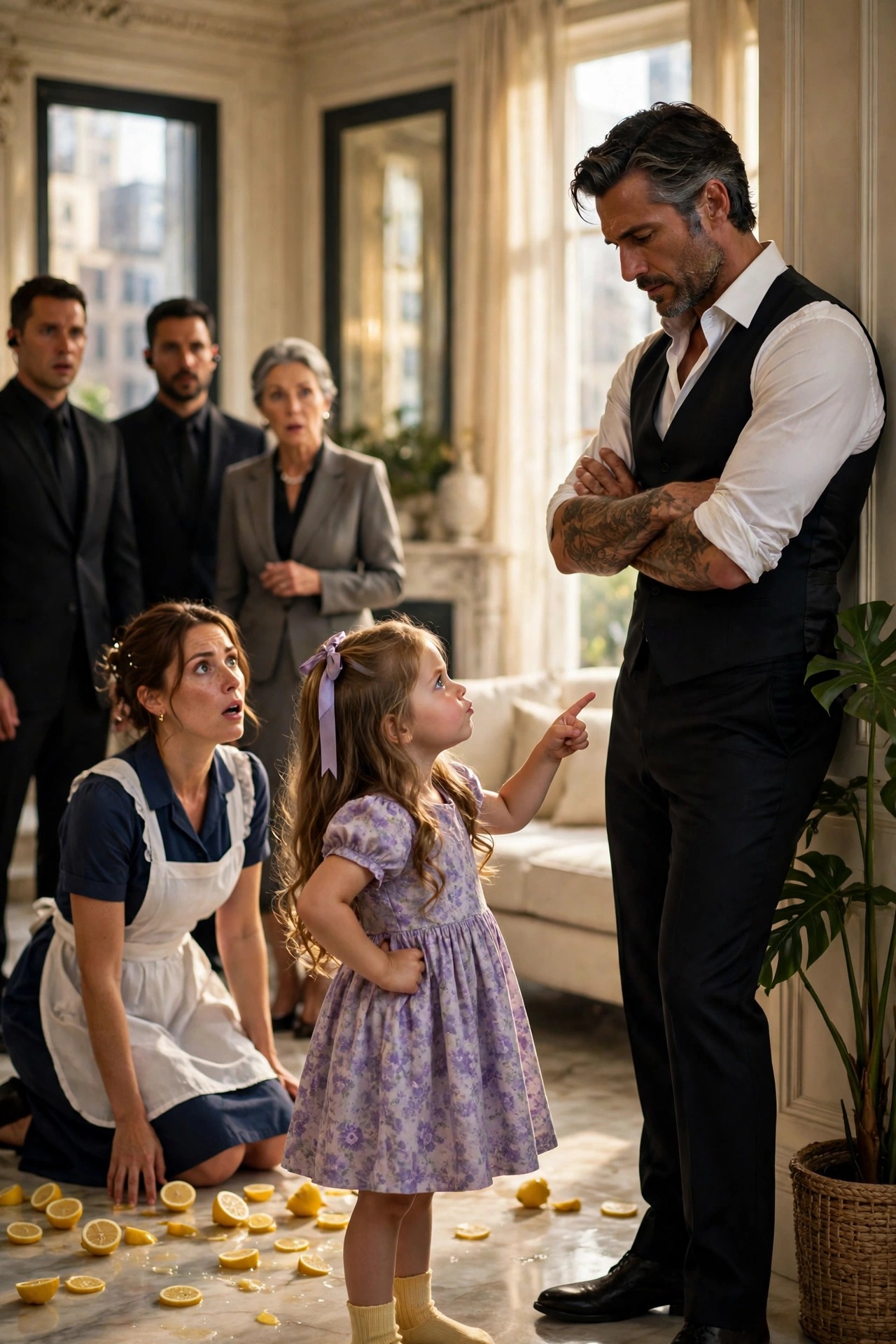
Weeks later, if you had walked through the enormous iron gates of the Marquetti estate, you would not have recognised the place — and then, a moment later, you would have, the way you recognise a person who has finally slept.
The house was the same. The gardens were the same, only kinder: Mrs. Bell had planted flowers along the drive, rows of them, in colours she chose with the air of a general finally allowed to plan a wedding instead of a war.
"Yellow," she told me firmly, with a trowel in her hand and mud on her very best shoes. "This house has had enough of black cars and grey mornings, Mrs. Reyes. We are having yellow."
"And pink?" Lily asked hopefully, crouching beside her in her lavender dress.
"And pink," Mrs. Bell conceded, "for the commanding officer."
Inside, there was music again.
That was Vincent's doing, though he pretended it was an accident of scheduling. A man came from the city on a Thursday to tune Isabel's piano — the piano that had sat silent in the sealed room for seven winters — and when he had finished, he played one piece to test it, something soft and unhurried, and the sound travelled through the house like light through an opened door.
I found Vincent standing in the doorway of that room, listening, with his healing shoulder stiff in its sling and his other hand resting, quite still, on the frame.
"I should have done that years ago," he said.
"You did it today," I told him. "Today counts."
The room was not a shrine any more. That had been Lily's work, mostly, and Mrs. Bell's, and mine, done gently and together, the way you help someone out of a heavy coat they have worn so long they have forgotten it has a weight. Isabel's photograph stood on the bookshelf in good light, smiling — a real smile, caught mid-laugh, the way she deserved to be remembered. Around her now there were armchairs, and a low table, and a basket of Lily's books, and a rug the colour of summer grass. It had become the room we all drifted to in the evenings: a reading room, a play room, a sunlit room. A room for the living, with her honoured in it, not apart from it.
"She would have liked the noise," Vincent said once, watching Lily arrange her crayons on Isabel's old desk with total concentration. His voice did not break on it. It only softened. "She always said this house was too quiet."
"It isn't quiet now," I said.
"No," he agreed, as Lily dropped the entire crayon box on the floor for the second time that morning. "It is not."
The sale went through in the end, the way honest things do — slowly, in offices, with far too much paper and not nearly enough drama to satisfy the newspapers. Vincent completed the legitimate sale of the warehouse routes to the logistics company, exactly as he had promised the room that terrible night. He sat where his lawyers told him to sit. He answered what he was required to answer. He co-operated, within the careful lines his counsel drew, and he kept — cleanly, completely, and for good — only what was lawful: the estate, and the businesses that had never needed shadows to survive.
Pete wrote to me that spring, by the way — a real letter, on paper, in handwriting like a fence in a high wind. He had left Chicago. He was working, lawfully, in his uncle's garage in Indiana, and studying at night, and he said to tell the commanding officer that he thought about the other part of sorry every single day. I read the letter aloud at breakfast. Vincent was quiet for a moment, and then he said, "Good man," and Lily, who understood more of the world than any of us, nodded and said, "He fixed it," as if that settled Pete forever. In our house, it did.
Staff stayed. That surprised people, though it never surprised me. Men and women who had spent years working for a feared name discovered they quite liked working for an ordinary employer instead — one who paid on time, kept regular hours, and was liable, at any breakfast, to be sent to a corner by a four-year-old.
Nico, of all people, became the great reformer of the kitchen.
"I am teaching the staff," he announced one Saturday, with enormous dignity, "to laugh at breakfast."
"You are teaching them?" I said.
"Someone must set an example." And then, because Lily was watching him with her arms folded, Nico — broad-shouldered, immovable Nico, who had once made grown men nervous by standing still — threw back his head and laughed, loudly and deliberately, at absolutely nothing, until the young cook laughed too, startled, and then the gardener's boy, and then all of us.
"Good manners!" Lily declared, delighted.
"Breakfast is at seven," Vincent said mildly, from the doorway. "The laughter, I am told, is compulsory."
It was around then — on an ordinary morning, with toast on the table and Lily's rules page watching us from the refrigerator — that I handed Mrs. Bell my resignation.
She took the envelope as if I had handed her something fragile. "Elena—"
"The paper matters," I said. "I need it to be right on paper. Whatever happens next in this house, I can't be the housekeeper any more. You understand."
"I understand that you have thought about it," she said, which in Mrs. Bell's language meant she understood everything, and she folded me, envelope and all, into the first hug she had ever given me in that house.
Vincent asked me that evening. I want to tell it properly, because of all the things he had ever done — the commanding, the ordering, the deciding for whole rooms full of people — this was the thing he did with the most care.
He found me in the reading room after Lily was asleep. No sling any more, though his shoulder still ached when it rained. He did not stand over me. He sat down in the opposite chair, the way a man sits when the answer is genuinely not his to give.
"I am told you have resigned," he said.
"I have."
"Good." He nodded slowly. "Then I can ask you something I had no right to ask your employer's — my — housekeeper." He folded his hands, and I realised, with a small shock, that Vincent Marquetti was nervous. "Elena. I am asking you to stay. Not as staff. Never as staff again. As family. As — " He stopped, and smiled at his own difficulty, that practised happy face doing bravely. "As my wife, if you will have me. In time. I am asking properly, which for me means: there is no command in this. None."
"Vincent—"
"Let me finish, because I have rehearsed it, and Nico says I ramble when I improvise." That surprised a laugh out of me, and some of the fear went out of the room. "There is money settled in your name. Yours, outright, whatever you answer — Daniel's girl will never count bills at a kitchen table again, and neither will you. And the cottage by the south gate is yours if you want it, or an apartment in the city if you'd rather. If you say no, Elena — if you say no, you take all of that, and my respect, and breakfast invitations for Lily, and you never owe this house another hour. I need you to know the no is real. Otherwise the yes means nothing."
The room was very quiet. Isabel's photograph smiled from the shelf, and the tuned piano waited down the hall, and somewhere above us my daughter slept in yellow socks.
"Is that what you want?" I asked him. "A yes that could have been a no?"
"It is the only kind I want," he said. "I have had the other kind all my life. Obedience. Fear. Silence when I entered a room." He looked at me steadily. "Then a four-year-old stood in front of my couch and offered me a choice, and it was the first honest thing anyone had given me in years. I am trying to learn how it's done."
I thought of Daniel then — not with pain, for once, but the way you think of a hand that once held yours and taught it something. Daniel had taught me that rules were meant to keep people safe. He had taught me to find the second way out of every room.
He had never meant for me to spend my whole life standing in the doorway.
"Then ask me again," I said, and my voice shook only a little. "Ask me properly, and I'll answer properly."
Vincent Marquetti, forty-eight years old, six feet three inches tall, a man whom police commissioners and politicians had never dared refuse, slid — carefully, mindful of his shoulder — down onto one knee on Isabel's summer-grass rug, and held out a small, simple ring. It was not the largest stone in Chicago. It was not meant to be. It was a modest band with one quiet stone, chosen, I would learn later, with Mrs. Bell's ruthless assistance and Lily's final inspection still to come.
"Elena Reyes," he said. "Will you marry me?"
"Yes," I said. "Yes. I choose you. Both of you. All of it. Yes."
The ring was inspected the following morning, at breakfast, with the full solemnity of a state occasion.
Lily held it up to the light. She turned it over. She looked at Vincent over the top of it, in an expression I recognised — one she had inherited, along with the rules, from her father.
"It's not purple," she observed.
"It is not purple," Vincent agreed gravely.
"Purple is the best colour."
"And yet—"
She considered. The whole kitchen waited. Mrs. Bell stopped pouring coffee. Nico stopped breathing, theatrically.
"Okay," Lily said at last, and slid the ring back across the table to me with two fingers, like a tiny queen returning a treaty. "It's shiny. You can keep it. But the wedding cake has to have purple on it. That's a rule. I'm writing it down."
"The wedding is in spring," I said, laughing, as Vincent put his hand over his heart in relief. "You have plenty of time to write it down."
"A small wedding," Vincent said. "In the garden. Family. Mrs. Bell's yellow flowers."
"And pink," said Lily.
"And pink," he agreed. "I have learned not to negotiate."
Which brings me to the rules page.
It still hung in the kitchen — Lily's original page, the four crooked sentences in purple crayon that had started everything, now framed properly at Vincent's insistence, because, as he put it, important documents should be protected. WASH YOUR HANDS. NO SHOES ON THE COUCH. EAT YOUR BREAKFAST. SAY SORRY WHEN YOU USE YOUR ANGRY VOICE.
On the morning of our engagement, Lily stood on a chair, with Vincent holding both the chair and his breath, and added a fifth line at the bottom, in her very best letters — and beneath it, at her instruction, in a grown man's careful, unfamiliar handwriting, Vincent wrote it a second time, so that, as Lily explained, the mister would not forget it was his rule too.
FAMILY EATS BREAKFAST TOGETHER.
"There," Lily said, satisfied, looking at the two versions — hers in purple crayon, his beneath in black ink. "Now it's official. Now it's everybody's."
And so, these days, breakfast is at seven.
I set the table. Mrs. Bell makes coffee strong enough to raise the dead and complains, happily, about the price of flowers. Lily arrives in her lavender dress or whatever royal garment the morning demands, ribbon in her hair, yellow socks on her feet, and takes her seat opposite Vincent's chair like a judge taking the bench.
And at seven — not seven-oh-five, not when his calls finish, not when the world has been attended to — Vincent Marquetti arrives at the breakfast table. On time. Shoes left by the door. Phone nowhere in sight. And on his face, that expression he once told my daughter was impossible for him: his happy face. Practised, at first, all those months ago. Real, now. Entirely, startlingly real, so that strangers who meet him these days sometimes refuse to believe the stories about the man he used to be.
He sits down. Lily inspects him.
"Did you wash your hands?" she asks.
"I washed my hands."
"Did you eat—" She stops herself. "You're eating now. That's the rule happening."
"It is the rule happening," Vincent agrees, and takes his toast like a man receiving an honour.
"Good manners!" Lily declares, beaming, and the kitchen fills — as it fills every morning now, as I believe it will fill for all the mornings I am lucky enough to be given in that house — with laughter. Real laughter. Nico's first, practised and enormous. Mrs. Bell's behind her hand. Vincent's, low and unguarded. Mine.
Nobody in Chicago tells Vincent Marquetti what to do.
Not police commissioners. Not politicians. Not the wealthy businessmen who once pretended they had never heard his name.
Only a four-year-old girl with purple crayons, a lavender ribbon, and a page of rules — and the truth is, he wouldn't have it any other way.
Neither, God help me, would I.
The End.