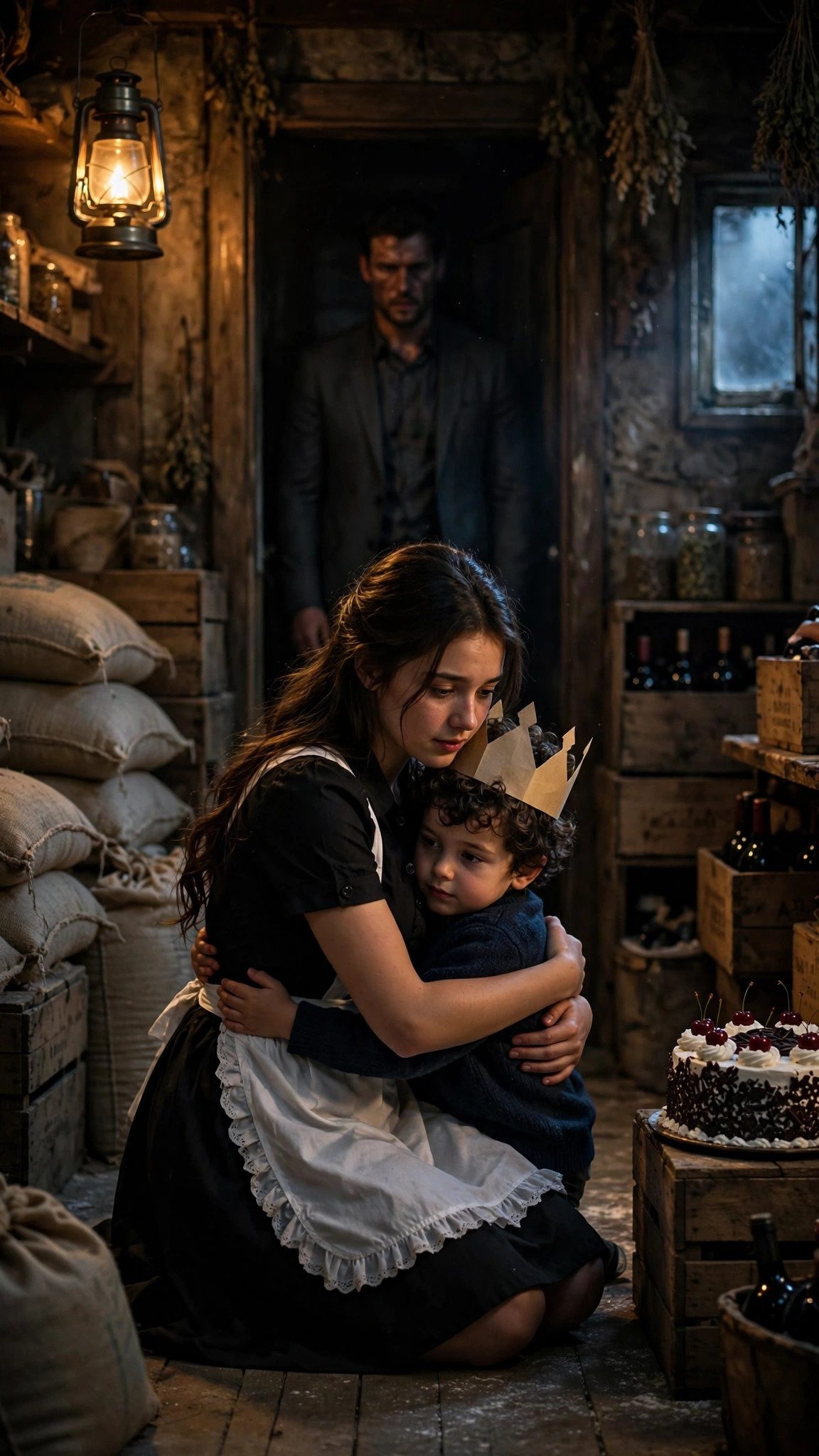
The black uniform was the first thing that ever truly belonged to me.
It was not beautiful. It was not expensive. It was a plain black dress with a white apron, the kind of uniform a hundred maids in a hundred restaurants wore, and when I put it on in the morning, I stopped being Salvatore Bellini's daughter and Regina's property and the girl everyone wanted to marry off. I became Aurora, the maid. Aurora, who cleaned tables and carried trays and baked the Black Forest cake on Sundays.
The uniform had pockets. I had never owned a dress with pockets before. I kept a pencil in one pocket and a folded paper in the other, and on the paper I had written my mother's recipe in her own handwriting, copied from the stained index card I had carried out of our house the day I left.
Black Forest cake. Cherries. Chocolate. Cream. Kirsch, if you could get it, and if you could not, cherry juice and a prayer. My mother used to say that a cake was a promise: you followed the steps, and the steps kept you safe, and at the end there was something sweet.
I needed promises I could keep.
Bellarosa was a restaurant on a quiet street in Brooklyn, the kind of place where the lights were always low and the tables were always full and the men in the back room spoke in voices too soft to overhear. Kian Moretti owned the entire building. He owned the restaurant, and the apartments above it, and the parking lot behind it, and the bakery two doors down that had been closed for years.
Everyone in the kitchen knew who he was. Nobody said it out loud.
"He is a good man," old Vince told me once, wiping his hands on his apron, "in the way a winter is good. It keeps you alive if you respect it. It kills you if you do not."
I learned the rhythms of the place quickly. Mornings were for cleaning and prep. The lunch crowd was businessmen and mothers with children. The evenings were for the men in dark suits who came in through the side door and sat in the back room and never ordered from the menu.
And Zayn was everywhere. He was three years old, then four, and he belonged to the restaurant the way a cat belongs to a house — he simply appeared, in the kitchen, under the tables, in the storage room where the flour sacks made a perfect fort.
His mother had died when he was two. Nobody told me how. In that world, you did not ask. I learned her name was Sofia, and that she had laughed easily, and that Kian had loved her the way a drowning man loves air, and that after she died, Kian had stopped laughing entirely.
Zayn did not remember her. He remembered the shape of her absence, the way a child remembers a room where someone used to sit. He asked about her sometimes, in the direct way children ask about impossible things.
"Where is my mommy?" he asked me one afternoon, while I was folding napkins at the big table in the back.
"She is in heaven," I said, because that was what the nanny had told him, and it was the kindest answer I had.
"Is heaven far?" he asked.
"Very far," I said.
"Can I write her a letter?" he asked.
"Of course you can," I said. "I will help you."
He dictated the letter to me, and I wrote it down in my careful handwriting, and he drew a picture of a house with a garden and a dog, and we folded it into a paper airplane and threw it off the fire escape, because Zayn was certain that was how letters got to heaven.
That was the day Kian Moretti first spoke to me.
I was still standing at the fire escape, watching the paper airplane turn in the wind, when his voice came from behind me, low and rough, like a man who had not used it in days.
"What did you tell him?" he asked.
I turned around. He was tall, and broad-shouldered, and exhausted in a way that had nothing to do with sleep. His suit was expensive and his tie was crooked and his eyes were the same dark eyes as his son's, only older and harder, with something broken behind them.
"I told him his mother is in heaven," I said. "And that he could write her a letter."
He was quiet for a long moment. Then he said, "Nobody else tells him anything. The nanny says 'ask your father.' The staff says 'ask your father.' And his father says nothing, because his father does not know what to say."
"You could try," I said, before I could stop myself. "Children don't need perfect answers. They just need someone to answer."
He looked at me then, really looked at me, and I saw something shift in his face, the way a door shifts when someone finally turns the key.
"What is your name?" he asked.
"Aurora," I said. "Aurora Bell."
He nodded slowly. "Aurora," he repeated, as if he were memorizing it. "From now on, you eat lunch with my son. Every day. One o'clock. The small table by the kitchen. Do you understand?"
"Yes, sir," I said.
"And you will bake the cake on Sundays," he said. "The Black Forest cake. He likes it."
"Yes, sir," I said again.
He turned to go, and then he stopped, and without turning around, he said, "Thank you. For the letter."
That was all. He walked away, and I stood at the fire escape with my hands shaking, because I had just been given something I had never had before: a place at a table, every day, at one o'clock, with a little boy who needed someone to answer his questions.
The lunches became the best part of my day. Zayn ate with the seriousness of a small king, and he talked without stopping, and he asked me everything: why the sky was blue, why the waiters wore black, why his father never smiled, whether heaven had cake.
"Does heaven have Black Forest cake?" he asked me once.
"Of course," I said. "Your mommy makes it there. That is why it is the best cake in the world — because she taught me."
He thought about this very seriously. "Then you are my mommy's helper," he decided. "You are the helper who stayed."
I did not correct him. I should have. I was eighteen, then nineteen, then twenty, and I knew better than to let a child build a home out of a maid in a black uniform. But the truth was that Zayn was building a home out of me, and I was letting him, because nobody had ever needed me before, and needing is a kind of love, and I was starving for it.
Regina, meanwhile, had not forgotten me.
She called the restaurant twice. The first time, the manager told her I did not work there. The second time, she came in person, in a red dress that was too tight and too bright for the low lights of Bellarosa, and she smiled at the hostess and asked for "my stepdaughter, Aurora Bellini."
The hostess, a girl named Maria who had been kind to me from the first day, looked at Regina and said, "We have no one here by that name."
Regina's smile did not move. "Tell her," she said, "that her stepmother misses her. And that the house is very empty without her. And that there are men who would pay a great deal of money to marry a girl with her bloodline."
Maria told me after she left. I stood in the kitchen with my hands in dishwater and felt the old fear climb up my spine, cold and familiar.
"She cannot take you from here," Vince said, appearing beside me with a towel over his shoulder. "This is Moretti's building. Regina has no power here. But be careful, girl. A woman like that does not stop. She waits."
He was right. Regina waited. She waited for two years, while I ate lunch with Zayn every day at one o'clock, while I baked the Black Forest cake on Sundays, while I learned to laugh again in a kitchen that smelled like my mother's kitchen.
And all the while, she was losing money at the card tables, and borrowing from men who did not forgive debts, and one night she borrowed fifty thousand dollars from a man named Tony Falco, who collected debts for Vincent Castellano.
Fifty thousand dollars. That was the price she put on me.
I did not know any of that yet. I only knew that my uniform had pockets, and that in one pocket I kept my mother's recipe, and that a little boy with chocolate on his face had asked me to stay.
The restaurant taught me things my father's house never had. It taught me that work could be a kind of prayer — the same motions, every day, done with care, adding up to something that fed people. It taught me that a kitchen at six in the morning, before the world wakes up, is the quietest place on earth, and that the smell of bread in the oven can make even the hardest morning bearable.
Maria, the hostess, became my first real friend. She was twenty-four, from Queens, with a loud laugh and a soft heart, and she had a habit of saving me the good tables — the ones near the window, where the light was kind — and of slipping me an extra bread roll when she thought I had skipped lunch.
"Eat," she would say, pressing the roll into my hand. "You are too thin. The men in the back room eat like kings, and you eat like a mouse. It is not right."
"I eat enough," I would say, and she would roll her eyes, and we would both laugh, and for a moment I would forget that I was a runaway hiding from a stepmother who wanted to sell me.
The lunch regulars learned my name. Mr. Okafor, who came every Tuesday for the soup, always asked about Zayn. "How is the little boss today?" he would ask, and I would tell him, and he would slip me a dollar for "the boy's college fund," and I would put it in the jar I kept in my locker.
There was a jar in my locker. I had started it the day Zayn asked me to stay. Every tip, every dollar, every coin anyone pressed into my hand — into the jar. Not for me. For him. For the day he would need something I could give him. I did not know what that day would look like. I only knew that a boy who had lost his mother deserved someone who was saving for him.
One winter afternoon, Zayn got sick. It started as a cough in the morning, and by lunchtime he was burning with fever, and Mrs. Kowalski was on the phone with the doctor, and Kian was in a meeting across town, and the apartment upstairs felt too quiet and too hot.
I stayed all night. I did not ask permission. I simply did not leave. I sat beside his small bed with a cold cloth, and I wiped his forehead, and I sang the lullaby, and when his fever broke at three in the morning, he opened his eyes and looked at me and said, "You stayed."
"Of course I stayed," I said, and my voice cracked, because I was so tired and so relieved I could hardly speak. "Where else would I go?"
"Other people go," he said sleepily. "Mommy went. Daddy goes. Mrs. Kowalski goes home. But you stayed."
I held his small hand until he fell asleep again, and I thought about the jar in my locker, and the recipe in my pocket, and the uniform with pockets, and I understood something that had been true for a long time without my noticing it: I had not just taken a job at Bellarosa. I had built a life there, one lunch at a time, one lullaby at a time, one cold cloth at a time.
Kian came home at dawn, and he found me asleep in the chair beside his son's bed, still in my uniform, with the cold cloth in my hand. He did not wake me. He stood in the doorway for a long time, and when I finally opened my eyes, he was holding out a cup of coffee, black, the way I liked it.
"Thank you," he said, and it was the second time he had said it to me, and it sounded different this time — heavier, like a man who was beginning to understand the size of a debt he could never repay.
"He is better," I said, taking the coffee. "The fever broke at three."
"I know," Kian said. "Mrs. Kowalski told me. She also told me you did not leave. That you stayed all night."
"Someone had to stay," I said.
He looked at me then, and I saw something in his face that I had not seen before — not the boss, not the storm, but a father, exhausted and grateful, looking at the woman who had sat up all night with his son.
"Yes," he said quietly. "Someone had to stay. And you stayed."
That was the morning I understood that Kian Moretti had begun to trust me. Not with his business. Not with his secrets. With the only thing in the world that mattered to him.
His son.
Old Vince told me once, while we were kneading dough side by side, that the restaurant had a history — that Kian's father had opened Bellarosa forty years ago, that the back room had seen deals that built an empire, that the building itself remembered things no living person could speak of.
"This place keeps its people," Vince said, flour on his forearms, his voice low. "It kept me for thirty years. It will keep you too, girl, if you let it. Buildings like this one know who belongs."
I wanted to belong. I wanted it so much it hurt. And for three years, I did belong — to the kitchen, to the small table by the door, to the boy who ate lunch with me every day at one o'clock.
And all the while, Regina was losing money at the card tables, and borrowing from men who did not forgive debts, and one night she borrowed fifty thousand dollars from a man named Tony Falco, who collected debts for Vincent Castellano.
Fifty thousand dollars. That was the price she put on me.
I did not know any of that yet. I only knew that my uniform had pockets, and that in one pocket I kept my mother's recipe, and that a little boy with chocolate on his face had asked me to stay.
So I stayed.