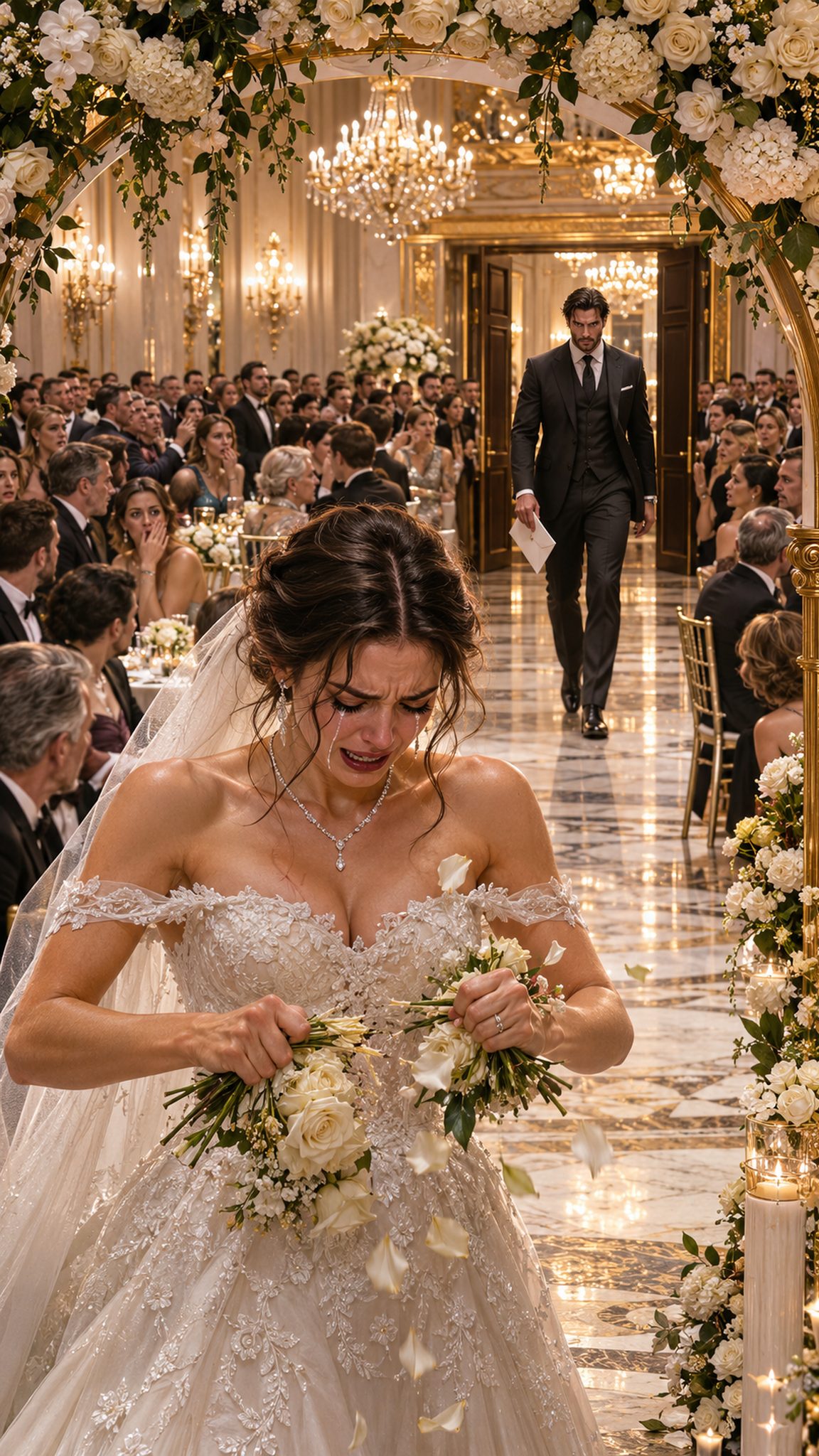
The first flower I destroyed was the white rose at the center of my bouquet.
I did not mean to tear it apart. My fingers had simply closed too tightly around the stems while I stood beneath the white-and-gold floral arch, waiting for a man who had promised to meet me there. The rose came loose with a small, wet snap. A petal drifted onto the front of my wedding dress.
Nearly two hundred people watched.
Some looked embarrassed for me. Some looked entertained. Most had discovered that pretending not to stare was harder than staring outright. Their whispers traveled across the Harbor Crown Hotel ballroom in little waves, rising whenever another minute passed without the groom.
I could hear fragments.
“He's not coming.”
“Did he leave her?”
“Imagine paying for all this.”
A man near the third table laughed. He tried to turn it into a cough when he noticed me looking, but the sound had already reached me. It lodged somewhere beneath my ribs.
I was thirty-seven years old. I had spent eleven months paying for that dress, and I had spent almost as long planning a wedding that would prove my life had not been reduced to the debts my mother left behind. The dress was ivory white, fitted through the waist, with a soft train that spread across the polished floor. I had chosen it because it made me feel like a woman who had finally been allowed to want something beautiful without calculating what it would cost.
Now I was standing alone in it, crushing the flowers I had arranged myself.
The arch above me was built from white roses, pale gardenias, and gold branches. I had designed it, ordered the materials, and spent the previous evening checking every fastening. I had wanted the flowers to look as if they had grown there naturally, as if beauty could be effortless. Nothing about that afternoon was effortless.
The pianist had stopped playing. The guests had begun shifting in their seats. At the far wall, six elderly guests stood awkwardly because someone had moved their chairs earlier and no one had thought to bring them back. I had noticed them before the ceremony began. I had asked the banquet manager to fix it. He had nodded and disappeared into the crowd. They were still standing.
I wanted to leave the altar and help them. I wanted to do something ordinary with my hands. Instead, I stood beneath the flowers and tried not to cry.
The ballroom doors at the far end were supposed to remain closed until the groom arrived. The entrance for the wedding party was on the opposite side, through the gold-trimmed doors beside the musicians. That was why the sound of another door opening made several guests turn.
A man stepped through the wrong ballroom entrance.
He was tall, looked about forty-five, and wore a dark suit that seemed made for him rather than selected from a rack. He did not hurry. He did not look around as if he had taken a wrong turn. He entered with the calm certainty of someone who expected every room to make space for him.
A thick white envelope rested in his right hand.
Even from the altar, I could see that a name had been written across its front.
Graham Vale.
The man’s appearance changed the room. Two hotel employees near the service station straightened so quickly that one nearly knocked a tray against the wall. A security guard lowered his eyes. The pianist’s hands hovered above the keys without moving.
I did not know the stranger. I knew only the effect he had on everyone who did.
His gaze traveled across the ballroom and settled on me. Not on the flowers, not on the guests, not on the empty space where Graham should have been. On me.
For a moment, I forgot the whispers.
Then the man began walking toward the altar.
I would learn his name later: Alessandro Moretti. I would learn that people in Boston spoke of him carefully, if they spoke of him at all. At that moment, he was simply a stranger carrying an envelope with my missing groom’s name on it.
And I was a bride whose wedding had already become a public disaster.
To understand why I had believed Graham would come back, I have to explain what Bellamy Blooms meant to me.
My mother opened the shop when I was still young enough to think that flowers appeared in buckets because someone had planted them there for her. Bellamy Blooms occupied a narrow storefront on a Boston street where the brick buildings leaned toward one another and the winter wind seemed to find every gap in the windows. The sign above the door was painted cream, with green lettering and a small gold bell. My mother chose the name because she wanted it to sound welcoming.
She said a flower shop should feel like a place where people could bring both good news and terrible news and still be met with kindness.
She was right.
People came in for wedding bouquets, funeral wreaths, birthday arrangements, apologies, and flowers they could not explain. Some customers knew exactly what they wanted. Others stood in front of the cooler with their hands in their pockets and admitted that they had no idea what to buy for someone they loved. My mother never made them feel foolish. She asked questions until she found the right flowers.
She taught me to notice the small things. A customer who bought yellow roses every Friday might be visiting a hospital. A man who asked for the same arrangement every year might be remembering an anniversary. A woman who ordered white lilies but kept changing the delivery address might be trying to say goodbye without having to say it aloud.
My mother believed flowers could carry what people could not manage to speak.
When she became ill, I started working longer hours. At first, I told myself I was helping her. Then I began handling the invoices, the supplier calls, and the repairs. I learned which wholesalers would extend a payment deadline and which ones would not. I learned how to keep the shop open when the heating failed, how to wrap bouquets with numb fingers, and how to smile at customers after spending the morning in a hospital corridor.
She died seven years ago.
The shop came to me with her name over the door and a stack of debts in the office drawer. There was a leaking roof that stained the ceiling above the ribbon shelves. There were unpaid supplier accounts and a refrigerator unit that made terrifying noises every third Tuesday. It was old enough to have its own moods. Sometimes it rattled for ten minutes and stopped. Sometimes it groaned through the night. Once, it made a sound so loud that a customer asked whether something was trapped inside.
I kept it because replacing it would have meant choosing between equipment and the money I needed to keep the doors open.
For years, I had treated the shop like a promise I could not break. My mother had built it with her hands. I would not be the person who let it disappear.
That was how I learned to build a life around careful decisions. I did not buy things because they were pretty. I bought them because they would last. I did not take days off unless I had someone reliable to cover the shop. I kept a notebook of expenses and another of orders. I knew which customers paid late and which suppliers would forgive a missed date if I called before they had to call me.
I was not unhappy. I had friends, a small apartment above a bakery, and a business that was still alive. But I had become very good at not expecting anyone to carry anything heavy for me.
Then Graham Vale walked into Bellamy Blooms.
It was three years before the wedding, on a gray afternoon near the end of summer. He came in looking for flowers for his mother’s birthday. He was forty-one, well dressed without seeming showy, and handsome in a way that did not depend on making sure everyone noticed. His hair was neatly cut. His coat was expensive, but he did not mention the label. He listened while I asked about his mother’s favorite colors and whether she preferred a traditional arrangement or something less formal.
“She likes things that look as though they belong in a garden,” he said. “Not too perfect.”
I showed him a bucket of pale roses, lisianthus, and eucalyptus. He studied them as if the choice mattered.
“It’s for her birthday,” he added. “She says she doesn’t need anything, which usually means she wants flowers.”
I laughed. “That is a very common condition.”
He smiled. “Is there a cure?”
“Not one I recommend.”
He bought the arrangement, then noticed the concrete planters near the front window. I had been trying to move them away from a draft, but each was too heavy for me to lift safely. I told him I could manage.
He looked at the planters, then at me.
“You can,” he said. “But you don't have to.”
Before I could argue, he set his coat aside and helped me carry them. He did not make a performance of it. He simply lifted one end and waited for me to guide him. When we had moved the last planter, he washed his hands in the little sink behind the counter and asked whether I needed anything else moved.
I said no. I remember that because I had wanted to say yes.
He returned a week later to tell me his mother had loved the flowers. After that, he found reasons to stop by. Sometimes he bought a small arrangement. Sometimes he brought coffee. Once, he came in with a paper bag of pastries because he said he had passed the bakery and thought I might have forgotten lunch.
He remembered details. He knew I liked the first quiet hour before the shop opened. He learned that my mother had started Bellamy Blooms and that I still used her old pruning shears. He never asked why I had not expanded the business or moved to a larger location. He seemed to understand that keeping one small shop alive could be a kind of ambition.
Graham was successful. He had a reputation as a sharp businessman, and people who knew him spoke of his work as if it were proof of his intelligence. Yet he did not constantly remind me of it. He could talk about a difficult negotiation without making it sound like a victory parade. He asked about my suppliers and listened to the answers. When he visited, he did not act as if my shop were a charming little hobby.
That mattered more than I expected.
Our relationship developed quietly. There were dinners after closing, walks along the harbor, and Sundays when he came to the shop and helped me sort deliveries. He learned to distinguish garden roses from spray roses. He was not particularly good at arranging them, but he tried. When I teased him, he said that his talents were better suited to balance sheets.
I told him flowers had balance sheets too. They simply wilted faster.
He laughed, and I remember thinking that I wanted to hear that sound for a long time.
The first time I saw how far he would go for me, the back door lock at Bellamy Blooms jammed during a thunderstorm.
It was nearly midnight. I had stayed late to finish an order for a funeral service, and rain hammered the alley so hard that the pavement shone like black glass. I tried the key twice, then again, turning it until my wrist hurt. The lock would not move. I called a locksmith and was told the wait could be more than an hour.
I was alone in the shop. The cooler rattled behind me. The storm shook the old windowpanes. I told myself I was safe, but the alley was dark, and the thought of standing there until someone arrived made my stomach tighten.
I called Graham.
I did not expect him to come. I only wanted to hear a familiar voice while I waited.
He asked where I was, then told me to stay inside. Less than half an hour later, his car pulled into the alley. He had driven across Boston in the middle of the storm. His hair was damp, and the shoulders of his coat were dark with rain.
“You came,” I said.
“You called.”
“The locksmith is on the way.”
“Then I’ll wait with you.”
He did not complain about the weather or the hour. He stood beside me until the locksmith arrived, and when the lock finally turned, he checked the door twice before walking me upstairs. I remember how ordinary he made it seem. As if crossing the city at midnight because I was frightened was not a grand gesture but the obvious thing to do.
I began to trust him with the parts of my life I usually kept hidden. I told him about the debts, the roof, and the refrigerator. I showed him the old photograph of my mother standing in front of the shop on opening day. He did not offer to buy the business or solve everything with money. He asked what I needed and listened when I told him.
He made me feel that I was not a burden.
There was one night, months before he proposed, when I woke at two in the morning and found him standing beside the bedroom window.
The room was dark except for the faint glow of the streetlights. Graham was facing the glass, one hand resting against the frame. He was whispering. I could not make out the words.
“Graham?”
He turned quickly.
For a second, his expression looked almost startled. Then he smiled and came back to bed.
“Sorry. Did I wake you?”
“Who were you talking to?”
“No one. I was thinking aloud.”
“You sounded like you were answering someone.”
He brushed a strand of hair from my face. “I’ve had a lot on my mind.”
I asked if something was wrong. He said work had been complicated, but he would explain when he could. Then he kissed my forehead and turned off the bedside lamp.
I did not press him. Everyone was entitled to private worries. I had my own. Still, I remembered the way he had been standing at the window, as if he had been trying to keep his voice from reaching someone outside.
The proposal came several months later. It was not extravagant. Graham took me to dinner at a quiet restaurant and gave me a ring in a small velvet box. He said he wanted to build a life with me, not because he thought my life needed rescuing, but because he wanted to be part of it.
I said yes.
For the first time in years, I allowed myself to plan something without first listing every possible way it could go wrong.
The wedding took eleven months to arrange. I handled most of it myself because I knew exactly what I wanted and because the budget had limits. I chose the Harbor Crown Hotel because its ballroom had tall windows, warm chandeliers, and enough room for the people Graham and I cared about. The hotel’s wedding coordinator wanted a grand entrance with a string quartet. I chose a pianist. The coordinator suggested elaborate imported centerpieces. I designed the floral arch and made the table arrangements myself.
I planned every centerpiece, every song, and every seating chart.
I chose warm smoked salmon on cucumber rounds for the first course. I tested a Basque cheesecake four times before settling on the version I wanted. I added a coffee station because Graham had said his family loved strong coffee. I even paid a supplement because the wedding designer insisted the aisle should be a specific shade of cream.
I checked the seating chart until I knew where every guest would sit. I made sure older relatives were close to the doors and that people who had trouble hearing were not placed beside the musicians. I called the hotel twice about the temperature in the ballroom. I asked the florist supplier to deliver extra white roses in case any blooms bruised during setup.
I was not trying to control every detail because I thought a perfect wedding would guarantee a perfect marriage. I simply wanted to make a beautiful day for the people who had supported us.
And I wanted my mother to have been able to see it.
I placed a small photograph of her in a silver frame near the guest book. It showed her outside Bellamy Blooms, smiling beneath the old sign. I did not put it on the altar. I wanted her close, but I did not want the day to become a memorial. She had taught me that flowers belonged to beginnings as well as endings.
On the morning of the wedding, Graham and I ate breakfast together at my apartment. We sat on opposite sides of the kitchen table. Neither of us had slept much. The coffee was strong, the toast was slightly burnt, and the sunlight made a pale rectangle on the floor.
He ate two bites of toast.
“You should eat something,” I told him.
“I’m not hungry.”
“You’ll regret that when the ceremony is over.”
He smiled faintly. “I’ll survive.”
He looked tired. I assumed it was the same nervousness I felt. I had spent the previous evening checking arrangements and answering messages. He had been dealing with last-minute calls from work. We had both promised not to let the wedding become another task to manage.
For a few minutes, we talked about ordinary things. The weather. The hotel. Whether his mother would cry. Whether my cousin would make a speech longer than the one she had promised. Graham reached across the table and took my hand.
“You look happy,” he said.
“I am.”
He rubbed his thumb across my knuckles. “Good.”
After breakfast, he went to get dressed. I changed into my robe and began checking the small things I had laid out: earrings, shoes, the folded note with the hotel coordinator’s number, and the envelope containing the final payment receipt. When Graham returned, he was wearing his dark suit and adjusting his tie.
He looked at himself in the hall mirror, then glanced toward me.
“There is one piece of marriage paperwork we should sign before the ceremony,” he said, almost casually.
I thought I had misheard him.
“What paperwork?”
“Just something we need to take care of. It won't take long.”
“What kind of paperwork?”
He straightened his tie. “A contract. I left it in the car. I’ll get it.”
I stared at him. “Graham, what contract?”
“It’s routine,” he said. “I'll explain when I bring it up.”
The words were not an answer. I knew that even then. But he spoke so calmly, as if we were discussing a delivery receipt, that I did not immediately understand how strange it was.
We had discussed the marriage license. We had discussed insurance, the apartment, and whether I wanted to keep my surname. We had not discussed another contract. We had not discussed signing anything that involved Bellamy Blooms, my accounts, or the business my mother had left me.
I asked if I should come with him.
“No. Stay here. You have enough to do.”
He leaned down and kissed my cheek. Then he picked up his car keys and walked out.
I watched him through the window as he crossed to the car. He opened the driver’s door and leaned inside. For a moment, I could see his shoulders moving as he searched. Then he straightened, looked toward the building, and got into the car.
I expected him to return in a minute.
I checked my phone. I sent him a message asking whether he had found the contract. It showed as delivered, but there was no reply.
I called. The call rang until it went to voicemail.
At first, I told myself he was driving. Then I told myself he might have stopped to take a call. When ten minutes passed, I called again. When twenty passed, I began to feel a cold pressure beneath my ribs.
The wedding coordinator called to ask whether the groom was on his way. I said yes, because I still believed he was. I told her there had been a small delay. She said she would hold the ceremony.
I put on my dress. My hands shook while I fastened the buttons. I kept looking at the phone. No message. No missed call. Nothing.
A driver had been arranged to take me to the hotel. I almost canceled. Then I thought of the guests, the staff, the money already spent, and the people who had traveled to be there. I thought that if Graham had been delayed, he would arrive at the hotel. Perhaps he had gone back to the office. Perhaps the contract had been more complicated than he expected. Perhaps there was an explanation that would sound reasonable once he stood in front of me.
I went.
At the Harbor Crown Hotel, the coordinator met me at the entrance and asked if I was ready. I nodded. My bouquet was placed in my hands. The white roses were cool against my fingers. I remember thinking that they smelled exactly as my mother’s shop used to smell on mornings when fresh deliveries arrived.
The music began.
I walked down the aisle alone for the first few steps because the coordinator had arranged for my uncle to meet me halfway. He was waiting near the first row. He smiled, but his eyes searched my face.
“Is he here?” I whispered.
“He'll be here,” he said.
I wanted to believe him.
My uncle walked me to the altar and kissed my cheek. The officiant waited. The pianist continued playing. I stood beneath the arch and watched the doors.
One minute passed.
Then five.
Then ten.
The coordinator moved discreetly toward the back of the room. Graham’s mother was not there. His brother had sent a message saying he was running late, but he had not arrived either. I looked at the front row and saw empty chairs where his family should have been.
I called Graham again.
Voicemail.
I sent another message.
Where are you? Please call me.
No answer.
The guests began to notice. A few exchanged looks. Someone leaned toward the person beside them. The whispers started softly, then grew. The officiant stepped closer and asked whether I wanted to pause.
I said no.
I did not know what else to say.
I waited because I loved him. I waited because I had promised myself I would not let fear decide what was true. I waited because the man who had driven across Boston in a thunderstorm had not seemed like someone who would leave me standing alone in front of two hundred people.
But he did not come.
The whispers sharpened. A man near the gift table picked up the box he had brought, tucked it beneath his arm, and walked out. Two women I had considered friends for almost ten years slipped through the doors without saying goodbye. The six elderly guests remained standing near the wall, forgotten while everyone watched the empty entrance.
I looked at the flowers. I had built the arch with my own hands. I had arranged the bouquet. I had chosen every detail because I wanted the day to feel like something I had made, not something I had been given.
Now it felt as though the room was waiting for me to admit that I had been foolish.
I began to pull the bouquet apart.
One stem snapped. Then another. White petals fell onto the floor and caught against the lace at my waist. I could not stop. I was not trying to make a scene. I was trying to keep my hands from shaking so badly that everyone would see.
Then the wrong door opened.
The room changed before I understood why. Conversations stopped in uneven patches. Hotel employees straightened. The security guard near the service station shifted aside.
A tall man in a dark suit entered carrying a thick white envelope.
He did not belong to the wedding. I knew that immediately. His face was unfamiliar, his manner too composed for someone who had stumbled into the wrong event. He looked across the ballroom as if he were searching for one person.
Then his eyes found me.
He crossed the room without hurrying. I saw the envelope in his hand. My groom’s name was written across it in dark ink.
Graham Vale.
My heart pounded so hard that it hurt. I wanted to disappear behind the bridal party, but there was nowhere to go. I held the broken bouquet against my dress and watched the stranger approach.
He stopped a few feet from the altar.
“What's his name?” he asked.
“Graham Vale,” I whispered.
The man’s expression did not change.
“That man never intended to marry you.”
I stared at him.
“What?”
“I saw him upstairs,” he said. “And I think he left because he realized I saw something he was not expecting.”
He lifted the thick white envelope slightly. The name Graham Vale remained visible.
The stranger had not come to congratulate me. He had not come to explain why my groom was late. He had walked into the wrong ballroom carrying something that belonged to the man who had abandoned me.
And as nearly two hundred guests watched us, I understood that Graham’s disappearance was not the worst thing that had happened that morning.
It was only the first thing I did not understand.