My mother died with my seven-year-old son holding her hand.
I know that sounds like the kind of sentence a person writes when she is trying to be poetic about grief, the kind of line you put in a sympathy card because the truth is too ugly to say plainly. It is not poetry. It is the truest thing I have ever written. My mother, Margaret Bennett, died at 6:14 on a Tuesday morning in a hospital room that smelled of antiseptic and rain, and my son Jason sat on the edge of her bed in his dinosaur pajamas, holding her left hand in both of his, whispering to her about the tree house his grandfather had promised to build him one day, as if the sound of his small voice could keep her here a little longer.
It could not. But God, he tried.
I arrived at Chicago General Hospital at 5:40 that morning, still wearing my nurse's scrubs from the night shift, because the charge nurse had called me at 4:58 and said the words no daughter is ever ready to hear. "Clara, it's your mother. The stroke was massive. You need to come now." I had run out of the nurses' station with my locker still open and my coffee still steaming on the counter, and I had driven through the empty Chicago streets with my hands shaking so hard I could barely hold the wheel.
My mother was in Room 412. I knew that room. I had worked that floor for nine years. I had held the hands of a hundred strangers in that room and told them that everything was going to be all right, and most of the time I had believed it. That morning I walked into Room 412 and I knew, the way nurses always know, that nothing was going to be all right.
She was so small in that bed. My mother had never been a large woman — five foot two, bird-boned, with silver hair she wore in a braid down her back until the day she decided she was too old for braids and cut it short — but the stroke had made her smaller still, as if her body were already folding itself away, politely, not wanting to be a burden.
"Mom," I said.
Her eyes opened. Just barely. One of them, the left one, found me and held on.
"Clara," she whispered. Her voice was thin as tissue paper. "Where's my boy?"
"Jason's on his way," I said, and it was a lie, because Jason was at home asleep and Marc was supposed to be watching him, and Marc had not answered his phone. "He's coming, Mom. He loves you so much."
She smiled. It was a crooked smile, the left side of her mouth rising while the right side stayed still, and it broke my heart in a way I had not known a heart could break while it was still beating.
"Tell him," she said, and then she had to stop and breathe, and the breathing sounded like paper tearing. "Tell him his grandma loved him first. Before anybody. Tell him that."
"I will, Mom. I promise."
"And the house," she said. "Clara. The house. Your father built that house with his hands. It is yours. Yours and Jason's. Don't let anybody —"
She stopped. Her eyes fluttered. The monitor beside the bed began to make a sound I had heard a hundred times and never once gotten used to.
"Mom!" I said, and I was a nurse again, suddenly, automatically, my hands moving to her chest, my voice going calm and professional in the way it always did when everything was falling apart. "Mom, stay with me. Stay with me."
The code team came running. I knew every one of them. Rosa from the night shift. Dr. Patel. Two residents whose names I could not remember because my mind had gone white and blank. They worked on my mother for eleven minutes while I stood in the corner of the room with my back against the wall, my scrubs still smelling of someone else's blood from the night shift, and I watched them do everything right and I knew it would not be enough.
At 6:14, Dr. Patel looked at me over his mask and said, very quietly, "Clara. I'm sorry. We have to stop."
I nodded. I do not remember nodding, but Rosa told me later that I did, that I was very calm, that I thanked them, that I asked them to leave the room so I could be alone with her.
I sat on the edge of the bed and I took my mother's hand. It was still warm. That was the worst part. It was still warm, and she was gone, and the warmth was just the body not knowing yet.
"I love you, Mom," I said. "Thank you for everything. Thank you for the house. Thank you for Jason. Thank you for loving us first."
I do not know how long I sat there. Long enough for the rain to start outside the window. Long enough for the morning shift to begin and the hallway to fill with voices. And then my phone buzzed, and it was Marc, finally, and his text said, "Where are you? Jason's awake. He's asking for you."
I called him back. "Mom's gone," I said. "She died at 6:14. Bring Jason. Bring him now. She wanted to see him."
Marc was quiet for a moment. Then he said, "Jesus, Clara. I'm sorry. We'll be there in twenty minutes."
He took forty-five. When he finally walked into Room 412, Jason was already crying before he saw the bed, because seven-year-old boys know, they always know, and I lifted my son up onto the mattress and I put his small hands around his grandmother's hand, and I said, "Hold her hand, baby. Just hold her hand. She loved you first, before anybody."
Jason held her hand for a long time. He whispered to her about the tree house. He told her about the spelling test he had passed on Friday. He told her he would take care of me. And then, very quietly, he said, "Grandma, it's okay. You can go now. Mommy and me will be okay."
My mother had been dead for almost an hour by then. But I swear to you, I swear on everything I have ever loved, that in that moment her face looked peaceful in a way it had not looked before. As if she had been waiting to hear that. As if she had needed permission from the smallest person in the room.
That was the last morning my family was whole. I did not know it yet. I thought the worst thing that could happen to us had already happened.
I was wrong.
The funeral was three days later, on a Friday, at the little white church on Linden Lane where my parents had been married forty-one years earlier. It rained the whole morning, a thin grey rain that made the world look like an old photograph. My mother had loved that church. She had sung in the choir there for thirty years. The choir sang "Amazing Grace" and their voices shook, and Jason sat beside me in his navy suit — the suit my mother had bought him for Christmas, a little too big in the shoulders — and he held my hand so tightly his knuckles went white.
Marc showed up late. Twenty minutes late, to his own mother-in-law's funeral, walking in during the second hymn with his tie crooked and his hair damp, sliding into the pew beside me as if he had just come from a business meeting instead of a funeral. He did not apologize. He did not put his arm around me. He sat there with his hands folded and his eyes on the coffin, and I told myself he was grieving in his own way, that men grieve differently, that I should not judge him on the worst day of my life.
After the service, while people were filing past the coffin and hugging me and telling me how sorry they were, I saw Marc across the room, standing in the corner with Mr. Doyle, our family lawyer. They were talking in low voices, and Marc was leaning in close, and Mr. Doyle's face had gone very still in the way lawyers' faces go when someone is asking them something they do not want to answer.
I walked over. "What are you two talking about?" I asked.
Mr. Doyle looked at me with kind, tired eyes. He was seventy years old and he had drawn up my father's will and my mother's will, and he had known my family since before I was born. "Your husband was asking about the house, Clara," he said. "About your father's house."
Marc smiled then. It was not a grieving smile. It was a quick, bright, businesslike smile, and it did not reach his eyes. "I was just asking about the paperwork," he said. "That's all. Somebody has to think about the practical things."
I stared at him. "My mother was buried an hour ago."
"I know that," he said, and his voice had an edge to it now. "I'm just saying, the house is an asset, Clara. We need to understand what we're dealing with."
"We're not dealing with anything today," I said. "Today we bury my mother."
He held up his hands, palms out, the way a man does when he wants you to think he is being reasonable and you are being emotional. "Fine. Fine. We'll talk about it later."
We went back to the house on Linden Lane after the funeral. My father's house. The house he had built with his own hands, plank by plank, when I was a little girl, telling me every day that one day it would be mine. The house where my mother had cooked Sunday dinners for forty years. The house where Jason had taken his first steps on the hardwood floor in the living room.
People came and went. Neighbors brought casseroles. Rosa from the hospital brought a chocolate cake and stayed to wash dishes. Jason fell asleep on the couch at eight o'clock with his shoes still on, and I carried him up to my old bedroom and tucked him in under the quilt my mother had made for me when I was twelve.
And then it was just Marc and me in the kitchen, at the table where my father used to sit every morning with his coffee and his newspaper, and Marc poured himself a glass of whiskey — my father's whiskey, from the bottle on the top shelf — and he looked at me across the table and he said the words that ended my marriage.
"Your father left that house to me," he said. "It's what he wanted. He called me his son."
I stared at him. For a moment I could not speak. I could hear the rain on the kitchen window. I could hear the refrigerator humming. I could hear my own heart beating very fast and very loud.
"That's not true," I said finally.
"It is true," Marc said. "Your father and I talked about it. Before he died. He told me the house would be mine one day. He trusted me to take care of it. He called me his son, Clara. His son."
"My father," I said, and my voice was shaking now, "told me since I was small that this house was for me and my son. He left it to me in his will. He left everything to me."
Marc laughed. It was a cruel laugh, low and certain, the laugh of a man who believes he has already won. "Then show me the will, Clara. Show me the paper. Because I think you're remembering what you want to remember."
I stood up. My legs were shaking, but I stood up, and I walked to the drawer in the hallway where my mother kept the important papers — the drawer with the rubber band around the folders, the drawer I had opened a hundred times as a girl looking for stamps — and I took out the folder marked WILL in my mother's neat handwriting, and I carried it back to the kitchen and I set it down on the table between us.
"Look at the will, Marc," I said.
He opened it. I watched his face while he read. I watched the smile fade. I watched his jaw tighten. I watched his eyes move across the page once, and then again, more slowly, as if the words might change if he read them a second time.
The will was very clear. My father, Thomas Bennett, had left the house on Linden Lane to me, Clara Bennett, and to my son Jason after me. He had left everything to me. There was no mention of Marc Johnson anywhere in the document except in one line, near the end, where my father had written, in his own hand, that his son-in-law was to receive his fishing rods and his toolbox, "because a man should have something useful in his hands."
Marc closed the folder slowly. He set it down on the table. He looked at me, and for a moment I saw something in his eyes I had never seen before. Not grief. Not love. Not even anger. Calculation. Cold, fast calculation, like a man adding up numbers in his head.
"Well," he said. "That's that, then."
He stood up. He finished his whiskey in one swallow. He walked upstairs without another word, and I heard the bedroom door close, and I sat alone at my father's kitchen table until two in the morning, listening to the rain, holding my mother's will in my hands like it was the only solid thing left in the world.
I thought that was the end of it. I thought the will had settled it. I thought my husband had lost, and that the house was safe, and that grief was the worst thing I would have to survive that year.
I was wrong about that too.
Because a week later, I found out he had been trying to sell the house all along.
It was Rosa who told me, in a way. Not directly. Rosa had a cousin who worked at a real estate office downtown, and the cousin had seen a listing draft — a beautiful old craftsman house on Linden Lane, four bedrooms, original hardwood, big garden, priced to move fast. The draft had Marc's phone number on it. The photos had been taken on a Tuesday afternoon, while I was at work and Jason was at school, by a photographer Marc had let into my father's house with a key I did not know he had copied.
I drove home that night in a daze. I walked through the house room by room, touching the walls my father had built, the banister he had sanded smooth by hand, the window seat where I had read books as a girl, and I tried to understand how a man could stand in his mother-in-law's kitchen on the day of her funeral and lie to his wife's face about a will, and then go home and try to sell her father's house behind her back.
That night, after Jason was asleep, I did something I had never done in eleven years of marriage. I looked at my husband's phone.
I wish I could tell you I felt guilty. I did not. I felt cold and clear and furious, and the fury felt like the first honest thing I had felt since my mother's hand went still in Room 412.
The messages were all there. Weeks of them. Months of them. A woman named Abi. Photos of a woman with dark red hair and a smile that looked expensive. Messages about Miami. About a boutique. About money. About how Abi needed the money to start her boutique in Miami, and how the house on Linden Lane was the answer, and how Marc just needed to get his wife to sign, or get around her, or get rid of her.
"She's weak," one message from Marc said. "She doesn't have anything in writing. Her father never wrote anything down. I'll handle it."
He thought I was weak. He thought I didn't have everything in writing.
He was wrong about that, too. But by the time I understood how wrong he was, it was almost too late.
I put the phone down. I walked upstairs. I looked at my husband sleeping in our bed — my mother's house, my father's house, the bed where I had slept as a girl — and I knew, with a clarity that felt like ice water, that I was done. Done with the lies. Done with the pretending. Done with the man who had stood at my mother's funeral and thought about real estate.
The next morning, I called Mr. Doyle. I called a divorce lawyer named Sarah Whitfield, whose card Rosa had pressed into my hand at the funeral. I found a small apartment for Jason and me in another city — a two-bedroom on the third floor of a brick building in Evanston, with a radiator that clanked and a window that looked out over a parking lot, but it was ours, and nobody could sell it out from under us.
And then, three days after we moved, on a wet Chicago night, I walked out of that apartment and into the rest of my life.
I had gone back into the city to pick up Jason's medicine from the pharmacy near the hospital — he had a cough that would not quit, the kind of cough that keeps a mother awake at night listening to every breath — and the rain was coming down hard, and I was tired, and I was not paying attention to where I was walking, and I found myself standing in front of a restaurant.
It was the kind of restaurant I would never have been able to afford on a nurse's salary. White tablecloths. Candles in tall glass holders. A doorman in a black coat holding an umbrella. And at the door, waiting in the rain like it had been waiting there all night, was a black Tesla.
I knew him the moment I saw him.
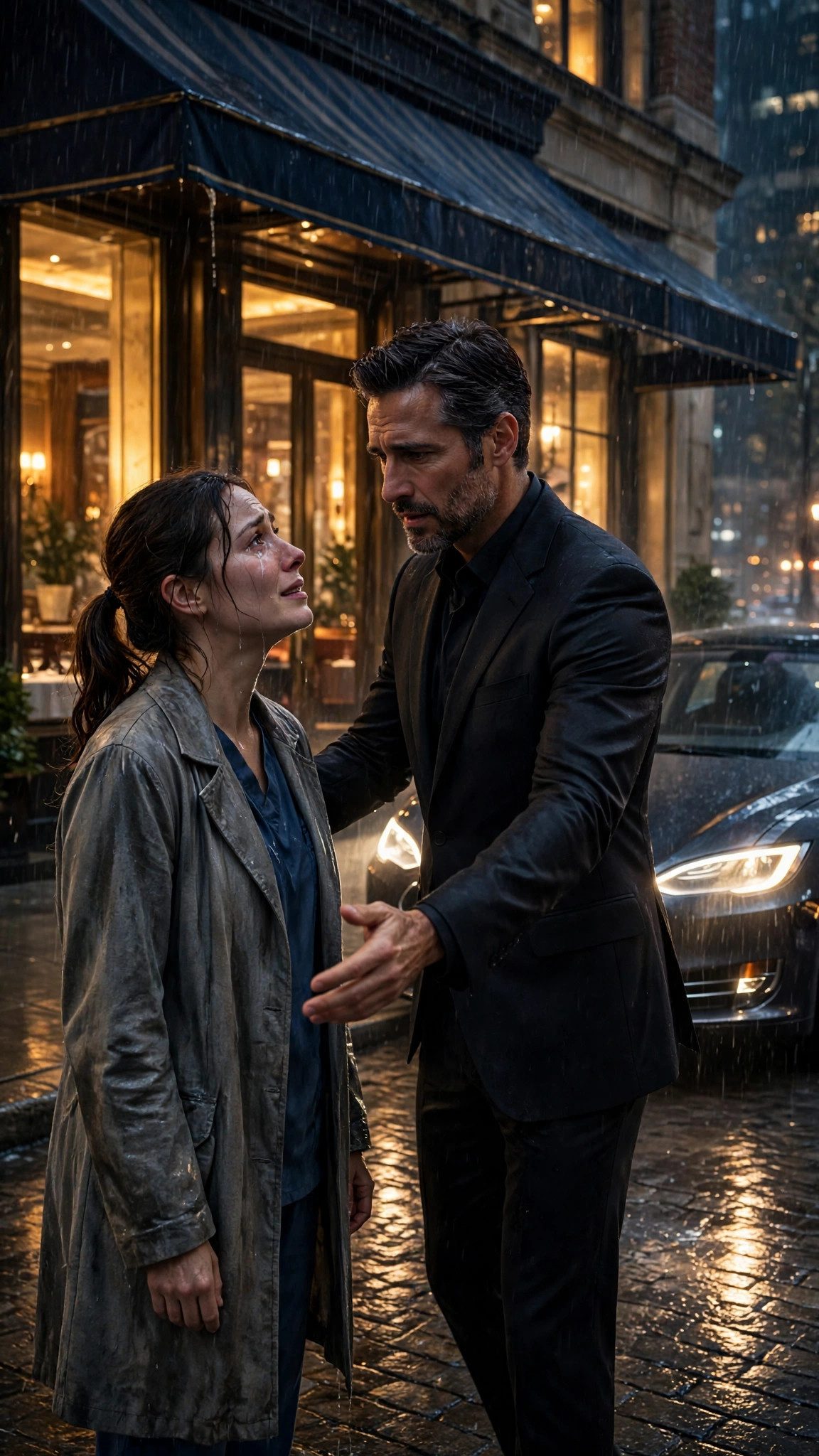
He was standing under the awning, tall and still, wearing a black suit that fit him like it had been made for him — because it had been, I was sure of it — and he was looking at me the way a man looks at someone he has been waiting a very long time to see.
A man who had once promised to take care of my family. A man who had once promised my father, on the worst night of my life, that if I ever needed him, he would come.
Alexander Moretti. One of Chicago's most powerful mafia bosses. A man feared by people who knew exactly what his name meant.
And he was the man I had first met twelve years ago, in a hospital hallway, at four in the morning, while his little brother was bleeding to death on my table.
"Clara," he said softly.
I stopped in the rain. My umbrella tilted. The water ran down my face and I did not wipe it away.
"I have been waiting for you," he said softly.
And in that moment, standing on a wet sidewalk in front of a restaurant I could not afford, with my dead mother's will in my bag and my sleeping son twenty miles away and my husband's betrayal still fresh as a wound, I understood something I had not understood before.
I had already made my choice. I had made it the day my mother died with my son holding her hand. I had made it the day my husband laughed at me across my father's kitchen table.
I was not weak. I had everything in writing. And I was done being afraid.
"Alexander," I said. "What are you doing here?"
He stepped forward, out from under the awning, into the rain with me. He did not seem to notice the water. Men like Alexander Moretti never notice the rain.
"Your father asked me to watch over you," he said. "Twelve years ago. In a hospital hallway. I gave him my word, Clara. And I keep my word."
He held out his hand. Not demanding. Not grabbing. Just holding it out, steady, in the rain, waiting for me to decide.
"Clara," he said. "I don't know how much he can lose, but he can't lose you."
I looked at his hand. I looked at the restaurant. I looked at the black Tesla waiting at the curb like a promise.
And I took his hand.