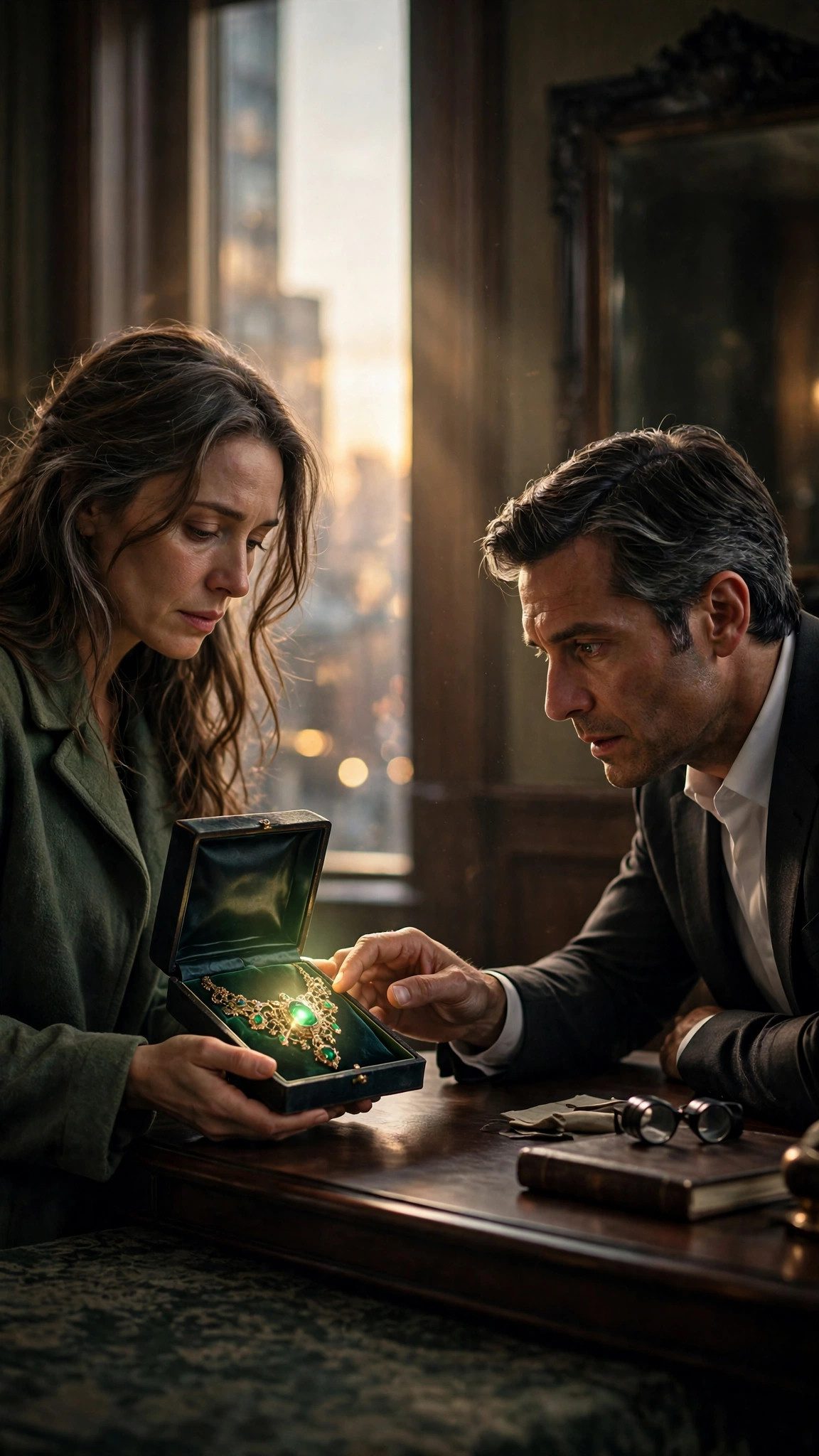
Grown men had begged me for mercy without stirring a single emotion in my chest, but the moment I saw the widow I had secretly loved selling her grandmother's last jewel, I forgot how to breathe.
I stood behind the one-way glass on the fourteenth floor of a building I quietly owned, watching the private appraisal room the way I had watched a hundred rooms before it — cold, patient, untouchable. The city spread itself below us in late afternoon light, gold on glass and steel, and none of it mattered. None of it had mattered for twelve years, not since the night I walked away from the only woman I had ever loved and did not look back.
Her name was Valerie Bennett. She was thirty-eight years old now. She wore a faded green coat pulled tightly across her soft figure, the kind of coat a woman buys once and wears for a decade because there is never money for another. Her long brown hair fell past her shoulders, threaded now with grey I had not put there, and exhaustion shadowed the warm brown eyes that had once made me dream of becoming a better man.
She did not know I was watching. She had not known, for twelve years, that I had never truly stopped watching. Marcus had reported to me, quietly, once a year, in the way he reported everything — without judgment, without commentary, simply the facts. Valerie had married a schoolteacher named Thomas Bennett. She was happy, Marcus had said, and I had told him never to tell me more than that, because more than that would have broken me. Later, Marcus had told me that Thomas had died, and that Valerie worked at a care home, and that her mother was ill. I had sent money once, anonymously, through a charity — enough to cover a hospital bill — and I had told myself it was the least I could do, and the most I was allowed to do. I had been wrong about both. The least I could do was nothing. The most I was allowed to do was everything. It took me twelve years, and a widow in a faded green coat, to learn the difference. She believed she was alone in that room with my advisor, Marcus Hale, and a small velvet box that held everything her family had left.
"Are you sure you want this one, Mr. Cain?" Marcus asked quietly from beside me. He was sixty-two, grey-haired, loyal in a way no other man alive had ever been loyal to me. He had never once contradicted a decision of mine. His disapproval now was written in the set of his shoulders, in the way he did not look at me.
"She was never just anyone to me," I said in a low voice, believing she was too far away to hear.
In the room beyond the glass, Valerie set the small box on the table. Her hands were steady when she opened it. They shook only when she spoke of what was inside.
"I was hoping you could assess this," she said. "It belonged to my grandmother."
Marcus stayed silent. He knew me better than anyone alive. He knew the cold expression I maintained during business negotiations, the face that had made grown men beg. He also knew the truth my father had forced me to accept years ago, the obligation that made me leave Valerie without explanation.
"It is a 1921 emerald and gold necklace," Marcus said, hiding his surprise well. "A rare piece. From a personal collection. One of a kind."
Valerie asked nothing more. She told him plainly that her mother's medical bills had drained every account she had. The electricity would be disconnected soon. She needed one thousand dollars, urgently, for her mother's chemotherapy. That was her only thought.
One thousand dollars. The necklace in that box was worth nearly two hundred thousand.
Openly deceiving her would have been simple. I had deceived better people than Valerie Bennett for far less reason, and I had slept soundly after every one of them. But for the first time in years, that option left a bitter taste in my mouth.
Valerie moved toward the window, and the city light touched the grey threads in her long brown hair. My throat tightened. Twelve years apart had not touched her beauty, yet time had proven cruel to her. There were lines at the corners of her eyes now, and a thinness in her cheeks that spoke of meals skipped so someone else could eat. She had married after I left her. She had buried a husband. She had kept her mother alive on a nurse's aide salary and a will that should have broken years ago.
I had built an empire in those twelve years. I had taken my father's business and made it larger, colder, and more feared than it had ever been. I owned buildings in three cities. I owned men who owned other men. And I had never once, in twelve years, been able to forget the sound of her laugh in a small kitchen on a rainy night, or the way she had looked at me like I was a man worth saving.
Then the appraisal room door opened, and a man I recognized immediately walked in.
"Excuse me," he demanded, his voice cutting through the quiet like a blade. "I am here about the necklace. It belongs to my wife's family."
That moment changed everything I believed about the owner of that jewel.
The man's cold smile and his casual certainty made it clear he was accustomed to taking what he wanted. His voice grew sharp as Valerie's grandmother's jewel was suddenly handled in a way that felt like a threat to my eyes.
"That necklace belongs to my family," he said.
I felt my pulse quicken as memories of our final night together came crashing back. Valerie had never mentioned family. What my father ordered me to force her to give up all those years ago had something to do with what this man wanted now.
Marcus looked at me, his face suddenly pale, and slid one final document across the desk.
I did not touch it yet. I stood behind the glass, watching the woman I had loved for twelve years in silence, and for the first time since my father's funeral, I was afraid — not of the man in the room, and not of what the document said, but of what I would have to become if I let history repeat itself.
Twelve years earlier, on the last night I ever spent with Valerie Bennett, it had rained the same way it rained over the city now — hard, grey, and endless. She had stood in the doorway of her small apartment with a chipped blue mug in her hands, wearing the same green coat, new then, and she had asked me one question.
"Will you come back tomorrow?" she had said.
I had lied to her. I had told her yes, and then I had walked down four flights of stairs and out into the rain, and I had never gone back. My father had given me a choice that was not a choice at all: the family or the woman. The necklace or her life as she knew it. I had chosen the family, and I had told myself for twelve years that it was the only choice a man like me could make.
Standing behind that glass, watching her hands shake over her grandmother's jewel, I understood for the first time that my father had not given me a choice. He had given me a cage, and I had lived in it for twelve years, calling it an empire.
That morning, Valerie had woken before dawn, the way she always woke when something important was going to happen — not with an alarm, but with a jolt, her heart already racing before her eyes were open. She lay in the dark for a long time, listening to the radiators click and the street sweepers pass below, and she went over the plan the way she had gone over it a hundred times: the bus across the city, the building on the fourteenth floor, the appraisal, the one thousand dollars, the hospital before Friday. She got up and made tea she did not drink, and she stood at the kitchen window watching the sky turn from black to grey, and she thought about her mother sleeping in the next room, breathing the shallow, careful breaths of a woman whose lungs were losing a war.
She dressed the way her grandmother had taught her to dress for important occasions: slowly, and with intention. The pale blue blouse with the least wear. The dark skirt Thomas had liked. The shoes she had polished the night before. She brushed her long brown hair until it shone, and she tied it back the way she had worn it when she was a nurse, because nurses are trusted, and today she needed to be trusted. She put on the green coat last, the way she always put it on last, and she stood in front of the hallway mirror for a moment, looking at the woman there — thirty-eight years old, tired, frightened, and still standing — and she said to her reflection, "For Mama," the way she had said it every morning for a year.
The bus ride across the city took forty minutes. Valerie sat by the window with the velvet box in her bag on her lap, and she watched the city wake up: the bakery opening its shutters, the men in suits buying coffee, the mothers walking children to school. She thought about the necklace, and about Rose, and about the letter she had not read in years. She thought about the day Rose had pressed the velvet box into her hands, three years ago, in the hospital, with tubes in her arms and a voice so thin it was barely a whisper. "Keep it safe, my girl," Rose had said. "And when the day comes that you need it more than you love it, let it go without shame." Valerie had promised, and she had kept the box at the back of a drawer ever since, and now the day had come, and she was letting it go, and the shame she felt was not for selling it — it was for the relief she felt underneath the grief, the small, guilty relief that there was still something left to sell.
The building was taller than any building she had ever entered. The lobby was all marble and quiet, and the receptionist looked at her green coat and her worn shoes and did not blink. The elevator was silent and fast, and it made her ears pop. On the fourteenth floor, a corridor of thick carpet and closed doors led to the appraisal room, and a young woman with a kind face offered her water, and Valerie said no, thank you, and sat down in a chair that was softer than her bed at home, and waited, with her hands folded in her lap, for a man named Marcus Hale to tell her what her grandmother's life was worth.
On the other side of the one-way glass, Nathaniel Cain had arrived an hour earlier, and he had stood in the dark observation room with a cup of coffee he had not touched, watching the empty chair where Valerie would sit. Marcus had briefed him the way Marcus always briefed him: quietly, thoroughly, and without telling him what to feel.
"She comes at two o'clock," Marcus had said. "She has asked for one thousand dollars. She does not know the value. She does not know you are here. She does not know anything except that her mother needs medicine."
"Does she know about the will?" Nathaniel had asked.
"No," Marcus had said. "Rose told me to keep it until the day someone came for the necklace. That day is today. I have kept my promise for twenty-eight years, Mr. Cain. Today, I intend to keep it."
Nathaniel had stood at the glass for a long time after Marcus left, looking at the empty room, and he had thought about the last night with Valerie — not the lie he had told her, but the truth he had carried up four flights of stairs and out into the rain. He had thought about his father's office, and the choice that was not a choice, and the twelve years of empire he had built on top of a wound that had never healed. He had thought about the drive home that night, with Marcus in the driver's seat, saying nothing, and the rain on the windshield, and his own hands shaking so hard he had to press them flat against his knees to make them stop.
He had not known, standing there in the dark, that a man named Vincent Castellano was already on his way to the building, with two men in dark suits and a folder full of forged papers, and a wife who had never met Rose Bennett and never would. He had not known that the day would end with a will, and a letter, and a truth ninety years old. He had known only one thing: that the woman he had loved for twelve years was about to walk into the room beyond the glass, and that for the first time since the night he left her, he would be in the same building as her, breathing the same air, and he would not be able to hide from what he had done.
When the door opened and Valerie walked in, in her faded green coat, with the velvet box in her hands, Nathaniel Cain forgot how to breathe — and twelve years of silence began, finally, to end.
Marcus's voice pulled me back to the room. "Mr. Cain," he said softly. "The document."
I looked down at the paper he had slid across the desk. It was old, yellowed at the edges, written in a hand I recognized even after all these years. My grandfather's hand.
And in that moment, I knew that nothing about the necklace — or about Valerie, or about the night I left her — had ever been what my father told me it was.