I found out I was pregnant on a Thursday morning, four days before the dinner, standing in the bathroom of our apartment with a little white stick in my hand and my heart beating so hard I thought it would wake the whole building.
Two pink lines. I stared at them for a long time, turning the stick over in my hands like it might change its mind, like it might be a mistake, like the universe had made an error and would correct it if I waited long enough. But the lines stayed. Two pink lines, clear and certain, and I put my hand over my mouth and laughed, and then I cried, and then I laughed again, because I was going to be a mother, and Alexander was going to be a father, and everything was about to change.
I sat down on the edge of the bathtub and thought about what to do. I could have told him right then. I could have walked into the kitchen where he was drinking his coffee and reading the newspaper, and I could have put the little white stick on the table in front of him, and I could have watched his face change. But I wanted it to be special. I wanted it to be a moment we would remember for the rest of our lives, not a rushed announcement on a Thursday morning before work.
I wanted to tell him the way a moment like that deserves to be told, with a table full of food and my mother's cooking and both of us sitting down together like a family. I wanted my mother there, because she had waited so long for a grandchild, because she had raised me alone and deserved to see the family grow, because she had earned the right to be in the room when her daughter told her husband they were going to be parents.
So I planned a dinner. A family dinner at my mother's house, on a Sunday evening, with all of my mother's best dishes, and I told Alexander it was just a dinner, just a chance for us to spend time with my mother, and he agreed without asking questions, because he trusted me, because he had no reason not to.
I did not tell him that Sophia had called me that morning, before I even took the test, to ask if Alexander was home, to ask if he was free for lunch, to ask if he had mentioned her, like a woman checking on a man who belonged to her. I did not tell him, because I was too happy to fight about Sophia, because I thought the news of a baby would change everything, because I believed that once Alexander knew he was going to be a father, he would finally see Sophia for what she was and choose us.
I spent the next four days in a kind of joyful secrecy, carrying the news inside me like a small, warm light. I went to the doctor on Friday morning, alone, because I wanted to be sure before I told anyone, and the doctor confirmed it, eight weeks pregnant, healthy, strong, everything as it should be. She gave me vitamins and a pamphlet and a smile, and she said, "Congratulations, Mrs. Moretti. You're going to be a wonderful mother."
I went shopping on Saturday. I bought a small pair of baby shoes, white with soft soles, and I wrapped them in tissue paper and put them in a little box, and I planned to give the box to Alexander at dinner, after the main course, when my mother brought out dessert, and watch his face when he opened it and understood.
I called my mother on Saturday night and told her I was planning a special dinner. I did not tell her I was pregnant. I wanted to surprise her too, to see her face when she realized she was going to be a grandmother, to watch her cry the happy tears she had earned after so many hard years.
"Come early," she said. "I'll cook all day. I'll make everything you loved when you were little. I'll make the roast chicken and the potatoes and the green beans, and I'll make your father's favorite cake, the one with the lemon frosting, even though he doesn't deserve it."
"Mom," I said, laughing, "Dad doesn't get cake."
"He doesn't," she agreed, "but you do, and the baby does, and that's what matters."
She didn't know. She didn't know about the baby, but she said it anyway, like mothers do, like she could feel it in her bones, like she already knew that something wonderful was coming.
Sunday morning, my mother started cooking. She spent nearly all day in the kitchen, moving between the stove and the counter with the easy grace of a woman who had cooked for her family for forty years, chopping and stirring and tasting, filling the house with smells that made me feel like a little girl again. The rosemary. The garlic. The lemon. The smell of home.
I helped her set the table. We used her good tablecloth, the white one with the embroidered edges that she only brought out for special occasions, and her good plates, the ones with the blue flowers that had belonged to her own mother, and I put candles in the center of the table, and I thought, this is it, this is the night everything changes.
Alexander arrived at seven o'clock. I heard his car pull up outside, and my heart jumped, and I smoothed my dress and checked my hair, and I walked to the door with a smile on my face, ready to welcome my husband into the evening I had planned so carefully.
And then I saw Sophia behind him.
She was wearing a cream-colored dress and carrying a bottle of wine like she had been invited, like she belonged there, like my mother's house was a place she had every right to walk into, and she smiled at me with that practiced smile of hers, and she said, "Claire, darling, I hope you don't mind. Alexander told me about the dinner, and I simply couldn't resist. Family dinners are so important, don't you think?"
Alexander did not look at me. He looked at Sophia, and he smiled, and he said, "I hope you don't mind, Claire. Sophia was feeling lonely, and I thought it would be nice for her to join us."
I minded. I minded more than I had ever minded anything in my life. But I did not say so, because my mother was standing behind me with a smile on her face, and I did not want to ruin the evening before it had even begun, and I told myself that it did not matter, that Sophia could sit at the table and eat my mother's cooking and it would not change anything, that Alexander would still open the little box with the baby shoes, and he would still understand, and everything would still be all right.
I was wrong. But I did not know it yet, and so I smiled, and I welcomed them both, and I sat down at my mother's table, and I waited for the moment I had been dreaming about for four days.
We ate the first course in silence. My mother served the soup, and Sophia tasted it, and she said, "How interesting. So rustic." My mother smiled and said nothing. I said nothing. Alexander said nothing.
Then my mother brought out the main dish, the chicken she had spent hours preparing, the dish with the cilantro, and Sophia saw the green flecks in the sauce, and she complained.
"Oh," she said, wrinkling her nose, "there's cilantro in this. I can't eat cilantro. It tastes like soap to me. Can't you make something else?"
My mother apologized. She apologized for her own cooking, in her own house, to a woman who had not been invited, and she began picking the cilantro out piece by piece with her fingers, standing over the dish like a servant, like a woman who had spent her whole life pleasing people who did not deserve it.
Sophia smirked. "I suppose when you've spent your life depending on other people, you learn how to please them."
I snapped. I had been holding it in for three years, holding in every insult, every smirk, every moment when Alexander had chosen her over me, and in that moment, watching my mother pick cilantro out of her own cooking with her bare hands, something inside me finally broke loose.
"Don't speak to my mother like that," I said, and my voice was steady and cold in a way it had never been before.
Alexander frowned at me. "Claire, don't start."
Then he picked up the dish my mother had spent hours preparing and dumped it into the trash, right in front of all of us, like it was garbage, like my mother's whole day of work meant nothing, like the woman who had raised me alone deserved to watch her food thrown away in her own kitchen.
Something inside me broke. Not loudly. Not all at once. Quietly, the way a glass breaks when you drop it on a carpet.
When Sophia insulted my mother again, I pointed toward the door. "Get out."
Alexander's expression turned cold. "Apologize to Sophia."
"No."
His eyes narrowed. Then he said the one thing he knew would hurt me most, the one thing he knew would cut deeper than anything else he could have said, the wound I had trusted him with when I was eighteen years old and believed he would never use it against me.
"Don't push me into doing what your father did and abandoning you and your mother."
I went completely still. He knew that wound. I had trusted him with it. And he had just pressed his thumb into it in front of the woman who had spent five years trying to destroy my marriage.
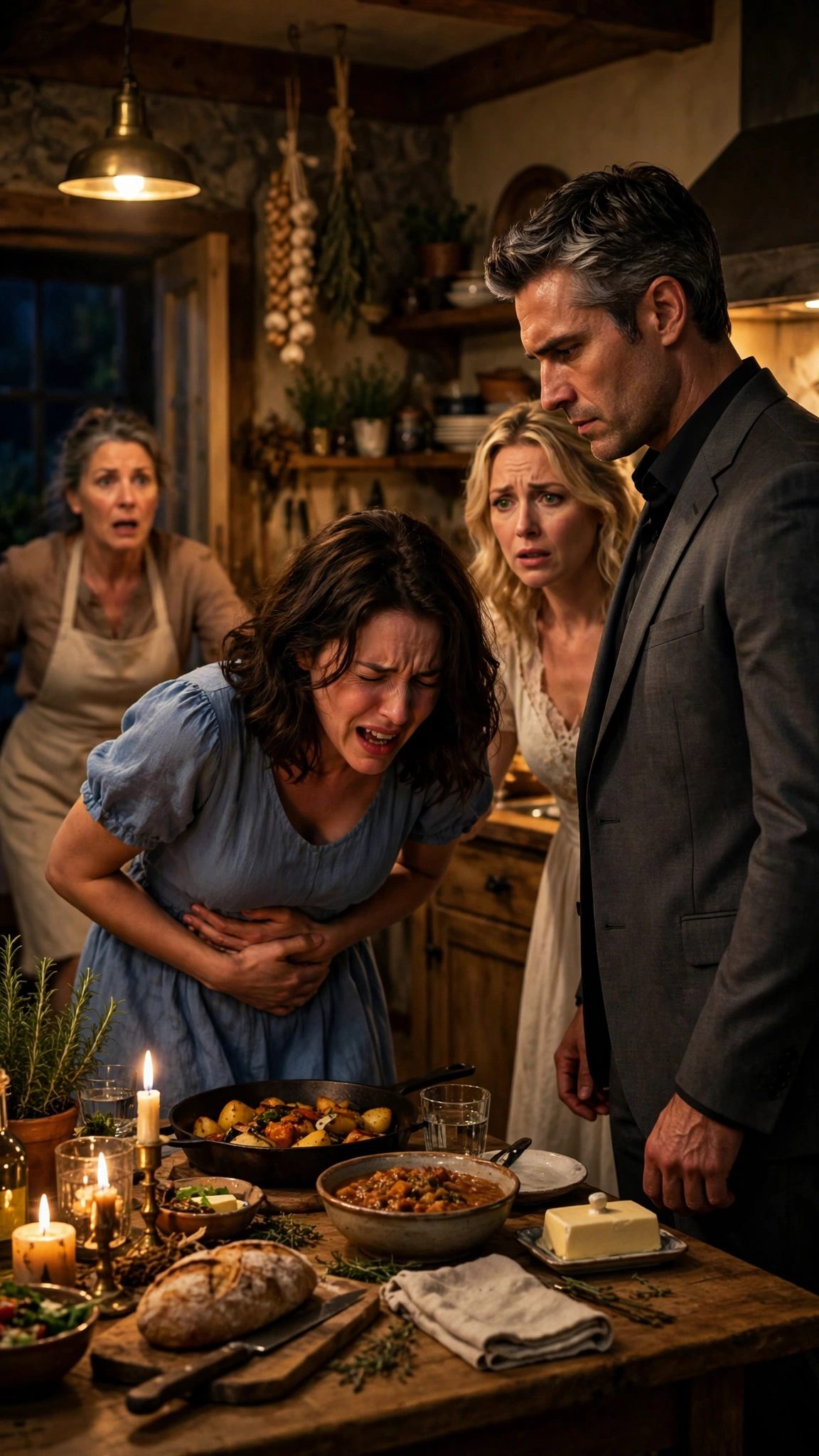
Then Sophia stepped toward me. The argument escalated. Her face was flushed, her voice was high, and she reached out, and she shoved me, hard, with both hands, and I stumbled backward, and my lower stomach slammed into the edge of the table.
Pain exploded through me. I folded over, both hands gripping my abdomen, and the room went white around the edges, and the only sound I could make was my mother's name.
"Mom," I whispered. "Mom, the baby."
My mother rushed toward me, shouting, crying, catching me as I slid toward the floor. "Your wife is hurt!" she screamed at Alexander. "Alexander, your wife is hurt!"
But Alexander looked at Sophia first. "Are you okay?"
Sophia began crying. "I didn't mean to push her that hard!"
Alexander moved protectively in front of her, like she was the one who had been hurt, like I was the danger in the room. Then he looked at me, and his face was cold, and his voice was colder.
"Claire, stop making this worse."
He walked out with Sophia. The front door closed behind them with a sound so ordinary it seemed impossible that my whole life had just ended inside it.
My mother took me to the hospital alone. She drove with one hand and held mine with the other, and she told me to breathe, and she told me to stay with her, and the doctors said the impact had caused serious pregnancy complications, and the baby might not survive, and I lay in that hospital bed staring at the ceiling and thinking about the little white box with the baby shoes in it, still sitting on my mother's kitchen table, waiting for a moment that would never come.
The morning sickness started the next day, a wave of nausea that rolled over me every time I smelled coffee, and I stood in the kitchen with my hand over my mouth, laughing at myself, because I had never been so happy to feel so terrible. Every wave of sickness was proof that the baby was real, that the two pink lines had not been a dream, that I was going to be a mother.
I went to the doctor on Friday morning, alone, because I wanted to be sure before I told anyone, and I sat in the waiting room with a magazine I did not read, watching the other women around me, some of them round and glowing, some of them nervous and new, all of them carrying the same secret I was carrying, all of them waiting to hear that everything was all right.
The doctor was a woman named Dr. Patel, with warm hands and a calm voice, and she did the examination, and she smiled, and she said, "Congratulations, Mrs. Moretti. You are eight weeks pregnant, and everything looks perfect. The baby is healthy. You are healthy. You have a wonderful journey ahead of you."
She gave me vitamins and a pamphlet about what to eat and what to avoid, and she told me to rest, to drink water, to take care of myself, and she said, "You are going to be a wonderful mother. I can always tell, in the first visit, which women are going to be wonderful mothers. It is in the way they ask questions. You asked all the right ones."
I walked out of that office with the pamphlet in my bag and the vitamins in my purse and a feeling in my chest so big I thought it might lift me off the ground. I was going to be a mother. Alexander was going to be a father. My mother was going to be a grandmother. Our family was going to grow, and everything was going to be different, and everything was going to be better.
On Saturday afternoon, I went to a small shop downtown, a baby shop with a window full of tiny clothes and soft blankets, and I walked through the aisles slowly, touching everything, imagining the baby in my arms, imagining Alexander holding her, imagining my mother rocking her to sleep. I bought a small pair of baby shoes, white with soft soles, the tiniest shoes I had ever seen, and I held them in my hands, and I thought, these are real. This is really happening.
I wrapped them in tissue paper and put them in a little white box, and I tied a ribbon around it, and I put the box in my bag, and I carried it home like it was made of glass, like it was the most precious thing I owned. Because it was. It was the future, wrapped in tissue paper, waiting for the right moment to be opened.
That night, I lay awake in bed beside Alexander, listening to him breathe, watching the shadows move across the ceiling, and I thought about how I was going to tell him. I thought about his face when he opened the little white box. I thought about the way he would laugh, the way he would pick me up, the way he would spin me around in my mother's kitchen and tell me he loved me. I fell asleep dreaming about it, and I woke up smiling, and I believed, truly believed, that Sunday dinner was going to be the best night of our lives.