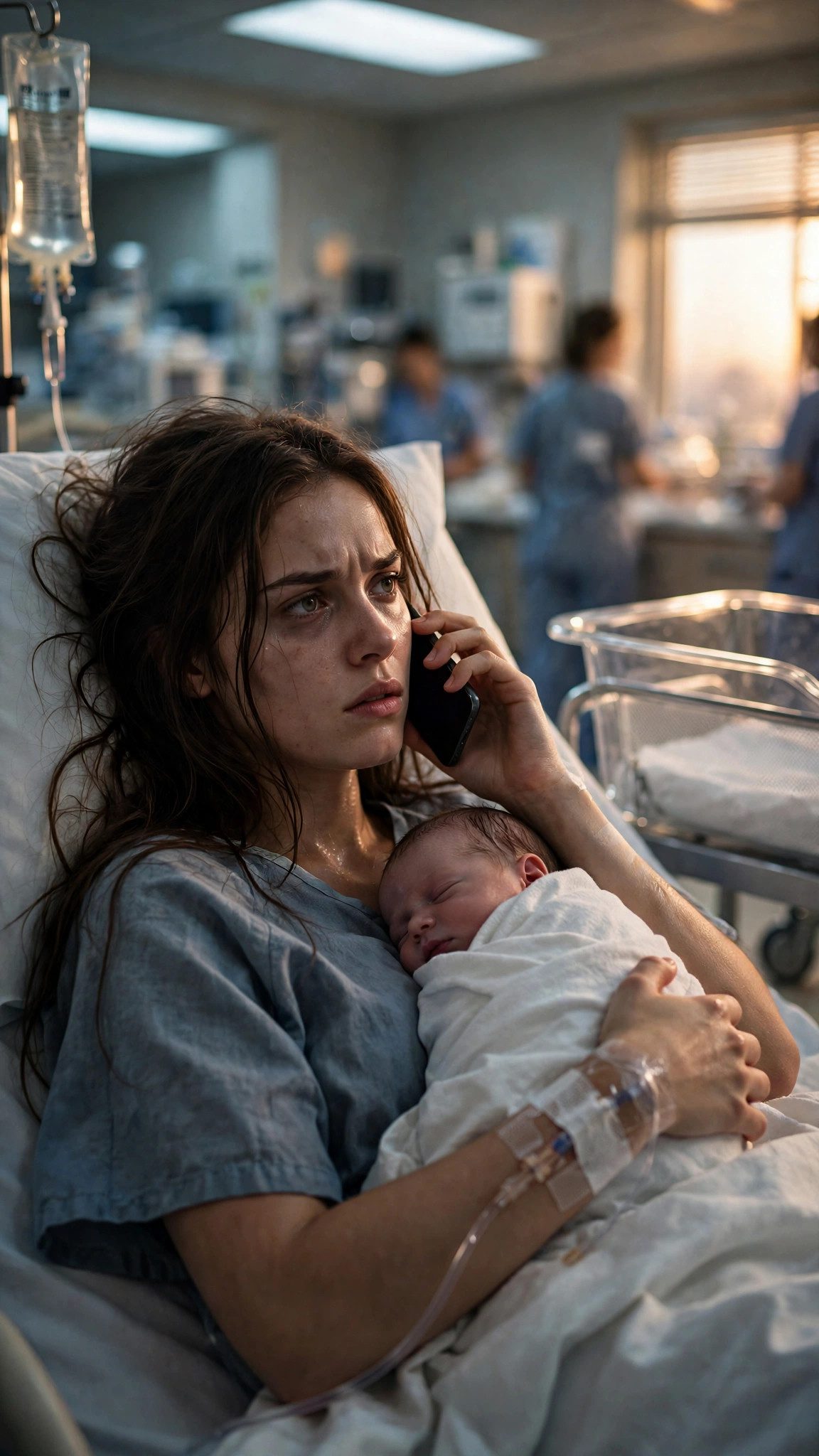
It was a Thursday in October, two years and four months after Owen was born, when they came for my son.
I remember the evening clearly, because it had been an ordinary one. Owen was two and a half, all knees and elbows and questions, and we had spent the afternoon at the studio, where he had appointed himself my assistant and spent an hour handing me fabric samples in the wrong order and telling my clients, with great seriousness, that the blue one was better. Margaret had taken him home at five, as she often did, so I could finish a proposal. I locked the studio at seven, walked the four blocks home in the cool autumn air, and found them in the kitchen: Margaret at the table with a cup of tea, Owen in his high chair, smearing spaghetti sauce across his face like war paint.
"How was the proposal?" Margaret asked.
"Sent," I said. "And the hotel wants us for all forty rooms."
"Good girl," Margaret said, and she kissed Owen's head and went home, and I gave Owen a bath, and I read him three stories, and I put him to bed with his toy dinosaur, and I sat at the kitchen table with my laptop and my tea, and I thought about how ordinary happiness was. How quiet. How easy to mistake for something that would last.
At eleven o'clock, I heard a sound at the back door. Not a knock. A scrape. Metal against metal, soft and deliberate, the sound of someone working a lock.
I froze. My hand stopped halfway to my teacup. The apartment was dark except for the kitchen light. Owen was asleep down the hall. Margaret was gone. My father was six hundred miles away.
I stood up slowly. I picked up my phone. And then the back door opened, and two men walked into my kitchen.
They were big men, in dark jackets, with the calm, unhurried movements of men who had done this before. The first one had a scar through his eyebrow. The second one was younger, with a shaved head and a gold chain at his throat. Neither of them raised his voice. Neither of them hurried. That was the worst part. They acted like they belonged in my kitchen, like they had an appointment.
"Mrs. Ashford," the scarred one said. "We're here for the boy."
My blood turned to ice. "My name is Mercer," I said. "And you need to leave my house."
The younger one smiled. "Mr. Castellano sends his regards. He'd like to meet your son. Just for a little while. Just long enough for his father to understand the situation."
I didn't scream. I didn't run. I did the only thing I could think of: I stepped between them and the hallway to Owen's room, and I planted my feet on the kitchen floor, and I said, "You will not touch my son."
The scarred man took a step toward me. "Lady, don't make this hard—"
And then the front door exploded inward.
I don't mean it opened. I mean it came off its hinges — wood splintering, the chain snapping, the whole door crashing into the hallway — and Graham Ashford came through it like a storm.
I hadn't seen him in two years and four months. He was thinner. There were lines around his eyes that hadn't been there before. His suit was rumpled, as if he had driven all night. And he had a gun in his hand — not pointed at anyone, held down at his side — and three men behind him, men I recognized from the old days, from Arthur's organization, men who had once stood outside ballrooms and looked at nothing.
"Get away from her," Graham said. His voice was quiet. It was the quietest voice I had ever heard from him, and it was the most frightening sound in the world.
The scarred man turned. "Ashford. We were just—"
"I said get away from her." Graham's gun came up, steady as a rock. "You have three seconds to walk out of this house. If you're still here in three seconds, you won't walk out at all."
The two men looked at each other. They looked at Graham's men filling the hallway behind him. They looked at me, standing between them and my son's bedroom with a phone in my hand and no fear left in my body at all, because fear had burned away and left something harder underneath.
They left. They walked out the back door the way they had come in, and they didn't run, but they didn't walk slowly either.
And then Graham lowered the gun, and his men melted back into the hallway, and he stood in my kitchen — my small, ordinary kitchen in Somerville, with the spaghetti sauce still on the high chair and my tea going cold on the table — and he looked at me, and I looked at him, and for a long moment neither of us said anything at all.
"How did you find us?" I asked finally.
"Castellano's men led me here," he said. "I've had someone watching them for a month. When they moved, I moved. I drove all night from Chicago. I got here twenty minutes before they did."
"You've been searching for us."
"For a year," he said. "Since Arthur died. Since I found out what Vanessa did. I've been looking for you for a year, Audrey. I went to your father's office. I hired investigators. I checked every record I could reach. I was going to come here tomorrow and knock on your door like a civilized person and ask you to talk to me. Then Castellano moved first."
"Why?" I asked. "Why now? Why after two years of silence? You told me to disappear, Graham. You told me to stay out of your life. Why are you standing in my kitchen?"
He was quiet for a long moment. He looked at the high chair. He looked at the crayon drawings taped to the refrigerator. He looked at the small shoes by the door, lined up in a neat row.
"Because I was wrong," he said. "About everything. About you. About Vanessa. About what mattered. Arthur died, and Vanessa turned out to be a thief, and I was alone in a penthouse that had never been a home, and I finally asked myself what I had actually lost. And the answer was you. And a son I've never held. And a family I threw away over the phone while you were bleeding in a hospital bed."
His voice cracked on the last word. Graham Ashford — the man who had never raised his voice to me, never apologized, never explained — stood in my kitchen with tears in his eyes.
"I don't expect you to forgive me," he said. "I don't expect you to let me stay. I just needed you to know that I'm here, and that Castellano's men won't come back tonight, because my men are outside, and they'll stay outside until I tell them to go. And I needed to ask you one thing."
"What?"
"Can I meet him? Just once. Just for a minute. I've never seen my son, Audrey. I've never held him. I've never heard his voice. Please. Just once."
I stared at him. Two years and four months of anger, of grief, of building a life out of nothing, all rose up in me at once. I wanted to throw him out. I wanted to scream at him. I wanted to ask him where he had been when Owen took his first steps, when he said his first word, when he had a fever of a hundred and three and I sat up all night with a cold cloth on his forehead, alone.
But then I thought about Owen, asleep down the hall with his toy dinosaur, and I thought about what was best for him. Not for me. Not for Graham. For Owen. And I knew that a boy deserved to know his father — if his father had finally become a man worth knowing.
"He's asleep," I said. "Come back tomorrow morning. Nine o'clock. You can meet him then. And Graham — if you hurt him, if you scare him, if you make him one promise you don't keep, I will make you disappear the way you once told me to disappear. Do you understand?"
"I understand," he said.
He left. His men left. The front door hung crooked on its broken hinges, and I spent the night sitting in a chair in Owen's doorway, watching him sleep, listening to every sound the old building made, holding the phone in my hand with my father's number already dialed.
I called Margaret first. She came in ten minutes, in her coat over her nightdress, with a baseball bat in one hand and no questions at all until she had checked every lock in the apartment and looked in on Owen herself.
"Tell me everything," she said, sitting down at the kitchen table with me, and I did. The scrape at the back door. The two men. Castellano's name. Graham coming through the front door like a storm.
Margaret listened without interrupting, which was the kindest thing anyone had done for me all night. When I finished, she poured us both fresh tea with hands that didn't shake at all.
"Do you know what I think?" she said. "I think a man who drives all night to stand between your son and two men with bad intentions is a man who has finally learned what a father is. That doesn't erase what he did. It doesn't buy him a place at your table. But it's a start, Audrey. It's a real start. And starts are rare. Most men never even get that far."
"I'm afraid," I said. It was the first time I had said it out loud. "I'm afraid to let him in, and I'm afraid to keep him out. I'm afraid Owen will love him and he'll leave again. I'm afraid I'll love him again and he'll leave again. I'm afraid of all of it."
"Of course you are," Margaret said. "You'd be a fool not to be. But fear isn't a reason to say no, dear. It's a reason to be careful. Let him meet Owen tomorrow. Watch him. Watch how he is with the boy. A man can lie to a woman, Audrey. He can't lie to a two-year-old. Children see straight through us. Owen will tell you everything you need to know."
She stayed until two in the morning, and then she went home, and I sat in the chair in Owen's doorway, watching him sleep, and I listened to the old building settle and creak around us.
At three in the morning, I heard footsteps on the porch. I stood up, my heart hammering, and I looked out the front window — and I saw one of Graham's men, a broad-shouldered man in his fifties with gray at his temples, standing by the steps with his hands in his pockets, keeping watch.
He saw me at the window and he nodded, and then he walked up to the door and knocked softly, so as not to wake Owen.
"Mrs. Ashford," he said when I opened the door a crack. "I'm sorry to bother you. My name's Eddie. I've worked for Mr. Ashford for twenty years. I just wanted you to know — the boss has been looking for you for a year. I've watched him do it. He fired three investigators for not finding you fast enough. He went through every record himself, night after night, in that empty penthouse. He stopped going to the club. He stopped going to the races. He sold the apartment in River North — Vanessa's apartment — and he gave the money to a women's shelter. He did all of that before he ever found you. I don't know what that means to you. But I thought you should know it before you decide anything tomorrow."
"Thank you, Eddie," I said.
"He's a different man than he was," Eddie said. "I wouldn't say it if it weren't true. I've known him since he was a boy. Losing you changed him. Losing the boy changed him more. Whatever you decide, Mrs. Ashford — he'll respect it. He told us that on the drive here. 'She owes me nothing,' he said. 'I'm asking, not taking.' That's not the Graham Ashford I used to work for."
He went back to the porch. I closed the door. I sat down in the chair in Owen's doorway again, and I thought about what Eddie had said, and about what Margaret had said, and about the man who had come through my front door with a gun in his hand and tears in his eyes.
At dawn, I called my father and told him everything. He was silent for a long time.
"Do you want me to come?" he asked.
"No," I said. "I need to do this myself. But Dad — he saved Owen. Whatever else Graham is, whatever he did, he drove all night and he got here in time. Castellano's men were in my kitchen, Dad. If Graham hadn't come through that door—"
"I know," my father said quietly. "I know, sweetheart. Be careful. That's all I ask. Be careful."
At nine o'clock the next morning, the doorbell rang. I opened the door, and Graham stood there in a clean suit, holding a small stuffed bear in one hand, looking more nervous than I had ever seen him.
Owen came out from behind my legs and stared up at him.
"Who are you?" Owen asked.
Graham knelt down, slowly, until he was at Owen's eye level. He held out the bear.
"I'm your daddy," he said, and his voice shook. "I've been looking for you for a very long time."
Owen took the bear. He looked at it. He looked at Graham. And then, with the fearless honesty of a two-year-old, he said, "Mama says my daddy lives far away. Are you far away?"
"Not anymore," Graham said. "Not if you'll let me stay close."
Owen considered this. Then he held out the bear and said, "His name is Barnaby. He sleeps with me. Do you want to see my room?"
And Graham Ashford — heir of the Ashford organization, the most feared man in Chicago, the man who had told me to take the baby and disappear — followed his two-year-old son down the hallway to look at a bedroom with crayon drawings on the walls, and I stood in the doorway of my kitchen, and I watched him go, and I felt something I hadn't felt in two years and four months.
I felt hope. Stupid, stubborn, unreasonable hope. The same hope I had felt in the hospital, holding a test with two pink lines.
And this time, I decided to let it live.