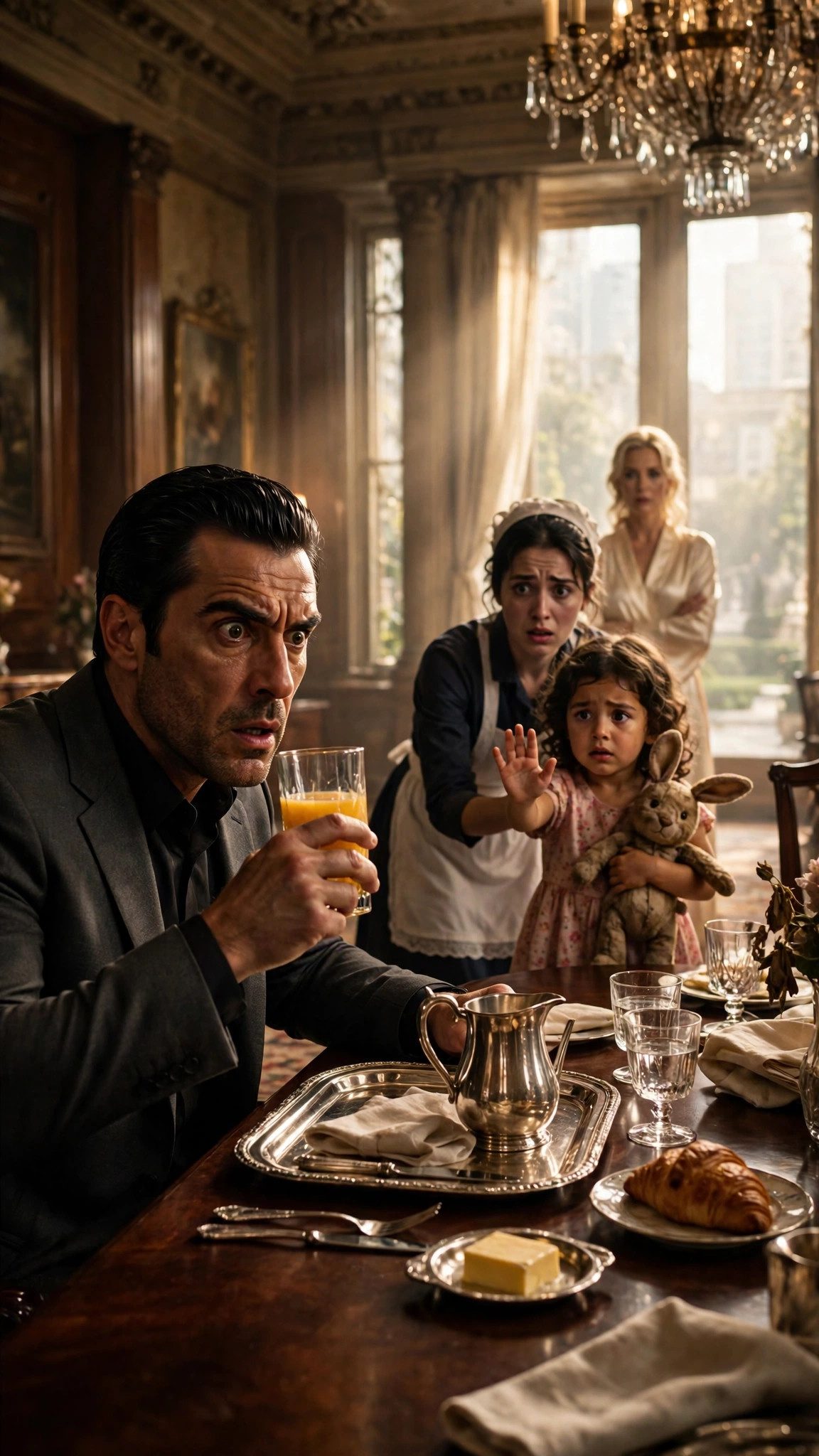
Raphael Costa worked the way he always worked: quietly, patiently, and without telling anyone what he was doing.
He started with the keys. The staff wing had one master key, kept in Mrs. Delgado's office. Three copies existed. One belonged to Mrs. Delgado. One belonged to the estate manager, a man named Ortiz who had worked for the Moretti family for thirty years. And one — Raphael learned this from Mrs. Delgado herself, after twenty minutes of careful conversation — had gone missing six weeks earlier.
"Missing how?" Raphael asked.
Mrs. Delgado's hands twisted in her apron. "I reported it to Mr. Ortiz. He said he would have a new one made and change the locks. Then the wedding preparations started, and everyone forgot."
"Who had access to your office in those six weeks?"
"Everyone, Mr. Costa. The office door doesn't lock either. Half the house passes through it."
Raphael wrote it down. A missing key, an unlocked office, six weeks. Six weeks was exactly when Vanessa had begun spending whole days at the estate, choosing flowers, tasting cakes, planning a wedding that would make her the mistress of the house.
Next, Raphael looked at Carla.
Carla Benetti was twenty-four, dark-haired, soft-spoken, and had been hired as Vanessa's personal maid three weeks earlier — the same week Dominic's symptoms began. Her references were perfect. Too perfect, Raphael thought. The agency that sent her had placed her in three houses in two years, and each of those houses had written her a glowing letter. Raphael called the agency. The woman who answered sounded nervous, and then she sounded honest.
"Miss Benetti came to us with a recommendation from a family in Lake Forest," she said. "We didn't check it as closely as we should have. We're a small agency. The recommendation looked real."
"Was it real?"
A pause. "The family in Lake Forest says they never employed her. They never heard of her."
Raphael thanked her and hung up. A maid with a false history, hired three weeks ago, who now claimed to have seen Elena at a tray. A maid who worked for Vanessa and no one else.
Then Raphael looked at Vanessa herself.
Vanessa Laurent had told Dominic she was the daughter of a French businessman and an American mother, raised in Paris and New York, educated in Switzerland. She had money of her own, she said — not as much as Dominic, but enough that no one could call her a fortune hunter. She had met Dominic at a charity gala eighteen months earlier, and the courtship had been swift and public and romantic.
Raphael checked the details the way he checked everything: by calling people and asking questions that sounded harmless.
The school in Switzerland had a record of a Vanessa Laurent. She had attended for one year, not four, and she had left without graduating. The French businessman father existed, but he had died when Vanessa was nineteen, and he had left debts, not a fortune. The American mother had remarried twice and lived in a small apartment in Queens.
And then there was the money. Vanessa's accounts — Raphael had a contact at her bank who owed him a favor — showed a pattern. For the past year, regular deposits had arrived from a company in Delaware with no clear business. The deposits stopped three months ago, around the time Vanessa began spending every day at the estate. In their place, a different pattern began: large cash withdrawals, and one payment, six weeks ago, to a pharmacy in Cicero. A pharmacy that had filled a prescription for digoxin under a false name.
Raphael brought all of it to Dominic on the fourth evening, in the study, with the door locked.
Dominic read the file twice. He did not speak for a long time. When he finally looked up, his face was gray — not with the poison, but with something worse.
"Tell me about the pharmacy," he said.
"The prescription was written for a man named Marco Rossi," Raphael said. "It was filled six weeks ago. Marco Rossi has been dead for eleven months."
Dominic closed his eyes. "She used a dead man's name to buy the poison that she would use to frame his widow."
"That's what it looks like."
"And the deposits from Delaware?"
"The company is owned by a holding firm. The holding firm is owned by Anthony Falcone."
The Falcone family. Dominic's oldest rivals. The family that had wanted his shipping terminals for a year. The family that had burned his warehouse in Cicero and offered double pay to his drivers.
"So it's not just Vanessa," Dominic said. "It's the Falcones. They found a woman with debts and a pretty face, and they pointed her at me."
"Or she found them," Raphael said. "Either way, the plan is the same. Marry you. Keep you weak. A little more poison every morning, and in a year you're dead of a heart condition, and your beautiful widow inherits the terminals. Or you stay alive but too sick to fight, and the Falcones take the routes piece by piece while your wife signs whatever they put in front of her."
Dominic stood up and walked to the window. Outside, Vanessa was in the garden with the wedding planner, pointing at the place where the tent would go. She looked happy. She looked like a woman planning the best day of her life.
"She knew about the medicine," Dominic said quietly. "At breakfast, the morning Lily spoke. I remember now. Before Lily said anything, Vanessa looked at the glass and said — no. Let me think." He pressed his fingers to his temples. "She said, 'That maid really needs to control her child.' But before that, when she came in, she glanced at the glass. Just a glance. And she smiled. Not at me. At the glass."
"Boss," Raphael said, "we need more than a glance."
"I know." Dominic turned from the window. "That's why we're going to give her a second chance to do it."
Raphael frowned. "A second chance?"
"A trap," Dominic said. "Tomorrow morning, Elena will serve my breakfast again. The same tray, the same juice, the same routine. But this time, the juice will be watched from the moment it leaves the kitchen. And the glass will be a test — a glass with a marker in it that only the laboratory can see. If anyone touches that tray between the kitchen and the table, we'll know. And if Vanessa goes near it again, we'll know that too."
"What if she doesn't take the bait?"
"Then we watch her until she does." Dominic's voice was cold. "She has been patient for three weeks. Patient people don't stop. They get bolder."
That night, Dominic went to the staff wing. He knocked on Elena's door, and when she opened it, he did something he had not done in twenty years: he apologized to a woman who worked for him.
"Elena," he said, "I owe you an apology. You did nothing wrong. I know that now. And I need your help."
She stared at him. "My help?"
"Tomorrow morning, I need you to serve my breakfast exactly as you always have. The same tray. The same routine. Nothing different. Can you do that?"
Her hands trembled, but her voice was steady. "Yes."
"And Lily," Dominic said, looking past her to the small bed where the child was pretending to be asleep, her rabbit tucked under her chin. "Lily stays in this room tomorrow morning. No matter what she hears. Do you understand?"
"I understand," Elena said.
Dominic turned to leave. Then he stopped.
"Elena. Your husband — Marco. Did he ever tell you why he kept his medicine in the suitcase, instead of the bathroom?"
Elena's eyes filled with tears. "He said a man should keep his weaknesses where no one can see them. He was proud, Mr. Moretti. Even when he was dying, he was proud."
Dominic nodded slowly. "Then someone used a proud man's medicine to try to kill me, and to blame his widow. I won't let that stand."
He walked back through the narrow hallway, and for the first time in four days, his headache seemed a little less heavy. He had been wrong about Elena Rossi. He had been wrong about his own house. But he was not wrong anymore.
Tomorrow, the person who had been poisoning him would get one more chance to do it.
And this time, Dominic Moretti would be watching.
The next day, Raphael drove to Cicero and walked into the small pharmacy on a quiet street where the sign in the window was faded and the bell over the door rang when he entered.
The pharmacist was an old man with thick glasses and hands stained faintly yellow from years of handling pills. He looked at the photograph Raphael showed him — a photograph of Vanessa Laurent, taken at a charity gala, blonde hair and green eyes and a smile that had charmed a room full of strangers — and he nodded slowly.
"Yes," he said. "She came in about six weeks ago. Sunglasses, even though it was cloudy. She paid cash. She gave a man's name. Rossi. Marco Rossi."
"Did she say why she needed it?"
"She said it was for her father. She said he had a heart condition and the prescription had run out. She was very polite. Very calm." The pharmacist adjusted his glasses. "I remember her because she asked me a question. She asked how much of it would be dangerous. She said her father was forgetful, and she was afraid he might take too much by accident."
Raphael wrote it down. "What did you tell her?"
"I told her the truth. That a small amount could make a strong man sick, and a large amount could stop his heart. She thanked me, and she left."
On the drive back to the estate, Raphael thought about the woman in the sunglasses. She had planned it carefully. She had used a dead man's name. She had learned the dose. She had been patient for three weeks, and she would have been patient for three more.
That evening, Dominic tested her himself.
They ate dinner in the dining room, just the two of them, candlelight on the silver, the way they had eaten a hundred times before. Vanessa talked about the wedding: the flowers, the music, the guest list. Dominic listened, and he waited for the right moment.
Then, halfway through the main course, he set his fork down and rubbed his chest, as if it ached.
"The doctor thinks it might be my heart," he said casually. "Like my father."
Vanessa did not flinch. She did not drop her fork. She did not even pause. She smiled, and she reached across the table and took his hand, and her voice was warm and smooth and perfectly calm.
"Then you should rest more, darling," she said. "You're working too hard. That's all it is. A little rest, and you'll feel like yourself again."
It was the perfect answer. Too perfect. A woman who loved a man would have been frightened to hear that his heart might be failing. A woman who had nothing to hide would have asked questions. Vanessa asked none. She simply smoothed it over, the way you smooth a wrinkle out of a tablecloth, and went back to talking about the flowers.
Later, after she had gone to bed, Dominic sat in his study and looked at the wedding guest list she had left on his desk. He read the names slowly, one by one. He knew most of them. Businessmen. Politicians. Old friends.
And then he saw the names he had not noticed before: three men from the Falcone family, listed under a different company name. A cousin of Anthony Falcone. A lawyer who worked for the Falcones. A shipping broker who had tried to buy Dominic's routes a year earlier.
Vanessa had invited his enemies to his wedding.
Dominic set the list down and poured himself a glass of water from a sealed bottle. He drank it slowly, standing at the window, looking out at the garden where the tent would go.
She had been planning this for a long time. The wedding. The poison. The slow weakening. The inheritance. All of it, laid out like a map, and he had been walking along it without seeing it.
But now he saw it. And tomorrow, he would set the trap.
That same night, while Dominic sat in his study looking at the wedding guest list, Elena sat in her small room and thought about Marco.
She had not spoken about him in weeks — not to anyone. Grief had taught her to keep him private, folded away like the sweater in her suitcase. But tonight, with the house quiet and Lily asleep, the memories came back the way they always did when she was tired: in small, sharp pieces.
Marco had been a bus driver. He had driven the same route for nine years, and he had known the names of half his passengers. He had been strong, broad-shouldered, always laughing. And then, one winter, he had started getting tired. He had blamed the early mornings. Then his ankles swelled. Then he could not climb the stairs without stopping. The clinic had said his heart was failing, and they had given him small white tablets in a brown bottle, and they had told Elena to make sure he took one every morning with his orange juice.
Elena had measured those tablets herself, every morning, for two years. She knew their smell — bitter, chemical, faintly sweet underneath, like almonds gone wrong. She knew the way the bottle rattled. She knew the way Marco's face changed after he took one: a small wince, quickly hidden, because he did not want her to worry.
Lily had watched all of it. She had sat at the kitchen table with her rabbit and watched her mother shake a tablet into her father's palm, watched him swallow it with his juice, watched him wince. She had learned the smell the way children learn everything: without being taught, and without forgetting.
When Marco died — quietly, in his sleep, eleven months ago — Elena had packed the bottles into a paper bag and put them at the bottom of her suitcase, because throwing them away would have felt like saying he had never existed. She had carried them to every room she had lived in since. She had never opened them. She had never counted them.
Someone else had counted them. Someone else had opened one, and taken a month's worth, and used them to try to kill a man Elena barely knew.
Elena pressed her face into her hands. Marco had died of a failing heart. His medicine had been meant to save him. Now someone had used that same medicine as a weapon, and the weapon had her dead husband's name on it.
She looked at Lily, asleep in the small bed, her rabbit tucked under her chin. Her daughter had saved a man's life with nothing but her nose and her courage. Marco would have been proud of her. Elena knew that the way she knew the smell of the medicine: completely, and without needing to be told.
She blew out the candle and lay down beside her daughter, and she slept — lightly, the way mothers sleep when they are afraid — with one hand on Lily's shoulder.