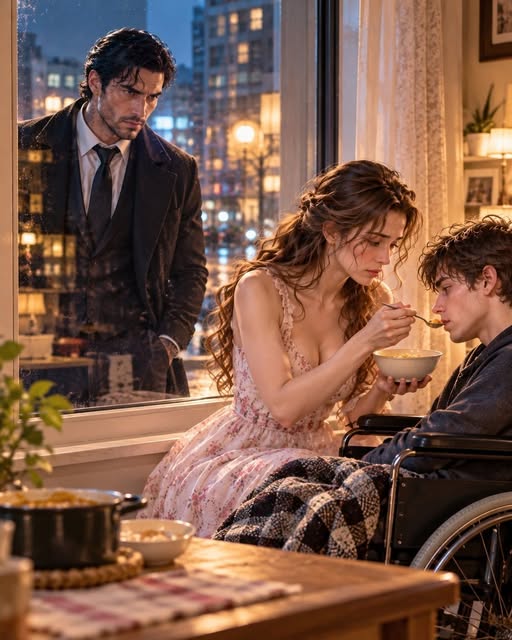
At 11:43 P.M., the most feared mafia boss in New York followed me home with a loaded gun, convinced I had stolen $20,000 from his private account.
But that night didn't start with a gun. It started with a number that wouldn't sit still.
My name is Tessa Hayes. I'm twenty-eight years old, and for three years I have been the personal secretary to Roman Caldwell — forty, tall, dark-haired, and so dangerously composed that boardrooms went quiet when he simply removed his cufflinks. Roman controlled shipping terminals along the Hudson, two casinos upstate, a skyline's worth of luxury properties, and an underground empire that made even dangerous men think twice before they crossed him.
His employees feared him. His enemies hated him. And the people closest to him all knew the same one thing.
Roman Caldwell did not forgive betrayal.
I wasn't afraid of him. Not because I didn't understand his reputation — I typed it into contracts every week. I simply had more important things to worry about. Like keeping my younger brother alive.
Leo was twenty-two when a car came out of the rain on the Cross Bronx Expressway and folded his life in half. The accident shattered his pelvis and damaged his spine. He survived — the doctors used the word "miracle" and then handed me a stack of bills that used the word "monthly." Now he used a wheelchair. His rehabilitation was expensive. His medication was expensive. His dignity, thank God, was free, and he guarded it like gold.
Before the accident, Leo had been the kind of young man strangers remembered. Six feet of restless energy, hands that could fix anything with an engine, a laugh that arrived half a second before the joke did. He'd been saving to open his own garage. He'd had a girl named Priya who brought him terrible homemade lasagna and ate his cooking like it was a love language, which it was. After the accident, Priya came to the hospital every day for a month. Then every week. Then she sent a letter — a kind one, which somehow made it worse — and Leo told me to stop setting a plate for her. He never cried about Priya. He cried once about the stairs to our building, in the rain, when the elevator died and I had to half-carry him up three flights while a neighbor pretended not to watch. He apologized the whole way up. I have hated very few things in my life with real purity, but I hate that staircase with my whole heart.
Our mother had died four years before the accident — a stroke, sudden as a door slamming — and our father had vanished so long before that that Leo used to ask if he'd been a rumor. So it was us. It had always been us. I was the one who signed the hospital forms. I was the one who learned what "spasticity" meant and how to pronounce it to insurance adjusters. I was the one who stood between my brother and every bill collector, every dismissive specialist, every pitying look. That was the job. Nobody had assigned it to me. It came with the last name.
We shared a two-room apartment in a building that was quietly giving up. The radiator knocked like a prisoner. The kitchen cabinets hung crooked on their hinges. Some nights I stood in the grocery aisle doing arithmetic with my dignity in my hand, choosing between Leo's prescriptions and food that wasn't on clearance.
So I worked. Long hours. Weekends. Every overtime shift Roman's executives were too important to take. At the Caldwell organization I managed schedules, confidential files, and financial records. I remembered every meeting, every deadline, every detail his executives overlooked. For three years, I never gave him one reason to doubt me.
Until $20,000 disappeared from his private account.
It happened on a Tuesday. I remember because Tuesdays were reconciliation days, and I had already flagged three vendor discrepancies before my coffee went cold. At 4:10 P.M., Roman's office door opened and Carlo Marchetti walked out — his underboss, silver-haired, soft-spoken, the kind of man who smiled with only the bottom half of his face. Carlo had never liked me. I had once corrected a figure in front of the captains, and men like Carlo never forget being corrected by a woman with a keyboard.
An hour later, Roman's voice came through my intercom. "Tessa. Bring me the private account ledger."
I brought it. I stood in front of his desk while he turned pages with terrible patience. Carlo stood by the window, watching me the way a cat watches a bird through glass.
"Twenty thousand dollars," Roman said at last. "Moved in three transfers across nine days. Coded as consultancy fees to a vendor that does not exist."
My stomach went cold. "Sir, I can pull the authorization trail—"
"She's the only one with access to those records, boss." Carlo's voice was gentle, almost sad. "You know I've never wanted to say this. But she's been moving money around. Small amounts. Testing. And now this."
"Are you certain?" Roman asked.
Carlo nodded. "I am."
And just like that, three years of flawless loyalty became a suspect's file. Roman didn't accuse me — not out loud. He simply closed the ledger and said, "Go home, Tessa. We'll discuss it tomorrow." His voice was so flat that I understood: the discussion had already happened. I was just the last to know.
That evening I left the office exhausted, carrying my bag and my shame past a security desk that suddenly wouldn't meet my eyes. I didn't know Roman was behind me. I didn't know about the gun in his coat. I didn't know he intended to watch where the thief went to spend his money.
He expected a beautiful apartment in a doorman building. Designer clothes. Luxury shopping bags. Proof.
Instead, I parked my ten-year-old sedan outside a crumbling building in the Bronx where the hallway lights flickered like they were deciding whether to bother. The elevator hadn't worked properly in months. The lock on our door needed replacing, and I had been putting it off for six weeks because locks cost money and money was already spoken for.
Roman watched from across the street as I let myself in. Then he crossed. Then he came up the stairs, quiet as weather, and stood outside my door with his hand inside his coat — preparing to confront a thief.
Until he saw us through the window.
Inside, I was kneeling beside Leo's wheelchair. One of its wheels had been damaged for weeks — it barely turned, and because I couldn't afford the repair, I had become the other wheel, easing him from room to room like furniture I loved.
"How was your day, Leo?"
He struggled to answer — speech therapy was another bill, another waiting list. I smiled like we had all the time in the world. "Take your time. I'm listening."
That night, dinner was one can of tomato soup. I warmed it on the stove, divided it into two bowls, and gave Leo almost all of it.
He looked at my portion. "Tess… aren't you hungry?"
I smiled. "I had a big lunch."
It was a lie. I had skipped lunch to save eleven dollars. And outside the window, Roman Caldwell — who had sat across a conference table from me at one o'clock, who knew I had eaten nothing but coffee during our afternoon meetings — stood in the darkness and did the arithmetic of my life.
Then I opened the stack of overdue medical bills. Rehabilitation. Medication. Wheelchair repair. Hospital charges. I calculated the totals once. Twice. Three times. The numbers didn't change. I didn't have enough. I would never have enough. Finally, I lowered my head into my hands and cried — not loudly. Never loudly. Leo couldn't be allowed to hear what his survival was costing me.
Outside, Roman's hand moved slowly away from his gun. Because the woman he had suspected of stealing $20,000 couldn't afford a proper dinner.
The next morning, someone knocked on our door. Two medical professionals stood in our broken hallway like angels who'd lost their way. They explained that Leo had been approved for a fully funded rehabilitation program — therapy, specialists, new equipment. Everything.
"There must be a mistake," I said. "I can't afford this."
"You won't have to," the woman smiled. "An anonymous benefactor has covered it in full."
I should have been purely happy. I was happy. I was also afraid. In my experience, nothing that expensive came without strings attached.
Later that morning I arrived at work, and Roman was waiting in his office. He looked different. Quieter. Almost uncomfortable — an expression I had never seen on him in three years.
"Tessa. Sit down."
My stomach tightened. "Did I do something wrong?"
He didn't answer immediately. Then he said the words that stopped my heart: "I thought you stole money from me."
I froze. "What?"
"Twenty thousand dollars disappeared from my account. Carlo said the evidence pointed to you." He held my stare like it cost him something. "I've protected your records, Roman. Your appointments. Everything. For three years." — "I know." — "Then why didn't you ask me?"
Roman looked down. And then he admitted the thing that made my face burn.
"Because I followed you home last night."
Silence. I couldn't move. "You watched me?" He nodded. I thought about the apartment, the broken wheelchair, the cold radiator, the single can of soup, my tears over the bills — the one place in the world where I was allowed to stop pretending I was fine. "How much did you see?"
"Enough to know I was wrong about you."
Then I remembered the knock on the door. My eyes narrowed. "The medical program. That was you, wasn't it?" He didn't deny it. Tears rose in my throat, hot and furious. "Roman, you cannot buy your way out of violating my privacy."
"I know."
I stood up. My legs were shaking and I hated that he could see it. "Three years, Roman. I have eaten lunch at my desk for three years so you would never wait on a document. I have lied to your captains, your lawyers, and once to a federal investigator's receptionist to protect your calendar. And the first time money went missing, you didn't ask me a single question. You loaded a gun."
Something moved in his face — not softness, exactly. Recoil. As if the sentence had landed somewhere he kept unguarded.
"You are right," he said. "About all of it."
"Then why did you do it?" I asked again, quieter. "The program. Why?"
"Because at one o'clock this morning I stood outside a window in the Bronx with a gun in my coat, hunting a woman who divides a can of soup into two bowls and gives away the bigger half. I have done many things I am not proud of, Tessa. I was not going to add that night to the list and then do nothing about the rest of it." He paused. "The program is not payment. It is the beginning of an apology I apparently have to make in installments."
"I don't want your installments, Roman. I want my privacy back — and you can't give me that."
"No," he agreed. "I can't."
His expression hardened — and for the first time that morning, I saw fear on the face of the most feared man in New York. "Because after I followed you, I discovered something worse than the missing money."
He opened a drawer, removed a thick folder, and placed it on the desk between us. Inside were photographs. Of me. Leaving work. Buying groceries. Walking into my building. Then photographs of Leo — near our window, outside the rehabilitation clinic. Our full names were printed beneath them. Along with our address.
"Someone has been watching you and your brother," Roman said. "One of my enemies has your personal information."
My hands started shaking. "Who? Why would they care about me?"
"That's what I'm trying to find out." He turned over the last photograph.
And everything inside me went cold.
A man stood beside a black SUV, his face caught clearly in the light. I knew him. I had seen him before — once, for less than a minute, on the worst night of my life — and I knew that if Roman Caldwell ever discovered how I recognized him, nothing about my life would ever be the same.
"Tessa?" Roman's voice was suddenly sharp. He stepped closer. "You know him?"
I swallowed. My mouth had gone completely dry.
Because the man in the picture wasn't a stranger. And the secret connecting him to my brother was something I had been desperately trying to keep out of Roman Caldwell's dangerous world.