The morning after the underpass, Roman declared war the way he did everything: quietly, and with paperwork.
Nadia Whitfield was the Caldwell organization's forensic accountant — a former IRS investigator Roman had hired at a salary that made captains weep, a woman who believed, with religious sincerity, that money could not lie and people could not be trusted to translate it. She arrived at Todt Hill with two laptops and no small talk, and by noon she had dismantled my stolen $20,000 down to the screws.
"Your credentials weren't guessed," she told me. "They were mirrored. Someone with building-level administrative access cloned your login token in March and has been warming it up ever since — small queries, no withdrawals, the digital equivalent of trying a key in a lock once a month to make sure it still turns. In September they stopped warming and started spending. Three transfers, coded as consultancy fees. The vendor is a shell registered in Delaware to a law office that does work for—" she turned the screen toward Roman "—Salto Ventures."
"Theft was never the point," Roman said.
"No," Nadia agreed. "Twenty thousand dollars is nothing to this organization. But a secretary caught stealing is a story. And a story, Don Caldwell, is a weapon. Someone wanted your most trusted pair of eyes either gone, terrified, or disgraced — ideally all three, in that order — right around the time Leo Hayes started getting well enough to talk."
I sat with that. All autumn, while I skipped lunches and cried over bills, my ruin had been under construction like a building — permits, schedules, a man in a hard hat checking the progress. Carlo's sorrowful smile in Roman's office. Carlo, an hour early to an accusation he'd written himself.
"There's more," Nadia said. "The clone was activated from inside this organization every single time. Keycard-authenticated terminal. I can't yet tie the card to a name — the rotations are muddy — but I can tie it to a floor." She paused. "The executive floor. There are eleven keycards that open that floor, Don Caldwell. Yours is one. Carlo Marchetti's is another."
Roman was silent for a while. Then he did the thing I have since learned to recognize as the most frightening sound in his world: he became almost cheerful.
"Wonderful," he said. "Then we won't investigate Carlo. We'll invite him to investigate himself."
That night, Roman cooked.
I want to be precise about this, because Leo tells this part to everyone and he embellishes, but the plain version is strange enough. The Don of the Caldwell family dismissed his own chef, stood in his own kitchen in shirtsleeves, and made pasta — badly at first, then less badly — while my brother offered commentary from his chair like a judge at a food competition he intended to fix.
"You know," Leo said, "the last man who cooked for my sister was a line cook in Yonkers who put her name in a dessert special. He's in Ohio now. There's no connection. I just like saying it ominously."
"Noted," Roman said. "Eat your bread."
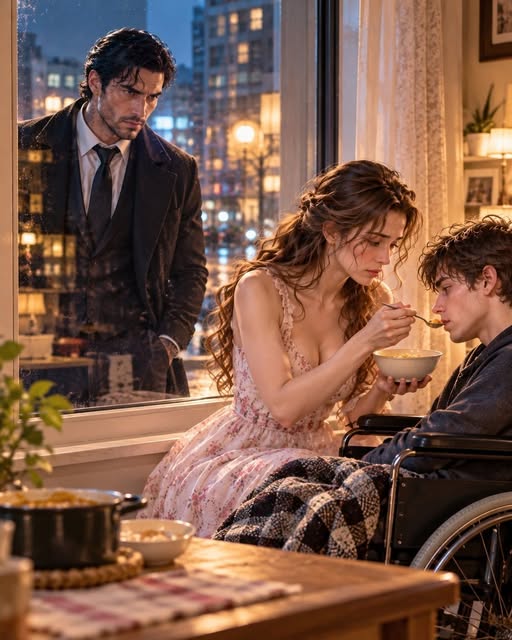
He served Leo first. Then — deliberately, and looking me directly in the eye while he did it — he served me a portion larger than his own. I understood the arithmetic he was performing. I had performed it myself, in reverse, a thousand times: love measured in ladles, the bigger bowl pushed across the table without discussion.
"No one in this house divides soup, Tessa," he said. "Eat."
I ate. I cried a little, into really excellent pasta, which Leo pretended not to see with the chivalry of a much older man.
Later, on the terrace, Roman stood with his hands in his pockets looking at nothing and said, "Ask me the question you've been carrying since the office."
"Why are you doing all of this?" I said. "The program. The house. The war. You could have paid me off and buried the whole thing. Men like you bury things."
"Men like me," he said, "built our houses out of other people's loyalty and called it strength. Then I stood outside a window in the rain and watched real strength dividing a can of soup, and I understood I'd been sold a counterfeit my whole life." He turned. In the terrace light he looked less like a statue than he ever had. "I'm not doing this instead of an apology, Tessa. I'm doing it because my apology would be an insult if it came without repairs. You kept your brother alive in a burning building for three years and called it Tuesday. The least the Caldwell family can do is carry some water."
The trap Roman built was made out of my brother's stolen phone — or rather, out of the idea of it. The Salvatores had the real one: a three-year-old handset with a dead battery and a cracked screen, currently defeating a Salvatore technician somewhere across the river, because men who solve problems with SUVs are rarely patient with electronics. Leo, questioned gently, remembered the phone's passcode and something better: he had taken not one photograph but three, and the third showed the facing page of the ledger — a list of codenames and payment dates.
"Codenames I might know," Roman said. "Sit with Nadia. Tell her every syllable you remember. A letter is enough. A number is enough. We're going to rebuild that page out of your memory, Leo, and check your memory against my money. Where they agree — that's my traitor."
It took two days. Leo sat with Nadia in the Todt Hill library like a witness at a trial of his own ghosts, and I watched my little brother — who apologized to furniture he bumped into — dictate dates and fragments in a voice that got steadier by the hour.
On the second afternoon I took a break from watching and found the gym therapist, Marco, counting out loud in the converted ballroom. Leo was between the parallel bars, arms locked, face a study in furious concentration, and as I came through the door he let go of the left bar.
One second. Two. His whole body trembled like a struck wire. Three. Four.
"Don't help him," Marco murmured, without looking at me. "He's been asking for this all week. He said — his words — 'my sister carries everything. I want one thing she doesn't have to.'"
Eight seconds. Ten. Leo grabbed the bar again and made a sound that was half laugh, half sob, and I stood in the doorway of a mafia don's ballroom and cried without making any sound at all, which is a skill you learn in apartments with thin walls and a brother who must not hear you.
"Twelve tomorrow," Leo announced to the room at large, breathless and incandescent. "Write it down, Tess. Put it in one of your ledgers. This one's going in the good column." Rook. Fenwick. The number 44 recurring like a heartbeat. A payment marked "harbor dues" on the last Friday of every month for two years.
On the second night, Nadia came out of the library carrying a single sheet, and her expression was the one accountants get in movies right before the building burns down.
"'Harbor dues,'" she said. "'Last Friday of the month. Forty-four thousand a month for twenty-six months.' It isn't one payment, Don Caldwell. It's a salary. Salvatore has been paying someone inside this house a salary for over two years — and the disbursement account is the same one that received a very interesting deposit pattern: just over a million dollars, washed through consultancy shells." She set the sheet down. "I can't name him from the money alone. But I can tell you the money stops being anonymous in exactly one place: the recipient bought a house in Coral Gables eighteen months ago. Cash. Through a trust."
"Whose son lives in Coral Gables?" Roman asked, in the tone of a man who already knew.
Dante answered from the doorway. "Carlo's."
The room was very quiet. Somewhere below us, Leo was doing his evening exercises with a therapist Roman had installed in the converted gym, and through the floor came the faint, rhythmic sound of the parallel bars taking his weight — eight seconds standing, the day before. Ten, that morning.
Roman stood looking out the window at his own dark gardens for a long time. I understood what it cost him. Carlo Marchetti had carried Roman's father out of a burning car in 1998. Carlo had held a gun on a hospital corridor so Roman's mother could die in a guarded room. Whatever the money said, the man in the ledger had once been the architecture of Roman's life. Betrayal at that depth isn't an event. It's a renovation of the past: every memory has to be re-inspected for rot.
"Do you want me to be wrong?" I asked him, when the others had gone.
"I want," Roman said, "to be certain. There's a difference. Doubt is a luxury. Certainty is a duty." He turned from the window. "So we'll give Carlo a door, and watch whether he walks through it."
The door was this: at Thursday's captains' meeting, with Carlo present, Roman announced — almost casually, a Don tidying his desk — that the Hayes boy's telephone had been recovered from a Salvatore warehouse by men loyal to the family, and that it would be brought to the Caldwell building Friday and opened in the vault in the presence of witnesses. The photograph, he said, would be read into the family's record. Everyone's names. Everyone's money. Friday.
It was a lie with a blade in it. If Carlo was innocent, Friday was an inconvenience. If Carlo was what the money said he was, Friday was an execution date — and a guilty man, given four days' warning of his own exposure, will always, always try to trade his way out of it with whatever he can still reach.
What Carlo could still reach was my brother.
Dante intercepted the first tremor on Wednesday night: a coded listing on a car-service board the organization monitored, the kind of nothing-message that means everything to the people it's for. Pickup. Medical facility. Thursday, 2 P.M. "Special assistance required." The Halden Institute. Leo's therapy session — the standing Thursday appointment the receptionist had cheerfully given away to a stranger a week before.
"They can't open the phone," Roman said, reading over Dante's shoulder. His voice had gone flat and terrible and almost pleased. "So Carlo is selling them the one key that opens everything. The boy himself. Leo, alive and talking, in exchange for Carlo's name staying off that page."
He turned to me. I was already standing. I think I had been standing since the word "medical."
"Thursday, then," Roman said. "We let them come. We let Carlo show us his whole hand." His eyes held mine. "And Tessa — I need you to trust me with the thing you trust least in this world. I need you to let Leo walk into that building on Thursday like nothing is wrong."
My mouth opened on a refusal so total it felt physical. Roman waited. He didn't argue, didn't command. He waited the way he had waited in our doorway with groceries, the way he had waited by the fire — a man learning, at forty, that some doors only open from the inside.
"Tell me the plan," I said at last. "All of it. Every man, every gun, every second. And Roman—" I made myself say it steady. "If one hair of him is harmed, I will spend the rest of my life making you sorry. And you know I keep my books balanced."
"Yes," he said quietly. "That's why it's your brother I'm trusting with this. He gets it from you."
That night I told Leo the plan myself, every man and every second, the way I had demanded it be told to me. He listened the way he'd listened to doctors for two years — completely, and saving his fear for later, in private, where it wouldn't cost anyone else anything.
"Okay," my brother said. "Thursday. I'll wear the good shirt. If I'm going to be bait, I want to look like expensive bait."
I laughed, and then I didn't, and he held out his hand and I took it, and neither of us said the thing we were both thinking: that in three years of siege, this was the first battle we were walking into on purpose, side by side, with an army at our backs.