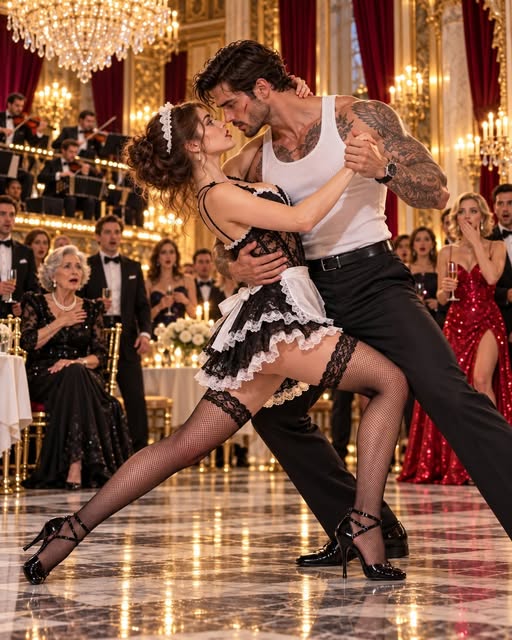
The Whitmore Foundation gala filled the Drake Hotel's ballroom with six hundred people, a silent auction, two senators, and enough orchids to funeral a small country. I wore a dress the color of deep water that Eleanor had chosen with the terrifying precision of a general choosing terrain, and a pair of tango shoes — real ones, broken in by Marta's cousin who danced — because Eleanor had informed the household that the future Mrs. Whitmore would not be opening the season in borrowed footwear.
"You look," Grant said, when I came down the hotel stairs on his arm, "like the answer to a question I asked as a joke."
"Careful," I said. "Your jokes have consequences. There's a ring and everything."
There was, by then, a ring — a plain band of his grandmother's, given not as choreography but because, as Eleanor put it, a woman opening the Whitmore gala bare-fingered would start a war in the jewelry market. It fit as if it had been waiting. I tried not to think about that. I failed regularly.
Conrad Hale found us twenty minutes before the speeches.
He was a big, silver, smiling man, and he shook Grant's hand like he was testing its resale value, and he did not look at me at all — I had been promoted, in the Hale taxonomy, from furniture to threat, and threats were negotiated with, never greeted.
"Grant. A word about spring." His smile stayed exactly in place. "The commission votes in nine days. My friends on it are — traditional men. They wonder about a Whitmore who breaks a twenty-year understanding over a dance. They wonder what his word is worth." The smile widened by a millimeter. "Vanessa is prepared to be generous. There's still a way for everyone to keep what matters."
"Name it," Grant said pleasantly.
"End this engagement business before the vote. Marry Vanessa in spring, as agreed when you were both nineteen and your fathers shook on it. The harbor is yours, the alliance holds, and — " this time he did glance at me, the way you'd glance at a stain you were offering to have cleaned " — arrangements will be made. Generous ones. The girl won't suffer."
I felt Grant's arm go still under my hand. Not tense. Still — the way the whole ballroom had gone still, once, at seven in the morning, when a man was learning the difference.
"Conrad," he said, "my father shook on a great many things. One of them was a piece of ground on Ashland Avenue that he took off a better man than either of us, and he never apologized for it, and it has been costing this family interest for thirty years." He smiled, and it was not a pleasant smile, and it was entirely honest. "I'm not adding your daughter to the ledger. Enjoy the gala."
He walked us away from Conrad Hale standing in the middle of his own ultimatum, and my heart was beating so hard I was sure Grant could feel it through his sleeve.
"You just chose a war," I whispered.
"I chose the accounts," he said. "They've been wrong long enough." Then, quieter, as the orchestra began to tune: "Dance with me tonight like my father's music is playing, Emily. Whatever happens after the speeches."
Before the speeches, there was the receiving line — an hour of handshakes and air-kisses in which I smiled at shipping magnates and judges and learned, in real time, the exact sound six hundred people make when they are recalculating what a housekeeper is for. Most were kind, in the polished way of people who have read which way the evening is blowing. A few were not. One foundation board member's wife held my hand a moment too long and said, "You must be enjoying all this attention, dear," in a tone that made attention sound like a disease of the lower orders, and I smiled at her with every tooth my father gave me and said, "I'm enjoying the shoes, mostly. Mine finally fit," and watched her decide, visibly, not to continue.
In the service corridor, fetching a glass of water with my own two hands because old habits are load-bearing, I passed a girl of maybe nineteen in a server's uniform with a tray balanced on one palm and nerves coming off her like heat. She stopped dead when she saw me.
"Miss Brooks?" she said. "Sorry — sorry, I just — my mum cleans offices downtown. Night shift, like you were. She watched the video maybe fifty times. She cried." The tray trembled; she steadied it with the automatic competence of our whole invisible tribe. "She said to say — if I ever saw you — she said to say thank you. For not running."
"What's your mum's name?" I said.
"Lucia. Lucia Ferrante."
"Tell Lucia the dance was my father's, and the not-running was hers — all of ours. She taught me by existing." I touched the edge of her tray to steady it, server to server, the old language. "And keep your chin up tonight. Whatever happens."
I went back to the ballroom and my fiancé and the six hundred witnesses with my hands steady and my heart full of other women's names, and I understood for the first time that the evening was not, whatever the Hales believed, about me at all. It was about every woman who had ever been handed a tray in a room full of people drinking — and which of the two kinds of story this one was going to be.
The speeches happened. The foundation's director spoke. A senator spoke. And then — because she had been raised by Conrad Hale and had learned, as I had, exactly what her moment was worth — Vanessa took the microphone for the toast nobody had scheduled.
She was magnificent. I have never denied it and I won't start now: red dress, steady voice, six hundred upturned faces, and a smile like the first crack in ice.
"To the Whitmore Foundation," she said. "And to new traditions." Her eyes found me, front table, beside Grant. "We're all so fond of the little housekeeper's story. The tango. The promise. It's like a fairy tale." A pause, expertly weighted. "But fairy tales leave things out, don't they? Ask her, sometime, whose family's money built the floor she's been dancing on. Ask her what the Whitmores did to her own father — his little studio on Ashland, that burned, and how the great Thomas Whitmore bought the ashes for pennies and built his empire on the ground where her family lost everything." She lifted her glass, gently, like a scalpel. "She knows. She's known for weeks. And she's still here, in the dress, with the ring. So you tell me, all of you — what exactly is being danced for, in this arrangement? The promise? Or the price?"
Six hundred people. Absolute silence. Cameras I could not see making their small hungry sounds.
It was beautifully done. It was designed to leave me two doors: run weeping, and be the fraud who fled; or stay silent, and be the fraud who stayed. Conrad Hale had raised a strategist. What none of the Hales had ever understood — because none of them had ever had to work for anything, including love — is that a woman who has mopped ballrooms knows something about standing in the middle of one.
I stood up.
Grant half-rose beside me; I put my hand flat on his shoulder — partner's pressure, the language we'd spent three weeks building — and he sat back down, trusting me in public, in front of everyone, with his whole empire watching. I would learn later that Marcus, watching from the wall, considered that the moment he actually believed in us.
I walked to the microphone on legs that were steadier than my voice, and my voice was steady enough.
"She's telling the truth," I said. "Mostly."
A murmur, like wind through a field.
"My name is Emily Brooks. My father was Daniel Brooks, and yes — he lost his studio to a fire in 2000, and yes, this family bought the land for almost nothing and never apologized, and yes, I have known for weeks, and it nearly sent me home." I looked at Vanessa — not with hatred. With something worse. With clarity. "What she left out is that I stayed anyway, and I can tell you why. Because the man who made that joke in his ballroom — " I pointed, gently, at Grant " — has spent three weeks getting up at six in the morning to be taught how to stand still. Because when he found out what his father did, he didn't bury it or buy my silence. He gave me the file. The original. He said, the secrets in this family end with me." I turned to the room. "Vanessa Hale framed me for theft, in this man's house, eleven days ago, with her friend's hands in my locker and a camera she had switched off. She poured wine down my back at a party because cruelty is her native language. And this — tonight — is her third attempt to be rid of a housekeeper without getting her own hands dirty." I let the silence do the work, the way my father taught me. "I'm not for sale, and I'm not a scandal, and I'm not going anywhere. I am the daughter of the best man I ever knew, and he taught half this city to dance — including, sixty years ago, the grandmother of the man I'm going to marry."
I set the microphone down in the explosion.
Because it did explode — sound, movement, six hundred people recalculating at once, and Conrad Hale on his feet shouting something about slander, and Vanessa's brother Derek pushing through the tables toward the stage with his face the color of his sister's dress and his hands coming up — and then simply not arriving, because Marcus Doyle had been a wall all night and now he was a wall in motion, and two of Grant's men folded the Hale heir's public moment into a quiet, efficient escort toward the service doors, to the applause of exactly nobody.
And Grant — Grant was standing. Grant was crossing the ballroom, through the noise, through the wreckage of twenty years of alliance, with his eyes on me and his hand coming up, held out, in front of six hundred witnesses and every camera in Chicago.
"Emily Brooks," he said, and the room quieted for him the way rooms do. "I owe this room two announcements, and I'll make them with my word, since my word is apparently the evening's entertainment." Something in his face was almost — almost — a smile. "First: the Whitmore organization returns the Ashland Avenue property to the Brooks family, with the distillery's profits from that ground since 2000 paid into a trust for the reopening of the Brooks Dance Studio. It should have happened thirty years ago. It happens this week, in writing, with witnesses — my family is finished being rich in the wrong direction. Second — " his hand, still extended " — there is no engagement to Vanessa Hale. There never was a spring. There is a promise I made in my own ballroom, to a woman in a wine-stained uniform, in front of two hundred people and eleven million strangers, and I am keeping it. Not because I have to." He looked at me, and his voice dropped, and the room leaned in with him. "Because it is the first true thing I ever said by accident."
I took his hand.
"Then dance," I said, for the second time in my life, and this time my voice carried to the very back of the Drake Hotel ballroom, "and this time, Mr. Whitmore — don't dance three seconds in the future."
The conductor — the same conductor, God bless him twice — lifted his baton. The bandoneon drew its long breath.
And we danced the opening tango of the Whitmore gala in a silence so complete it felt like reverence: six hundred people, two senators, one furious family in full retreat, and the whole thing held on the frame of two people who had learned, at ruinous expense, how to listen to each other. Heel. Toe. Pause. The pause where my father used to say the trust lived — and Grant stood in it with me, perfectly still, perfectly present, a man who ran an empire standing motionless in front of it because the woman in his arms had taught him that this, too, was strength.
In the dip, at the last bar, with my back over his arm and the chandeliers burning above us like a small, borrowed heaven, I looked past his shoulder and found Eleanor at the front table, in silver silk, with both hands pressed to her heart and tears running down her face — the same tears as the first night, and entirely different ones.
Sixty years, she'd waited, to watch Daniel Brooks' choreography danced like that, by his daughter and her grandson, in the light.
When the music ended, the room came up off its chairs. And Vanessa Hale, standing at the wreckage of her father's alliance with her glass still raised and forgotten, looked at me across the ruins with an expression I will remember all my life — not rage. Recognition. The look of a woman seeing, for the first time, the exact dimensions of the thing she had spent the evening trying to buy, frame, frighten, and shame off the floor.
It had never been on the market. That was her whole education, arriving all at once.