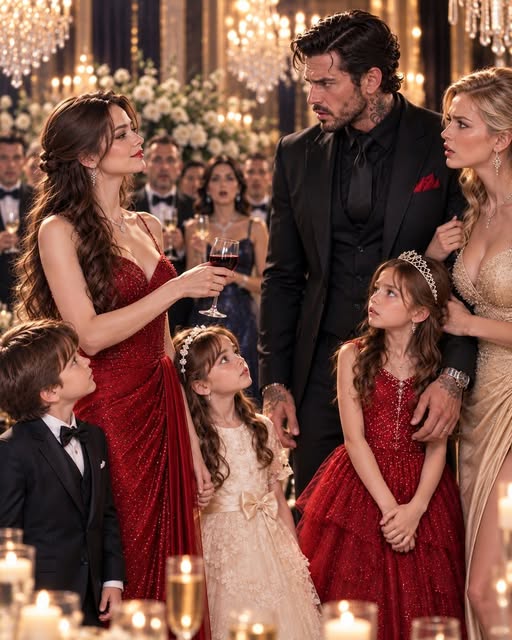
The DNA results took forty-eight hours, which was exactly forty-seven hours longer than anyone in that family actually needed.
Francesca settled the matter in her own way on Sunday morning, appearing at our hotel suite with Marta, a pastry box, and a leather photograph album older than I was. She set the twins at the suite's dining table with hot chocolate and opened the album across their knees: Alexander at four, gap-toothed, with the crescent behind his ear. Alexander at nine — Leo's exact age, Leo's exact face, down to the serious set of the mouth. Alexander at fifteen, already practicing the stillness Luna had inherited like a title. Luna studied the pages with a scholar's frown. Leo touched the photograph of his nine-year-old father with one careful fingertip and said, to no one in particular, "He looks like he had rules too."
"He did," Francesca said. "He wrote them himself. Moretti men." She closed the album and looked at me over the children's heads, and her voice gentled into something I had never heard from her. "The lab will confirm what this room already knows, Claire. But I did not come to wait for paper. I came to say that I suspected, once — the night of that banquet, I saw a girl with honest eyes standing in a golden room being fed to wolves, and I did nothing but remark on it to myself. I have had ten years to be ashamed of that remark. A grandmother does not intend to waste ten more."
Alexander came that afternoon. Not with lawyers, not with security — alone, in a plain coat, to a hotel suite door, where he knocked and waited to be admitted to see his children like any ordinary divorced father in any ordinary city, and something about his willingness to simply knock nearly undid me more than the ballroom had.
Leo received him the way a small head of state receives a delegation whose intentions are unverified. "Mom says you're our dad," he said. "The test isn't back yet, but she doesn't lie. So." He considered. "Rule One in our house is nobody makes Mom cry. She cried in the car on the way here yesterday. I counted that as the gala, not you, but I'm watching."
"I already made her cry," Alexander said quietly. "Years before you were born, in ways I am only now learning the size of. I'm not here to ask anybody to forget that. I'm here to make sure the count stops." He looked at my son without flinching. "Watch all you need to, Leo. That's your job. You're good at it."
Luna, who had been circling him like a small inspector of works, delivered her verdict to the room at large: "He brought a present but he's hiding it because he's not sure he's allowed. It's book-shaped. I can tell by the bag." It was — a first edition of the atlas his own father had given him, which he produced, suddenly and entirely mortal-looking, from the bookstore bag. "Your mother mentioned once — " he stopped. Corrected himself, with an effort I could see. "A long time ago, your mother told me she wanted her children to know every road out of every place they ever felt trapped. I kept it. I didn't know who I was keeping it for."
We did not hug. Nobody cried, except me, once, in the bathroom, efficiently, with the tap running, like a professional. He stayed two hours. He learned that Leo plays chess and Luna plays the whole room; that Luna is allergic to strawberries and Leo is allergic to being interrupted; that his daughter intended to be a marine biologist and his son intended, currently, to be a judge, "because judges get the last word and everybody has to listen." At the door Alexander paused with his hand flat against the frame, the way a man steadies himself on a ship.
"Whatever the paper says," he told me, very low, "I know. I knew on the dance floor. A man doesn't mistake his own face twice in one lifetime, Claire. He only gets to ignore it once."
The paper, when it came on Tuesday, said what the room already knew, in the cold type of a laboratory: probability of paternity, for both children, 99.99 percent.
By then, the other file was already open on his desk — the one he had demanded within the hour, in the ballroom, while three hundred guests were still filing out past the quartet stands.
The settlement file.
That same week, at Francesca's insistence, I went back to the penthouse to collect what was left of me there.
I had expected it redecorated out of recognition. Instead it stopped my breath in the doorway: my kitchen, my shelves, the reading chair by the window with its lamp — kept, all of it, dusted and waiting, like a room in a museum of a country that no longer existed. Marta, following me in, misread my silence entirely. "He wouldn't let anyone change it, miss. After you left, it was like the north wing of a house after a death. Mrs. Moretti — the second Mrs. Moretti — she never lived here. He kept an apartment for them near the school. This place he just… kept."
In the drawer where I had left it ten years earlier, face-down under a drift of old gala programs, I found the photograph from Napa: the two of us laughing in a vineyard, taken by a stranger who thought we were just a couple in love. The paper had yellowed at the edges. Someone — and there was only one someone it could have been — had taken it out over the years and put it back, over and over; the corners were soft from handling in a way one turning-down could never explain.
I stood there a long time with my marriage in my hands. Then I put the photograph in my bag, face-up, and went back down in the service elevator for the last time — because I chose to, and because some doors you have to close yourself, from the inside, before anyone can ever ask you to walk through them again.
I was not present for the audit. I heard it afterward in pieces — from Priya, who came out of retirement-from-my-life in one phone call and stayed for all of it; from Francesca, who told me the parts that were fit for a grandmother to repeat; and eventually, on a night weeks later, from Alexander himself, who left nothing out even when leaving things out would have made him look better.
The five million dollars had left the settlement account three days after my divorce was final, exactly as the forged confirmation said. It simply had not gone to me. It had gone to an account belonging to Bennett Holdings LLC — a company with my maiden name in it and nothing else of mine: registered eleven days before the divorce by a corporate services firm, on instructions paid for by the office of Reynolds Maritime. Sophia's father's company. Administered, in its short and profitable life, by Sophia's younger brother.
The house in Evanston — the house Alexander had chosen for me, with a garden, because I had once said in passing that I missed gardens — had been transferred within the month to a Reynolds family trust. It had been lived in, for several summers, by Sophia's parents.
And the letter. The letter in my handwriting, wishing him well. The foundation's forensic accountant — a man who authenticates documents for federal courts — found the truth in an afternoon: the ink and the pressure patterns showed the body of the letter had been traced, letter by letter, from genuine samples of my writing. Lists. Notes. Place cards. Three years of a secretary's access to everything that had ever come across her desk from the boss's secret wife, harvested and stored against a rainy day. She had even kept the rain in mind: the paper was a stock the penthouse office had used for exactly one winter.
There was one more page in the file, and it was the oldest. The photograph — me, climbing out of Alexander's car, his hand at my back, the photograph that had started the banquet, the photograph that had made me too dangerous to acknowledge. It had been sent to the gossip pages from an anonymous account, yes. But the original image file, recovered from the photographer's full take, had been purchased — bought outright and buried — by Alexander's own office two days after publication. The purchase order was signed with an authorization code belonging to the executive secretary. Sophia had leaked the photograph herself, and then sold the family its own embarrassment back, and then stood at Alexander's right hand at the banquet to watch it work. She had known about the marriage for over a year by then — she had found the courthouse certificate copy in his desk while reorganizing his files, the way she reorganized everything, thoroughly and without being asked. She had simply waited for a moment when the secret could be made to detonate at maximum range.
She confessed to most of it, in the end, in the family lounge where she'd been kept the night of the gala — no, that's not right either; that night she had confessed to nothing but outrage. It took the file, four days later, laid out page by page in Alexander's study with Francesca in attendance like a hanging judge, for Sophia Reynolds Moretti to finally run out of corridor.
"I was supposed to be you," she said to me — because she had demanded I be there, and I had gone, because I wanted to hear it from her and not from paper. "That's what no one will say. My father and his grandfather drafted it over cigars when I was nineteen: the Reynolds contracts, married into the Moretti line. Then he went and married a nobody in a courthouse like a — like a boy with a crush. And kept her. In a drawer. And I was the one who poured his coffee and ran his life and memorized how he takes a room apart, and he looked at me every day the way you look at furniture." Her voice did not break; she was too well made for that. It frayed. "You think I stole money, Claire? I stole my life back. The money was just the part I could count. He was never going to say your name in that room. I just made sure that when he didn't, it would finish you — because if it didn't finish you, it was going to finish me."
She signed a full confession and restitution that week — the money with ten years of interest, the house's value, her Reynolds shares placed in trust for Isabella, who was, everyone agreed in a rare moment of unanimity, guilty of nothing at all. The marriage was dissolved on grounds I don't need to detail here; the law has words for what she did, and so does the Church, and so, in private, did Francesca. There would be no criminal referral. That was my condition, and Alexander honored it with visible difficulty: not for Sophia's sake — for Isabella's, who would grow up with a mother she could visit and a story she would one day be told whole, by people who loved her, in a room where no one laughed.
On the last evening of that long week, Alexander came to the hotel once more. The twins were asleep in the suite's second bedroom, worn out from an afternoon in which their father had been soundly beaten at chess and had demanded, with great dignity, a rematch. He stood in the doorway with his coat over his arm, and from his pocket he took a small object and held it out to me on his open palm.
A plain gold band.
"You left it on the marble," he said. "Eleven days after you left it, I fired the cleaning company for nearly throwing it away in a sweep. It has been in my desk drawer for ten years." He turned his hand slightly; the band caught the light. "I'm not asking for anything with it. I have a list of things to earn and it is longer than my life was supposed to be. I just wanted you to know it was never thrown away. You were never thrown away. I was only too much of a coward to come and find out whether you believed that."
I took the ring from his palm. I did not put it on. I closed my hand around it and felt its weight, which was nothing, and its weight, which was everything.
"Then start finding out, Alexander," I said. "You can begin by losing to your son at chess again on Saturday. He expects it now. It's on the calendar."