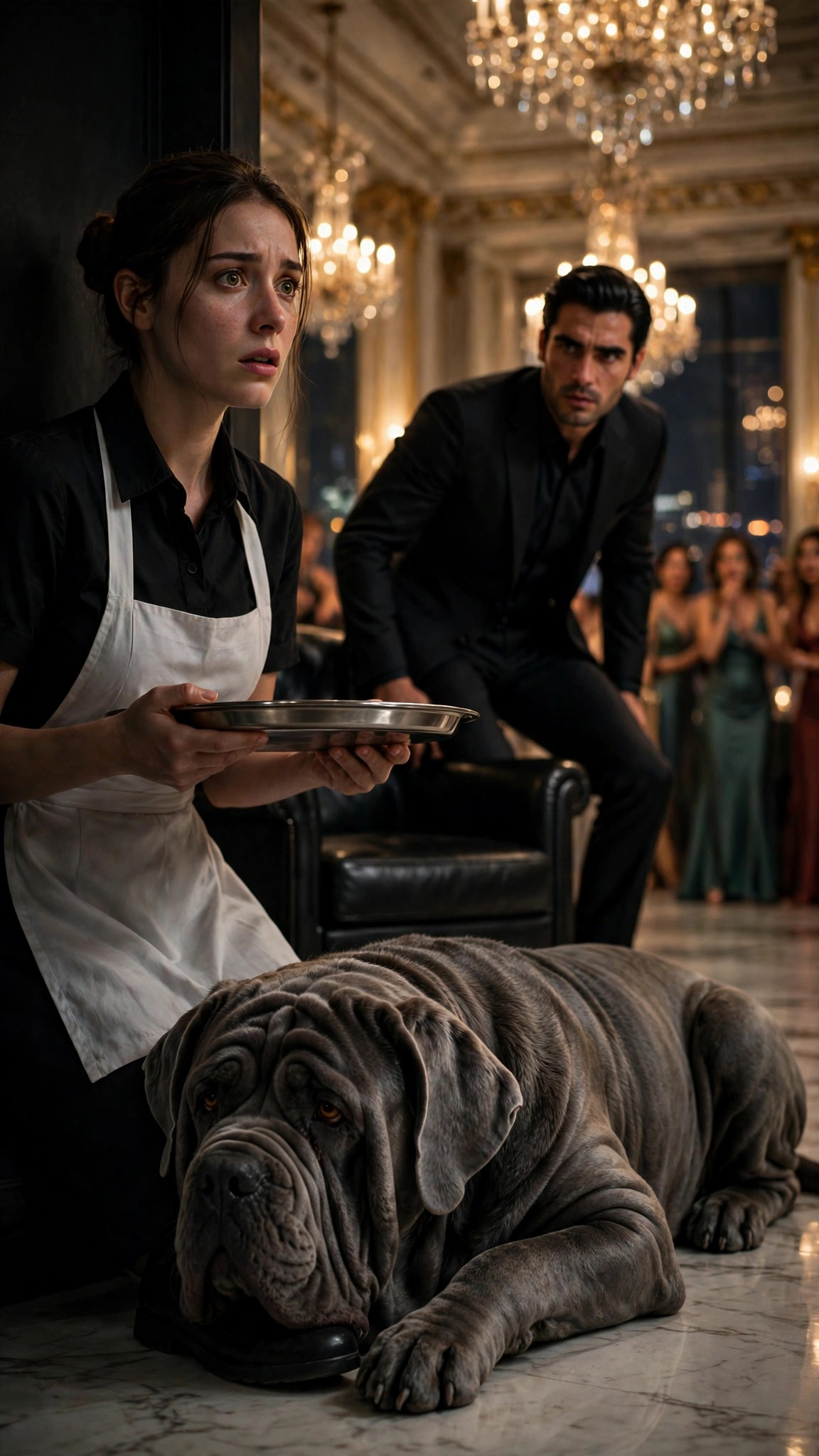
The council met at noon the next day, in the same ballroom where it had all begun.
The fifteen heiresses were gone. Their families were there instead: the capos, the lieutenants, the old men who had run the East Coast syndicate since before Kendrick was born, sitting in a great circle of chairs on the marble floor where Titan had knelt to a waitress three days earlier.
Barrett Ashford stood in the center of the circle, in handcuffs, with two of Kendrick's men behind him. He did not look frightened. He looked tired, and old, and almost relieved, the way a man looks when he has carried a weight for a very long time and someone has finally taken it from him.
Kendrick stood at the head of the circle, in his black suit, with his mother's letter in one hand and his father's ledger in the other.
"Fourteen years," he said, and his voice carried to every corner of the ballroom. "For fourteen years, this man has been stealing from all of you. From your docks. From your routes. From your families. Millions of dollars, moved through shell companies, through a construction firm that does not exist, into the accounts of Vincent Castellano."
He held up the ledger.
"The numbers are here. Every dollar. Every date. Every transfer. My mother found them first, nineteen years ago, and she wrote to Elena Kendrick about it, and Elena hid the letter in my father's library, and Elena died with the secret inside her, because she was afraid for her daughter."
He held up his mother's letter.
"My mother is gone. Elena is gone. Thomas Kendrick is gone. My father is gone. Four good people, dead, because this man wanted the docks, and because Vincent Castellano wanted the East Coast."
He looked around the circle, at the old men, at the capos, at the faces that had known him since he was a boy.
"And three days ago," he said, "when my dog knelt to a waitress in this room, Barrett tried to remove her. He planted a diamond bracelet in her locker. He called the police on a woman who has never stolen anything in her life. He threatened her five-year-old daughter."
A murmur went through the circle. One of the old men — Don Enrico Moretti, seventy years old, white-haired, the most respected man in the room — leaned forward in his chair.
"Is this true, Barrett?" he asked.
Barrett looked at the old man, and then at Kendrick, and then at the floor, and for a moment, Penny thought he was going to deny it. Then he lifted his head, and his voice, when he spoke, was clear and steady.
"Yes," he said. "It is true. All of it."
The ballroom went silent.
"I did it because this family was dying," Barrett said. "Marcus was a good man, but he was weak. He would not make the hard choices. He would not marry Kendrick to the Castellanos. He would not take the docks from the Russians. He would not do what had to be done. So I did it. I took the money, and I gave it to Vincent, and Vincent promised me that when Kendrick was gone — when Kendrick married Vivian and the Castellanos had their seat — I would run the East Coast, and the family would be strong again."
He looked at Kendrick.
"You were never going to be strong enough, nephew. You were always too soft. You kept a dog. You remembered a cook's daughter. You let a waitress sleep in your tower. You are your father's son, and your father was weak, and weakness kills families."
Kendrick listened to all of it without moving. Then he nodded, once, and he turned to the doors.
"Agent Reyes," he said. "Come in."
FBI Agent Daniel Reyes walked into the ballroom with four federal agents behind him, and he was carrying a folder, and he was smiling the thin, tired smile of a man who had been waiting three years for this exact moment.
"Barrett Ashford," Reyes said, "you are under arrest for racketeering, fraud, conspiracy, and the murder of Marcus Ashford and Thomas Kendrick. You have the right to remain silent."
As the agents moved toward Barrett, one of Barrett's men — a young lieutenant named Cole, who had been standing by the door with his hand inside his jacket — moved suddenly. He lunged across the ballroom toward Mia, who was sitting on a chair beside her mother, and his hand closed around the little girl's arm.
"If you want the child alive," Cole shouted, "you let Barrett walk out of here!"
Penny screamed. Kendrick moved. But Titan moved faster.
The one-hundred-fifty-pound dog crossed the ballroom in three great bounds, and he hit Cole like a falling wall, and the young man went down on the marble with Titan's enormous paws on his chest and Titan's teeth an inch from his throat, and Cole froze, and did not move, and did not breathe.
"Good boy," Mia said, very calmly, from her chair. "Good boy, Titan."
Kendrick lifted Mia into his arms, and he held her close, and he looked at Barrett, who was being led away in handcuffs, and at the circle of old men, who were watching him with new eyes.
"The Castellanos," Kendrick said, "are finished. Vincent Castellano was arrested this morning, at his home in Brooklyn, on the evidence in this ledger and in my mother's letter. His daughter Vivian has agreed to testify. The docks are ours. The routes are ours. The East Coast is ours."
He paused, and he looked around the circle one more time.
"And as for the rest," he said, "I have something to say."
He set Mia down gently. He walked to the center of the circle, where Barrett had stood, and he looked at the old men, and at the capos, and at Penny, who was standing by the door with Rosa's arm around her shoulders.
"I refused to choose a bride," he said, "because I did not believe a bride could be chosen. I believed a wife was something you found, not something you picked from a line. I believed that for twelve years. I was wrong about many things in twelve years. But I was not wrong about that."
He turned, and he looked at Penny, and his gray eyes were no longer cold at all.
"Three days ago, my dog knelt to a waitress in this room," he said. "He knelt because she hid him under a kitchen table twelve years ago, when she was fifteen years old and her father had just been killed, and she fed him bread from her mother's apron pocket and whispered to him until he stopped trembling. He knelt because she is the bravest person I have ever known. He knelt because she is the woman my father would have chosen for me, if he had lived to choose."
He walked toward her, across the marble, step by step, and the whole ballroom watched, and Titan walked beside him, and Mia ran ahead of them both.
"Penny Kendrick," Kendrick said, stopping in front of her, "I am not asking you to marry a Don. I am asking you to marry the boy who showed you a drawer full of peppermints. Will you?"
Penny looked at him. She looked at Mia, who was beaming. She looked at Titan, who was sitting at her feet, his chin on her shoe, waiting. She looked at Rosa, who was crying quietly into her handkerchief. She looked at the ballroom, at the chandeliers, at the marble floor, at the fifteen empty chairs where fifteen heiresses had sat three days ago.
And she thought about the two-room apartment in Queens, and the rent notice on the refrigerator, and the jar on top of the refrigerator with five dollars a week in it, and the silver tray she had carried in a hundred ballrooms for people who did not see her.
And she thought about the girl she had been at fifteen, hiding a puppy under a kitchen table, whispering, "Shh, it's all right, I'm here."
"Yes," she said. "Yes, Kendrick. I will."
The ballroom erupted then — not with shouting, but with something stranger and rarer: applause. It started with Don Enrico Moretti, seventy years old and white-haired, who rose slowly from his chair and clapped his hands together, once, twice, three times, and then the capos joined him, and then the lieutenants, and then the whole circle was on its feet, applauding a waitress and a five-year-old girl and a one-hundred-fifty-pound dog, and Penny stood in the middle of it with tears running down her face, holding Kendrick's hand, holding Mia's hand, not understanding how she had gotten here, only understanding that she was here, and that it was real.
After the applause died down, there was business to do. There is always business to do, in a family like the Ashfords, even on the happiest day of a man's life.
Don Enrico took the floor first. He stood in the center of the circle, where Barrett had stood, and he looked around at the old men, and his voice, when he spoke, was the voice of a man who had buried three sons and two brothers and had earned the right to be heard.
"I have known this family for fifty years," he said. "I knew Marcus. I knew Sofia. I knew the boy Kendrick was, and I know the man he is. And I tell you this: a family that chooses its future with its heart is a family that will live. A family that chooses its future with its wallet is a family that will die. Barrett chose with his wallet. Kendrick has chosen with his heart. I stand with Kendrick."
One by one, the capos stood. One by one, they said the same thing, in their own words, in their own ways: we stand with Kendrick. We stand with the Don. We stand with the family.
And then Kendrick spoke about the future.
"The syndicate will change," he said. "Slowly. Carefully. But it will change. The docks stay. The routes stay. But the money that has flowed through shadows will flow through light. We will have real businesses, with real books. We will pay our taxes. We will employ people who go home to their families at night. My father built this family on loyalty. I will build it on loyalty and on law. Anyone who cannot live with that is free to leave, with my blessing and with his share. Anyone who stays will be part of something better than what we were."
There were questions. There were arguments. One capo, a hard man named Salvatore who had run the Brooklyn docks for twenty years, stood up and said the family would be weak without its old ways, and Don Enrico stood up and said the family had been weak for fourteen years and had not known it, because Barrett had been stealing its strength, and Salvatore sat down again, and said no more.
It took three hours. Three hours of talking, and arguing, and voting, and at the end of it, the family had a future, and the future had a name, and the name was not Castellano.
While the council talked, Penny and Mia slipped out to the garden.
The garden was on the roof of the tower, a small green place in the sky, with a fountain and a bench and a view of the whole city. Mia ran to the fountain at once, and Titan followed her, and Penny sat on the bench, and Rosa came and sat beside her, and the two women sat together in the late afternoon sun, saying nothing for a long time.
"He loves you," Rosa said at last. "Did you know? He has loved you since you were twelve years old and he was fifteen, and he showed you a drawer full of peppermints. He did not know it then. Men never know it then. But he knows it now."
"I love him too," Penny said quietly. "I think I always have. I think I loved him when I was twelve, and I forgot, because I had to forget, because girls like me do not marry men like him. But the dog remembered. And now I remember too."
Rosa took her hand. "Your mother would be so proud of you," she said. "Elena always said you were the bravest girl she had ever known. She said you hid a puppy under a table while men with guns searched the house, and you did not make a sound. She said you were born brave, and the world would try to make you afraid, and you must never let it."
Penny wiped her eyes. "I'm still afraid, Rosa. A little."
"Good," Rosa said. "Brave people are always a little afraid. Only fools are never afraid. The trick is to be afraid and do it anyway. You have always done it anyway."
That evening, after the council ended and the families went home and the tower was quiet, Kendrick took Penny to a small jewelry shop in the Diamond District — not the grandest shop, not the one with the armed guards and the velvet ropes, but a small shop with a bell over the door, run by an old man named Goldberg, who had sold rings to three generations of Ashfords.
"I want something simple," Kendrick told him. "No diamonds the size of peas. No gold that shouts. Something quiet. Something true."
Goldberg opened a drawer and laid out a dozen rings, and Kendrick looked at each one, and then he picked up a thin band of white gold with a single small diamond, no bigger than a grain of rice, and he held it up to the light, and he nodded.
"This one," he said. "This is hers."
He paid for it himself, in cash, from his own wallet, and he put the little box in his pocket, and he did not propose with it that night. He waited. He waited for the right moment, for the right place, for the kitchen where it had all begun — because some things, Kendrick Ashford had learned, should not be rushed.
Some things should be done properly, in the place where they belong, with the people who belong there, and the dog lying at your feet.