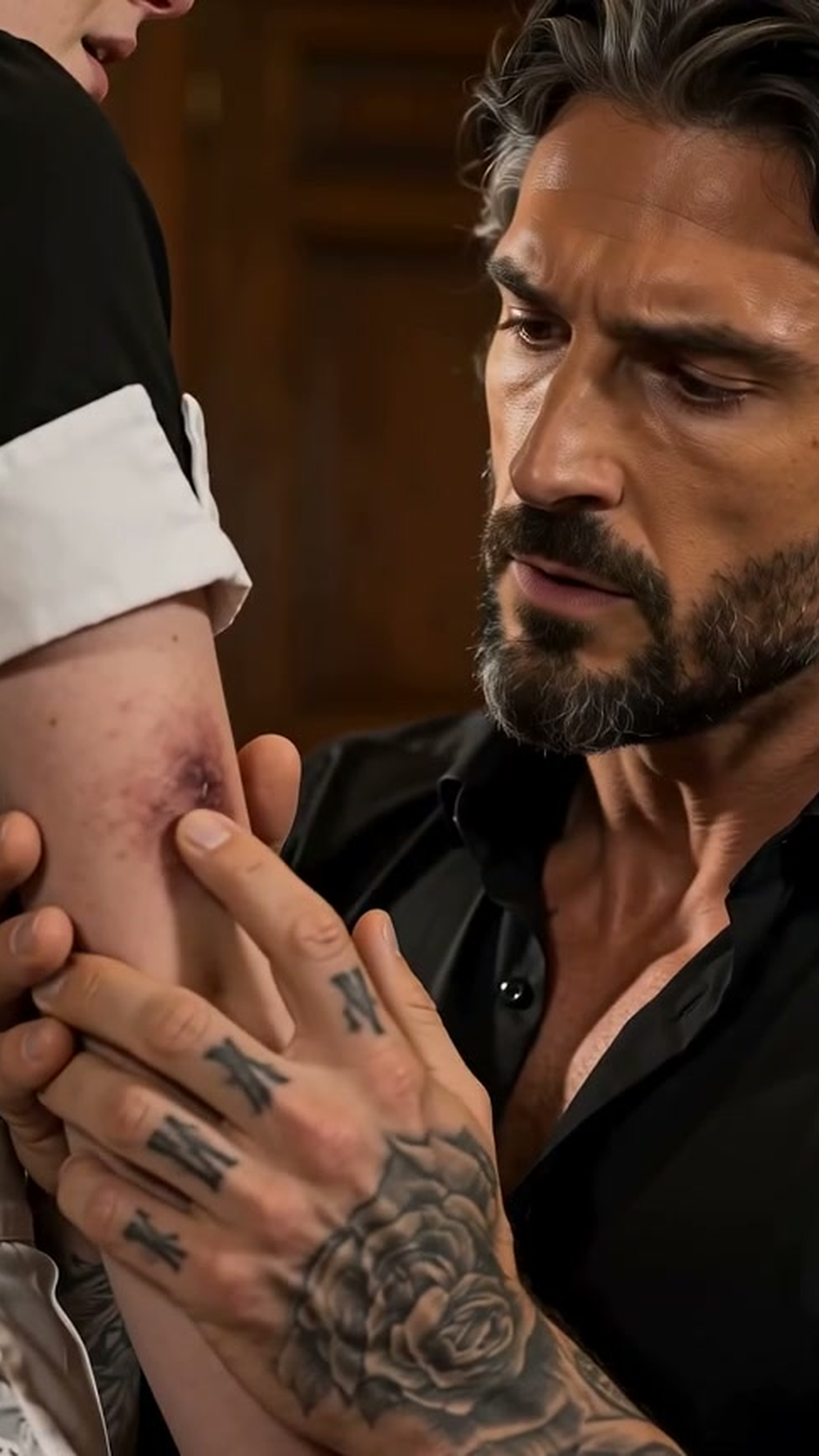
Preston Caldwell arrived at the Blackwell estate at four o'clock on the afternoon of the gala, in a car the color of money, with a contract in a leather folder and a smile for the staff who opened his door.
The staff felt his arrival the way sailors feel weather. Extra silver came up from the vault. The good candles — the ones that were never lit for mere millionaires — came out of their tissue. Mrs. Whitmore, who feared God and very little else, used his name at full volume in the kitchen, which she did for no living person except the boss: "Mr. Caldwell's car in twenty minutes. Mr. Caldwell takes the blue room. Mr. Caldwell's whisky is the eighteen-year, and the girl who pours it does not speak unless spoken to." Kate, soaping glasses at the deep sink with one hand and a forearm full of splint and secrets, listened to the house rehearse its reverence, and thought about how cathedrals must have felt, dressing for a bishop who came to burn them.
He was not merely a guest. This was what Rosa had tried to tell her, in the laundry, in the way of a woman laying out weather: the gala was not a party, it was a coronation. Tonight, before three hundred witnesses, Damon Blackwell and Preston Caldwell would announce the merger of their shipping interests into a single Atlantic empire — Blackwell muscle and Caldwell hulls, the legitimate face of the organization washed clean in champagne. There would be photographers. There would be a senator. Preston Caldwell was not attending the gala.
Preston Caldwell was half of its purpose.
Kate learned all of this the way she learned most things in that house — with her hands in hot water, from Rosa, in pieces — and understood at once what it meant for her. The man who had broken her arm in a locked corridor was about to become, publicly and permanently, the second most powerful man in her world. After tonight, there would not even be the theoretical possibility of appeal. You cannot accuse the king's brother of anything. You can only survive him, quietly, at whatever price he sets, for as long as he finds you interesting.
At five o'clock, Mrs. Whitmore conducted the final inspection of the gala staff in the great kitchen, walking the line of girls in their formal uniforms the way a general walks a parade — cuffs, collars, hands, nails, hair. She stopped in front of Kate for exactly one second too long.
"Your right cuff is crooked, Bennett."
"Yes, Mrs. Whitmore. Sorry, Mrs. Whitmore." Kate's heart was slamming against the splint so hard she was certain the whole line could hear it. The formal cuff was the splint's camouflage; straightening it one-handed, under inspection, in front of twenty witnesses, was beyond her.
"Well? Hands are for using, girl."
Rosa, two places down, in a voice of magnificent boredom, said: "She burned it on the press this morning, Mrs. Whitmore. Right hand. I dressed it myself. She can pour and carry, but buttons—" she shrugged, "you know burns."
Mrs. Whitmore's gaze moved between them with the slow sweep of a lighthouse. Twenty years in great houses had taught Agnes Whitmore many languages, and the one she was hearing now was fluent: staff covering staff, the oldest sacrament of the below-stairs world. What she chose to do with it would decide the evening.
"Then she pours and carries," she said at last, "and keeps the hand out of the photographs." She moved on. "Bennett — the sitting room wants candlesticks before six. Mind you're not seen doing it."
It was mercy, dressed as an order, and it sent Kate up the back stairs toward the sitting room with the silver candlesticks in a linen-lined box against her hip, minutes before Preston Caldwell came looking for the room himself.
"Then I survive him," Kate said, to the sink, to herself, to the arithmetic. "One night. The folly, whatever he—" She stopped. Breathed. "One night, and then the deposit is paid, and then—"
"And then there will be another night," Rosa said flatly. "Hermana. There is always another night with men like that. That is the whole of their religion."
But the roster was the roster, and the deposit was due in eight days, and by five o'clock Kate was in her formal uniform with the long cuffs and the lace apron starched to a blade's edge, carrying candlesticks into the private sitting room off the ballroom — the room reserved for the boss and his principals, away from the music. It was the loveliest room in the house and the one she liked least: dark polished panels, gold that gleamed like honey in the lamplight, paintings of other men's ancestors scowling down at furniture too expensive to sit on. She set the candlesticks on the marble table — left hand, then the second, placed with the care of a girl defusing something — and stood a moment in the quiet, breathing in beeswax and old wood and the faint leather breath of the chair by the fireplace, and allowed herself one traitorous thought: that she would like, just once, to be a person who entered rooms like this through the front, in a dress, with both arms whole and nothing in her past that had to be hidden under a cuff. Then she heard the latch — when the door opened behind her and the temperature of the air changed.
"You see," said Preston Caldwell, "the house agrees with me. It keeps putting you in rooms with me."
He had the leather folder under one arm. He was already dressed for the evening, and he looked — this was the obscene part, the part she would never be able to explain to anyone who hadn't lived it — magnificent. Silver-blond hair swept back, dinner jacket cut like an apology for every sin underneath it. Evil, in Kate's experience of it before this house, had been shabby: shouting men, cheap flats, doors with locks that didn't hold. She had not been prepared for evil with a tailor.
"The candlesticks, Mr. Caldwell," she said. "I was just—"
"Your arm." He nodded at her right side with the interest of a man inspecting his own workmanship. She had kept it pressed to her body, the splint hidden under the formal cuff, the apron over all. "Still favoring it. You haven't had it set, have you? Of course you haven't. Good girl. I knew you were a sensible one under all the theater."
"Please," Kate said, "I have to finish the room. They'll come looking—"
"No one comes looking for a maid, Kate. That's the whole beauty of you." He set the folder down on the marble table with terrible gentleness. "Tonight, after the announcement, there are fireworks over the garden. Everyone watches fireworks. It's practically liturgy. When they begin, you will slip away from your station — I've already seen to your roster, don't look so surprised, you read it yourself this morning — and you will come to the garden folly, where it is dark, and private, and very far from the house. And there, you will apologize for the scene in the corridor. On your knees, if your arm permits. I haven't decided yet whether it will."
The candlesticks were silver and heavy. In her good hand, one of them weighed, suddenly, like a possibility.
"You feel that urge," he observed, delighted. "I can see it. Go on, then. Strike the boss's partner with his own candlestick, in his own sitting room, two hours before the announcement. Let us all enjoy the consequences together — you, me, and your mother, when the hospital asks where this month's money has gone." He stepped closer, into the range where she could smell the clean citrus of his cologne over something warmer and worse, and his voice dropped to the register of a man discussing shipping schedules. "Or be sensible. Gardens. Fireworks. A short unpleasantness, and then you keep everything — the job, the money, the little heart ticking away at St. Aurelia's. I've kept my side of our bargain, haven't I? No one knows. No scene. I even let you keep the arm."
The door to the sitting room stood open. Beyond it, the ballroom glittered empty and enormous, filling with the first music of the evening as the orchestra tuned. Somewhere in the house, three hundred invitations' worth of people were beginning to arrive at the gates.
"Say it," he said. "Yes, Mr. Caldwell. I enjoy hearing it. It settles things."
Kate's mouth opened. The words were there — she had rehearsed survival for three days; she knew exactly what survival sounded like. And behind her eyes, unbidden, the arithmetic failed for the first time: she saw not the deposit, not the hospital, but her own face in the laundry mirror at dawn, practicing how to hold a teapot with a broken arm without weeping, and something in her — the last unbroken thing, smaller than a candlestick flame — simply declined.
"No," she said.
His hand came up.
It never landed. Because at that precise moment, from the ballroom doorway, a voice spoke — not loudly, which in that house was never necessary.
"Preston."
Damon Blackwell stood in the open door with a cufflink half-done and his brother at his shoulder, and his dark eyes moved through the room the way weather moves through a field — taking in the folder on the marble table, the candlestick in the maid's fist, the two feet of charged air between his partner and his staff, and the way Kate, without knowing she had done it, had stepped backward until the antique sofa stopped her.
"Am I interrupting a negotiation?" Damon asked.
"Hardly." Preston's smile reassembled itself like a weapon being safetied. "Your girl was arranging candles. I was admiring the room. You've outdone yourself tonight, Damon. The old house looks almost legitimate." He picked up the folder. "Shall we? The contracts won't sign themselves, and I believe we have an empire to announce."
"We shall." Damon did not move from the door. He watched Preston pass him with the courtesy of a priest watching a coffin pass, and then his eyes came back to Kate, and stayed.
"Kate." Just that. Her name, in the tone a man uses for a chess piece he has suddenly realized is not where he left it.
"Sir," she managed. "The candles are— I'll finish. Right away."
"Leave them."
"Sir—"
"Leave the candles, Kate. Go down to the kitchens. Stay where there are people." A pause, calibrated to the width of a hair. "That is an instruction."
She went. She walked past him close enough to feel the heat of him, with her broken arm pinned against her apron and her heart slamming against the splint's hard edge, and she did not stop until she was in the kitchen among the steam and the shouting and Rosa, who took one look at her face and put her on cold desserts, in the middle of the room, under the lights, with eleven other people — as ordered, though Rosa never knew she'd been given the order by two masters at once.
She never learned what was said in the sitting room after she left. But forty minutes later, as the first guests were being announced in the hall and the orchestra struck its opening chord, Matteo Blackwell appeared in the kitchen doorway with his sharp smile entirely absent, and crooked one finger at the duty roster, and asked — of the room in general, in the tone of a man asking about the weather — who had drawn the security rotation for the gala.
And by nine o'clock, standing at her station in the east wing with a tray of champagne she was forbidden, by Rosa's stricken whisper, from having been assigned at all — the roster had been changed back, and then changed again, by hands nobody could identify — Kate understood that something in the house had begun to move. Something vast and quiet, like a ship changing course in the dark.
At half past nine, the fireworks roster was called, and her name was on it, and the garden lay below the terrace black and gold and breathing with music, and somewhere out in that darkness stood the folly.
And in the private sitting room, behind a closed door, Damon Blackwell was looking at a security log on his brother's phone — at the east corridor, Thursday, 3:04 p.m., where the footage dissolved into gray static at exactly the moment a locked door's shadow crossed the frame — and saying, very quietly, to no one in particular:
"Someone in my own house held the door for him."