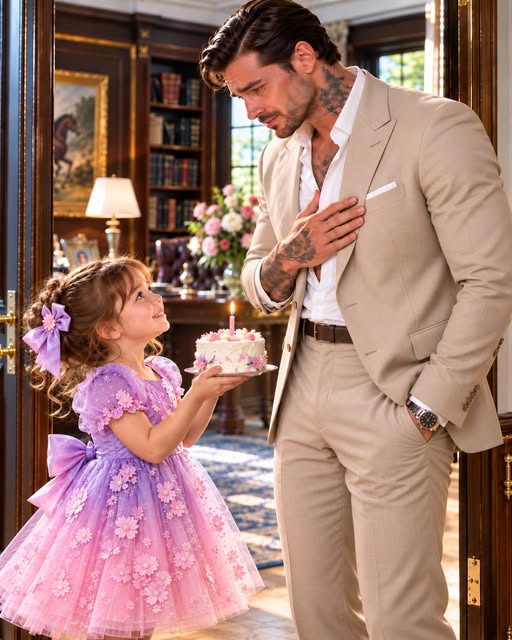
Gabriel Valenti was halfway down the grand staircase when Mara Ellis called.
"Stop where you are."
He froze.
"Where's my daughter?"
"She's safe."
"Then tell me where."
"Not until you listen."
Gabriel gripped the carved banister.
His entire body demanded movement. For eight years, he had imagined what he would do if someone finally gave him the opportunity to see Sofia again.
He had pictured running toward her.
Holding her.
Apologizing until his voice disappeared.
Now that moment might finally arrive, and a federal agent was ordering him to remain inside his own home.
"Mara, I am not asking for permission to see my child."
"I'm not debating your rights as a father. I'm telling you that your daughter is frightened, someone may be trying to locate her, and you rushing through Chicago with a private security convoy will make our job harder."
Gabriel shut his eyes.
"What happened?"
"Sofia reached a community outreach center on the North Side. A volunteer helped her contact us. The man's voice you heard belonged to one of the center's staff members."
"Who was chasing her?"
"We haven't confirmed that anyone was. She saw an unfamiliar vehicle outside and became frightened."
"Is Victor involved?"
"Possibly. But fear isn't proof, Gabriel."
He exhaled slowly.
"Can I speak to her?"
"When she's ready."
"She called me."
"Yes. And that matters. But she's a fifteen-year-old girl who's lived under another identity for eight years. She gets a say in what happens next."
Gabriel looked toward the upstairs hallway.
The last time he had made a decision for his daughter without asking what she wanted, he had lost eight years of her life.
"All right," he said.
Mara seemed surprised.
"All right?"
"Tell her I want to see her. Tell her she doesn't have to decide tonight."
He paused.
"And tell her I'm sorry."
After ending the call, Gabriel remained on the staircase.
Downstairs, the birthday decorations were being removed.
White roses were disappearing into cardboard boxes. Empty champagne glasses were collected from tables. Employees were polishing surfaces that had already been immaculate before the party began.
The house was returning to its usual perfection.
But Gabriel knew nothing inside it would ever be the same.
Sofia Valenti sat on a worn sofa in a secure interview room, watching rainwater trickle down the window.
She had her father's eyes.
Not that she particularly wanted them.
At fifteen, Sofia was old enough to recognize when adults were lying and young enough to still hope that the people she loved might have good reasons for doing it.
She had grown up believing her mother was dead.
That much was true.
Everything involving her father had been more complicated.
Evelyn Caruso had told her that Gabriel was alive but couldn't safely be part of her life. The explanation had changed slightly as Sofia grew older.
When she was eight, it was because dangerous people might recognize them.
When she was ten, it was because her father had complicated responsibilities.
When she was twelve, Evelyn had told her that his presence might endanger them both.
At fourteen, Sofia stopped accepting explanations.
She began collecting questions instead.
Why had no one ever shown her a police report about the fire?
Why did photographs of her mother disappear from public records?
Why had Evelyn insisted she never tell classmates her real surname?
Why did packages arrive every Christmas without a return address?
And why did her father apparently possess enough money to pay for anything except a visit?
One afternoon, Sofia discovered an old cardboard box in Evelyn's attic.
Inside were newspaper clippings, photographs, and several letters Isabel had written before her death.
Most were ordinary.
A grocery list.
A birthday invitation.
A postcard from Chicago.
But one envelope contained a photograph of seven-year-old Sofia with a young man standing beside her mother.
On the back, Isabel had written:
Daniel Morgan, who fixed our lights and stayed for cake. Sofia says he is her new best friend.
Sofia searched the name online.
The results led to an obituary.
Daniel Morgan had died two years earlier.
He had left behind a wife named Claire and a baby daughter named Mia.
Another search revealed that Claire worked at a large private estate outside Chicago.
The owner was Gabriel Valenti.
Sofia had stared at the screen for almost an hour.
Her father had found a place for Daniel Morgan's widow inside his household.
Yet he had never found a way to come see his own daughter.
Something about that felt wrong.
She bought a bus ticket using money she had saved from tutoring younger students.
Then she left Wisconsin before sunrise.
She didn't intend to disappear forever.
She intended to find someone willing to tell her the truth.
At the outreach center, Sofia met an elderly volunteer named Ruth Peterson.
Ruth noticed that the teenager kept watching the windows.
"Are you waiting for somebody, sweetheart?"
Sofia hesitated.
"I think somebody might be looking for me."
"Do you feel safe here?"
"I don't know."
Ruth offered her a cup of hot chocolate.
"You can stay while we figure that out."
Sofia had almost started crying.
For years, adults had treated her questions like dangerous objects.
Ruth simply treated her like a frightened child who needed help.
While waiting, Sofia looked through a folder of photographs she had carried from Wisconsin.
One picture showed Gabriel standing beside Victor Romano at a fundraiser.
She remembered Victor.
Not clearly.
Eight years was a long time, especially when most of the memories involved terror and confusion.
But she remembered a silver ring.
And a man's voice telling her father that some people had to disappear so others could survive.
When she saw Victor's picture, a sickening sensation moved through her stomach.
She searched more photographs.
In one image, he stood beside her mother at a charity reception.
On his right hand gleamed the same distinctive ring.
Sofia had called Gabriel impulsively.
"I found the man who killed Mom."
But what she actually possessed was suspicion.
Memory.
And a fear she could no longer ignore.
Mara Ellis explained that distinction carefully.
"We'll examine everything you remember," she told Sofia. "But I don't want you to feel responsible for proving what happened."
Sofia stared at the floor.
"Then whose responsibility is it?"
"The adults who failed to protect your family. And the people investigating the crimes."
"My dad says he's protecting me."
"That may be what he believes."
"He didn't even come to my eighth birthday."
Mara remained quiet.
"Or my ninth. Or my tenth."
Tears gathered in Sofia's eyes.
"He could've called me. He could've sent one letter with his name on it."
"You're allowed to be angry."
Sofia wiped her cheeks.
"I'm not just angry."
"What else?"
"I'm afraid that if I see him, I'll still love him."
Mara's expression softened.
"Those feelings can exist together."
That afternoon, Claire arrived at the secure location with Daniel's photograph.
Mara had asked whether she would be willing to speak with Sofia.
Claire agreed, although she wasn't certain what she could possibly say.
When she entered the room, the teenager stood.
For several seconds, they stared at each other.
Claire recognized the child from Gabriel's study.
But the little girl had grown into a slender young woman with long dark hair, thoughtful eyes, and a posture that suggested she had spent years trying to appear braver than she felt.
"You're Claire Morgan?" Sofia asked.
"Yes."
"Daniel was your husband?"
Claire nodded.
Sofia glanced at the photograph in Claire's hands.
"He saved me."
"That's what your father says."
"Do you believe him?"
Claire considered the question.
"I believe Daniel would have tried to save you. Even if he didn't know who you were."
Sofia's lower lip trembled.
"People keep telling me what happened to him."
"They're still investigating."
"I'm sorry."
Claire shook her head.
"You don't have anything to apologize for."
"But he died because of that night."
"We don't know exactly why Daniel died. And none of it was your fault."
Sofia looked away.
Claire sat down.
"Would you like to hear something about him?"
The teenager nodded.
"He sang terribly."
Sofia blinked.
Claire smiled through tears.
"He loved music, but he couldn't stay on key to save his life. He used to sing while making breakfast, and I would threaten to hide the radio."
A small smile appeared on Sofia's face.
"He was nice to me."
"I'm sure he was."
"He carried me out of the fire."
Claire reached across the table, then stopped short of touching her.
"He would have been glad you survived."
Sofia's eyes filled.
"I don't remember Mom's voice very well."
Claire felt her heart breaking for the girl.
"Your father might have recordings."
"He doesn't talk about her."
"Maybe because he doesn't know how."
Sofia frowned.
"Do you think he's a good man?"
Claire was silent for a long moment.
"No," she answered carefully. "Not in every way."
Sofia lowered her eyes.
"But I think he has a chance to make better choices."
"Is that enough?"
"No. Better choices have to be followed by actions."
The teenager studied her.
"You're different from the people he usually knows."
Claire almost laughed.
"I certainly hope so."
Gabriel and Sofia met the following evening.
The meeting took place in a quiet room arranged by Mara, with Evelyn waiting nearby and no reporters, business associates, or armed guards in sight.
Gabriel arrived early.
For nearly an hour, he stood beside the window, rehearsing words that sounded inadequate even inside his own mind.
I'm sorry.
I missed you.
I never stopped loving you.
Each sentence was true.
None could restore eight stolen years.
When the door opened, Sofia entered wearing jeans, white sneakers, and a navy sweater.
Gabriel turned.
The years collapsed.
He could still see the seven-year-old girl who had held his hand in the garden.
But standing before him was someone older.
Taller.
A young woman who had lived an entire childhood he hadn't witnessed.
"Sofia," he whispered.
She stopped several feet away.
"Hi, Dad."
He had imagined hearing those words thousands of times.
Now that they were real, he could barely remain standing.
"You've grown."
The sentence sounded foolish.
Sofia glanced toward the floor.
"That happens."
A painful smile touched his mouth.
"Yes. I suppose it does."
Silence settled between them.
Gabriel wanted to embrace her.
His arms even moved slightly.
Then he stopped.
"Can I hug you?"
Sofia's eyes filled.
She shook her head.
"Not yet."
Gabriel lowered his hands immediately.
"Okay."
The word cost him more than anyone in the room could have understood.
Sofia sat across from him.
"Why did you do it?"
He didn't pretend to misunderstand.
"I thought keeping you away would keep you alive."
"Why didn't you visit?"
"I was afraid someone would follow me."
"Why didn't you call?"
"I was afraid your calls would be traced."
"Why didn't you write?"
Gabriel swallowed.
"Because I kept telling myself that if I left you completely alone, nobody would know where to look."
Sofia stared at him.
"That's stupid."
"Yes."
She seemed startled by the admission.
Gabriel leaned forward.
"I don't have an excuse that makes what I did fair. I loved you. I was afraid. And I made decisions that hurt you."
"You made me think I wasn't worth seeing."
His eyes filled.
"That was never true."
"Then why did you let me believe it?"
Gabriel couldn't answer immediately.
Finally, he said, "Because I cared more about avoiding the danger I could imagine than about the pain I was causing you every day."
Sofia looked down.
"I used to think you forgot my birthday."
"Never."
"Then where were you?"
"In this house. Usually alone."
"Why?"
"Because celebrating without you felt wrong."
Sofia's voice cracked.
"Then why didn't you come?"
Gabriel covered his mouth.
There was no answer left.
Only a man who had mistaken absence for protection.
And a daughter brave enough to tell him exactly what that absence had cost.
Meanwhile, Victor Romano was beginning to lose control of the story.
He had learned that federal investigators were examining old records connected to the fire.
He also knew that Daniel Morgan's widow had spoken to them.
That was intolerable.
For eight years, Victor had maintained control through carefully arranged misinformation.
He had told Gabriel the fire was ordered by a rival faction.
He had helped direct the internal investigation toward men who were already dead.
He had arranged for key witnesses to withdraw their statements.
And when Daniel Morgan began asking questions, Victor had taken steps to ensure that his concerns would never receive proper attention.
Now the dead electrician's records were resurfacing.
Worse, Sofia Valenti was alive and speaking with investigators.
Victor couldn't control her memories.
He couldn't control Gabriel's guilt.
And he couldn't control the unexpected bond forming between Gabriel and Claire Morgan.
So he decided to attack their credibility.
An anonymous message reached several local reporters.
It accused Claire of stealing confidential material from the mansion and attempting to blackmail Gabriel Valenti.
Another message suggested that the supposedly deceased Sofia had been hidden by her father to manipulate family trusts and avoid financial obligations.
The allegations were incomplete, distorted, and partly constructed from facts stripped of context.
But they were damaging.
By the following morning, speculation was spreading.
News organizations began asking whether Gabriel had falsified records concerning his daughter's death.
Business partners called demanding explanations.
Attorneys warned that criminal and civil investigations could threaten his entire financial empire.
Gabriel read every message.
Then he called Jonathan Reed.
"Prepare a public statement."
Jonathan hesitated.
"Gabriel, we need to be careful."
"I know."
"Admitting the false death record could expose you to prosecution."
"Then I'll answer for it."
"What about your businesses?"
"Separate the legitimate employees and lawful operations from whatever may be seized or investigated. I don't want innocent workers paying for my mistakes if it can be avoided."
Jonathan sighed.
"And Victor?"
"Don't mention him publicly until the evidence is properly reviewed."
"You're listening to legal advice?"
Gabriel looked toward Mia's cake, now covered carefully and kept in the refrigerator.
"I'm trying something new."
Before he could release the statement, Sofia asked to see her mother's belongings.
Gabriel arranged a supervised visit to the study.
Claire accompanied her.
Mia remained safely with Mrs. Bell at the cottage.
Sofia entered the room slowly.
It smelled of polished wood, old books, and expensive leather.
Everything was larger than she remembered.
Gabriel showed her a framed wedding photograph.
Isabel stood beside him in a simple ivory dress, laughing at something outside the camera's view.
Sofia touched the edge of the frame.
"She looks happy."
"She was."
"With you?"
Gabriel's voice softened.
"Yes. For a long time."
Sofia looked around.
"Did she know about your business?"
Gabriel hesitated.
"She knew enough to worry. Not enough to feel safe."
"Did she want you to quit?"
"Yes."
"Why didn't you?"
He looked at his daughter.
"Because I kept telling myself that everything I built was for my family."
Sofia glanced at the enormous office.
"And then you lost us."
Gabriel nodded.
"Yes."
She turned toward the desk.
"Where's the birthday picture?"
He opened the drawer and removed the silver frame.
Sofia studied her seven-year-old self.
"Oh my gosh."
"What?"
"That cake."
Gabriel smiled sadly.
"Your mother made it."
"I remember."
"Do you?"
Sofia nodded.
"She let me decorate the flowers. I made them all lopsided."
Gabriel laughed quietly.
"She said they were perfect."
"She was lying."
"Beautifully."
For a few seconds, father and daughter shared something neither had expected.
A happy memory.
Then Sofia turned the frame over.
"Did you ever look behind this?"
Gabriel frowned.
"What do you mean?"
"Mom used to hide things behind pictures."
He stared at her.
Sofia continued.
"She said people never looked properly at things they thought they already understood."
Gabriel carefully opened the backing.
A folded sheet of paper lay concealed between the photograph and the cardboard.
His breath caught.
Isabel's handwriting.
A list of dates.
Numbers.
Names.
Several financial transactions involving a charitable foundation connected to Victor Romano.
At the bottom, one sentence had been underlined twice.
If anything happens to me, Gabriel must know who is using his name.
Gabriel stared at the paper.
Claire moved closer.
"What does that mean?"
He read the sentence again.
A memory surfaced.
Eight years earlier, Isabel had asked him about suspicious transfers from one of his legitimate foundations.
He had dismissed her concerns.
He had promised Victor would review the accounts.
Three days later, she died.
Gabriel looked at Sofia.
"Your mother was investigating something."
Sofia's expression changed.
"Something Victor did?"
Gabriel nodded slowly.
"Maybe."
Claire examined the list.
One date matched a transfer Daniel had highlighted in his own records.
Another matched the week before the fire.
And beside a final entry was a notation that made Gabriel's blood run cold.
It referred to a large payment authorized under Gabriel's name.
He had never seen the transaction.
Someone had used his authority.
Someone Isabel had discovered.
Gabriel closed his eyes.
The fire hadn't merely destroyed his family.
It had silenced a woman who was preparing to expose the people closest to him.
Sofia looked at the paper.
"She knew, didn't she?"
Gabriel nodded.
"She knew something."
"And nobody listened."
He had no defense.
Sofia carefully took the photograph.
For the first time, she reached toward her father.
Not for an embrace.
For his hand.
Gabriel let her take it.
"Dad," she whispered, "please don't hide anything else."
He looked into her eyes.
"I won't."
But that promise was about to face its greatest test.
Because the documents they had discovered didn't implicate Victor Romano alone.
They also linked Gabriel's empire to years of wrongdoing he had allowed himself not to see.
To clear Isabel's name and bring Daniel's killer to justice, Gabriel would have to expose the truth about his own organization.
And this time, he couldn't protect his daughter by disappearing.
He would have to stay.
He would have to testify.
And he would have to accept whatever happened afterward.