Six months later, on a Saturday in April, the Rossi estate smelled like rain and lilacs, and the garden was full of white chairs, and the oak tree at the far end had new leaves on it, green and bright, and a small boy in a dark suit was running down the path with a wooden train in one hand and a small oak box in the other, shouting, "Hannah! Hannah! It is time! It is time!"
Hannah Collins stood under the oak tree, in a white dress she had bought with her own money, with her brown hair loose down her back for the first time since she had come to the house, and she watched Leo run toward her, and she thought about how much had changed in six months, and how much had stayed the same, and how a life can turn, completely, in the space of a single night, and never turn back.
Leo was healthy. Dr. Marsh had said so, three times, in three different checkups, with a smile that grew wider each time. The concussion had healed. The bruise on his forehead had faded. The nightmares had stopped, slowly, a little at a time, the way nightmares do when a child feels safe again. He still carried his gray blanket, but he did not clutch it anymore. He still carried his oak box, but he had started letting Hannah hold it sometimes, when his hands were full, and that, Adrian said, was the greatest compliment Leo had ever paid anyone in his life.
Tony Falco had gone to prison. The trial had lasted three weeks, and Hannah had testified, in her quiet, steady voice, and the jury had believed her, because she had no reason to lie, and Tony had been sentenced to life in prison without the possibility of parole. The two men from the basement had testified, too, and they had received twenty years each. And Vincent Castellano — the man who had paid Tony, the man who had tried to take the Rossi family apart from the inside — had been arrested two months later, on the evidence Adrian had given the FBI, on the phone records, and the bank records, and the metal box from the pool house, and he was awaiting trial, and Agent Reyes had called Adrian personally to tell him that the case against Castellano was the strongest the FBI had built in twenty years.
Adrian had kept his promise. He had changed the family. He had spent six months taking the Rossi businesses apart, piece by piece, and putting them back together as something clean — shipping, freight, warehouses, restaurants, all of it legitimate, all of it on the books, all of it paying taxes. It had cost him money. It had cost him men — men who had not wanted to be legitimate, men who had left, men who had gone to work for other families. But it had not cost him his son. And it had not cost him Hannah. And Adrian Rossi, who had spent twenty years earning men's loyalty with fear, had discovered something he had never expected to discover: that there were men who would stay, not because they feared him, but because they respected him. And that was a different kind of loyalty, and a stronger one, and it did not need a gun to protect it.
Livy had changed, too. She had apologized to Hannah, not once, but many times, in small ways — a hand on her shoulder in the hallway, a cup of tea left on her desk, a word of praise in front of the staff. She had taught Hannah how to run the house, the way Rosa had taught her, forty years ago, and she had told Hannah stories about Adrian when he was a boy, and about Isabella, and about the family, and she had said, one evening, sitting in the garden with Hannah, "Rosa would have liked you. She told me so, the week before she died. She said, 'That girl has her mother's hands.' I did not understand what she meant then. I understand now."
They had buried Rosa in the family plot, beside Adrian's father, with a stone that said, "Rosa Benedetti. She kept this house. She kept this family." Adrian had paid for the stone himself. He had stood at the funeral with Leo on one side and Hannah on the other, and he had said, in front of everyone, "Rosa Benedetti raised me. She raised my son. She died protecting my family. There is no higher honor than that." And Leo had put a white flower on her grave, and he had whispered, "Thank you, Rosa. Thank you for telling Papa the truth."
And now, on a Saturday in April, under the oak tree where Leo had once called himself a bird, Adrian Rossi was going to marry Hannah Collins. Not in a church. Not in a ballroom. In the garden, under the tree, with white chairs, and lilacs, and a small boy in a dark suit carrying the rings in a small oak box that had held the Rossi family crest for three generations.
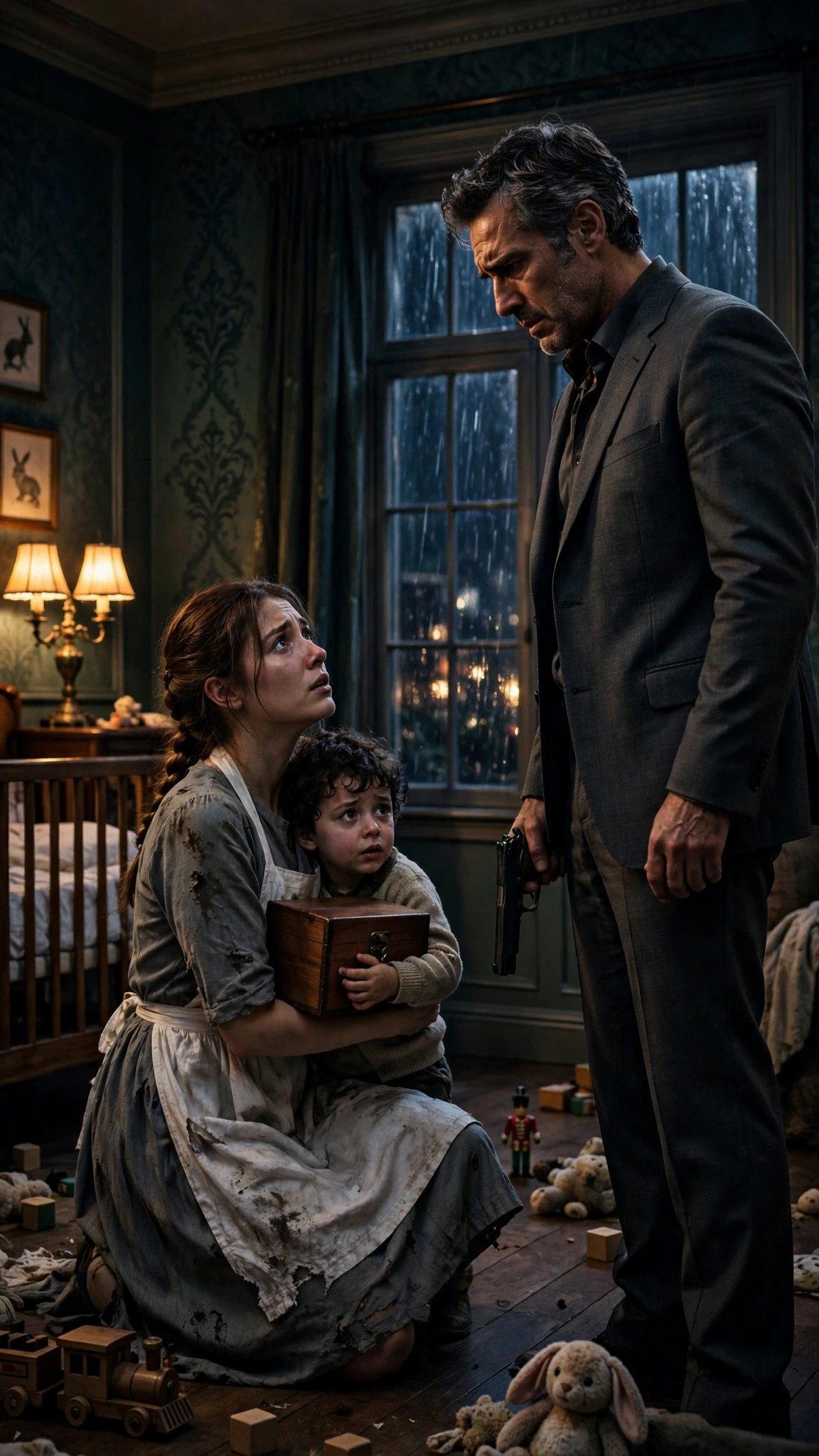
Adrian stood under the tree, in a charcoal suit, with his hair graying at the temples, and his hands — his hands that had never shaken, not once in his life — were shaking. He saw Hannah walking down the path toward him, on Livy's arm, in her white dress, with her brown hair loose, and he thought about the first time he had seen her, a year ago, in his office, a thin girl from Ohio with a suitcase and a paperback book, and he thought about the night he had pointed a gun at her, and the morning he had asked her to stay, and he thought about how a man can spend his whole life building walls, and then one day a woman walks through them like they were never there, carrying a book and a gray blanket, and reading to his son about a fox.
Hannah reached the tree. Livy kissed her cheek, and stepped back, and took her seat. Leo ran forward, holding out the oak box, and Adrian knelt down, and he opened it, and inside, beside the silver crest, were two rings — one for Hannah, and one for him. And Leo said, very loudly, so everyone could hear, "Papa! The rings! I kept them safe! I did not tell anyone!"
Everyone laughed. It was a small laugh, a gentle laugh, the kind of laugh that sounds like a window opening in a house that has been locked for years. And Adrian took the rings out of the box, and he took Hannah's hand, and he said, in a voice that was slow, and calm, and almost gentle, but this time it was the calm of a man who had finally learned how to be happy, "Hannah Collins. A year ago, you came into my house with nothing but a suitcase and a book, and you sat on the floor of my son's nursery, and you read to him, and you made him laugh, and you saved his life. Twice. You saved his life in the woods, and you saved his life in his own bedroom, and you saved my life, too, although I did not know it at the time, because you taught me that loyalty is not earned with fear. It is earned with love. And I love you. I love you for your hands, and your voice, and your courage, and your patience, and for the way you read to my son about a fox. Will you marry me? Will you be my wife? Will you be Leo's mother? Will you be the woman who makes this house a home?"
Hannah looked at him. Her eyes were full of tears. She looked at Leo, standing beside them with the oak box, and at Livy, sitting in the front row with her hands folded, and at the garden, and the lilacs, and the oak tree, and she thought about her mother, in the hospital in Ohio, who had taught her that a woman's hands were for holding children and healing the sick. And she said, in a voice that shook, and then steadied, "Yes. Yes, Adrian. I will marry you. I will be your wife. I will be Leo's mother. I will stay."
Adrian put the ring on her finger. Hannah put the ring on his. And Leo, who could not contain himself any longer, threw his arms around both of them, and shouted, "Now we are a family! Now we are a real family!"
In the first month after the wedding, Hannah learned what it meant to be Mrs. Rossi. She learned it slowly, the way she had learned everything in that house — carefully, and completely, and without fuss. On her first morning as a married woman, she woke up in Adrian's room, in a bed bigger than any bed she had ever slept in, and Leo climbed in between them with his gray blanket, and he said, "Mama Hannah, can we have pancakes? Triangles, not squares." And Hannah laughed, and Adrian laughed, and they went down to the kitchen together, all three of them, and Hannah made pancakes, and she cut them into triangles, and Leo ate three of them, and Adrian ate two, and it was the most ordinary morning in the world, and it was the happiest morning Hannah had ever known.
Leo started school in September, a small private school ten minutes from the estate, and on his first day, Hannah walked him to the gate, holding his hand, and he was wearing his new backpack and carrying his oak box in his pocket, and he turned to her at the gate and said, "Mama Hannah, will you be here when I come out?" And Hannah said, "I will be right here, Leo. I will always be right here." And she was. She stood at the gate for six hours, reading her mother's book of poems, waiting, and when Leo came out, he ran to her, and he told her everything — about his teacher, about the boy who sat next to him, about the drawing he had made of a fox — and Hannah listened to every word, the way she had always listened, carefully and completely.
One evening in October, a year to the day after Tony had taken Leo to the woods, Adrian sat with Leo in the library, and he opened the oak box, and he took out the silver crest, and he told his son, for the first time, what it meant. "This eagle," he said, "has been in our family for three generations. Your grandfather carried it. I carried it. And one day, you will carry it. But I want you to understand something, Leo. The crest does not make you a Rossi. Being a Rossi is not about the box, or the name, or the house. It is about who you protect. Your grandfather protected this family with his life. I failed to protect it, once, and a good woman died because of it. But you — you protected Hannah, with your eyes, on the night I pointed a gun at her. You told me the truth. And that is what makes you a Rossi. Not the crest. The truth." Leo listened, very seriously, and then he took the crest, and he put it back in the box, very carefully, and he said, "Papa, when I am big, I am going to protect Mama Hannah, too. Just like she protects me." And Adrian, who had not cried since his wife's funeral, felt his eyes fill with tears, and he pulled his son close, and he said, "I know you will, Leo. I know you will."
On a Sunday in November, the three of them drove to the family plot, and they stood at Rosa's grave, and Hannah laid white lilies on the stone, and Leo laid a small wooden train beside them, and Adrian stood with his arm around Hannah, and he said, very quietly, "Rosa. You told me, the week before you died, that Hannah had her mother's hands. You were right. She has her mother's hands, and her mother's heart, and she has made this house a home again. Thank you, Rosa. Thank you for seeing what I could not see. Thank you for telling me the truth, with your last breath." And Leo, in his small, clear voice, said, "Thank you, Rosa. Thank you for the whistle. I still have it." And he took the small silver whistle out of his pocket — Rosa's husband's whistle, the one she had given Hannah on the night of the woods — and he blew it, three times, soft and clear, into the autumn air. Three blasts. I found him. I am safe. I am home.
That night, after the guests had gone, after the chairs had been folded, after the lilacs had been gathered into vases and set on the kitchen table, Hannah sat in the nursery with Leo, the way she had sat a hundred times before, with Leo in her lap and his gray blanket wrapped around them both, and she read to him from her mother's book of poems. And when she finished, Leo looked up at her, and he said, "Hannah — Mama Hannah — will you sing me the song? The song my first mama used to sing?"
Hannah took a breath. She had never sung it before. She had only hummed it, very quietly, when she thought no one was listening. But now, in the nursery, with Leo in her lap, and Adrian standing in the doorway, watching them, she sang it. She sang about night wishes and morning songs, about asking God to keep the people you love safe while you sleep, about the moon coming up over a field, and the fox going home to its den, and the morning coming, always, no matter how dark the night had been.
Leo closed his eyes. He smiled. And as he drifted off to sleep, he whispered, "Mama Hannah. My first mama asks God to feed me night wishes and morning songs. And you sing them to me. So now I have two mamas. One in heaven, and one here. And that is the best thing in the whole world."
Adrian came into the room, very quietly, and he sat beside them, and he put his arm around Hannah, and he looked down at his son, asleep in her lap, with his gray blanket and his oak box beside him on the bed, and he thought about everything that had happened — the gun, the woods, the tree, the night the gatehouse fell, the blood, the trial, the prison, the change — and he thought about what his wife had tried to teach him, eight years ago, and what his son had tried to teach him, with his eyes, on the night he almost made the worst mistake of his life.
He had been a lone wolf. He had been a man who could not help but devour the wreckage of his own life. He had been a boss who pointed a gun at the only woman his son trusted. And now he was a husband, and a father, and a man who had learned that the most dangerous thing in his house had never been a maid from Ohio. The most dangerous thing in his house had been his own blindness. And the only thing that had saved him — the only thing that had saved his son — was a woman who had stayed, and read, and held, and stood between a boy and a gun, and never once stepped aside.
"Hannah," Adrian whispered, so as not to wake Leo. "Thank you. Thank you for my son. Thank you for this house. Thank you for staying."
Hannah leaned her head against his shoulder, and she smiled, and she said, "I will always stay, Adrian. That is what family does. That is what love does. It stays."
And outside the nursery window, the moon came up over the garden, and the oak tree stood dark against the sky, and the house was quiet, and it was the kind of quiet that comes after a storm, when everyone is safe, and the lights are on, and no one is waiting for another one to come.
The End.
THE END