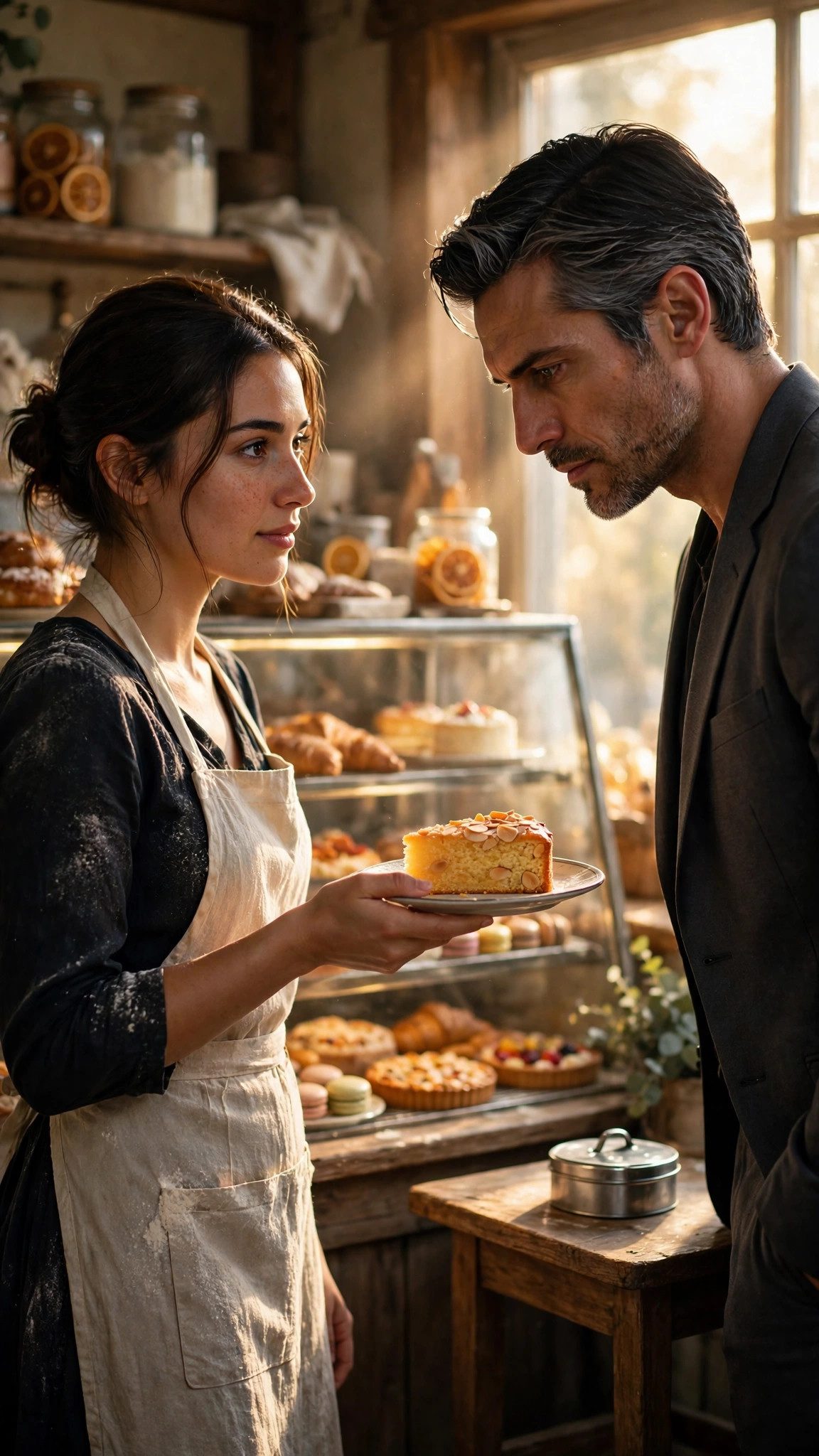
The trouble came on a Friday, three days after I went to Adrien's house, and it came in the form of a thin white envelope that Priya found slipped under the bakery door before dawn.
It was an eviction notice.
The letter said that the building had been sold. It said that the new owner was a company called Lakeshore Holdings, and that Lakeshore Holdings had decided not to renew the lease on the bakery, and that Benedetti Bakery had thirty days to vacate the premises. Thirty days. After three years. After Rosa had saved for thirty years to buy the shop, after I had kept it alive with my own two hands, after everything, I had thirty days.
I read the letter three times, and my hands were shaking so badly that Priya had to take it from me, and she read it, and she went pale, and she said, "Lucia, who is Lakeshore Holdings?"
I did not know. But I had a feeling, cold and certain in the pit of my stomach, that I knew exactly who it was.
I called my landlord, Frank Deluca, a tired old man who had owned the building for forty years and who had always been kind to Rosa and to me. He did not answer. I went to his office, and his secretary told me he was out of town, and she would not meet my eyes. I went back to the bakery, and I sat at the little table by the window, the table where Adrien sat, and I stared at the eviction notice until the words went blurry.
At ten o'clock, Adrien walked in, right when the sun hit the bakery window, and he took one look at my face, and he said, "What happened?"
I showed him the letter. He read it once, and his face went very still, the way it had gone still when Castellano was shouting, and he folded the letter very carefully, and he put it in his jacket pocket, and he said, "Wait here."
He stepped outside, and he made a phone call, and when he came back, his eyes were dark, and he said, "Lakeshore Holdings is a shell company. It belongs to Vincent Castellano. He bought the building from Frank Deluca two weeks ago, for cash, for twice what it is worth. Frank did not tell you because Castellano paid him not to. And Castellano did not buy the building because he wants the building, Lucia. He bought it because he wants the bakery. And he wants the bakery because he wants the recipe."
"The recipe?" I whispered. "Why would he want the recipe?"
"Because my father paid twenty-five thousand dollars for that recipe, and Castellano was there when he did it," Adrien said. "He was my father's associate, and he was in the room, and he heard my father say that the recipe was worth more than gold, because it was the only thing my mother, I mean my grandmother, had ever truly loved. And Castellano has spent thirty years believing that if he could own the recipe, he could own a piece of my family. He wants to open a chain of bakeries. He wants to put your grandmother's cake in a hundred shops across the country, and he wants to call it his own. And to do that, he needs you gone, and he needs the recipe card, and he needs the world to forget that Rosa Benedetti ever existed."
I felt sick. I felt like the floor was tilting under my feet. "What do I do?" I asked. "I have thirty days. I don't have money for a lawyer. I don't have anywhere else to go."
"You do not need a lawyer," Adrien said. "You have me."
And then the door banged open, and Castellano walked in, with four men behind him, and this time he was not shouting. This time he was smiling, and the gold teeth were flashing, and he was carrying a thick brown envelope, and he set it down on the counter like a man setting down a winning hand of cards.
"Good morning, Miss Benedetti," he said. "I have come to make you an offer. A very generous offer. I will buy your bakery, your ovens, your recipes, all of it, for a sum that will let you retire tomorrow and never work again. All you have to do is sign."
He opened the envelope, and he spread the papers out on the counter, and there were a great many papers, and at the bottom of the last one there was a line for my signature, and beside it, a check, already filled in, for two hundred thousand dollars.
"Two hundred thousand dollars," he said, and his voice was soft and warm, like honey. "For a little bakery on Taylor Street. For some old recipe cards. That is more than generous, wouldn't you say, Adrien?"
Adrien did not answer. He was looking at something behind Castellano, and I followed his gaze, and I saw his driver, Sal Ferraro, standing by the door, and Sal was not looking at Adrien. Sal was looking at the floor, and his hands were shaking, and I understood, in that moment, what Asher had meant when he said you can never be too careful about who you trust.
"Sal," Adrien said, very quietly. "How long?"
Sal Ferraro did not answer at first. Then he swallowed, and he said, "Three weeks, boss. He paid me fifty thousand dollars. He wanted to know when you came here. He wanted to know what time, and how long you stayed, and what you talked about. I didn't think it would hurt anyone. I thought it was only a bakery."
Adrien looked at him for a long time, and I had never seen a face so cold, and so sad, all at once. "You told him about the cake," he said. "You told him about the recipe. You told him about her."
"I needed the money," Sal whispered. "My wife is sick. The doctors—"
"Get out," Adrien said. "You are finished. You will never work for this family again. And if you ever come near this bakery, or near Lucia, I will forget that you once drove my car."
Sal went out the door, and he did not look back, and the bell rang, and the bakery was quiet, and Castellano was still smiling, and he tapped the check with one thick finger, and he said, "Well? Two hundred thousand dollars, Miss Benedetti. Sign, and this can all be over."
I looked at the check. Two hundred thousand dollars. It was more money than I had ever seen. It would pay off the ovens. It would pay off the rent. It would let me start over somewhere else, somewhere safe, somewhere Castellano could not find me. And all I had to do was sign my name, and give him the recipe, and walk away from everything my grandmother had built.
I looked at Adrien. He was watching me, and he did not say a word, and he did not tell me what to do, and I understood that this was my choice, and my choice alone, and that whatever I chose, he would respect it.
And then I thought about Rosa, standing in a kitchen in Palermo, looking at an envelope full of money, and choosing her daughter over her pride. And I thought about the tin box upstairs, and the recipe card with Caterina Moretti's name on it. And I thought about the photograph on Adrien's wall, of two women laughing in a kitchen, a long time ago.
I picked up the check, and I tore it in half. And then I tore it in half again. And I let the pieces fall on the counter, and I said, very clearly, so that everyone in the bakery could hear me, "No. The recipe is not for sale. Not for two hundred thousand dollars. Not for any amount of money in the world. My grandmother told me that a secret is the only thing nobody can take from you unless you give it away yourself. And I am not giving it away."
Castellano's smile went away, all at once, like a light going out. "You will regret this," he said, and his voice was low and ugly now, nothing like honey. "Thirty days, Miss Benedetti. Thirty days, and this bakery is mine, and you are on the street. And your friend here cannot protect you from the law. Even he cannot stop a legal eviction."
He turned to leave, and his men followed him, and the bell rang, and the bakery was quiet again, and I stood there with my hands shaking, and the torn pieces of the check on the counter, and I did not know whether I had just done the bravest thing of my life or the stupidest.
Adrien came and stood beside me, and he put his hand over mine, very gently, and he said, "You did the right thing. And Lucia, I promise you this: Castellano will not take this bakery. Not in thirty days. Not ever. I will stop him. Whatever it takes."
And for the first time since I had met him, I believed him. Not because he was the most dangerous man in Chicago. But because, when he said it, he was not talking like a mafia boss. He was talking like a man who had finally found something worth protecting.
That evening, after the bakery closed, Adrien's men came, two of them, quiet and professional, and they stood outside the bakery all night, in the dark, in the rain, watching the street. I told Adrien I did not need guards, and he told me I did not get a vote, and for once I did not argue, because the truth was that I was frightened, and knowing his men were outside made it possible for me to sleep.
But I did not sleep well. I dreamed about the eviction notice, and about the torn check, and about Castellano's gold teeth flashing in the dark, and I woke up three times, and each time I went to the window and looked down at the street, and his men were still there, standing in the rain, and I felt grateful, and I felt guilty, and I felt angry, all at once, because I had built this bakery with my own hands, and I had kept it alive for three years, and now I needed a mafia boss's gunmen to keep it safe, and that did not feel like the life Rosa had wanted for me.
The next morning, Priya came in early, before the sun was up, and she found me sitting at the little table by the window with the eviction notice spread out in front of me, and she sat down across from me, and she said, "Lucia, tell me the truth. Are you going to be all right?"
"I don't know," I said. "I have thirty days. I don't have money for a lawyer. I don't have anywhere else to go. And Castellano is right about one thing: even Adrien cannot stop a legal eviction. The law is the law."
"The law is the law," Priya said, "but the law also says a landlord cannot sell a building out from under a tenant without notice, and it says a lease cannot be broken without cause, and it says a man cannot threaten a woman in her own shop. I looked it up last night. I stayed up half the night reading about tenants' rights, Lucia, because you are my best friend, and I am not going to let that man with the gold teeth take your bakery without a fight."
I stared at her. "You looked up tenants' rights?"
"I looked up everything," she said, and she pulled a notebook out of her bag, full of pages of careful handwriting. "And I called my cousin, who is a law student, and he says Frank Deluca cannot do this, not the way he did it, and he says Castellano's company might not even exist, not legally, and he says if we can prove that, the whole sale falls apart. So we are going to fight, Lucia. You and me. And Adrien, if he wants to help. But mostly you and me."
Mrs. Delgado came in that morning with a basket of flowers, not to sell, but to give to me, and she put them on the counter, and she said, "For the window, Lucia. So that everyone who walks past can see that this bakery is loved." And old Mr. Okafor came in, and he left a fifty-dollar bill on the counter, and he said, "For the lawyer, Lucia. Do not argue with me. I have been eating your lemon pound cake for three years, and it is the only good thing left in my life, and I will not lose it to a man with gold teeth."
And then more people came. The young mothers with their children. The college students. The men from the garage down the street. They all came, and they all left something, a little money, a little food, a little note, and by noon the counter was covered in envelopes and flowers and casseroles, and Priya was crying, and I was crying, and the bakery smelled like oranges and like home, and I understood something I had never understood before: the bakery was not just mine. It belonged to the whole street. It belonged to everyone who had ever walked through that door and been fed. And Castellano could buy the building, and he could tear up the lease, and he could threaten me, but he could never buy the people who loved this place, and he could never make them stop coming.
That afternoon, two of Castellano's men came to the bakery, not to buy anything, but to measure. They walked through the shop with tape measures, and they measured the windows, and they measured the ovens, and they measured the counter, and they wrote numbers down in little notebooks, and they did not look at me, and they did not speak to me, and I stood behind the counter with my hands in fists, and I wanted to scream at them, and I wanted to throw them out, and I did neither, because Adrien had told me not to be alone with them, and not to sign anything, and not to give them any reason to say I was difficult.
When they left, Adrien's men came in, and one of them, a young man named Marco with kind eyes, said, "Miss Benedetti, Mr. Moretti says to tell you that his lawyers are working on it, and that the sale is not what it seems, and that you should not worry. And he says to tell you that he will come himself tomorrow morning, and that he has something to show you."
"What does he have to show me?" I asked.
Marco smiled, just a little. "I don't know, miss. But he has been smiling all day, and I have worked for Mr. Moretti for five years, and I have never seen him smile like that. Whatever it is, it must be good."
That night, I slept better than I had in days. Not well, but better. Because for the first time since the eviction notice had arrived, I did not feel alone. I felt the whole street standing behind me, and I felt Priya beside me, and I felt Adrien's hand over mine, and I felt Rosa, somewhere, watching over all of it, and saying, in her quiet, certain voice, "You finish what you start, Lucia. A cake you throw away teaches you nothing. A cake you finish teaches you everything." And I knew that I was going to finish this. Whatever it took, I was going to finish it.