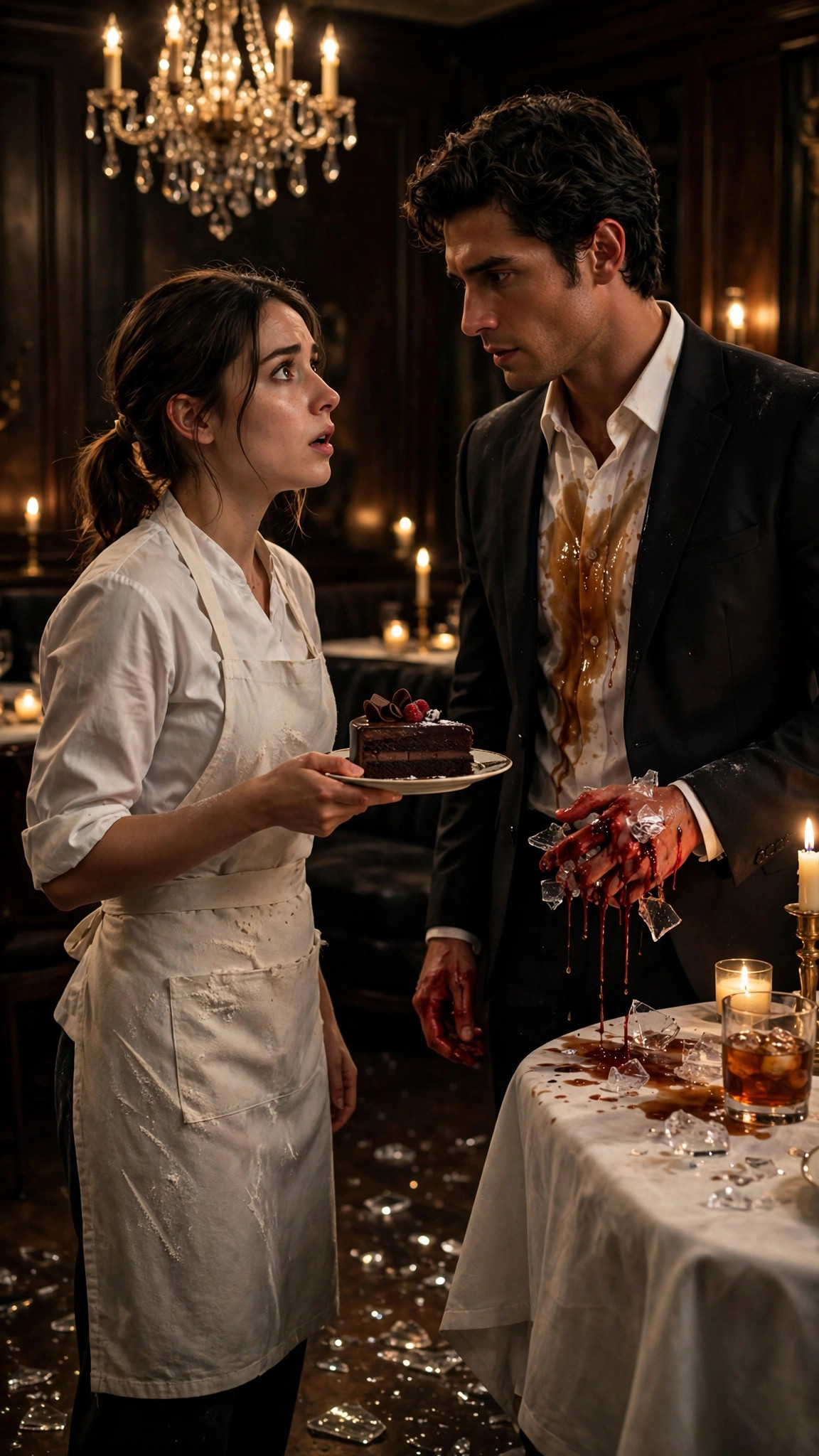
The mafia boss asked whether I had a boyfriend, and when I said, "Not yet," the crystal glass in his hand exploded.
Blood ran down his palm, bourbon stained his white shirt, and every man in the room froze. I did not move. I could not move. The broken glass glittered on the floor of the Imperial like spilled diamonds, and the most dangerous man in Chicago was looking only at me.
My name is Camila Williams. I am the head pastry chef at the Imperial, one of the most exclusive restaurants in Chicago. I was twenty-nine years old, and until that night, the biggest danger in my life had been a collapsing soufflé.
The mafia boss that night was Lorenzo Moretti. A man so dangerous, he did not need to raise his voice to make men tremble. He was there for dinner, but he was not alone. He asked for the head chef because he wanted to thank her personally for the dessert.
I had never seen him in person before that night. I had only heard stories. Stories about the Moretti family. Stories about the men who disappeared after crossing him. Stories about how he never smiled.
But that night he was smiling at me, and it terrified me more than any gun could.
"Is it true you made this yourself?" he asked, holding up a fork with a piece of my chocolate cake on it.
"Yes, sir," I answered. "I am the head pastry chef."
He looked at me for a long moment, his dark eyes studying my face like he was trying to memorize it. Then he asked, "Do you have a boyfriend?"
The question caught me completely off guard. I did not know what to say. I had never been asked such a personal question by a customer, let alone by a man like Lorenzo Moretti. But something in his eyes made me answer honestly.
"Not yet," I said quietly.
Before I could even finish my sentence, the crystal glass in his hand shattered. The sound echoed through the restaurant. Blood began to run down his palm, mixing with the bourbon that had stained his white shirt. Every man in the room froze.
Lorenzo did not even flinch. He did not look at his bleeding hand. He did not look at the broken glass on the floor. He looked only at me, his dark eyes burning with an intensity that made my heart race.
"Not yet?" he repeated, his voice low and dangerous.
"Yes, sir," I whispered, my voice shaking. "Not yet."
Lorenzo slowly stood up from his chair. He was tall, easily over six feet, and his presence filled the entire room. He took a step toward me, then another. Every man in the room held his breath.
"Then you will be mine," he said, his voice cold and commanding. "From this moment on, you belong to me."
My heart stopped. I did not know what to say. I did not know what to do. I had heard stories about Lorenzo Moretti, but I had never imagined I would become one of them.
That was how it began. But to understand how a pastry chef ended up claimed by a mafia boss in front of a room full of his men, you have to go back to the morning of that same day, when the only thing I was worried about was chocolate.
I woke at four in the morning, the way I always did. My apartment in Pilsen was small and quiet, and the first thing I did every day was put on the kettle and look at the photograph on my kitchen wall. My grandmother Rosa, standing in front of her little bakery on 18th Street, her hands covered in flour, smiling like the world had never hurt her. She had raised me after my mother died, and she had taught me everything I knew about baking before she died two years ago, leaving me her recipe notebook and a debt I refused to let anyone else pay.
By five, I was at the Imperial. The kitchen was mine before anyone else arrived. I liked it that way. The ovens warming, the smell of butter and dark chocolate filling the air, the city still dark outside the high windows. I tied my dark brown hair back, pulled on my white chef's blouse, and started the day the way Rosa had taught me: with the cake.
The Midnight Chocolate Cake. Three layers of dark chocolate sponge, brushed with bourbon syrup, filled with espresso ganache, finished with a pinch of flaky sea salt on top. It was the most ordered dessert at the Imperial, and it was mine. I had built it from Rosa's old notebook, from a recipe she had never written down in full, from a taste I remembered from childhood, when she would let me lick the spoon and tell me, "Camila, a cake is a promise. You make it the same way every time, or you do not make it at all."
I worked in silence for two hours. My sous-chef, Priya, arrived at seven with coffee and gossip. My line cooks drifted in. The kitchen woke up around me, loud and warm and familiar. I checked the reservations for the night and saw the name at the top of the list, written in Marcus Hale's careful handwriting: Moretti, party of eight, private dining room, 8 p.m.
"Is that who I think it is?" Priya asked, peering over my shoulder.
"If you think it is Lorenzo Moretti, yes," I said.
Priya let out a low whistle. "The whole family is coming? He never eats out. My cousin works at a hotel downtown and she says he has his food brought in by his own men."
"Then he must really want dinner," I said, and went back to my cake.
I had heard the stories, the same as everyone else in Chicago. Lorenzo Moretti was thirty-eight years old and had run the Moretti family since his father died. He was tall, dark-eyed, and famously cold. People said he had not smiled in seven years, not since his younger brother Enzo was killed in an ambush that had been meant for him. People said that when Lorenzo Moretti walked into a room, powerful men found reasons to leave it.
I did not care about any of that. I cared about my ovens, my chocolate, and the fact that my sister Sofia's culinary school tuition was due at the end of the month. Sofia was nineteen, bright and stubborn, and she was going to be a better chef than me one day. I had promised our grandmother I would make sure of it, and I kept my promises.
The day went on the way days at the Imperial always went on. Lunch service, a wedding cake consultation, a fight with the delivery man about the cream, a burned batch of madeleines that I threw away rather than serve. At six, I changed into a fresh blouse, wiped the flour from my hands, and went to check the private dining room.
It was beautiful, the way it always was. Dark wood, soft light, a long table set with crystal and white linen. Eight places. I watched from the kitchen door as they arrived, one by one, men in black suits with the careful, watchful walk of men who were always armed. And then him.
Lorenzo Moretti was taller than I had expected, and quieter. He did not stride in. He simply entered, and the room rearranged itself around him. His dark wavy hair was brushed back. His suit was black, his shirt white, his tie gone. He looked at the room once, the way a man checks a room for exits, and then he sat at the head of the table.
Dinner went on for two hours. I sent out course after course and heard nothing back, which was normal. The Imperial's guests did not send compliments to the kitchen. They simply came back, night after night, and paid.
Then, just after ten, the general manager, Anthony Russo, came into my kitchen with a look on his face I had never seen before. Anthony was thirty-four, smooth, always smiling, always a little too interested in what everyone else was doing. That night he was not smiling.
"Camila," he said. "Mr. Moretti wants to thank the head chef personally for the dessert. He asked for you. In the dining room. Now."
My hands were covered in chocolate. I wiped them on my apron, took the apron off, and smoothed my blouse. "The cake," I said. "He liked the cake?"
"He ate two slices," Anthony said. "He never eats dessert. Go."
I walked into the private dining room with my heart beating too fast, and every man at the table turned to look at me. Lorenzo Moretti was at the head of the table with a glass of bourbon in his hand and a plate in front of him with nothing left on it but crumbs and a smear of ganache. And he was smiling.
It was a small smile, almost uncertain, like a man remembering how to do it. It changed his whole face. For one second, he did not look dangerous at all. He looked like a man who had just tasted something that reminded him of home.
"Is it true you made this yourself?" he asked, holding up a fork with a piece of my chocolate cake on it.
"Yes, sir," I answered. "I am the head pastry chef."
He studied me for a long moment. His dark eyes moved over my face slowly, carefully, like he was trying to memorize it. "Do you have a boyfriend?"
The room went silent. One of his men shifted in his chair. Anthony, standing by the door, went pale.
I should have lied. I should have said yes, or said it was none of his business, or said nothing at all. But something in his eyes made me answer honestly.
"Not yet," I said quietly.
The glass in his hand exploded. The sound was sharp and terrible in the quiet room. Blood ran down his palm, mixing with the bourbon that stained his white shirt. Every man in the room froze.
Lorenzo did not flinch. He did not look at his hand. He looked only at me.
"Not yet?" he repeated, his voice low and dangerous.
"Yes, sir," I whispered.
He stood up slowly, and the room seemed to shrink around him. He took a step toward me, then another, and I could smell the bourbon and the blood and the clean, dark scent of his suit. His hand was still bleeding. He did not seem to notice.
"Then you will be mine," he said. "From this moment on, you belong to me."
Behind him, one of his men, an older man with silver in his hair, closed his eyes briefly, like a man watching something he could not stop. Another man, younger, stared at the floor. Anthony made a small sound in his throat.
I looked up at Lorenzo Moretti, at his dark eyes and his bleeding hand and the bourbon stain spreading across his white shirt, and I understood something in that moment that I would spend the next weeks learning to live with. He was not asking. He was not flirting. In his world, a claim made in front of witnesses was a law, and he had just made one.
"I don't belong to anyone," I said. My voice shook, but I said it.
Something flickered in his eyes. Surprise, maybe. Or respect. He reached out with his uninjured hand, slowly, giving me time to pull away, and when I did not, he touched my cheek with the back of one finger, very lightly, like a man touching something he was afraid to break.
"You do now," he said quietly. "And Camila, I need you to understand something. I am not a patient man. But I have waited seven years to feel anything at all. I am not going to wait for someone else to take what I have only just found."
He turned then, and walked out of the dining room, his men rising and following him in silence. The older man with the silver hair paused beside me on his way out.
"Go home tonight, Miss Williams," he said, not unkindly. "Lock your door. Do not be afraid. But do not go anywhere alone for a while. And whatever you do, do not answer the door for anyone you do not know."
"Who are you?" I whispered.
"Marco Benedetti," he said. "I have worked for the Moretti family for thirty years. I am telling you this because I liked your cake too, and because I have not seen him smile in seven years, and I do not want to see what happens if someone takes the reason away."
Then he was gone, and I was standing alone in the private dining room with broken glass on the floor, blood on the white linen, and the taste of my own chocolate cake still in the air.
Anthony came in with a dustpan, his hands shaking. "Camila," he said, "do you know what you have just done?"
"I didn't do anything," I said. "I answered a question."
"You said 'not yet,'" he said. "Do you know how many women in this city would give anything to hear Lorenzo Moretti say what he just said to you?"
"I don't want to hear it," I said.
Anthony looked at me for a long moment, and for the first time since I had known him, his smooth face showed something real underneath. It looked a lot like fear.
"Then you had better learn to live with it," he said quietly. "Because in his world, Camila, what he said tonight is done. It cannot be unsaid. Not by you, not by me, and not by anyone in this city."
I went home that night in a cab, and I locked my door twice, and I sat at my kitchen table until dawn with Rosa's photograph on the wall above me and her recipe notebook open in front of me, and I tried to understand what had just happened to my life.
I had made a cake. A man had tasted it and smiled. And now he said I belonged to him.
I did not know then that the cake was only the beginning. I did not know that another man had been sitting at the bar that night, watching me through the glass, or that the owner of the Imperial owed that man four hundred thousand dollars. I did not know that my name was already written down in a ledger in another part of the city, or that Lorenzo Moretti's claim had not been a whim, but a warning, and that it had been aimed at someone else in the room entirely.
I only knew that my hands were still shaking, and that somewhere across the city, a man with blood on his palm and bourbon on his shirt was thinking about me.
And that terrified me more than any gun could.