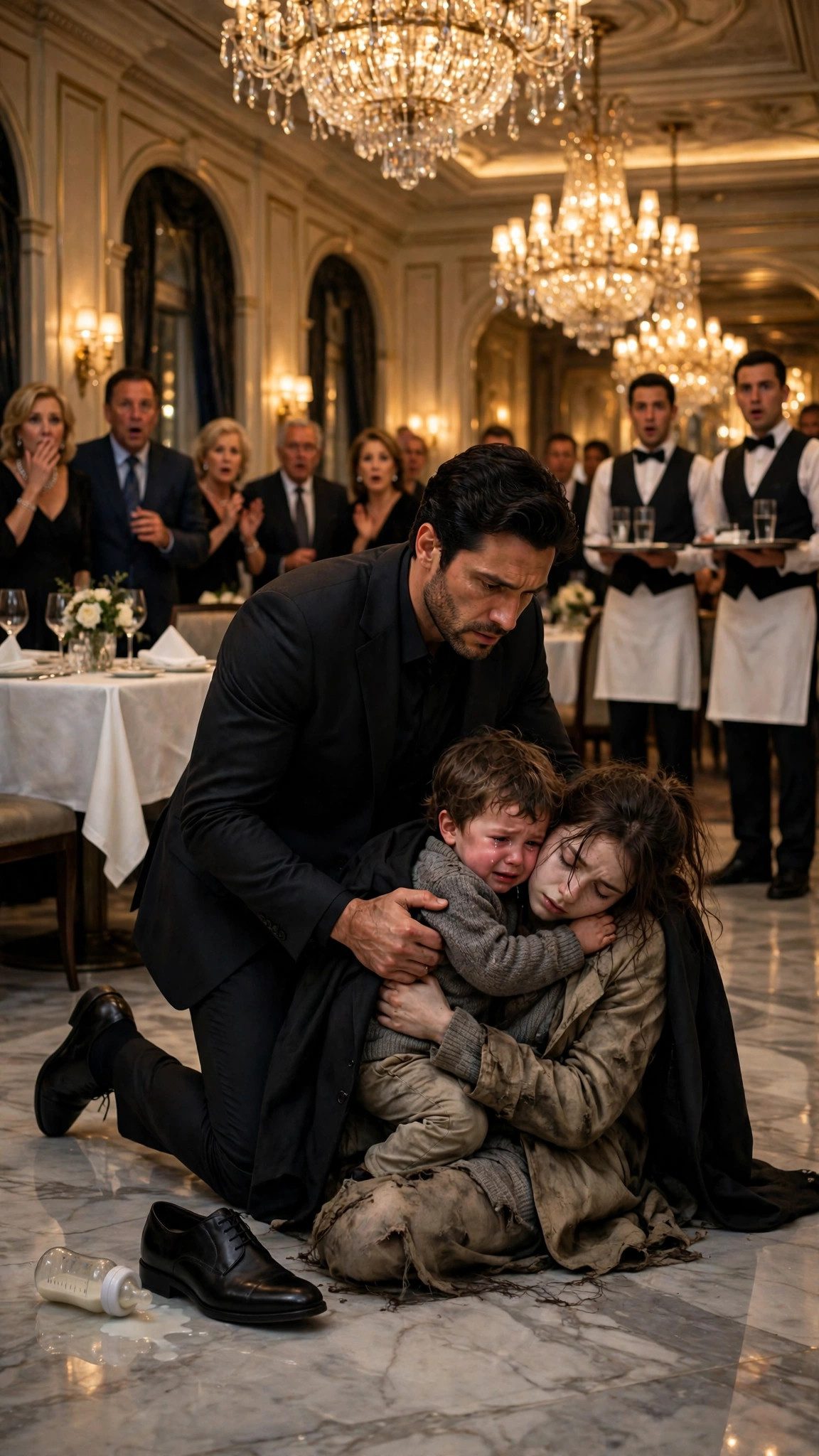
Ethan Hayes had been nineteen years old when his mother died, and he remembered the last thing she said to him as clearly as if she had said it that morning.
She had been a waitress at the Marlowe Room for twenty-three years. Rosa Hayes had carried trays across that same marble floor when she was young and beautiful and newly arrived from Palermo, and she had stayed when she got older and slower, because Mr. Marlowe had never once asked her to leave, and because the restaurant was the only place in Chicago where she had ever felt like she belonged. Ethan had grown up in the kitchen of the Marlowe Room, doing his homework at the pastry station while the chefs shouted in Italian, stealing warm bread rolls when old Benito wasn't looking, falling asleep under the coat rack in the staff room on the nights his mother worked late.
Rosa had gotten sick when Ethan was seventeen. Cancer, the kind that starts quietly and then takes everything all at once. She had kept working for as long as she could, because that was who she was, and then one day she couldn't carry a tray anymore, and Mr. Marlowe had come to their apartment himself, a white-haired old man in a suit that cost more than their rent, and he had sat in their kitchen and told Rosa that her job would be waiting for her whenever she was ready, and that the restaurant would take care of her family. He had meant it. He had paid her medical bills for six months, out of his own pocket, until the day she died in County General with Ethan holding her hand.
"Don't become your father," she had whispered to him, her voice so thin he had to lean close to hear it. "Your father had a good heart once. The streets took it from him. Don't let them take yours."
Ethan had promised. He had promised, and then he had buried his mother, and then he had gone to work for his father, because there was nothing else for a nineteen-year-old boy with no college and no trade and a dead mother and a father who ran the docks. Frank Hayes had been a hard man, a feared man, a man who had built the Hayes family from nothing into the most powerful organization on the South Side, and he had raised his son the way he had been raised: with a belt and a lesson and no room for softness. Ethan had learned fast. He had learned to count money and to read men and to never show fear and to never, ever show mercy where mercy could be mistaken for weakness.
When Frank was killed five years later, shot in his own car outside a warehouse on the docks, Ethan was twenty-four years old, and the family looked at him and saw a boy, and the rival families looked at him and saw an opening. They were wrong on both counts. Ethan Hayes buried his father on a Tuesday and by Friday he had settled every debt, answered every challenge, and made it clear to the entire city of Chicago that the Hayes family was not going anywhere. He did it without raising his voice. He did it without making a single threat he did not intend to keep. And within a year, the men who had doubted him called him boss, and the men who had tested him were gone, and the name Ethan Hayes became the name that made grown men lower their voices when they said it.
The first test came in his second week. A crew chief on the docks, a man named Big Tony who had worked for Frank Hayes for twenty years and thought he knew more about the business than the boss's boy, shorted a shipment and pocketed the difference, and then stood in front of Ethan in the warehouse office and told him, to his face, that the boy didn't have what it took to run his father's family. Ethan had listened to the whole speech without interrupting, and then he had opened the ledger on the desk, and he had shown Big Tony the numbers, line by line, and he had told him exactly how much he had stolen, and exactly where it had gone, and exactly what would happen if it ever happened again. Big Tony had left the warehouse that day with his job and his life, and he had never stolen another dollar, and he had told every man on the docks that the boy was not a boy at all, that the boy was his father's son, and that the family was in good hands. That was how Ethan Hayes built his reputation: not with shouting, not with cruelty, but with the cold, unshakable certainty of a man who always knew the numbers and always kept his word.
He kept his mother's promise the only way he knew how. He never forgot what she had said. But the streets took their price anyway, year by year, deal by deal, until the boy who had done his homework at the pastry station was a man who could order a dining room emptied with a raised hand and not feel a thing about it. He told himself it was strength. He told himself his mother would have understood. He told himself that the man who ran the Hayes family could not afford to have a heart, because a heart was a door, and doors could be kicked in.
And then, three months ago, he had bought the Marlowe Room.
He had not planned it. He had been driving down Michigan Avenue one night, coming back from a meeting at the docks, and he had seen the restaurant's sign, the same gold letters he had stared at as a boy, and something in his chest had tightened, the way a fist tightens. He had pulled over. He had sat in his car for a long time, looking at the windows, remembering his mother in her black uniform with the white apron, remembering the smell of the kitchen, remembering the way Mr. Marlowe used to slip him a coin for the vending machine when he thought no one was looking. And the next morning he had called his lawyer and told him to find out who owned the Marlowe Room and what it would take to buy it.
Fifty million dollars. Cash. The holding company had laughed until they realized he was serious, and then they had taken the money so fast it made his lawyer smile. Ethan had not cared about the price. He had cared about the restaurant. He had cared about the fact that the place where his mother had spent twenty-three years of her life, the place that had fed her family and kept her dignity intact, was now his, and that nobody would ever again be able to tell a waitress in that dining room that the door was right there.
That was the theory, anyway. The practice was messier. Ethan knew nothing about running a restaurant, and he knew it, so he had kept the existing staff and the existing manager, a man named Derek Voss, and told him to keep the place running exactly as it was. He came to the restaurant two or three nights a week, sat at the corner table, ate whatever the chef sent out, and watched. He watched the waiters. He watched the guests. He watched the money. And what he watched, more and more, was the way the staff moved around Voss, the way they went quiet when he walked into the kitchen, the way their eyes dropped to the floor.
His right-hand man, Marco Bellini, had noticed it too. Marco was forty-four years old, built like a doorway, and he had been with Ethan since they were both boys on the docks. He was the only man in the world who could tell Ethan Hayes something he did not want to hear, and on a Thursday night in early November, sitting in the back of the Lamborghini after dinner, he finally said it.
"Boss," Marco said, "the books at that restaurant don't add up."
Ethan did not look at him. "Explain."
"The food costs are right. The liquor costs are right. The revenue is right. But the labor costs are too low for the number of people working there, and the tip pool payouts don't match the card receipts. Somebody's skimming, boss. Somebody's been skimming for a long time."
"Voss."
"Voss is the only one who touches the money between the register and the staff," Marco said. "And there's something else. Three of the waitresses who quit in the last six months were girls who'd been there for years. Good girls. Loyal girls. You don't lose good people like that unless somebody's pushing them out."
Ethan was silent for a long time. He thought about his mother, carrying trays across that marble floor, and about Mr. Marlowe paying her medical bills out of his own pocket, and about the promise he had made to a dying woman in a hospital bed. He thought about the fact that he had bought the Marlowe Room to protect the people in it, and that the people in it were being robbed under his own roof, in his own restaurant, by a man he had trusted to run it.
"Get me the real numbers," he said at last. "Every receipt, every payout, every name. I want to know exactly how much he took and exactly who he took it from. And Marco — don't tell Voss. Don't tell anyone. I want to look that man in the eye when I ask him about it."
Marco nodded. "And if the numbers are bad?"
"Then I'll deal with him the way I deal with thieves," Ethan said, and his voice was so cold that Marco, who had known him for twenty years and feared almost nothing, felt the hairs rise on the back of his neck.
Ethan had not told Marco the whole truth about why he had bought the restaurant, and he had not told anyone, because there were some things a man like Ethan Hayes did not say out loud. The truth was that the night he signed the papers, he had gone to the Marlowe Room alone, after closing, and asked the night manager to let him walk through the dining room by himself. He had stood in the middle of that empty room, under the chandeliers, with the chairs stacked on the tables and the marble floor gleaming in the dark, and he had tried to remember what it felt like to be nine years old, doing his homework at the pastry station while his mother worked.
He remembered the smell of the kitchen best. Butter and sugar and yeast, and the sharp green smell of the herbs old Benito kept in pots by the window. Benito had been the chef then, a young man in those days, with black hair and a loud laugh, and he used to slip Ethan warm bread rolls when Rosa wasn't looking, and tell him, in his thick Italian accent, "Eat, piccolo. A growing boy needs bread." Ethan remembered the night his mother had brought him to the restaurant for his birthday, and Mr. Marlowe himself had come to their table and given him a slice of chocolate cake with a candle in it, and told him to make a wish. He had wished, with all the fierce seriousness of a nine-year-old, that his mother would never get sick. The wish had not come true. But he had never forgotten the kindness of it.
On that first night as owner, Ethan had walked into the kitchen, and old Benito was still there, seventy years old now, his hair white, his hands shaking a little, but his eyes still sharp. Benito had looked at him for a long moment, and then he had said, "You are Rosa's boy."
"Yes," Ethan had said.
"Your mother was the best waitress this restaurant ever had," Benito said. "She carried trays until the day she couldn't stand up anymore, and she never once complained, and she never once dropped a plate. Mr. Marlowe loved her like a sister. And when she got sick, he paid her bills, and he came to her funeral, and he cried. I saw him cry. A man like Mr. Marlowe, crying in a church. You remember that, piccolo. You remember what kind of man that was."
"I remember," Ethan had said.
"Good," Benito said. "Then you remember that this restaurant was built by a man who took care of his people. And if you are going to own it, you had better be that kind of man too. Otherwise, you are just another rich man with a building, and this city has enough of those already."
Ethan had stood in that kitchen, listening to an old chef tell the most feared man in Chicago how to run his restaurant, and he had not been angry. He had been grateful, because nobody had spoken to him like that in years, not since his mother died. Everyone else in his life was afraid of him, or wanted something from him, or both. Benito wanted nothing except for the restaurant to be what it had been when Rosa Hayes carried trays across its floor.
"I'll try," Ethan had said, and Benito had nodded, and gone back to his work, and Ethan had walked out into the dining room and sat down at the corner table, the same table he would sit at for the next three months, and he had looked around at the empty chairs and the dark windows, and he had thought, for the first time in years, that maybe his mother had been right. Maybe a man's heart was not something the streets could take from him. Maybe it was something he had given away himself, piece by piece, and maybe — just maybe — it was something he could take back.
That was Thursday. On Friday night, Ethan Hayes drove to the Marlowe Room for dinner, the way he always did, his Lamborghini pulling up to the curb, his bodyguards fanning out around him. He walked through the doors in his black suit and his brand-new Oxford shoes, and the waiters froze, and the billionaires fell silent, and he took his usual seat at the corner table, and he did not know that within the hour, a starving woman and her little boy would walk through those same doors, and that everything he thought he knew about himself would change before the night was over.
He did not know it. But somewhere in the back of his mind, in the part of him that still remembered doing his homework at the pastry station, he had the strangest feeling, as if his mother were standing somewhere just behind him, watching, waiting to see what her son would do.