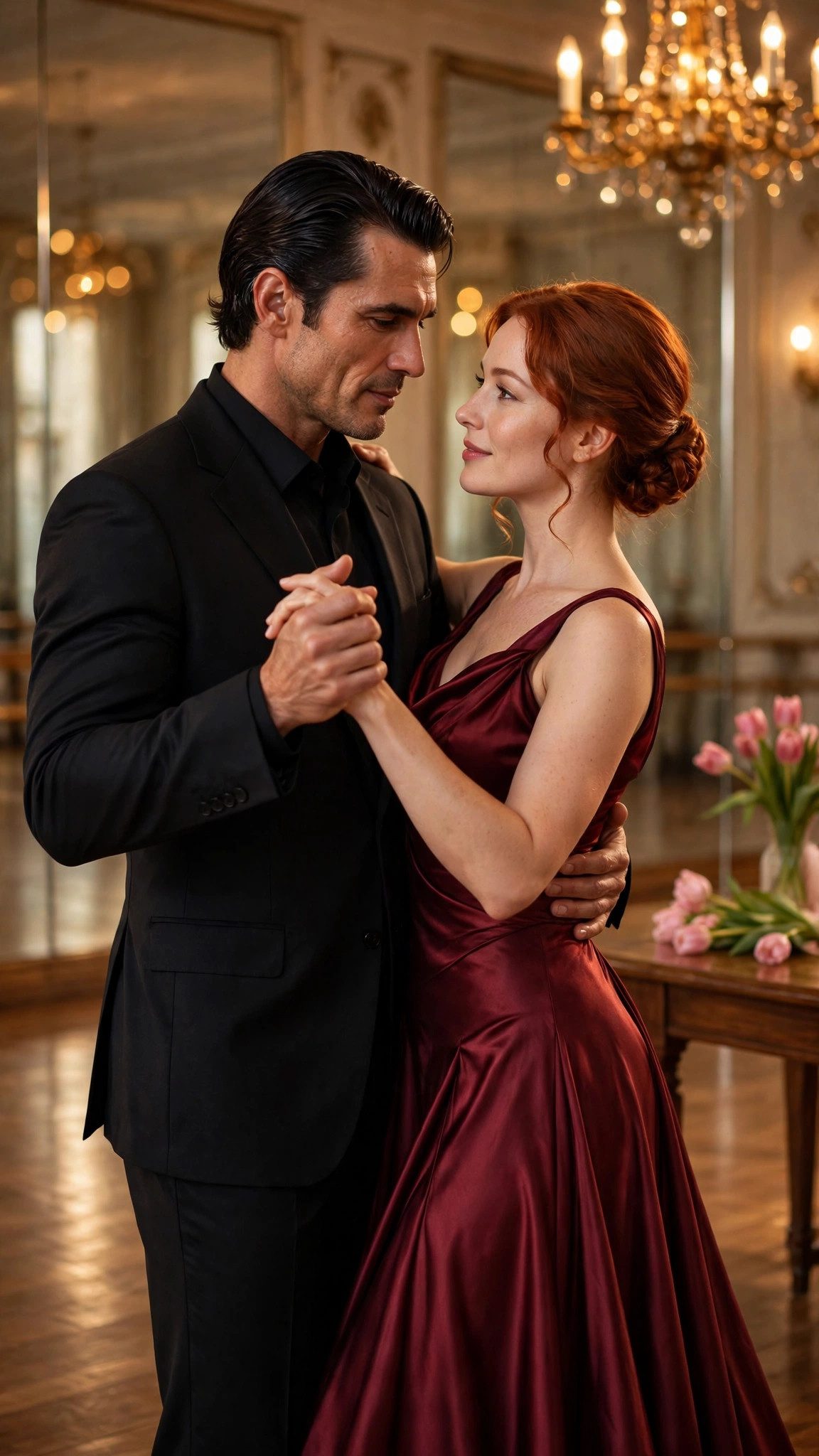
The next afternoon, Gabriel Moretti arrived fifteen minutes early.
Alone.
I was on my knees in the middle of the studio floor, polishing a scuff mark near the mirror, when the door opened and his shadow fell across the wood. I looked up, and there he was — no grandmother, no pink purse, no audience. Just Gabriel Moretti in a charcoal suit, standing in my doorway with his hands in his pockets, looking at the empty floor the way a man looks at a room he is not sure he is allowed to enter.
"Mrs. Moretti is not with you," I said. It was not a question. It was an observation, and I tried to keep my voice steady, because the truth was that my heart had started beating very fast indeed.
"My grandmother had a hair appointment," he said. "She sent me. She said —" He stopped. His jaw worked. "She said I should not waste your time by being late."
I stood up slowly, wiping my hands on my apron. "You're early," I said.
"Fifteen minutes," he said, as if confessing to a crime.
I almost smiled. I did not. I was not sure it was safe to smile at Gabriel Moretti yet. Instead I walked to the sound system and put on a slow waltz, the same one we had used the day before, and I turned to face him across the polished floor.
"Shall we begin?" I asked.
He took off his jacket — carefully, folding it over the back of a chair the way a man does when the jacket costs more than my monthly rent — and he rolled his shirtsleeves up to his elbows, and he stepped onto the floor.
He danced differently this time. Yesterday he had moved like a man being led to an execution. Today he was truly trying. His frame was still too stiff, his steps still too large, and he still counted under his breath — one-two-three, one-two-three — but there was something new in the way he held himself. Attention. He was paying attention. To the music. To my hands. To the space between us, which he was learning, one step at a time, not to fill with force.
"You're not as terrible as my grandmother thinks," I joked, when he managed three full turns without stepping on my feet.
He almost smiled. It was the strangest expression I had ever seen on a man's face — a smile that started somewhere deep and got caught halfway up, as if it had forgotten the way. It made me wonder who Gabriel Moretti might have been if his father hadn't died in prison, if his world hadn't been built on fear, if someone had once taught him that a man's hands could hold something gently and not lose anything by it.
"My grandmother thinks I am terrible at everything that matters," he said. His voice was low and careful, the way a man speaks when he is saying something he has never said out loud before. "She may be right."
"She thinks you need dance lessons," I said.
"She thinks I need a great many things," he said. "Dance lessons are the only ones she can buy me in cash from a pink purse."
I laughed then. I could not help it. He looked startled — and then, to my amazement, he laughed too. It was a short, rough sound, like a man clearing his throat, but it was real, and for a moment the most feared man in Chicago stood in my studio laughing at his grandmother's pink purse, and the afternoon sun came through the windows and turned the mirrors gold.
"Tell me about her," I said, when the music ended and we stood facing each other in the middle of the floor. "Your grandmother. Rosa."
He went still. "She told you her name."
"She told me she has been watching my classes through the window for a month," I said. "She told me her grandson needs kind people. She did not tell me you were —" I stopped. I did not say the word. I did not need to. "She told me she wants to waltz at her eightieth birthday party."
"She will be eighty in seven weeks," he said. "The party is at the house in Lake Forest. Half of Chicago will be there. The other half will be watching from the street."
"And you will waltz with her," I said.
"I will waltz with her," he agreed, and the way he said it sounded like a vow. "It is the one thing she has asked me for in ten years. She has never asked me for anything else. Not money. Not protection. Not favors. Just this." He looked down at his hands. "I do not know how to give it to her."
"That is what the lessons are for," I said gently.
He was quiet for a long moment. The waltz had ended, and the studio was silent except for the hum of the old refrigerator in the back room and the distant sound of traffic on Halsted.
"My father died in prison when I was nineteen," he said at last. His voice was flat, the way a man speaks when he has rehearsed the facts so many times that the feelings have worn off them. "He never taught me to dance. He taught me how to count money and how to count enemies and how to make men afraid of me. He taught me how to control a room. He never taught me how to be in one."
"People in your world think you are cold," I said, before I could stop myself. "Because of your father."
"People in my world think a great many things," he said. "No one dares to say them out loud."
"I am saying it out loud," I said.
"Yes," he said, and there was something almost like respect in his eyes. "You are."
We danced for another hour. He did not step on my feet once in the last twenty minutes, and when the lesson ended he stood in the middle of the floor looking faintly stunned, the way a man looks when he has just discovered that he can do something he believed he could not do.
"Thursday," he said, as he put his jacket back on.
"Thursday," I agreed.
He was at the door when he stopped and turned back. "Miss Donovan," he said.
"Yes?"
"My grandmother was right," he said. "About the lessons. And about you." Then he left, and the door closed behind him, and I stood alone in my studio with the mirrors and the tulips and the fading afternoon light, and I thought about the man who had just walked out — a man who controlled warehouses and nightclubs and half the criminal operations in Chicago, a man who had just spent an hour learning to count one-two-three like a schoolboy — and I thought about his grandmother, small and bright-eyed, who had watched my classes through the window for a month and had known exactly what her grandson needed.
It was not dance lessons. It was learning how to be kind, and how to connect with people. She had known that all along.
The lessons went on. Thursday became Tuesday and Thursday, and then Monday, Wednesday, and Friday too, because Gabriel Moretti, who had once told me he attended meetings and not dances, began arriving fifteen minutes early to every lesson, alone, and staying late to practice the box step by himself in the corner while I wiped down the barre and pretended not to watch.
He began to reveal a little more of himself with each lesson, the way a man reveals himself when he thinks no one is looking. He told me his family operated the shipping business his grandfather had started with two trucks and a warehouse on the South Side. He told me his mother had died when he was twelve, and that Rosa had raised him after that, in a small house with a garden full of roses, and that she had tried — God, she had tried — to teach him the waltz when he was a boy, in the kitchen, while the radio played. He had refused. He had been too proud, too angry, too much his father's son even then.
"I remember the kitchen," he said one afternoon, standing by the mirror with his hand on my waist, counting under his breath. "The radio. Her hand on my shoulder. She said, 'Gabriel, a man who can waltz can talk to anyone.' I told her I did not need to talk to anyone. I was fourteen. I thought I knew everything."
"What do you think now?" I asked.
"I think," he said slowly, "that I was wrong about a great many things."
One afternoon we finished our lesson by walking past the rest of the building while another student arranged floral tulips on a nearby table — Jenna, from the flower shop, had brought over a fresh bunch for the studio, and the whole room smelled like spring. When I looked up, I saw his dark eyes were already deep in thought, fixed on me in a way that made my breath catch.
"Why are you looking at me like that?" I asked.
He was quiet for a moment. The tulips glowed in the late light. The mirrors held our reflections, two people standing very close together in an empty studio.
Then he finally said something I never expected to hear from a mafia boss.
"Because if you keep looking at me like that," he said, very quietly, "we can never hang out again."
I broke his gaze and turned my head, my face burning. I did not know what he meant. I did not know whether he meant it as a warning or a confession. I only knew that my heart was beating so hard I was certain he could hear it, and that for the first time in my life, I understood what it meant to want something I had no business wanting.
Two days later, Gabriel arrived at my studio with large bouquets of tulips.
It was already dark outside, and my building had been closed for hours. I was alone, locking up, when I heard the knock — three soft raps on the glass door — and I looked up and saw him standing there in the dark with his arms full of flowers, looking like a man who had rehearsed this moment a hundred times and still did not know what to say.
"I hope you're not taking a break," he said, when I opened the door.
"I'm locking up," I said.
"I know," he said. "I waited until the students left. I did not want an audience."
He held out the tulips. There were so many of them that I had to take them with both arms, and they smelled like rain and spring and something I could not name, and I stood there in the doorway of my own studio holding an armful of flowers from the most feared man in Chicago, and I did not know whether to laugh or cry.
"Thank you," I said.
He nodded. He looked at me for a long moment, and then he said, very quietly, "Good night, Claire."
It was the first time he had used my first name.
That night, I put the tulips in water on the table by the mirror, and I stood in my empty studio for a long time, looking at them, and thinking about the man who had brought them. I thought about his hands, learning to hold a person instead of controlling one. I thought about his grandmother, who had seen all of this coming from a month away, through a window, with a pink purse on her lap. And I wondered — I wonder if this, that we could actually do something, something serious, has passed through his mind too.
I did not know then that within days, word would spread through our neighborhood that something terrible had happened to his grandmother, and that tall men in black cars would appear outside my studio, and that everything I had built would be threatened by a man I had never met.
I did not know any of that yet.
All I knew was that Gabriel Moretti had brought me tulips in the dark, and that he had called me Claire, and that the most dangerous man in Chicago was learning, one lesson at a time, how to be gentle.
At the fourth lesson, Gabriel asked me a question of his own.
We were resting between songs — he was drinking water from the bottle he had started bringing, and I was wiping down the barre — when he said, quite suddenly, "Why did you open this place?"
I looked at him. No student had ever asked me that before. Students ask about steps and timing and whether they will embarrass themselves at their weddings. They do not ask why a woman opens a dance studio on the west side of Chicago and spends eight years teaching strangers to count one-two-three.
"My grandmother taught me to dance," I said, after a moment. "Not in a studio. In a church hall, on Saturday mornings, with a record player that skipped and a floor that sloped a little to the left. She was not a professional. She was a seamstress. But she believed that every person deserves one hour a week when someone holds them properly and the world goes quiet. When she died, I promised myself I would give people that hour. So I saved for five years, and I found this building, and I opened the studio."
Gabriel was quiet for a while. He looked at the mirrors, at the tulips, at the polished floor, as if he were seeing the room for the first time.
"My grandmother taught me in a kitchen," he said at last. "With a radio. She said a man who can waltz can talk to anyone. I told her I did not need to talk to anyone." He shook his head slowly. "I was fourteen. My father had just gone to prison. I thought softness was something you could not afford. I thought if I let anyone hold me, even for three minutes, I would lose something I could never get back."
"And now?" I asked.
"Now," he said, "I think I was wrong about that too."
We danced for another hour after that, and he did not count under his breath once. He simply moved — one-two-three, one-two-three — looking at me the whole time, as if I were the only steady thing in the room. And when the lesson ended, he stayed to help me stack the chairs, without being asked, and he carried the old sound system speaker back to the storage room, and he asked me what time I locked up, and whether the back door locked properly, and whether the alley light worked.
It was the first time anyone had ever asked me whether my studio was safe. I did not know then that within weeks, that question would matter more than either of us could have imagined.