Castellano struck on a Tuesday night, a week after Gabriel bought the building.
I was upstairs in my apartment, grading nothing, sleeping badly, listening to the wind rattle the windows, when I heard it: glass breaking below me, and then shouting, and then the sharp, acrid smell of gasoline seeping up through the floorboards.
I ran downstairs in my bare feet, my heart hammering against my ribs, and I found my studio full of smoke. Two men in dark jackets were at the back door with a can of gasoline, and a third was smashing the mirror with a crowbar, and the tulips on the table were scattered across the floor in a drift of pink petals.
I screamed. I do not remember what I screamed. I think it was his name.
"Gabriel!"
And then the front door burst open, and Sal came through it like a wall falling down, and behind him came three more of Gabriel's men, and the men with the gasoline can did not get a second chance to use it. It was over in less than a minute — no gunfire, no shouting, just the fast, brutal efficiency of men who knew exactly what they were doing — and then the intruders were on the floor, zip-tied, coughing in the smoke, and Sal was on his phone, and someone had opened the windows, and someone else was already mopping up the gasoline with towels from the back room.
Gabriel arrived four minutes later. He came through the door at a run, his suit jacket half off, his tie loose, his face white under the streetlights. He took one look at me — barefoot, in my nightdress, standing in the middle of my smoke-filled studio with a broom in my hands — and he crossed the floor in three strides and pulled me into his arms.
"Are you hurt?" he demanded. "Claire. Are you hurt?"
"No," I said, and my voice shook. "No, I'm all right. The mirror —"
"The mirror can be replaced," he said. "You cannot." He held me tighter. "You cannot."
Sal came over, wiping his hands on a towel. "Three men, Mr. Moretti. Castellano's. The police are on their way. They had gasoline, rags, and a crowbar. They were going to burn the place."
Gabriel's face went very still. It was the stillness I had learned to fear — the stillness of a man deciding how much damage he was about to do. He looked down at the men on the floor. He looked at the broken mirror. He looked at the scattered tulips. And I saw his hands curl into fists at his sides, and I knew, with a terrible certainty, what he was about to do.
"No," I said.
He looked at me. "Claire —"
"No," I said again, and I took his fists in my hands, and I uncurled his fingers one by one, the way I had taught him to uncurl his hands for the waltz. "Not like this. Not with blood. Not for me. Rosa said the right way is the way where nobody gets hurt. Do you hear me, Gabriel? Nobody gets hurt. Not even them."
"They came to burn your studio," he said, his voice low and dangerous. "They came with gasoline while you were sleeping upstairs. They could have killed you."
"I know," I said. "And you stopped them. Your men stopped them. The police are coming. That is enough. That has to be enough. Because if you go after Castellano the way your father would have, then he wins — he turns you back into the man you were before you walked into my studio. And I will not let him do that. Not to you."
For a long moment, he said nothing. The smoke drifted through the open windows. The sirens wailed in the distance, getting closer. The three men on the floor stared up at the ceiling, waiting to see what the most feared man in Chicago would do to them.
And then Gabriel Moretti did something I had never seen him do. He let go. He unclenched his fists. He stepped back. He looked at Sal and said, in a voice that was calm and cold and absolutely final, "Give them to the police. All three. With the gasoline can and the crowbar. Make sure the police know whose men they are."
"And Castellano?" Sal asked.
"Castellano," Gabriel said, "gets a visit from me. In the morning. In his office. In front of his lawyers and his accountants and everyone he pays to make him feel respectable." He looked at me. "And I will make him an offer he understands. Not a threat. An offer. The way you would make it, Claire. With papers. With signatures. With witnesses."
"What offer?" I asked.
He smiled then — a real smile, small and sharp and entirely his own. "I am going to buy his warehouse," he said. "The one next door to this block. The one he uses for his storage. I am going to buy it for twice what it is worth, and I am going to turn it into a community center, with a dance floor, and I am going to put your name on the door. And then I am going to tell him that if he ever comes near this block again, I will buy every building he owns, one by one, and turn them all into dance studios."
I stared at him. "You can't —"
"I can," he said. "I have the money. I have the lawyers. And now, thanks to you, I have the patience to do it the right way." He took my hand — gently, the way I had taught him. "Rosa always said a man who can waltz can talk to anyone. Tomorrow morning, I am going to talk to Vincent Castellano. And I am going to waltz him right out of this neighborhood."
The police came. They took the three men away. They took statements. They took the gasoline can as evidence. One of the officers, an older man with tired eyes, looked at the broken mirror and the scattered tulips and Gabriel standing beside me with his hand on my shoulder, and he said, "Miss Donovan, you are very lucky. That could have been much worse."
"I know," I said. "I was lucky. I have good neighbors."
The officer nodded, as if he understood exactly what I meant, and went back to his car.
Gabriel stayed that night. He did not leave until the glazier had boarded up the broken mirror and the smoke had cleared and the floor was mopped and the tulips — the ones that could be saved — were back in water on the table. He sat on the bench by the mirror, in the dark, while I swept the last of the glass into the dustpan, and he watched me the way a man watches the only steady thing in a shaking world.
"Claire," he said, when the studio was quiet again. "I need to tell you something."
"Yes?" I said, setting down the broom.
"I have spent my whole life believing that protection means control. That if you love something, you hold it tighter, and you frighten everyone else away from it. My father taught me that. The men who work for me believe it. Castellano believes it." He looked down at his hands. "But tonight, when I saw you standing in the smoke with a broom in your hands, refusing to let me hurt anyone — I understood something. Protection is not control. Protection is making sure that what you love is safe enough to be free. That is what you taught me. That is what the waltz taught me. You hold a person. You do not control them. You hold them, and you let them move, and you move with them."
I sat down beside him on the bench. The studio was dark except for the streetlight coming through the window. The mirrors held our reflections, two people sitting close together in the quiet.
"Then you have learned the lesson," I said softly.
"Have I?" he asked.
"Yes," I said. "And there is one more lesson, Gabriel. The most important one. Are you ready?"
"What is it?"
I took his hand. I placed it the way I had placed it a hundred times — palm open, fingers relaxed, the hand of a man who is holding a person, not controlling one.
"The last lesson," I said, "is that you have to ask."
He looked at me. His dark eyes were very serious in the half-light.
"Ask what?" he said.
"You will know," I said. "When the time comes, you will know. And you will ask — properly, the way Rosa taught you, the way the waltz taught you — and you will wait for the answer, instead of taking it."
He nodded slowly. He held my hand for a long time, and neither of us spoke, and the studio was quiet around us, and the tulips stood in their water on the table, pink in the dark, waiting for morning.
The next morning, Gabriel went to see Vincent Castellano.
I do not know exactly what was said in that office. Gabriel never told me the details, and I never asked. What I know is this: by noon, Castellano had signed the papers selling his warehouse. By one o'clock, his men were gone from our block — the black cars, the watchers, all of them. By two o'clock, the retired couple came back to the studio, and the nervous bride called to rebook, and the office workers returned, and Jenna brought over a fresh bunch of tulips and put them on the table herself, and the whole block seemed to breathe again, like a person waking up from a long, bad dream.
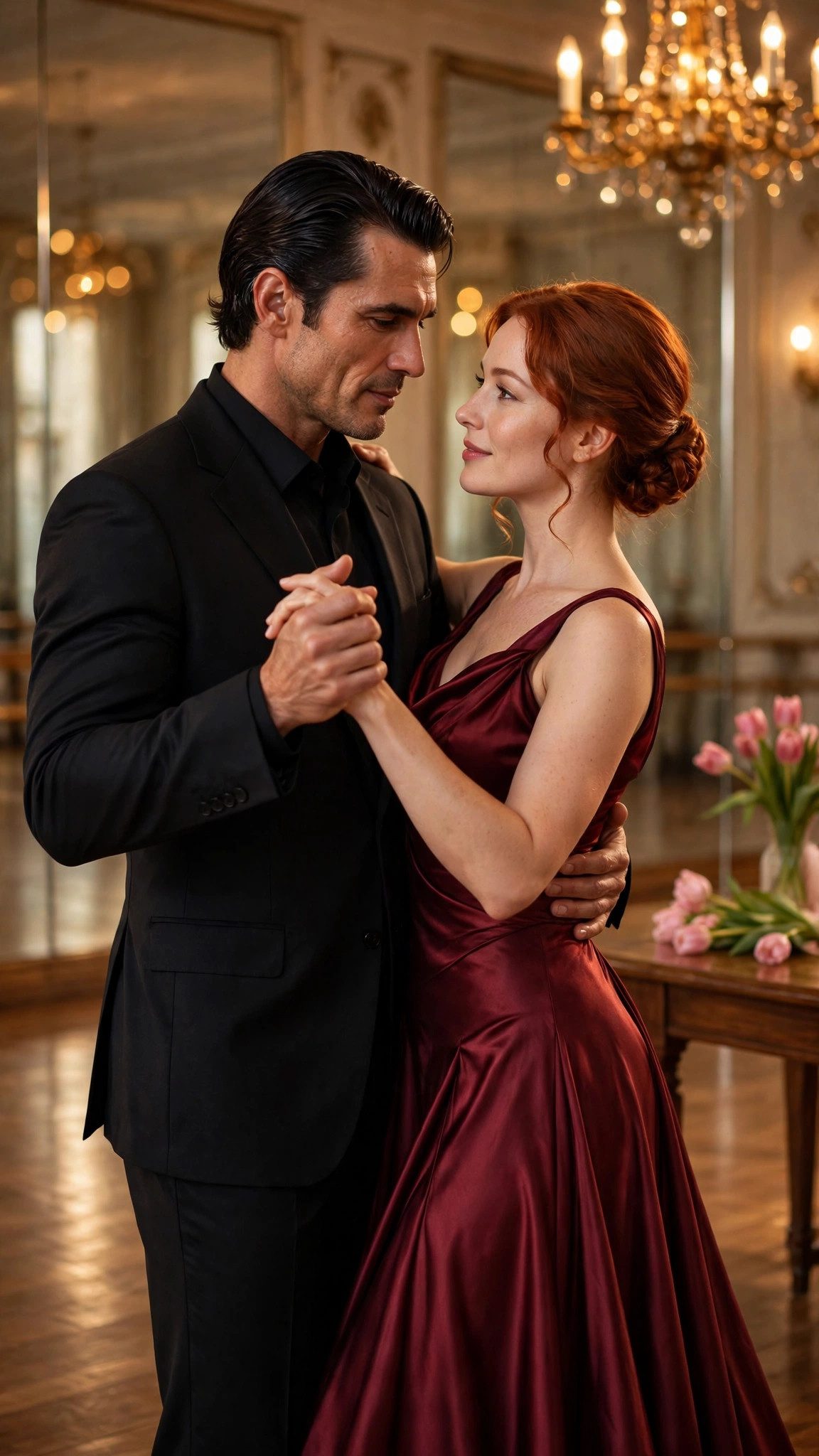
And that evening, Gabriel came to the studio for his lesson, fifteen minutes early, alone, and he danced with me as if nothing had happened — as if the smoke and the gasoline and the broken mirror had never been — and when the lesson ended, he stood in the middle of the floor and said, very quietly:
"Five weeks from Saturday, my grandmother turns eighty. I would like you to be there. Not as my teacher. As my guest."
"I will be there," I said.
He nodded. He put on his jacket. He walked to the door. And then he stopped, and he turned back, and he said the words I had been waiting a month to hear — not a command, not a demand, not a decision made for me, but a question, asked properly, by a man who had finally learned how.
"Claire Donovan," he said. "Will you save me the last dance?"
The morning after the fire, the retired couple came back.
Mr. and Mrs. Henderson arrived at nine o'clock sharp, as they always did on Wednesdays, carrying a casserole dish wrapped in a tea towel, and Mrs. Henderson set it on the table by the mirror — next to the tulips, which Sal had rescued and put back in water — and said, "We heard what happened, dear. We brought lasagna. Everyone needs lasagna after a fire."
I nearly cried. I did cry, a little, and Mrs. Henderson patted my shoulder and told me not to be silly, and Mr. Henderson went straight to the broken mirror and inspected the damage with the careful eye of a man who had spent forty years as a carpenter.
"I can fix this," he announced. "Not today — the glass has to be ordered — but I can fix the frame, and I can board it properly, and when the new mirror comes, I will hang it myself. No charge. You have taught my wife and me to dance for three years, Miss Donovan. It is the least we can do."
By noon, the word had spread, and my students began to trickle back — the office workers, the nervous bride, the young couple learning for their wedding — and they all brought something: a plate of cookies, a bunch of flowers, a card, a promise to come to every lesson from now on. Jenna came over with a fresh bunch of tulips and a sign she had painted herself, in bright pink letters: DONOVAN DANCE STUDIO — OPEN, AND STAYING OPEN.
She taped it to the window, right where the brick had come through, and she stepped back to admire it, and she said, "There. Let Castellano read that."
Sal stayed outside all day, directing the cleanup, and in the afternoon, when the studio was quiet for a moment, he came inside and stood by the barre, turning his cap in his hands, looking uncharacteristically uncertain.
"Miss Donovan," he said. "May I tell you something?"
"Of course, Sal."
"I have worked for Mr. Moretti for twelve years," he said. "I have seen him do many things. I have seen him frighten men twice his size with a look. I have seen him buy buildings and sell them and ruin men who crossed him. But I have never — not once, in twelve years — seen him ask anyone for anything." He looked at me, and his big, impassive face was entirely serious. "Last night, when those men came with the gasoline, I watched him. I watched him decide not to hurt them. I watched him choose the police over his own hands. And I have never seen him do that before. Not once."
"Why are you telling me this, Sal?" I asked.
"Because you changed him, Miss Donovan," Sal said simply. "You taught him something in this studio that no one else could teach him. And I wanted you to know that the men — all of us, the drivers, the guards, everyone who works for him — we see it. And we are glad of it. A man who can ask is a better man to follow than a man who can only take."
He put his cap back on and went outside, and I stood alone in my studio with the lasagna on the table and the pink sign in the window and the tulips in their water, and I thought about what Sal had said. A man who can ask is a better man to follow than a man who can only take.
That evening, Gabriel came for his lesson, fifteen minutes early, as always, and he looked at the sign in the window, and at the casserole on the table, and at the students' cards lined up on the mirror, and he stood in the middle of the floor for a long moment without saying anything. Then he turned to me, and he said, very quietly, "They came back."
"Yes," I said. "They came back."
"Because of you," he said. "Not because of me. Not because of my men. Because of you. Because this place is yours, and people know it, and they will not let anyone take it from you."
"Because of us," I corrected him gently. "You bought the building, Gabriel. You stopped the fire. You gave me the lease. I only taught the lessons."
"No," he said, shaking his head. "You taught me the lesson. There is a difference." He held out his hand. "Shall we dance, Miss Donovan?"
We danced until the sun went down, and the studio was full of gold light, and the sign in the window glowed pink, and for the first time in a week, the whole world felt steady under my feet.